
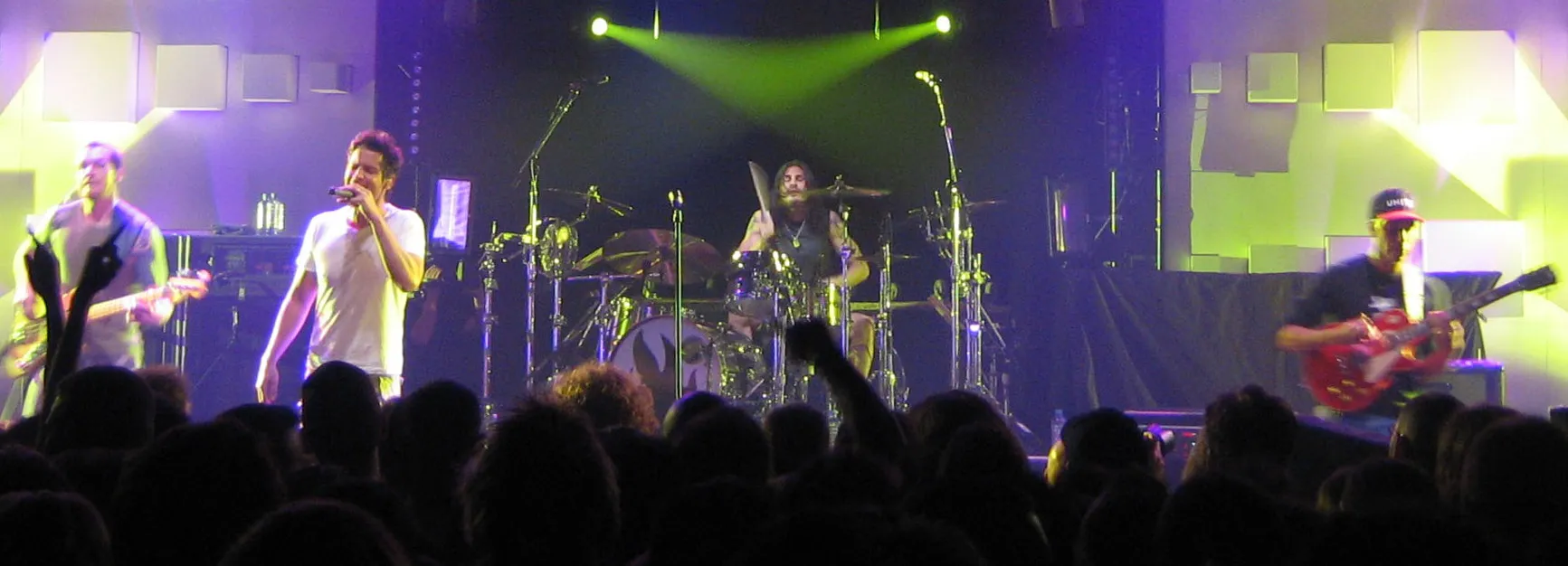
Photo by Simon Jacquier from Vernayaz (near Martigny, Valais), Switzerland , licensed under CC BY-SA 2.0 · Wikimedia Commons
Rank #428
Audioslave
Chris Cornell-RATM supergroup of brawny post-grunge rock.
From Wikipedia
Audioslave was an American rock supergroup formed in Glendale, California, in 2001. The four-piece band consisted of Soundgarden's singer and guitarist Chris Cornell with Rage Against the Machine members Tom Morello, Tim Commerford, and Brad Wilk (drums). Critics first described Audioslave as a combination of Soundgarden and Rage Against the Machine, but by the band's second album, Out of Exile, it was noted that they had established a separate identity. Their sound was created by blending 1970s hard rock and 1990s alternative rock, with musical influences that included 1960s funk, soul and R&B. As with Rage Against the Machine, the band prided themselves on the fact that all sounds on their albums were produced using only guitars, bass, drums, and vocals, with emphasis on Cornell's wide vocal range and Morello's unconventional guitar solos.
Members
- Brad Wilk
- Chris Cornell
- Tim Commerford
- Tom Morello
Studio Albums
- 2002 Audioslave
- 2003 Live in Tokyo
- 2005 Out of Exile
- 2006 Revelations
- 2006 Covers & Rare
- 2007 Covers & Rare II
Source: MusicBrainz
Deep Dive
Overview
Audioslave was an American rock supergroup that emerged in Glendale, California, in 2001, uniting Soundgarden vocalist and guitarist Chris Cornell with the three-piece rhythm section of Rage Against the Machine: guitarist Tom Morello, bassist Tim Commerford, and drummer Brad Wilk. The band occupied a distinctive position in the hard rock landscape of the 2000s, operating outside the dominant trends of post-grunge radio rock and nu-metal while maintaining the raw sonic intensity both of their parent bands. Though initially read by critics as a straightforward merger of Soundgarden’s vocal-driven song craft with Rage Against the Machine’s instrumental virtuosity, Audioslave quickly established themselves as a separate entity, blending 1970s hard rock and 1990s alternative rock with influences drawn from 1960s funk, soul, and R&B.
Formation Story
Audioslave’s origins trace to the dissolution of both its component bands in the late 1990s and early 2000s. Soundgarden disbanded in 1997 after a decade of defining Seattle’s grunge era; Rage Against the Machine followed suit in 2000 after a seven-year run as one of alternative rock’s most politically urgent acts. Morello, Commerford, and Wilk—the rhythmic spine of Rage—sought to continue making music without vocalist Zack de la Rocha. The recruitment of Cornell, one of hard rock’s most distinctive vocalists with a four-octave range that had defined Soundgarden’s melodic sophistication, completed the lineup in 2001. Their formation was more than a casual reunion; it represented a deliberate effort to synthesize two distinct lineages of American rock, each with strong instrumental and vocal identities.
Breakthrough Moment
Audioslave’s self-titled debut arrived in 2002 on Epic Records and immediately validated the supergroup concept. The album, featuring tracks that showcased Cornell’s vocal command alongside Morello’s unconventional guitar textures and the band’s tightly interlocked rhythm section, connected with audiences who had followed either of its constituent acts. The album established that this was neither a Soundgarden tribute nor a Rage vehicle with a guest vocalist, but a genuine collaboration with its own character. The album’s commercial success and critical reception positioned the band as one of rock’s major active forces heading into the mid-2000s, particularly appealing to listeners fatigued by nu-metal’s stylistic dominance and seeking harder-edged alternative rock with substantive musicianship.
Peak Era
Audioslave reached their commercial and creative apex between 2005 and 2006 with the albums Out of Exile and Revelations. By their second album, Out of Exile (2005), the group had shed any lingering perception as a Soundgarden-Rage pastiche and instead crystallized a fully formed sonic identity. Revelations (2006), arriving the same year, further cemented their status as a major rock act capable of translating stadium ambition into album length. This two-album stretch represented the band at their most confident and productive, balancing Cornell’s increasingly ambitious vocal arrangements with Morello’s continued refusal to submit guitar playing to conventional soloing structures. The group’s live presence during this period also solidified their reputation as a formidable touring act, drawing crowds across North America and internationally.
Musical Style
Audioslave’s sound was built on a foundational principle: all textures were achieved through guitars, bass, drums, and vocals, eschewing electronic augmentation or studio trickery common in their contemporaries. This approach reflected the instrumental ethics of both Rage Against the Machine and Soundgarden, each known for refusing synthesizers and programmed elements. Morello’s guitar work, marked by feedback manipulation, unconventional voicings, and tonal experimentation that strayed far from blues-based rock orthodoxy, remained central; his approach had always resembled a lead vocalist as much as a traditional guitarist. Commerford’s bass playing provided harmonic weight and rhythmic counterpoint; Wilk’s drumming anchored the arrangements with both precision and swing. Cornell’s voice—capable of soaring into the uppermost registers, sustaining notes with operatic control, or dropping into powerful, dark mid-range passages—served as the band’s primary melodic vehicle. The ensemble drew from 1970s hard rock’s structural clarity, 1990s alternative rock’s emotional intensity, and funk and soul’s rhythmic suppleness, creating a sound simultaneously rooted and modernist.
Major Albums
Audioslave (2002)
The debut introduced the supergroup’s sound to the world: Cornell’s commanding vocals matched with Morello’s inventive guitar textures, set against Commerford and Wilk’s muscular foundation, demonstrating immediately that the collaboration was creatively viable.
Out of Exile (2005)
The second album solidified Audioslave’s independent identity, moving beyond the “supergroup novelty” framing into territory that felt distinctly their own, with expanded sonic sophistication and deeper thematic exploration.
Revelations (2006)
Released the same year as Out of Exile, this album represented the band’s sustained creative peak, showcasing refined song construction and Cornell’s most ambitious vocal performances within the group’s framework.
Signature Songs
- “Cochise” — The album opener and first single from their debut, a propulsive hard rock statement with Cornell’s voice cutting above Morello’s textured guitar work and the rhythm section’s locked groove.
- “Like a Stone” — A defining song showcasing Cornell’s vocal range across a soaring melodic arc, becoming the band’s most widely recognized track.
- “Gasoline” — Demonstrates the band’s ability to merge funk-influenced rhythm with hard rock intensity, with Cornell delivering the hook with characteristic power.
- “Your Soul Today” — Highlights Morello’s unconventional guitar approach and the band’s capacity for introspective intensity without sacrificing heaviness.
Influence on Rock
Audioslave proved instrumental in demonstrating that hard rock remained a vital vehicle for artistic ambition in an era dominated by nu-metal and post-grunge’s commercial tail end. By reuniting members from two of the 1990s’ most influential alternative rock acts, they provided a bridge between Seattle’s grunge movement and the politically conscious rap-rock crossover of the 1990s, showing that both lineages had further creative ground to explore. Their insistence on acoustic instrumental foundations—guitars, bass, drums, and vocals only—implicitly critiqued the over-processed production aesthetic gaining ground in mainstream rock, influencing a subset of acts that valued tonal authenticity and instrumental transparency. For musicians, Morello’s continued innovations in non-traditional guitar texturing and Cornell’s fearless vocal range set standards that rippled through alternative and hard rock circles.
Legacy
Audioslave dissolved in 2007 after an initial run that had established them as one of 2000s rock’s most credible acts. Though their catalog was briefer than either of their constituent bands, they left a defined body of work that resists easy dating or trendy obsolescence. The band reunited briefly in 2017, demonstrating the ongoing affection and respect that bound the members. In the decades since their initial dissolution, their albums have maintained steady streaming presence and continue to circulate among rock listeners seeking substantive hard rock with intellectual and instrumental rigor. Chris Cornell’s tragic death in 2017, occurring during this reunion period, cast a shadow over the band’s future and elevated their catalog as part of his broader artistic legacy—a chapter in which his voice demonstrated yet another register of expression and power.
Fun Facts
- Audioslave released a live album, Live in Tokyo, in 2003, capturing the band’s concert presence during their peak touring years.
- The band recorded two volumes of covers material, Covers & Rare (2006) and Covers & Rare II (2007), demonstrating their engagement with influences spanning funk, soul, and rock traditions.
- All four members brought songwriting credits to the band’s original albums, maintaining the collaborative authorship model established by both Rage Against the Machine and Soundgarden.
Discography & Previews
Click any album to expand its track list. Each track plays a 30-second preview streamed from Apple Music. Tap the link icon next to a track to open it in Apple Music for full playback.
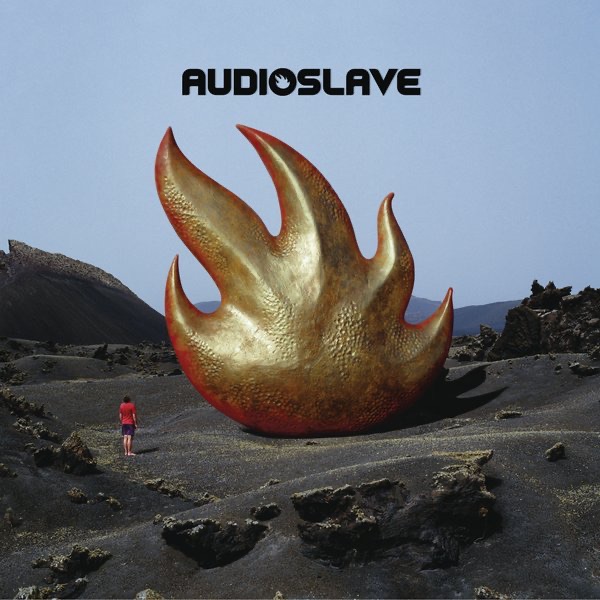
- 1 Cochise ↗ 3:42
- 2 Show Me How to Live ↗ 4:38
- 3 Gasoline ↗ 4:39
- 4 What You Are ↗ 4:09
- 5 Like a Stone ↗ 4:54
- 6 Set It Off ↗ 4:23
- 7 Shadow On the Sun ↗ 5:43
- 8 I Am the Highway ↗ 5:35
- 9 Exploder ↗ 3:26
- 10 Hypnotize ↗ 3:27
- 11 Bring Em Back Alive ↗ 5:29
- 12 Light My Way ↗ 5:03
- 13 Getaway Car ↗ 4:59
- 14 The Last Remaining Light ↗ 5:17

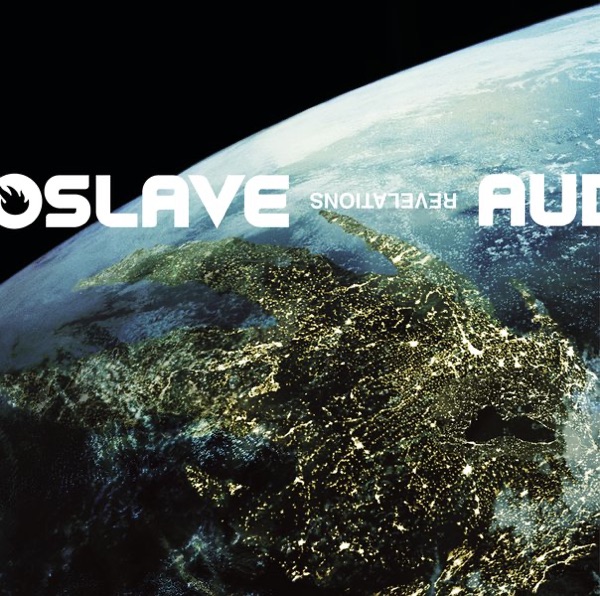
- 1 Revelations ↗ 4:12
- 2 One and the Same ↗ 3:38
- 3 Sound of a Gun ↗ 4:20
- 4 Until We Fall ↗ 3:51
- 5 Original Fire ↗ 3:39
- 6 Broken City ↗ 3:49
- 7 Somedays ↗ 3:34
- 8 Shape of Things to Come ↗ 4:35
- 9 Jewel of the Summertime ↗ 3:53
- 10 Wide Awake ↗ 4:26
- 11 Nothing Left to Say But Goodbye ↗ 3:33
- 12 Moth ↗ 4:58
- 13 Show Me How to Live (Live at the Quart Festival) [Live] ↗ 5:02