
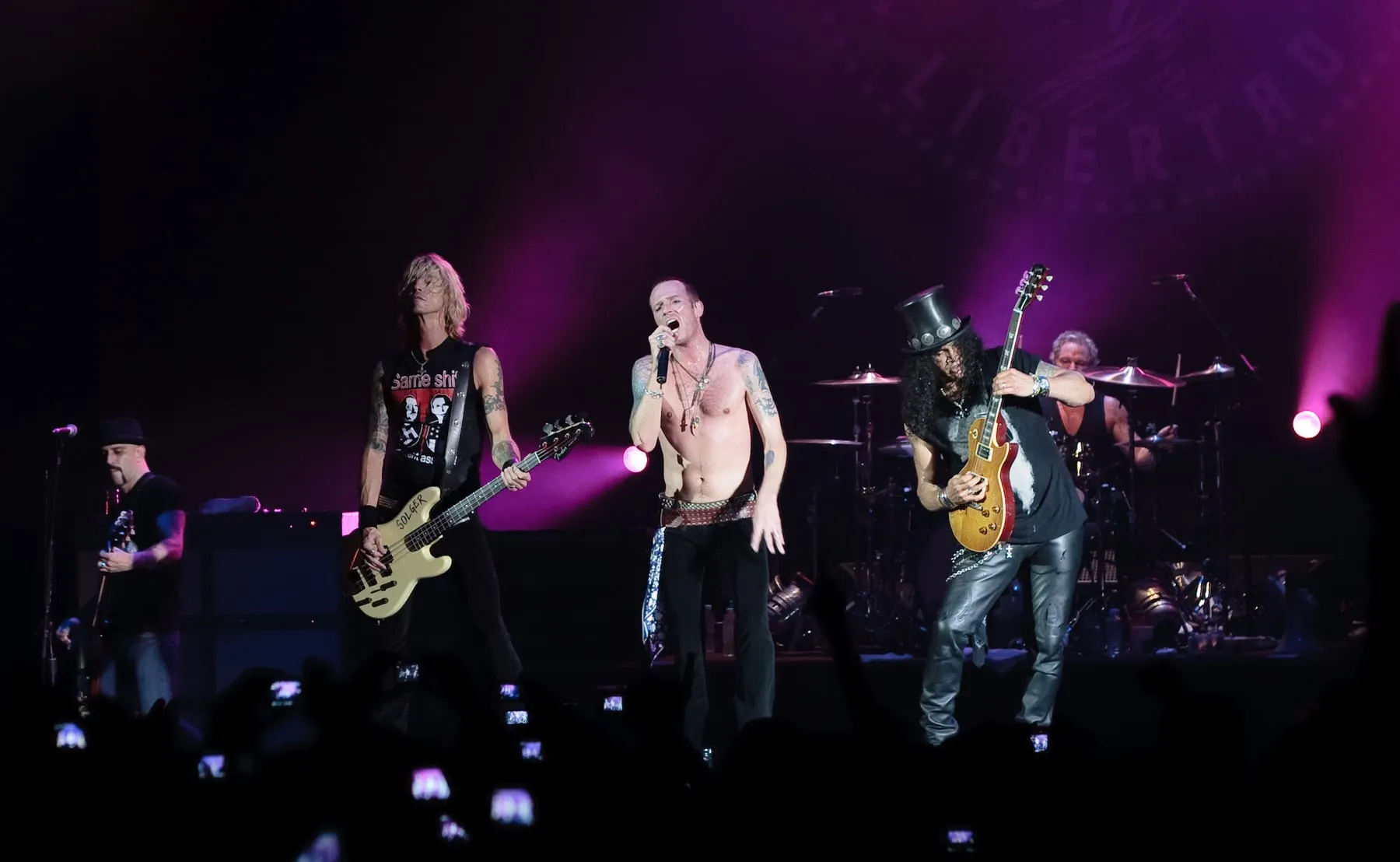
Photo by Kreepin Deth , licensed under CC BY 3.0 · Wikimedia Commons
Rank #429
Velvet Revolver
GN'R-Weiland supergroup who briefly revived 90s arena hard rock.
From Wikipedia
Velvet Revolver was an American hard rock supergroup consisting of Guns N' Roses members Slash, Duff McKagan and Matt Sorum, alongside Dave Kushner formerly of punk band Wasted Youth, and Scott Weiland formerly of Stone Temple Pilots. The band formed in 2002 and was active until 2008, when Weiland was fired from the band and subsequently rejoined Stone Temple Pilots.
Members
- Dave Kushner
- Duff McKagan
- Matt Sorum
- Scott Weiland
- Slash
Studio Albums
- 2004 Contraband
- 2004 Lethal Injection
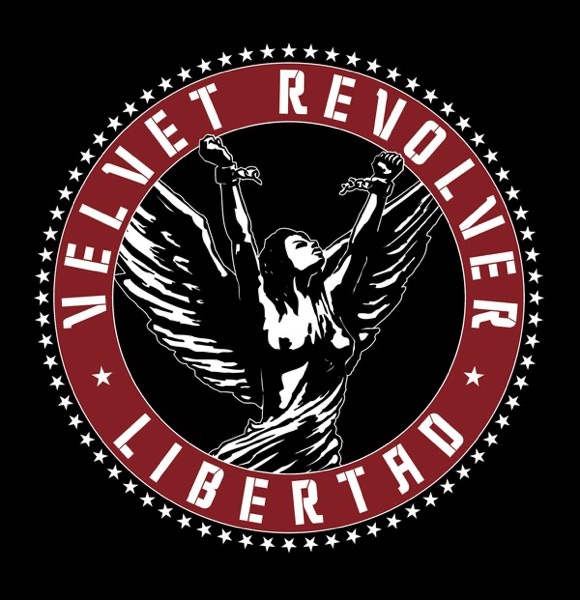
- 2007 Libertad
Source: MusicBrainz
Deep Dive
Overview
Velvet Revolver was an American hard rock supergroup formed in 2002, assembling three members of Guns N’ Roses—Slash, Duff McKagan, and Matt Sorum—with Dave Kushner on guitar and Scott Weiland as vocalist. The project represented a confluence of 1990s and 2000s rock lineages: the residual creative energy of one of the 1980s’ biggest stadium rock acts and the architectural confidence of grunge-era alternative rock. Operating from 2002 to 2008, Velvet Revolver occupied a particular moment in rock history when arena hard rock could still command mainstream attention, even as musical tastes shifted toward other genres.
Formation Story
Velvet Revolver came together in Rancho Santa Margarita, California, in 2002. Slash, McKagan, and Sorum—three-fifths of Guns N’ Roses’ most successful lineup—had effectively parted ways with that band and sought new creative outlets. The addition of Dave Kushner, a guitarist with roots in the Los Angeles punk scene (previously of Wasted Youth), brought a leaner, more direct approach to songwriting. The final piece was Scott Weiland, whose tenure with Stone Temple Pilots had ended, providing a vocalist with both arena-rock credentials and the emotional range that had defined STP’s output. The lineup’s pedigree—anchored in two of the most successful hard rock acts of their respective decades—positioned Velvet Revolver as an immediate draw.
Breakthrough Moment
Velvet Revolver’s debut album, Contraband, released in 2004 on RCA Records, introduced the supergroup to a waiting audience. The album established the band’s sound as a synthesis of Slash’s guitar-driven hard rock and the alternative-rock sensibility Weiland brought from Stone Temple Pilots. Contraband succeeded in presenting a unified voice rather than a mere assembly of famous names, signaling that the partnership was musically coherent rather than opportunistic. The record’s arrival in 2004 placed the band squarely within an era when hard rock remained a legitimate force on rock radio and MTV, even as the broader cultural moment had moved substantially beyond the 1980s stadium rock heyday.
Peak Era
Velvet Revolver’s most creatively vital and commercially visible period spanned 2004 to 2007, bookended by their first and second studio albums. Between Contraband (2004) and Libertad (2007), the band maintained momentum as a touring act and recording concern. The 2004 release of Lethal Injection further solidified their discographic footprint during this window. By the mid-2000s, however, the band faced the same headwinds affecting hard rock broadly: streaming was beginning to reshape how music circulated, and the post-grunge hard rock sound that Velvet Revolver embodied was no longer the dominant force it had been in the 1990s. Nevertheless, their albums demonstrated a band confident in its craft and composition.
Musical Style
Velvet Revolver’s sound fused the blues-derived, heavily amplified guitar work that defined Guns N’ Roses with the grunge-influenced songwriting and vocal approach associated with Stone Temple Pilots. Slash’s lead guitar lines remained central—fluid, pentatonic, and anchored in classic hard rock phrasing—while McKagan and Sorum provided a rhythm section equally comfortable with straightforward rock grooves and more syncopated arrangements. Kushner’s rhythm guitar and compositional contributions added texture without overwhelming the band’s core aesthetic. Weiland’s vocals, marked by a distinctive timbre and range, offered both the raw power expected of hard rock frontmanship and the introspective qualities he had cultivated in his previous work. Lyrically and structurally, Velvet Revolver favored concise, hook-driven songs rooted in traditional rock composition rather than experimental or progressive approaches.
Major Albums
Contraband (2004)
The band’s debut established their signature blend of arena hard rock and alternative sensibilities, with Slash’s guitar work and Weiland’s vocals driving the primary melodic and emotional content. The album’s success confirmed that the supergroup concept could yield cohesive artistic output rather than serving as a mere novelty.
Lethal Injection (2004)
Released the same year as Contraband, this album further developed the band’s songwriting and demonstrated their ability to sustain productivity during their initial creative surge.
Libertad (2007)
Velvet Revolver’s third full-length represented their final album before internal fractures led to Weiland’s dismissal and the band’s dissolution in 2008. Libertad maintained the band’s core sound while reflecting the musical evolution of its constituent members across the mid-2000s.
Signature Songs
- “Slither” — The band’s most commercially successful single, showcasing Slash’s melodic guitar work and Weiland’s vocal range.
- “Fall to Pieces” — A mid-tempo hard rock track that balanced intensity with accessibility, demonstrating the band’s ability to craft memorable hooks.
- “Illegal I Song” — A composition that highlighted the band’s proficiency at structured rock songwriting.
- “She Builds Quick Machines” — A track exemplifying Slash’s instrumental voice within the band’s ensemble context.
Influence on Rock
Velvet Revolver arrived at a moment when supergroups remained culturally plausible ventures. Their formation and subsequent output influenced perceptions of how veteran musicians might collaborate outside their original contexts. Although Velvet Revolver did not pioneer new sonic territory, they demonstrated that hard rock’s fundamental architecture—loud guitars, stadium-friendly melodies, and emotional vocals—could still command an audience in the 2000s. The band’s existence kept the lineage of 1980s Guns N’ Roses and 1990s alternative rock hard rock visibly connected, creating a bridge across those decades within a single ensemble.
Legacy
Velvet Revolver’s active lifespan ended in 2008 when Scott Weiland was dismissed from the band and subsequently returned to Stone Temple Pilots. The supergroup’s dissolution marked the conclusion of what had been a significant if circumscribed chapter in 2000s rock. In retrospect, Velvet Revolver occupied a transitional moment: they emerged when hard rock could still sustain major-label investment and mainstream visibility, yet they dissolved as those conditions eroded. Their three studio albums remain evidence of a distinct musical moment and a credible synthesis of two influential rock lineages. Streaming platforms and archival interest have maintained their catalog’s accessibility, ensuring that listeners can still encounter their work within the broader context of early 2000s hard rock.
Fun Facts
- The band’s name, Velvet Revolver, was chosen to reflect both the softness and hardness inherent in their sound—a deliberate contradiction meant to capture their fusion of styles.
- Velvet Revolver was active for a relatively concentrated six-year period, resulting in only three studio albums during their existence, despite the high profile of their membership.
- The band’s formation represented one of the rare instances where three musicians from a single band (Slash, McKagan, and Sorum from Guns N’ Roses) formed a supergroup with external partners rather than continuing under the original band name.
Discography & Previews
Click any album to expand its track list. Each track plays a 30-second preview streamed from Apple Music. Tap the link icon next to a track to open it in Apple Music for full playback.

- 1 Sucker Train Blues ↗ 4:28
- 2 Do It for the Kids ↗ 3:56
- 3 Big Machine ↗ 4:26
- 4 Illegal I Song ↗ 4:17
- 5 Spectacle ↗ 3:41
- 6 Fall to Pieces ↗ 4:31
- 7 Headspace ↗ 3:43
- 8 Superhuman ↗ 4:16
- 9 Set Me Free ↗ 4:06
- 10 You Got No Right ↗ 5:37
- 11 Slither ↗ 4:08
- 12 Dirty Little Thing ↗ 3:57
- 13 Loving the Alien ↗ 5:50
- 1 Let It Roll ↗ 2:32
- 2 She Mine ↗ 3:25
- 3 Get Out the Door ↗ 3:14
- 4 She Builds Quick Machines ↗ 4:02
- 5 The Last Fight ↗ 4:03
- 6 Pills, Demons & Etc. ↗ 2:54
- 7 American Man ↗ 3:56
- 8 Mary Mary ↗ 4:33
- 9 Just Sixteen ↗ 3:59
- 10 Can't Get It Out of My Head ↗ 3:58
- 11 For a Brother ↗ 3:26
- 12 Spay ↗ 3:06
- 13 Gravedancer ↗ 8:40