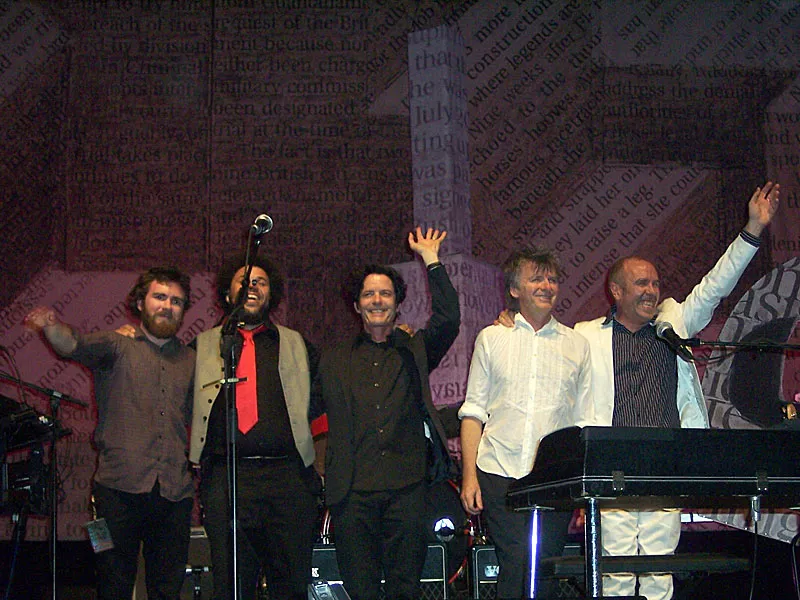
Photo by Mick Muise , licensed under CC BY 2.0 · Wikimedia Commons
Rank #308
Crowded House
Trans-Tasman rockers behind enduring hits like 'Don't Dream It's Over'.
From Wikipedia
Crowded House are an Australian rock band, formed in 1985 in Melbourne, Victoria, Australia. The founding members were Neil Finn and Paul Hester (drums), who were both former members of Split Enz, and Nick Seymour (bass). Later band members included Finn's brother Tim, who was also formerly in Split Enz; sons Liam and Elroy; as well as Americans Mark Hart and Matt Sherrod. Neil Finn and Seymour are the sole constant members.
Members
- Neil Finn (1985–present)
- Nick Seymour (1985–present)
- Paul Hester (1985–1994)
- Tim Finn (1990–present)
- Peter Jones (1994–1996)
- Mitchell Froom (2020–present)
- Liam Finn
Studio Albums
- 1986 Crowded House
- 1988 Temple of Low Men
- 1991 Woodface
- 1993 Together Alone
- 1996 The Final Sessions
- 1998 Homebrew
- 2007 Time on Earth
- 2010 Intriguer
- 2021 Dreamers Are Waiting
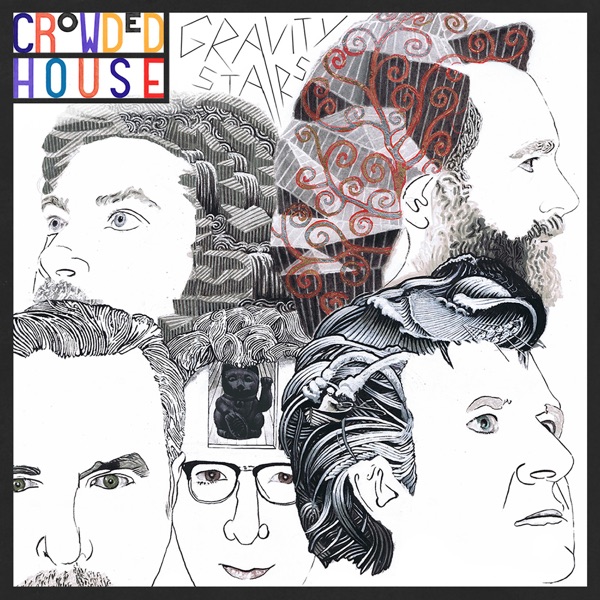
- 2024 Gravity Stairs
- — Fleadh
- — Spare Room
Source: MusicBrainz
Deep Dive
Overview
Crowded House emerged from Melbourne in 1985 as a rock band anchored by the songwriting partnership of Neil Finn and the rhythmic foundation of Nick Seymour on bass. Forming in the mid-1980s, they bridged the gap between art-house pop sensibilities and straightforward rock radio appeal, eventually becoming one of the most recognizable acts to emerge from the Australia–New Zealand musical axis. Their 1986 debut album established them as serious alternative-rock contenders, and a series of increasingly assured albums through the early 1990s cemented their status as major figures in the pop-rock mainstream, particularly through enduring songs that transcended commercial categorization.
Formation Story
Crowded House crystallized around Neil Finn and Paul Hester, both veterans of the art-rock band Split Enz, who recognized complementary creative energies and formed the new project in Melbourne in 1985. Nick Seymour, recruited as bassist, rounded out the trio that would define the band’s core identity. This founding lineup—Finn on vocals and guitar, Hester on drums, and Seymour on bass—carried forward Split Enz’s sophistication while tilting toward more direct, hook-driven songwriting. The Melbourne origin point situated them within a fertile Australian rock scene that had generated diverse international talents across the 1970s and early 1980s. Within a year, they were recording and preparing for release.
Breakthrough Moment
Crowded House’s self-titled 1986 debut album announced their arrival as a serious creative force, establishing a template they would refine across subsequent releases. The album’s blend of intricate arrangements, Finn’s emotionally direct vocals, and deceptively simple-seeming melodies proved commercially viable at the exact moment rock radio was opening to alternative-rock sensibilities. Temple of Low Men followed in 1988, deepening their sonic palette and radio reach. By the time Woodface arrived in 1991, the band had achieved sufficient commercial momentum and critical respect to be positioned alongside American and British acts in the alternative-rock hierarchy of the early 1990s. This period—spanning 1986 through 1991—marked their transition from promising newcomers to established platinum-selling artists.
Peak Era
The early 1990s represented Crowded House’s commercial and creative zenith. Woodface (1991) and Together Alone (1993) showcased the band at maximum confidence, with expanded lineups (Tim Finn, Neil’s brother, joined in 1990 after his own Split Enz history) and increasingly sophisticated production. These albums sold substantially and generated consistent radio rotation and MTV presence. The songwriting deepened; arrangements moved beyond garage-rock fundamentals into layered, almost baroque pop textures. Woodface in particular struck a balance between accessibility and artistry that few rock bands of the era achieved. Together Alone extended that run, though its relative commercial performance suggested the marketplace’s appetite was beginning to shift away from the guitar-based alternative rock that had dominated MTV since 1991. After 1993, the band would never again occupy quite the same cultural footprint, though their productivity and touring schedule did not diminish.
Musical Style
Crowded House’s sound derived from post-punk and new-wave foundations—inheritance from Split Enz—but evolved toward something more straightforwardly melodic and rock-oriented. Neil Finn’s songwriting favored emotionally direct lyrics paired with instantly memorable hooks; his vocal delivery, neither particularly powerful nor technically virtuosic, conveyed vulnerability and sincerity in ways that resonated across generational and geographical boundaries. Instrumentally, the band typically foregrounded Finn’s guitar work and keyboard textures—a prod toward art-pop lineage—while Paul Hester’s drumming provided crisp, articulate timekeeping rather than bombast. Bass lines were melodic and syncopated rather than anchoring low-end thunder. As the 1990s progressed, the band incorporated more electronic textures and studio production sophistication, though never abandoning the core template of guitar-based rock with pop sensibilities. The addition of Tim Finn brought vocal harmony and keyboard contributions that enriched arrangements without fundamentally reshaping the band’s identity.
Major Albums
Crowded House (1986)
The debut introduced the band’s core strengths: Finn’s gift for harmony-based songwriting and his ability to embed emotional depth within deceptively simple pop structures. Songs like “Don’t Dream It’s Over” would eventually define their mainstream legacy, but the album as a whole showcased sophisticated arrangement work and a band fully formed from day one.
Temple of Low Men (1988)
The second album consolidated their early success while expanding sonic range, moving from straightforward alternative rock toward more layered, textured production. This was essential to their evolution but perhaps lacked the immediate memorability of the debut.
Woodface (1991)
Argued by many supporters to be the band’s strongest work, Woodface merged the accessibility that had made “Don’t Dream It’s Over” ubiquitous with artistic ambition and the harmonic richness that came with Tim Finn’s full integration. The album balanced rock directness and baroque pop ornamentation in a way that resonated across multiple listening contexts—radio-friendly and album-friendly simultaneously.
Together Alone (1993)
The final album of their commercial peak, Together Alone continued the sophisticated approach of Woodface while exploring slightly more introspective terrain. Commercial returns began to soften as grunge and hip-hop shifted mainstream attention, yet the album revealed a band comfortable with their artistic maturity.
Signature Songs
- “Don’t Dream It’s Over” — The 1986 breakaway hit that became ubiquitous across radio and MTV, establishing the band’s melodic calling card globally and remaining their most recognizable composition.
- “Better Be Home Soon” — A tender, keyboard-driven ballad that showcased the emotional directness central to Finn’s songwriting approach across the band’s catalog.
- “Weather To” — A standout from Woodface highlighting the band’s ability to craft complex arrangements around deceptively simple emotional cores.
- “Together Alone” — The title track and final major single of their commercial peak, demonstrating their sophistication without sacrificing hooks.
Influence on Rock
Crowded House represented a particular strain of 1980s and early-1990s alternative rock that emphasized melodic songwriting and art-pop sophistication over raw volume or punk aggression. In that capacity, they provided a template—alongside contemporaries like The Talking Heads and R.E.M.—for how rock bands could remain commercially viable while pursuing artistic goals that transcended three-minute single structures. Their success in multiple territories, particularly given their Australian-New Zealand origin and no American childhood nostalgia anchor, demonstrated that sophisticated melodic rock could compete globally against grunge and Britpop. The lineage from Split Enz through Crowded House to subsequent New Zealand and Australian artists speaks to a particular musical lineage emphasizing pop melody and production sophistication. While they did not pioneer any specific sound, they were efficient translators of post-punk and art-pop sensibilities into the mainstream alternative-rock context of the 1990s.
Legacy
Crowded House maintained steady touring and recording activity across multiple decades following their commercial peak. The band released albums including Homebrew (1998), Time on Earth (2007), Intriguer (2010), and eventually Dreamers Are Waiting (2021) and Gravity Stairs (2024), indicating sustained creative output and audience interest despite limited mainstream radio presence after the mid-1990s. “Don’t Dream It’s Over” achieved enduring status as a wedding and karaoke standard, introducing Crowded House to generations of listeners who never engaged with the full discography. The band remained active performers, touring festivals and headline venues regularly, maintaining a streaming presence and steady catalog sales. Neil Finn and Nick Seymour’s consistency as core members across nearly four decades provided unusual stability within the rock-band model, and subsequent lineup expansions including Tim Finn’s continued participation and later musicians maintained artistic credibility. While Crowded House did not dominate critical reassessment narratives of 1990s alternative rock in the manner of grunge or Britpop bands, their catalog retained respect among rock critics and musicians as exemplifying thoughtful, melodically sophisticated pop rock.
Fun Facts
- Paul Hester, the band’s original drummer and founding member, departed in 1994 after nine years, marking a significant lineup shift as the band entered what would prove a lower-profile commercial phase.
- Tim Finn, who joined the band in 1990, was Neil Finn’s brother and had previously been a founding member of Split Enz alongside Neil, making Crowded House in some sense a family recombination of that earlier artistic partnership.
- The band’s name derived from a lyric in a song by Split Enz, emphasizing the continuity between Neil Finn’s previous band and his new project.
- Mitchell Froom joined as a band member in 2020, bringing additional instrumental and production perspectives to the continuing lineup decades into the band’s existence.
Discography & Previews
Click any album to expand its track list. Each track plays a 30-second preview streamed from Apple Music. Tap the link icon next to a track to open it in Apple Music for full playback.

- 1 Mean To Me ↗ 3:14
- 2 World Where You Live ↗ 3:08
- 3 Now We're Getting Somewhere ↗ 4:07
- 4 Don't Dream It's Over ↗ 3:59
- 5 Love You 'Til the Day I Die ↗ 3:35
- 6 Something So Strong ↗ 2:54
- 7 Hole in the River ↗ 3:58
- 8 Can't Carry On ↗ 3:57
- 9 I Walk Away ↗ 3:05
- 10 Tombstone ↗ 3:30
- 11 That's What I Call Love ↗ 3:39


- 1 Chocolate Cake ↗ 4:02
- 2 It's Only Natural ↗ 3:32
- 3 Fall at Your Feet ↗ 3:19
- 4 Tall Trees ↗ 2:20
- 5 Weather with You ↗ 3:44
- 6 Whispers and Moans ↗ 3:40
- 7 Four Seasons in One Day ↗ 2:50
- 8 There Goes God ↗ 3:50
- 9 Fame Is ↗ 2:23
- 10 All I Ask ↗ 3:56
- 11 As Sure as I Am ↗ 2:53
- 12 Italian Plastic ↗ 3:40
- 13 She Goes On ↗ 3:16
- 14 How Will You Go ↗ 4:46

- 1 Kare Kare ↗ 3:36
- 2 In My Command ↗ 3:44
- 3 Nails in My Feet ↗ 3:39
- 4 Black and White Boy ↗ 4:00
- 5 Fingers of Love ↗ 4:27
- 6 Pineapple Head ↗ 3:27
- 7 Locked Out ↗ 3:18
- 8 Private Universe ↗ 5:39
- 9 Walking On the Spot ↗ 2:55
- 10 Distant Sun ↗ 3:50
- 11 Catherine Wheels ↗ 5:13
- 12 Skin Feeling ↗ 3:57
- 13 Together Alone ↗ 3:56

- 1 Nobody Wants To ↗ 4:10
- 2 Don't Stop Now ↗ 3:54
- 3 She Called Up ↗ 2:53
- 4 Say That Again ↗ 5:20
- 5 Pour le Monde ↗ 5:10
- 6 Even a Child ↗ 3:58
- 7 Heaven That I'm Making ↗ 3:57
- 8 A Sigh ↗ 3:17
- 9 Silent House ↗ 5:52
- 10 English Trees ↗ 3:43
- 11 Walked Her Way Down ↗ 4:17
- 12 Transit Lounge ↗ 4:26
- 13 You Are the One to Make Me Cry ↗ 3:43
- 14 People Are Like Suns ↗ 3:53


- 1 Bad Times Good ↗ 3:41
- 2 Playing With Fire ↗ 3:28
- 3 To the Island ↗ 3:59
- 4 Sweet Tooth ↗ 3:13
- 5 Whatever You Want ↗ 3:22
- 6 Show Me the Way ↗ 3:44
- 7 Goodnight Everyone ↗ 3:31
- 8 Too Good For This World ↗ 3:40
- 9 Start of Something ↗ 3:20
- 10 Real Life Woman ↗ 3:48
- 11 Love Isn't Hard At All ↗ 3:02
- 12 Deeper Down ↗ 3:11