
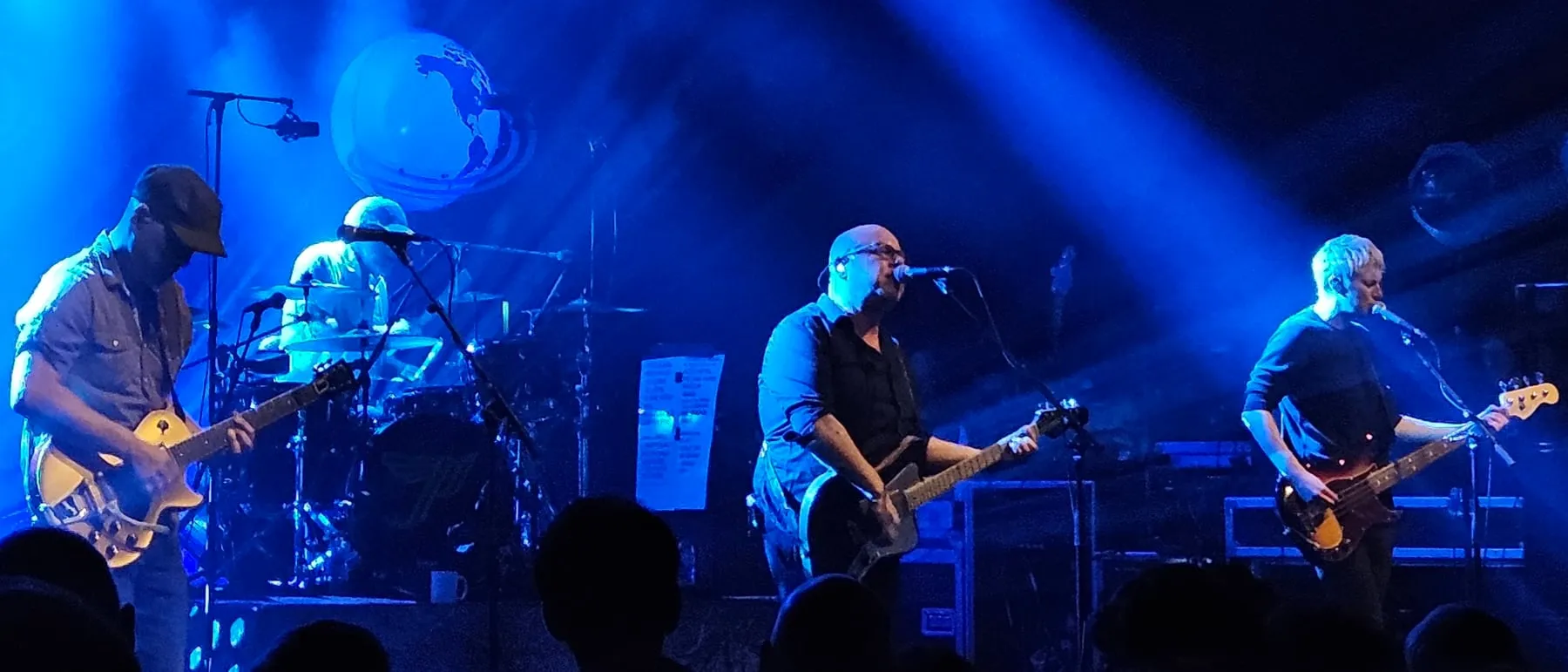
Photo by Black Kite , licensed under CC0 · Wikimedia Commons
Rank #41
Pixies
Loud-quiet-loud Boston quartet who taught alternative rock how to be weird.
From Wikipedia
The Pixies are an American alternative rock band formed in Boston, Massachusetts, in 1986. The original lineup consisted of Black Francis, Joey Santiago, Kim Deal and David Lovering (drums). The Pixies are associated with the 1990s alternative rock boom, and draw on elements including punk rock and surf rock. Their music is known for dynamic "loud-quiet-loud" shifts and song structures. Francis is the primary songwriter; his often surreal lyrics cover offbeat subjects such as extraterrestrials, incest, and biblical violence.
Members
- Black Francis
- David Lovering
- Joey Santiago
- Kim Deal
Deep Dive
Overview
The Pixies are an American alternative rock band formed in Boston, Massachusetts, in 1986. They stand among the most consequential acts of the post-punk era, not because they dominated commercial charts in their original run but because they invented a template that dozens of major alternative rock acts would follow. The band’s signature approach—sudden, dramatic shifts between barely-audible verses and explosive choruses, married to Black Francis’s surreal, often disturbing lyrical fixations—proved infectious enough to influence an entire generation of musicians who came of age in the early 1990s.
Formation Story
The Pixies coalesced in Boston in 1986 around Black Francis (vocals, guitar) and Joey Santiago (guitar), who had known each other since high school. Kim Deal joined on bass, bringing her own songwriting sensibility and vocal presence, while David Lovering completed the lineup on drums. The city of Boston, then a thriving post-punk and indie rock hub, provided both a proving ground and an audience hungry for challenging alternative rock. The four-piece crystallized quickly, developing a sound that drew from punk rock’s raw energy and surf rock’s sonic textures, yet pushed both toward something more experimental and unnerving.
Breakthrough Moment
The Pixies’ initial breakthrough came with their debut album, Surfer Rosa (1988), a release that circulated widely among college radio stations and independent record shops before making any impact on mainstream attention. Surfer Rosa introduced the loud-quiet-loud dynamic that would become their calling card, with tracks that moved from whisper-soft verses into walls of distorted sound. The album’s commercial footprint remained modest, but its critical and underground reputation grew steadily. Their second album, Doolittle (1989), solidified this trajectory, deepening both their sonic sophistication and their appetite for strange, often violent or surreal subject matter in Francis’s lyrics. By the end of the 1980s, the Pixies had established themselves as one of the most interesting bands in alternative rock, even if mainstream recognition had not yet arrived.
Peak Era
The Pixies’ creative and commercial peak unfolded across the early 1990s, spanning the albums Bossanova (1990) and Trompe le Monde (1991). These records arrived just as alternative rock was beginning its ascent in the wider culture, and the Pixies found themselves positioned at the forefront of a movement whose sound they had in many ways already invented. The band maintained their commitment to dynamic contrast and unsettling lyricism while exploring new textural possibilities, particularly in the production choices that shaped each record. During this period, the Pixies demonstrated that their initial formula was not a novelty but a genuine artistic framework capable of supporting continued growth and experimentation.
Musical Style
The Pixies’ sound rested fundamentally on contrast. Francis’s guitar work and Joey Santiago’s complementary textures would drop to near-inaudibility beneath Francis’s flat, often deadpan vocal delivery, only to erupt into dense, distorted crescendos. Kim Deal’s bass lines often drove these shifts, moving from subtle support to prominent melodic statements. David Lovering’s drumming maintained a tight, economical approach that served the song structures rather than dominating them. Lyrically, Francis drew on punk’s tradition of transgression but applied it to surreal, often grotesque imagery—extraterrestrials, incest, biblical violence—rendered in sparse, sometimes cryptic language. The overall effect unsettled listeners in ways that punk rock’s more straightforward rebellion did not; the Pixies made discomfort through strangeness rather than volume alone.
Major Albums
Surfer Rosa (1988)
The debut established the loud-quiet-loud aesthetic and Francis’s taste for surreal, often disturbing lyrical content, immediately signaling that the Pixies occupied a space distinct from their post-punk and indie rock peers.
Doolittle (1989)
The follow-up deepened production sophistication and expanded the range of sonic textures, proving the initial template was not a one-off and building a devoted underground audience that would accelerate through the early 1990s.
Bossanova (1990)
Released as alternative rock began its mainstream breakthrough, Bossanova maintained the band’s distinctive approach while incorporating new production ideas and further refining the interplay between Francis and Santiago’s guitar work.
Trompe le Monde (1991)
The band’s final album before an initial hiatus, Trompe le Monde consolidated their artistic vision with renewed focus on songcraft and arrangement, featuring some of their most accessible yet still challenging work.
Signature Songs
- “Where Is My Mind?” — The closest the Pixies came to a mainstream hit, built on a deceptively simple bass figure and demonstrating how effectively their dynamic approach could translate to a quasi-anthemic format.
- “Here Comes Your Man” — A relatively upbeat track from Doolittle that showcased Francis’s ability to pair melodic hooks with his characteristic vocal flatness and cryptic lyrics.
- “Bone Machine” — A Surfer Rosa standout exemplifying the band’s capacity to make unsettling subject matter emotionally gripping through careful dynamic control.
- “Gigantic” — The album’s opening track, featuring Deal on lead vocals and establishing immediately that the Pixies operated outside conventional rock dynamics.
Influence on Rock
The Pixies’ influence on 1990s alternative rock proved immense, even if contemporary recognition of that influence was often implicit rather than explicit. Bands including Nirvana, Radiohead, and countless others drew directly or indirectly from the loud-quiet-loud template and the willingness to make popular music strange. The Pixies demonstrated that alternative rock need not choose between accessibility and artistic challenge; Francis’s surreal lyricism and the band’s uncompromising arrangement choices influenced how a generation of alternative rock songwriters approached storytelling and production. The band’s example—that underground credibility could coexist with genuine musical sophistication, and that pop-influenced melodicism could be paired with punk rock’s skepticism and transgression—reshaped what rock music could be.
Legacy
After Trompe le Monde, the Pixies disbanded in 1991, though the members’ subsequent projects—particularly Kim Deal’s work with The Breeders—extended their influence. The band reunited for performances and later full-scale album production, returning with Indie Cindy in 2014 and maintaining an active recording schedule with Head Carrier (2016), Beneath the Eyrie (2019), Doggerel (2022), and The Night the Zombies Came (2024). These later releases demonstrated both the durability of their foundational approach and their continued willingness to evolve. The Pixies’ legacy rests not on a single canonical masterpiece but on a sustained demonstration that strange, uncomfortable, intellectually rigorous rock music could be compelling and influential. Streaming platforms and retrospective documentary attention have only expanded their reach beyond the college radio and independent record shop audience that first discovered them.
Fun Facts
- The band’s name reportedly came from a term used in folklore and fairy tales, reflecting Black Francis’s fascination with surreal and fantastical subject matter.
- Surfer Rosa, despite its eventual influence, initially received a limited release and was recorded at a relatively modest budget, yet became one of the most influential alternative rock albums of the 1980s.
- Kim Deal left the band during their original run to pursue The Breeders, her own project, yet contributed to the band’s legacy through both her original work and later reunion efforts.