
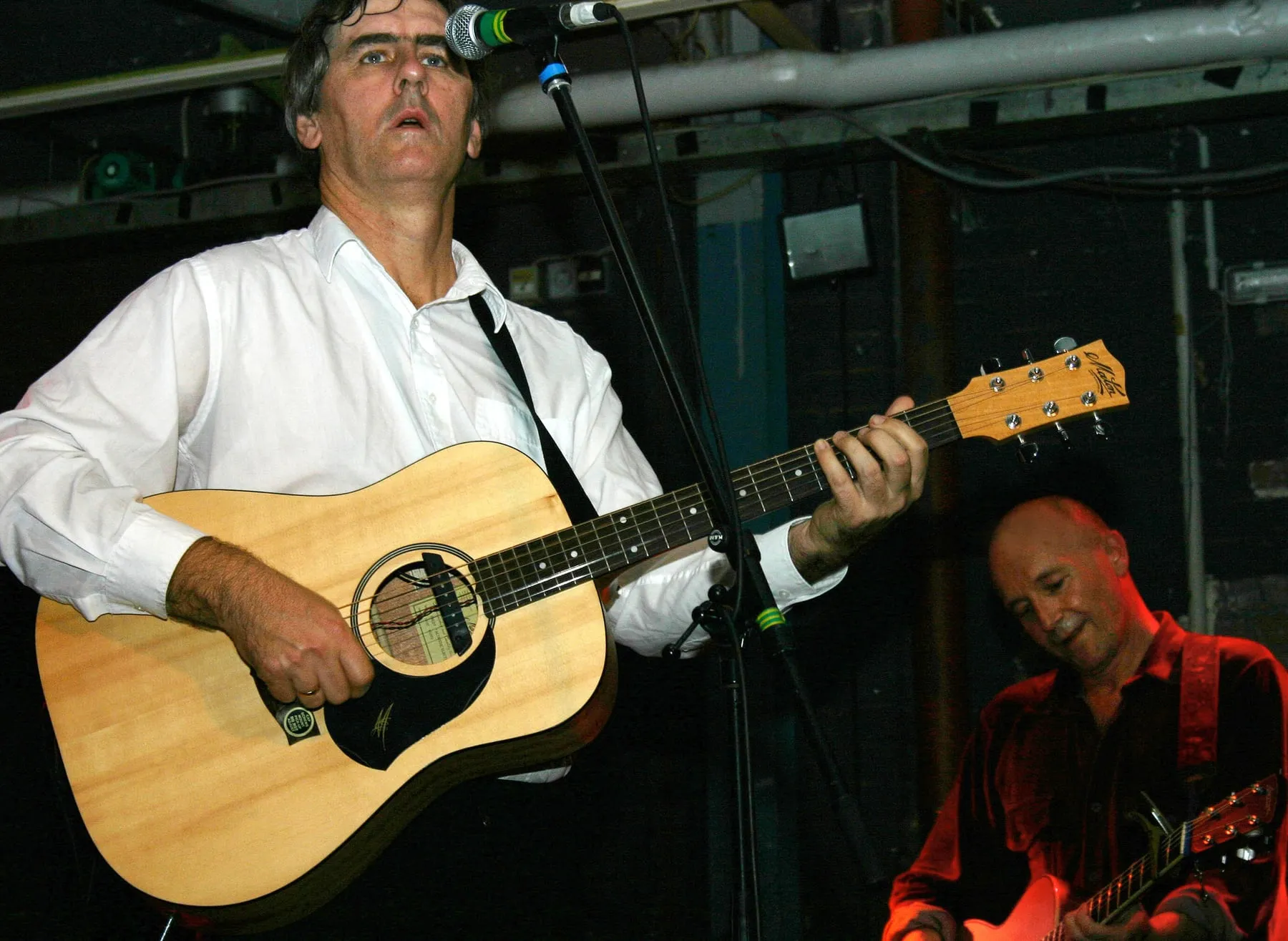
Photo , licensed under CC BY-SA 3.0 · Wikimedia Commons
Rank #321
The Go-Betweens
Brisbane indie-pop band of literary jangle and slow-burn international acclaim.
From Wikipedia
The Go-Betweens were an Australian indie rock band formed in Brisbane, Queensland, in 1977. The band was co-founded and led by singer-songwriters and guitarists Robert Forster and Grant McLennan, who were its only constant members throughout its existence. Drummer Lindy Morrison joined the band in 1980, and its lineup would later expand to include bass guitarist Robert Vickers and multi-instrumentalist Amanda Brown. Vickers was replaced by John Willsteed in 1987, and the quintet lineup remained in place until the band split two years later. Forster and McLennan reformed the band in 2000 with a new lineup that did not include any previous personnel aside from them. McLennan died on 6 May 2006 of a heart attack and the Go-Betweens disbanded again. In 2010, a toll bridge in their native Brisbane was renamed the Go Between Bridge after them.
Studio Albums
- 1982 Send Me a Lullaby
- 1983 Before Hollywood
- 1984 Spring Hill Fair
- 1986 Liberty Belle and the Black Diamond Express
- 1987 Tallulah
- 1988 16 Lovers Lane
- 1999 78 ’til 79: The Lost Album
- 2000 The Friends of Rachel Worth
- 2003 Bright Yellow Bright Orange
- 2005 Oceans Apart
Source: MusicBrainz
Deep Dive
Overview
The Go-Betweens were an Australian indie rock band formed in Brisbane, Queensland, in 1977. Led by singer-songwriters and guitarists Robert Forster and Grant McLennan, the band became one of the era’s most intellectually rigorous indie acts, blending literary lyrical sensibilities with jangly guitar work and pop structures. Though the band achieved only modest commercial success during their initial run, they accumulated devoted audiences across Australia, the United Kingdom, and North America, and remain central figures in the development of indie rock aesthetics in the 1980s.
Formation Story
Robert Forster and Grant McLennan founded The Go-Betweens in Brisbane in 1977, establishing themselves as the band’s creative core and only constant members throughout its first incarnation. The city of Brisbane, isolated from Australia’s major cultural centers, fostered a distinctive music scene in which literary ambition and indie sensibility flourished. Drummer Lindy Morrison joined the band in 1980, anchoring the group’s rhythm section and establishing the foundational trio that would define the band’s early sound. Over subsequent years, the lineup expanded to include bassist Robert Vickers and multi-instrumentalist Amanda Brown, creating the fuller instrumentation that characterized the band’s work through the late 1980s.
Breakthrough Moment
The Go-Betweens’ initial breakthrough came with the release of their debut album, Send Me a Lullaby, in 1982 on Missing Link Records. The album introduced their distinctive aesthetic: pop songcraft informed by literary references, underpinned by bright, economical guitar arrangements. Subsequent releases, including Before Hollywood (1983) and Spring Hill Fair (1984), deepened their reputation among indie rock cognoscenti, particularly in the United Kingdom and North America, though mainstream radio acceptance remained elusive. By the mid-1980s, the band had established a dedicated following through touring and critical appreciation, positioning themselves as thinking listeners’ alternative to both mainstream pop and punk orthodoxy.
Peak Era
The Go-Betweens reached their artistic and commercial peak between 1986 and 1988, releasing three albums of increasing ambition and sonic refinement. Liberty Belle and the Black Diamond Express (1986) and Tallulah (1987) showcased the band’s maturation, layering their pop sensibilities with orchestral arrangements and more complex song structures. The arrival of bassist John Willsteed in 1987 (replacing Robert Vickers) solidified a quintet lineup that persisted through 16 Lovers Lane (1988), widely regarded as the band’s most fully realized work. Despite the quality of these releases, mainstream commercial breakthrough eluded them, and the band disbanded in 1989 as the cultural landscape shifted away from the indie aesthetics they had cultivated.
Musical Style
The Go-Betweens’ sound drew from the British Invasion tradition—particularly the jangly pop of bands like The Beatles and The Byrds—filtered through an Australian indie rock sensibility. Forster and McLennan’s dual guitar approach emphasized economy and melodic clarity; their vocals, often in harmony, conveyed emotional restraint and intellectual distance rather than raw expressionism. The band’s distinguishing feature lay in their songwriting, which incorporated literary references, emotional complexity, and intricate narrative detail more commonly associated with art-rock or folk traditions. Under the production guidance visible on later albums, the band embraced fuller arrangements, incorporating strings, horns, and keyboard textures without abandoning their core indie aesthetic. This combination of pop accessibility, literary ambition, and instrumental sophistication set them apart from both punk-influenced post-punk bands and synthesizer-driven new wave acts of the same era.
Major Albums
Send Me a Lullaby (1982)
The Go-Betweens’ debut established the template for their career: literate pop songs built on ringing guitars and thoughtful arrangements, released on indie label Missing Link Records.
Liberty Belle and the Black Diamond Express (1986)
Marking a sonic expansion, this album introduced orchestral and horn arrangements while maintaining the band’s core identity, signaling their ambitions to transcend strict indie categorization.
Tallulah (1987)
Named after actress Tallulah Bankhead, the album deepened the band’s arrangements and lyrical sophistication, featuring some of their most enduring compositions and showcasing the mature quintet lineup.
16 Lovers Lane (1988)
Wide regarded as their masterpiece, this final album of their initial run synthesized all prior developments into a cohesive, emotionally rich statement, combining pop immediacy with orchestral sophistication and thematic depth.
The Friends of Rachel Worth (2000)
Following their reformation in 2000, Forster and McLennan reunited The Go-Betweens with a new backing lineup, returning to recording after an eleven-year hiatus with an album that acknowledged their past while exploring contemporary production.
Oceans Apart (2005)
Their final studio album before Grant McLennan’s death in 2006, Oceans Apart saw the band continuing to record and perform, maintaining their literary sensibilities and distinctive approach into the 2000s.
Signature Songs
- “Cattle and Cane” — A meditation on memory and rural Australian childhood, exemplifying the band’s combination of narrative storytelling and melodic grace.
- “Bachelor Kisses” — Built on restless guitar figures and yearning vocal harmonies, the song captures the emotional reticence characteristic of Forster and McLennan’s songwriting.
- “Right Here” — A standout from their peak era, demonstrating the band’s ability to craft pop hooks within emotionally complex frameworks.
- “A Quick Commercial Break” — Showcasing their wit and pop sensibility, the song exemplifies their approach to wrapping clever observations in accessible melodies.
- “Dive for Dreams” — A signature piece that balances orchestral arrangements with the band’s essential indie aesthetic, popular throughout their touring career.
Influence on Rock
The Go-Betweens’ influence emerged gradually, as their work gained reassessment in the 1990s and 2000s as indie rock matured and critics recognized the sophistication of their approach. Their insistence on literary quality in songwriting, orchestral arrangement without sacrificing indie credibility, and emotional intelligence in vocal delivery influenced subsequent generations of alternative rock and indie pop songwriters who similarly valued lyricism and harmonic complexity. They bridged traditions—the British pop-rock lineage, American indie sensibilities, and Australian geographical isolation—into a distinctive aesthetic that helped establish indie rock as a viable site for sophisticated artistic expression beyond punk provocation or post-punk austerity. Their reunion in 2000 and subsequent continued activity through the early 2000s ensured their work remained visible during indie rock’s transformation into a mainstream cultural force.
Legacy
Grant McLennan’s death on May 6, 2006, from a heart attack effectively ended The Go-Betweens’ active career, though their recorded legacy has only grown in estimation. The Brisbane Go Between Bridge, renamed after the band in 2010, stands as official recognition of their cultural importance to their native city. Their catalogue has benefited from the broader reissue and streaming culture, making their work widely accessible to listeners discovering indie rock’s history. Robert Forster survived McLennan and has continued occasional musical activity; the band’s songwriting partnership remains recognized as one of indie rock’s great partnerships, evidence of how sustained artistic vision and intellectual rigor can accumulate influence even without mainstream commercial success. The Go-Betweens’ trajectory—from 1970s Brisbane formation through international cult status to retrospective critical vindication—established a template for indie rock careers in which artistic integrity and slow-burn influence take precedence over immediate commercial triumph.
Fun Facts
- The band’s 1999 release 78 ‘til 79: The Lost Album consisted of previously unreleased material recorded during their first two years, documenting their earliest sonic explorations and the stylistic foundations later refined on their official debut.
- Robert Forster and Grant McLennan remained the only constant members across The Go-Betweens’ entire 1977–1989 existence, with all other lineup changes occurring around this unchanging core.
- Lindy Morrison, the band’s drummer from 1980 onward, was the sole female member during their most active period and contributed substantially to the band’s distinctive rhythmic character.
- Upon reformation in 2000, Forster and McLennan assembled an entirely new backing band with no members from their original lineup, effectively restarting the group as a vehicle for the songwriting partnership.
Discography & Previews
Click any album to expand its track list. Each track plays a 30-second preview streamed from Apple Music. Tap the link icon next to a track to open it in Apple Music for full playback.

- 1 Your Turn, My Turn ↗ 3:02
- 2 One Thing Can Hold Us ↗ 3:16
- 3 People Know ↗ 2:10
- 4 The Girls Have Moved ↗ 2:33
- 5 Midnight to Neon ↗ 2:31
- 6 Eight Pictures ↗ 4:52
- 7 Careless ↗ 2:34
- 8 All About Strength ↗ 2:13
- 9 Ride ↗ 3:32
- 10 Hold Your Horses ↗ 2:15
- 11 Arrow in a Bow ↗ 1:58
- 12 It Could Be Anyone ↗ 4:30


- 1 Spring Rain (Remastered) ↗ 3:10
- 2 The Ghost and the Black Hat (Remastered) ↗ 2:37
- 3 The Wrong Road (Remastered) ↗ 4:59
- 4 To Reach Me (Remastered) ↗ 3:39
- 5 Twin Layers of Lightning (Remastered) ↗ 4:24
- 6 In the Core of a Flame (Remastered) ↗ 2:58
- 7 Head Full of Steam (Remastered) ↗ 3:38
- 8 Bow Down (Remastered) ↗ 3:48
- 9 Palm Sunday (On Board the S.S. Within) [Remastered] ↗ 3:21
- 10 Apology Accepted (Remastered) ↗ 4:21


- 1 Love Goes On! (Remastered) ↗ 3:19
- 2 Quiet Heart (Remastered) ↗ 5:21
- 3 Love Is a Sign (Remastered) ↗ 4:14
- 4 You Can't Say No Forever (Remastered) ↗ 3:58
- 5 The Devil's Eye (Remastered) ↗ 2:04
- 6 Streets of Your Town (Remastered) ↗ 3:40
- 7 Clouds (Remastered) ↗ 4:06
- 8 Was There Anything I Could Do? (Remastered) ↗ 3:11
- 9 I'm All Right (Remastered) ↗ 3:14
- 10 Dive for Your Memory (Remastered) ↗ 4:13


