
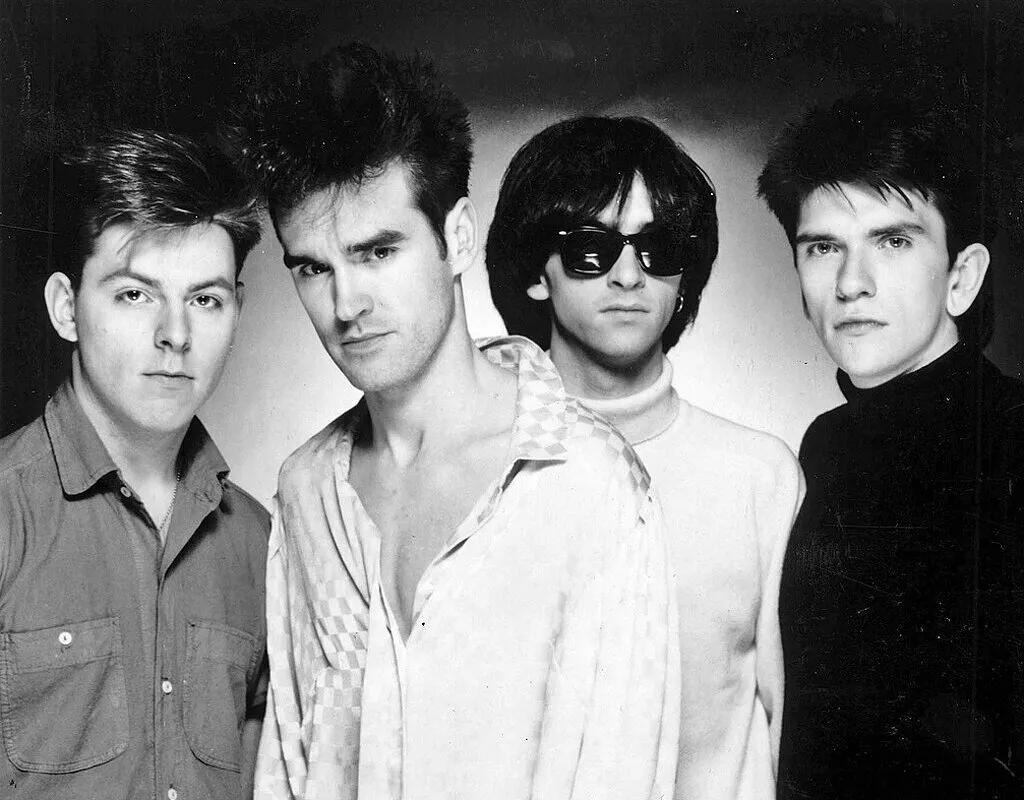
Photo by Paul Cox; Distributed by Sire Records , licensed under Public domain · Wikimedia Commons
Rank #38
The Smiths
Manchester icons whose four albums defined British indie.
From Wikipedia
The Smiths were an English rock band formed in Manchester in 1982, composed of Morrissey (vocals), Johnny Marr (guitar), Andy Rourke (bass) and Mike Joyce (drums). Morrissey and Marr formed the band's songwriting partnership. The Smiths are regarded as one of the most important British bands and one of the pioneers of 1980s independent music.
Members
- Johnny Marr
- Morrissey
Studio Albums
- 1984 The Smiths
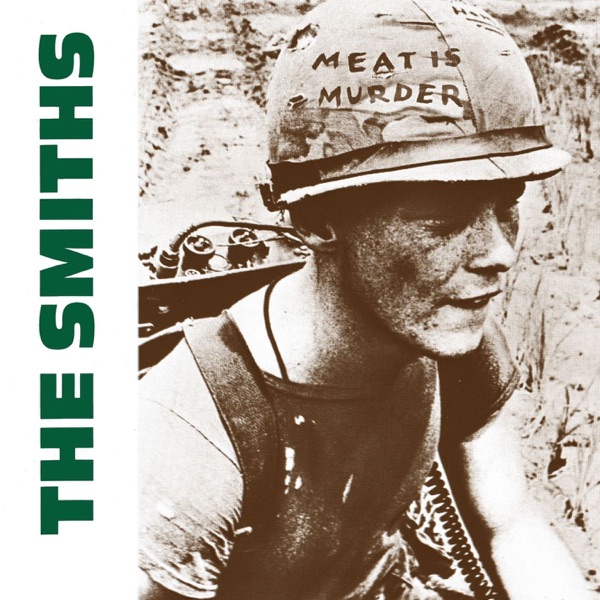
- 1985 Meat Is Murder
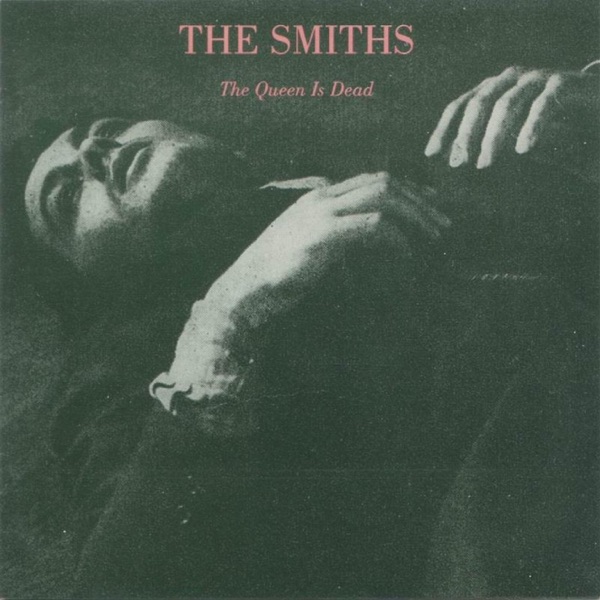
- 1986 The Queen Is Dead
- 1987 Strangeways, Here We Come
- 1990 Rusholme Ruffians Play at Home
- 1991 Live in Madrid
- 1993 I Suffer
- 1995 Dance With Octopuses
- 2023 Human Cries: Live In Oxford, 1985
- — You Just Haven’t Earned It Yet, Baby
Source: MusicBrainz
Deep Dive
Overview
The Smiths were an English rock band formed in Manchester in 1982, composed of Morrissey on vocals, Johnny Marr on guitar, Andy Rourke on bass, and Mike Joyce on drums. Over five years, the band released four studio albums that became the foundation of 1980s British independent music and established Manchester as a creative center for alternative rock. The songwriting partnership of Morrissey and Marr created music that blended post-punk severity with pop sensibility, jangle pop melodies with introspective lyricism, defining a template that would influence British indie rock for decades to come.
Formation Story
The Smiths coalesced in Manchester in 1982 when Morrissey and Johnny Marr formed the band’s songwriting core. Marr, a guitarist with roots in post-punk and new wave, brought angular, melodic instrumentation and production sensibility. Morrissey contributed distinctive vocals and lyrics marked by wit, melancholy, and social observation. The addition of Andy Rourke on bass and Mike Joyce on drums completed the classic lineup that would record the band’s first three studio albums and establish themselves as Manchester’s leading musical force. The city itself—with its industrial heritage and recent musical history anchored in Joy Division and Factory Records—provided both sonic and thematic context for their emergence.
Breakthrough Moment
The Smiths announced their arrival with their self-titled debut album in 1984, released on the independent label Rough Trade. The album’s blend of jangle pop guitar, post-punk rigidity, and Morrissey’s ornate vocal phrasing attracted immediate critical attention and built a devoted fanbase within the UK independent music scene. The record’s success established them as more than a local Manchester act and set the template for their subsequent releases: tightly composed songs built on Marr’s inventive guitar work and Morrissey’s often caustic, sometimes tender lyrics that addressed themes of alienation, desire, and social commentary. By the mid-1980s, The Smiths had become the defining band of British indie rock.
Peak Era
The band’s creative and commercial apex occurred between 1984 and 1987, spanning the release of their first three studio albums. Meat Is Murder (1985) and The Queen Is Dead (1986) expanded on the template established by their debut, with increasingly sophisticated arrangements and more assured production. During this period, The Smiths moved from independent label Rough Trade to the major label Warner Bros. Records, a transition that expanded their audience without diluting their artistic identity. By 1987, with the release of Strangeways, Here We Come, the band had established themselves as one of the most important British acts of the decade, their influence visible across independent radio, music press coverage, and a growing international fanbase. The band’s dissolution came in 1987, ending their initial active period after five concentrated years of recording and touring.
Musical Style
The Smiths’ sound fused post-punk’s angular approach with the melodic accessibility of jangle pop and new wave. Johnny Marr’s guitar work—characterized by clean, often arpeggiated lines played on Fender Jaguars and Telecasters—provided the instrumental backbone, complemented by Rourke’s melodic bass lines and Joyce’s precise, economical drumming. Morrissey’s vocal delivery ranged from crooning romanticism to spoken-word deadpan, often within the same song, and his lyrics balanced literary allusion with contemporary reference, emotional vulnerability with sardonic distance. The band’s production—often spare and unadorned, allowing the interplay of instruments to breathe—reflected post-punk values while remaining fundamentally pop in its concern for melody and song structure. Across their albums, the band explored variations on this formula: they could build towards orchestral arrangements, strip songs down to bass and voice, or lock into steady, almost post-punk grooves that anchored Marr’s more elaborate guitar textures.
Major Albums
The Smiths (1984)
The debut established the band’s essential sound: jangle pop melodies over post-punk foundations, with Morrissey’s vocals positioned as a lead instrument. Songs built on Marr’s clean guitar lines and the rhythm section’s precise, understated support created a template the band would refine across subsequent releases.
Meat Is Murder (1985)
The band’s second album deepened their approach, with more varied tempos and increased lyrical density. The record showed both their pop accessibility and their willingness to embrace longer, more complex arrangements while maintaining their core aesthetic.
The Queen Is Dead (1986)
By their third album, The Smiths had refined their craft into a confident balance of melodic sophistication and emotional directness. The record consolidated their status as the leading indie rock band of the mid-1980s, with songs that ranged from intimate character studies to broader social commentary.
Strangeways, Here We Come (1987)
The band’s final studio album before their 1987 dissolution, Strangeways showed increased experimentation within their established framework, with orchestral elements and varied production approaches across its tracks. It stands as the definitive statement of The Smiths’ original era.
Signature Songs
- “How Soon Is Now?” — The band’s most enduring composition, its tremolo guitar riff and Morrissey’s yearning vocal became their calling card.
- “This Charmed Life” — A meditation on desire and contentment that showcases the interplay between Morrissey’s lyrical wit and Marr’s melodic craftsmanship.
- “There Is a Light That Never Goes Out” — An epic romantic statement built on Marr’s soaring guitar work and Morrissey’s most direct emotional delivery.
- “Bigmouth Strikes Again” — A punkier, more rhythmically insistent track that revealed the band’s post-punk roots.
- “Panic” — A critique of radio formatting and mass culture built on a deceptively simple, memorable melody.
Influence on Rock
The Smiths established the template for British indie rock in the 1980s and beyond, demonstrating that intelligent, literarily informed songwriting and unconventional vocal approaches could exist within pop music without dilution. Their influence rippled through the alternative rock explosion of the late 1980s and 1990s, audible in bands that valued melody and words with equal weight. The Manchester sound they helped define—post-punk derived, but fundamentally pop in its concerns—shaped the era’s alternative rock and subsequent British indie movements. Marr’s guitar approach influenced countless alternative rock and indie musicians, while Morrissey’s vocal character and lyrical sensibility established a model for art-rock frontmanship that prioritized personality and idiosyncrasy over technical virtuosity.
Legacy
The Smiths’ four studio albums remain canonical texts in indie rock history. Their influence persists across alternative, indie, and art-rock contexts, and their songs continue to appear in popular culture decades after their 1987 dissolution. The band’s commercial and critical reassessment has only deepened with time; their records have acquired the status of essential listening for understanding 1980s British rock and the origins of modern indie rock. Morrissey and Johnny Marr’s songwriting partnership, though dissolved after 1987, continues to be studied as one of the most successful and creatively generative in rock music.
Fun Facts
- The band recorded material that was released posthumously in various formats, including live recordings from Oxford in 1985, which emerged decades later as Human Cries: Live In Oxford, 1985 in 2023.
- Johnny Marr’s guitar work drew from diverse influences including post-punk, surf rock, and folk, creating a distinctive sound that was immediately recognizable but difficult to categorize within conventional indie rock terms.
- The Smiths’ move from independent label Rough Trade to major label Warner Bros. Records represented a significant shift in 1980s indie rock history, demonstrating the possibility of artistic credibility within major label infrastructure.
Discography & Previews
Click any album to expand its track list. Each track plays a 30-second preview streamed from Apple Music. Tap the link icon next to a track to open it in Apple Music for full playback.

- 1 Reel Around the Fountain ↗ 5:57
- 2 You've Got Everything Now ↗ 4:00
- 3 Miserable Lie ↗ 4:28
- 4 Pretty Girls Make Graves ↗ 3:43
- 5 The Hand That Rocks the Cradle ↗ 4:38
- 6 This Charming Man ↗ 2:43
- 7 Still Ill ↗ 3:21
- 8 Hand In Glove ↗ 3:22
- 9 What Difference Does It Make? ↗ 3:50
- 10 I Don't Owe You Anything ↗ 4:05
- 11 Suffer Little Children ↗ 5:31
- 1 The Queen Is Dead ↗ 6:25
- 2 Frankly, Mr. Shankly ↗ 2:19
- 3 I Know It's Over ↗ 5:50
- 4 Never Had No One Ever ↗ 3:37
- 5 Cemetry Gates ↗ 2:41
- 6 Bigmouth Strikes Again ↗ 3:13
- 7 The Boy with the Thorn In His Side ↗ 3:17
- 8 Vicar In a Tutu ↗ 2:24
- 9 There Is a Light That Never Goes Out ↗ 4:04
- 10 Some Girls Are Bigger Than Others ↗ 3:18

- 1 A Rush and a Push and the Land Is Ours ↗ 3:01
- 2 I Started Something I Couldn't Finish ↗ 3:48
- 3 Death of a Disco Dancer ↗ 5:26
- 4 Girlfriend In a Coma ↗ 2:03
- 5 Stop Me If You Think You've Heard This One Before ↗ 3:36
- 6 Last Night I Dreamt That Somebody Loved Me ↗ 5:06
- 7 Unhappy Birthday ↗ 2:45
- 8 Paint a Vulgar Picture ↗ 5:35
- 9 Death at One's Elbow ↗ 2:02
- 10 I Won't Share You ↗ 2:51