
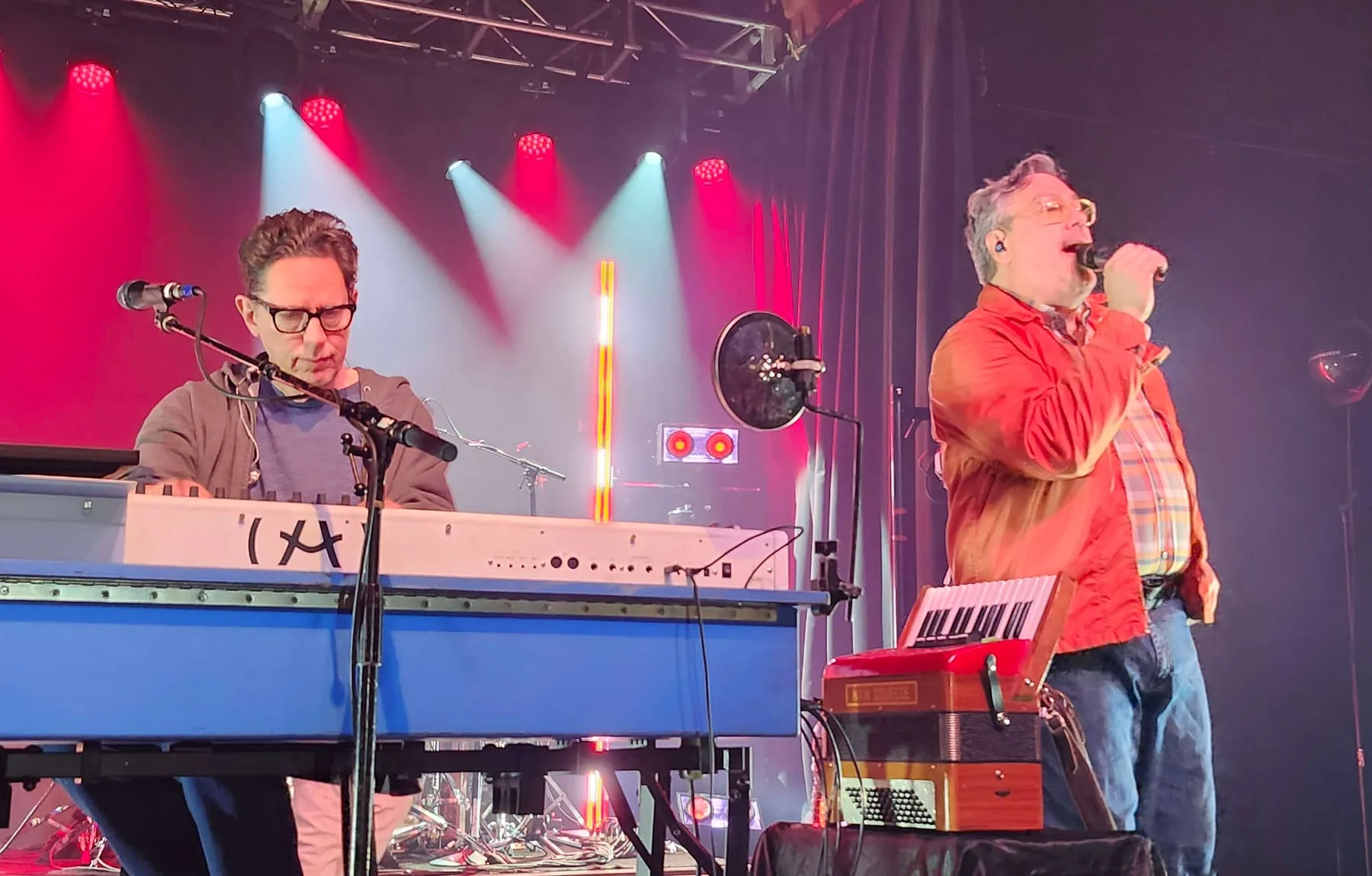
Photo by CharlesMichael2002 , licensed under CC0 · Wikimedia Commons
Rank #419
They Might Be Giants
Brooklyn duo of clever, durable alt-pop across many decades.
From Wikipedia
They Might Be Giants, often abbreviated as TMBG, is an American alternative rock band formed in 1982 by vocalist and guitarist John Flansburgh and vocalist and multi-instrumentalist John Linnell. During the band's early years, Flansburgh and Linnell frequently performed as a musical duo, often accompanied by a tape machine or a drum machine. In 1992, They Might Be Giants expanded to include a backing band. The band's current backing artists are Danny Weinkauf, Dan Miller, and Marty Beller, and their horn section consists of Dan Levine, Stan Harrison, and Mark Pender.
Members
- John Flansburgh · guitar (1982–present)
- John Linnell · musical keyboard (1982–present)
- Tony Maimone · bass guitar (1992–1995)
- Brian Doherty · drum (1993–1996)
- Graham Maby · bass guitar (1995–1997)
- Eric Schermerhorn · guitar (1996–1996)
- Dan Hickey · drum (1997–2003)
- Dan Miller · guitar (1998–present)
- Danny Weinkauf · bass guitar (1998–present)
- Marty Beller · drum (2002–present)
- Mark Pender · trumpet (2003–present)
- Stan Harrison · bass clarinet (2006–present)
Deep Dive
Overview
They Might Be Giants is an American alternative rock band formed in Brooklyn in 1982 by vocalist and guitarist John Flansburgh and vocalist and multi-instrumentalist John Linnell. Over four decades, the two Johns have built one of indie rock’s most durable and stylistically restless careers, moving from cassette-era lo-fi experimentation through major-label alternative rock, children’s music, and sustained independent output. Their significance lies not in a single breakthrough album or era, but in their refusal to calcify: the band has remained productive and creatively uncompromising across generations, treating commercial success and artistic constraint with equal skepticism.
Formation Story
Flansburgh and Linnell met in Brooklyn and began collaborating as They Might Be Giants in 1982, drawing on the city’s post-punk and art-rock underground. In the band’s early years, the two frequently performed as an acoustic duo, often accompanied by a tape machine or drum machine—an aesthetic that reflected both economic necessity and deliberate artistic choice. This stripped-down approach became the band’s calling card: sparse arrangements, high-concept lyrics, and a willingness to build elaborate production from minimal live resources. The pair’s partnership proved foundational; both remained the sole writing and creative core of the band across all subsequent lineups and expansions.
Breakthrough Moment
They Might Be Giants released their eponymous debut album in 1986, establishing the duo’s eclectic, lyrics-forward approach. The album caught the attention of alternative radio and college stations, but it was Lincoln (1988) and especially Flood (1990) that secured the band’s foothold in the emerging alternative rock mainstream. Flood became their breakthrough commercial success, introducing a broader audience to their trademark fusion of power pop melodicism, lo-fi production quirks, and deadpan wit. The album’s success led to a major shift: in 1992, the band expanded to include a full backing ensemble, professionalized touring, and a more polished studio sound on Apollo 18 (1992).
Peak Era
The band’s most commercially prominent period extended through the mid-1990s with John Henry (1994) and Factory Showroom (1996). These albums represented They Might Be Giants at their most accessible, marrying catchy melodies and radio-friendly production to the band’s intellectual and playful sensibility. The backing band, which included drummer Brian Doherty (1993–1996) and bassist Graham Maby (1995–1997) alongside the core duo, provided the live and studio cohesion necessary for touring and television appearances. By the late 1990s, however, the band’s commercial momentum had stalled; Long Tall Weekend (1999) and Mink Car (2001) showed the band pivoting toward more experimental and less commercially calculated work.
Musical Style
They Might Be Giants occupy a difficult-to-classify space within alternative and indie rock. Their sound synthesizes elements of power pop (bright, hook-laden melodies), experimental rock (unconventional song structures, electronic manipulation), and geek rock (science and mathematics themes, self-conscious intellectualism). Flansburgh’s guitar work tends toward rhythmic precision and percussive tonality, while Linnell’s keyboards range from playful synth textures to orchestral arrangements. Vocally, both Johns employ understated delivery, often trading lead and harmony lines; they rarely employ the emotional intensification or vocal histrionics common in rock. The band’s production has evolved from lo-fi tape-based aesthetic to professional studio craft, though their willingness to use unconventional instrumentation, found sounds, and arrangements that prioritize cleverness over polish has remained constant. Their genre touchstones include the avant-garde pop of Frank Zappa, the melodic experiments of post-punk, and the DIY ethos of college radio.
Major Albums
Flood (1990)
The album that brought They Might Be Giants to alternative radio and MTV, Flood demonstrated the duo’s ability to craft infectious pop hooks while maintaining lyrical and sonic idiosyncrasy. The record’s clean production and radio-friendly single potential represented a significant departure from their earlier tape-based aesthetic.
Apollo 18 (1992)
Released as the band expanded to a full backing ensemble, Apollo 18 showcased increased instrumental sophistication and tighter arrangements while maintaining the band’s trademark wit and structural playfulness. The album solidified their position in the alternative rock mainstream of the early 1990s.
John Henry (1994)
Named after the American folk legend, John Henry represented the band at their commercial and creative peak, balancing accessibility with compositional ambition across a diverse array of songs and styles. The album’s success confirmed They Might Be Giants’ durability within alternative rock.
Factory Showroom (1996)
Released midway through their major-label era, Factory Showroom continued to explore pop songcraft and baroque instrumentation, though the band began experimenting with more abstract and less immediately accessible material alongside their signature hooks.
No! (2002)
Released as a children’s album, No! marked a significant shift in the band’s primary output. Their work in children’s music—continuing through Here Come the ABCs (2004), Here Come the 123s (2008), and Here Comes Science (2009)—became a sustained focus, demonstrating the band’s ability to engage complex concepts through simple, playful structures.
The Else (2007)
A return to adult-oriented indie rock after years of children’s programming, The Else showcased the band’s continued ability to balance accessibility with experimentation and represented a mature statement from musicians in their mid-forties.
Signature Songs
- “Don’t Let’s Start” — An early declaration of the band’s philosophical and musical ambitions, establishing their pattern of linking clever wordplay to infectious melody.
- “Birdhouse in Your Soul” — Perhaps their most recognizable song, a synth-driven pop confection that exemplifies their ability to layer whimsy over precisely constructed arrangements.
- “Istanbul (Not Constantinople)” — A cover of a 1950s novelty song that became emblematic of the band’s approach to appropriation, irony, and genuine enjoyment of pop culture.
- “They Might Be Giants” — The self-titled theme song from their 1986 debut, a compact manifesto of their aesthetic and philosophical orientation.
- “Your Racist Friend” — A biting social commentary delivered through the band’s signature deadpan delivery and pop structure.
Influence on Rock
They Might Be Giants’ influence operates at multiple scales. In the alternative rock ecosystem of the 1980s and 1990s, they demonstrated that intellectual content, formal experimentation, and commercial accessibility were not mutually exclusive—a lesson absorbed by countless indie rock acts. Their willingness to treat rock songwriting as a space for humor, science, mathematics, and abstract philosophy helped legitimize geek culture within rock music at a moment when such legitimacy was still contested. Perhaps more significantly, their refusal to remain static, their embrace of technological change (from drum machines to digital production), and their integration of children’s music into an artistic portfolio showed a generational cohort how to remain creatively engaged across decades without retreating into nostalgia or heritage-act status.
Legacy
With over four decades of continuous activity, They Might Be Giants have established themselves as one of alternative rock’s most durable acts. Their prolific output across multiple formats—studio albums, live recordings, children’s programming, experimental side projects—has kept them visible and engaged without depending on periodic reunion tours or the nostalgia machine that has claimed many of their 1990s contemporaries. The band’s official website and ongoing touring maintain their presence; their integration of science and mathematics into popular music has found an expanded audience through children’s educational programming, introducing new generations to their philosophical and musical approach. They remain active into the 2020s, with albums continuing to appear: BOOK (2021) and the forthcoming The World Is to Dig (2026) demonstrate that the band shows no signs of artistic retreat or burnout.
Fun Facts
- The band’s name derives from a 1971 film of the same title, a noir-influenced comedy featuring George C. Scott; Flansburgh and Linnell were fans of the film and adopted its title as their band name.
- They Might Be Giants released music on Elektra Records during the 1990s, a major-label home that would have seemed unlikely for a band built on lo-fi aesthetics and experimental tendencies.
- The band’s children’s music output, beginning with No! in 2002, has become a substantial portion of their creative work, demonstrating a commitment to the education and entertainment of younger audiences that parallels their adult-oriented projects.
- Dan Miller has served as guitarist since 1998, providing instrumental continuity across the band’s most recent two decades and two-thirds of their total lifespan.
- The band’s use of drum machines in their early years was partly an economic decision, but became an aesthetic signature that influenced their compositional approach even after they expanded to a full backing band with live drummers.