
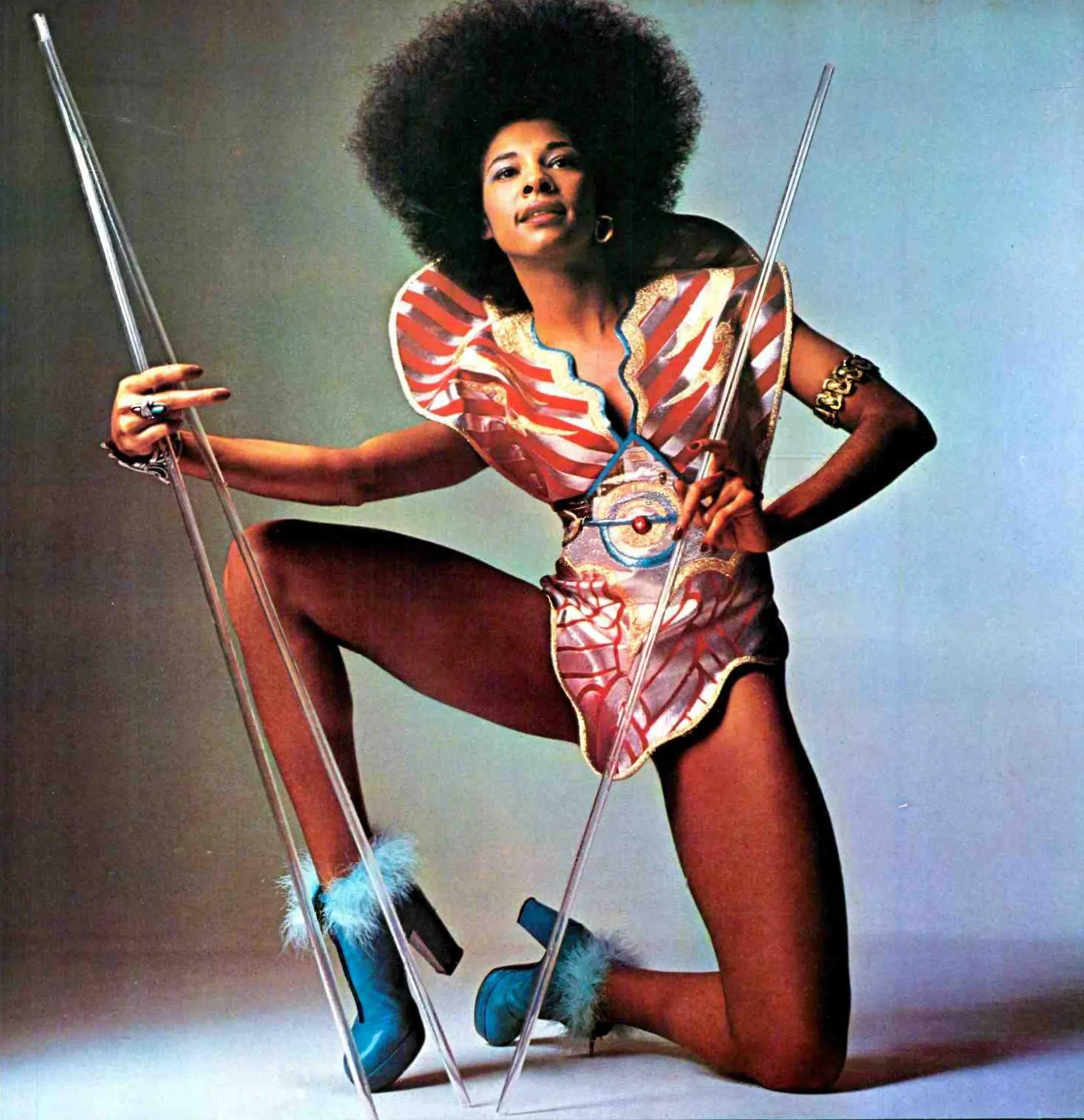
Photo by Just Sunshine Records , licensed under Public domain · Wikimedia Commons
Rank #478
Betty Davis
From Wikipedia
Betty Davis was an American singer, songwriter, and model. She was known for her controversial sexually oriented lyrics and performance style, and was the second wife of trumpeter Miles Davis. Her AllMusic profile describes her as "a wildly flamboyant funk diva with few equals ... [who] combined the gritty emotional realism of Tina Turner, the futurist fashion sense of David Bowie, and the trendsetting flair of Miles Davis".
Discography & Previews
Browse through and click an album to open and play 30-second previews streamed from Apple Music.

They Say I’m Different
1974 · 12 tracks
- 1 Shoo-B-Doop and Cop Him ↗ 3:57
- 2 He Was a Big Freak ↗ 4:08
- 3 Your Mama Wants Ya Back ↗ 3:27
- 4 Don't Call Her No Tramp ↗ 4:05
- 5 Git In There ↗ 4:46
- 6 They Say I'm Different ↗ 4:15
- 7 70's Blues ↗ 4:59
- 8 Special People ↗ 3:26
- 9 He Was a Big Freak (Record Plant Rough Mix) ↗ 4:43
- 10 Don't Call Her No Tramp Record Plant Rough Mix) ↗ 4:37
- 11 Git In There (Record Plant Rough Mix) ↗ 4:38
- 12 70's Blues (Record Plant Rough Mix) ↗ 5:02


Is It Love or Desire
2009 · 10 tracks
-
 They Say I’m DifferentBetty Davis197412 tracks
 -
 Nasty GalBetty Davis197510 tracks
 -
 Is It Love or DesireBetty Davis200910 tracks
Deep Dive
Overview
Betty Davis stands as one of rock and funk’s most audacious and uncompromising female voices. An American singer, songwriter, and model active from the 1970s onward, Davis built her reputation on sexually explicit and emotionally raw material delivered with a fearlessness that was virtually unparalleled among her contemporaries. Her career—marked by four studio albums released between 1973 and 1975, then a decades-long hiatus before returning to recording in the 1990s—traces a singular arc: a woman who claimed her sexuality and agency at a time when the music industry and society at large expected female performers to remain demure and decorative.
Formation Story
Born in 1944, Betty Davis emerged from a background that uniquely positioned her at the intersection of music, fashion, and cultural rebellion. She came of age during the civil rights era and the early stirrings of second-wave feminism, influences that would color her artistic vision. By the early 1970s, Davis had already worked as a model and was moving through creative circles that included some of rock and soul’s most innovative figures. Her path into recording came as the music industry was beginning to embrace funk and soul as commercially viable genres, yet she would push those genres into territories their architects had not necessarily intended—places of frank sexuality, female desire, and unabashed self-presentation that challenged the era’s conventions around what women performers could say and do.
Breakthrough Moment
Davis released her self-titled debut album Betty Davis in 1973 on Island Records, immediately establishing her as a provocative and distinctive voice. The album announced her arrival with unfiltered funk and soul that centered her perspective and agency. Her second album, They Say I’m Different (1974), deepened that statement, proving the debut was no accident. That same year she consolidated her reputation as a boundary-pusher unafraid of her own sexuality and the frank expression of it. By 1975, with the release of Nasty Gal, Davis had cemented a three-album run that remains the cornerstone of her original body of work.
Peak Era
The years 1973 to 1975 constitute Davis’s primary creative peak. During this concentrated three-year span, she released three studio albums that defined her artistic vision and established the sonic and lyrical template she would become known for. These records arrived at a moment when funk was ascending as a force in popular music, yet Davis’s contribution remained distinctive—filtered through a female perspective and delivered with a sexual frankness that was genuinely transgressive. Island Records provided the platform, though Davis’s uncompromising artistic voice meant she never achieved the mainstream commercial success that some of her male contemporaries did. The intensity and originality of those three albums, however, ensured that her legacy would rest on undeniable creative substance rather than chart dominance.
Musical Style
Betty Davis’s music blended funk, soul, pop, and rock into a genre-fluid whole that resisted easy categorization. Vocally, she brought an emotional rawness and sensual confidence to her delivery, channeling influences that ranged from Tina Turner’s gritty realism to the futurist stylization of David Bowie. Lyrically, Davis distinguished herself by centering female sexuality and desire in ways that were uncommon in mainstream rock and funk; her songs did not apologize for her perspective but asserted it as truth. The production on her early albums embraced the funkified grooves and horn arrangements that defined early-1970s soul-funk, yet her vocal presence and lyrical specificity gave her work a character distinct from her era’s other funk and soul voices. Over the decades that followed her initial run, her musical identity would remain rooted in that core sensibility, though the stylistic palette evolved with subsequent recordings.
Major Albums
Betty Davis (1973)
Davis’s debut announced a fully formed artistic vision: sexually direct funk and soul performed with absolute conviction and no concern for respectability politics.
They Say I’m Different (1974)
Her follow-up deepened the template, proving that her debut was the beginning of a sustained artistic statement rather than a novelty or provocation.
Nasty Gal (1975)
Davis’s third album in three years represents the culmination of her original creative period, a record as uncompromising as its title.
Betty Davis Hangin’ Out in Hollywood (1995)
After a gap of two decades, Davis returned to recording with this album, signaling that her artistic voice had not diminished.
Is It Love or Desire (2009)
Davis’s final studio album, released when she was in her mid-sixties, demonstrated her continued commitment to recording and performing.
Signature Songs
While the supplied discography does not itemize individual track listings, Davis’s reputation rests on the albums above as cohesive artistic statements. Her body of work as a whole—rather than discrete hit singles—defines her legacy, which is consistent with her positioning as an album artist and provocateur rather than a pop chartmaker.
Influence on Rock
Betty Davis’s impact on rock and funk derives not from commercial dominance but from artistic fearlessness and the unapologetic centering of female perspective and sexuality in genres often dominated by male voices and male viewpoints. She preceded by years the more commercially successful female funk and soul artists who would follow; she demonstrated that women could claim those genres and reshape them from within. Her willingness to sing about desire, control, and sexual agency set a template that influenced subsequent generations of female artists across rock, funk, soul, and hip-hop. Though she was not a household name in the way that some of her contemporaries became, her artistic courage and uncompromising vision ensured that any serious history of 1970s funk and soul would have to reckon with her contribution.
Legacy
Betty Davis passed away in 2022 at the age of seventy-seven, ending a career that spanned nearly fifty years of musical activity, though with significant gaps between her initial peak and her later recordings. Her three early albums remain the foundation of her reputation, preserved on Island Records and later reissued and discovered by subsequent generations of listeners and critics. Her AllMusic profile captures the scope of her influence: a synthesis of Tina Turner’s emotional authenticity, David Bowie’s fashion-forward sensibility, and Miles Davis’s trendsetting flair—the latter a personal as well as artistic connection, given her marriage to the jazz trumpeter. Her recordings have found new audiences through reissue campaigns and streaming platforms, introducing her work to listeners born long after her 1970s heyday. Davis’s legacy stands as a case study in artistic integrity and the price and reward of refusing to compromise one’s vision for commercial palatability.
Fun Facts
- Betty Davis was married to jazz legend Miles Davis, a union that connected her to one of rock and jazz’s most influential circles, though her own artistic identity remained fully independent.
- Despite her fearless lyrical content and provocative stage presence, Davis never achieved the mainstream commercial success of many of her peers, a testament to how thoroughly her work challenged the expectations of the music industry and radio gatekeepers of her era.
- Davis returned to recording in 1995 with Betty Davis Hangin’ Out in Hollywood after a gap of two decades, demonstrating an artistic commitment that extended well beyond the initial burst of creative activity that defined her reputation.