
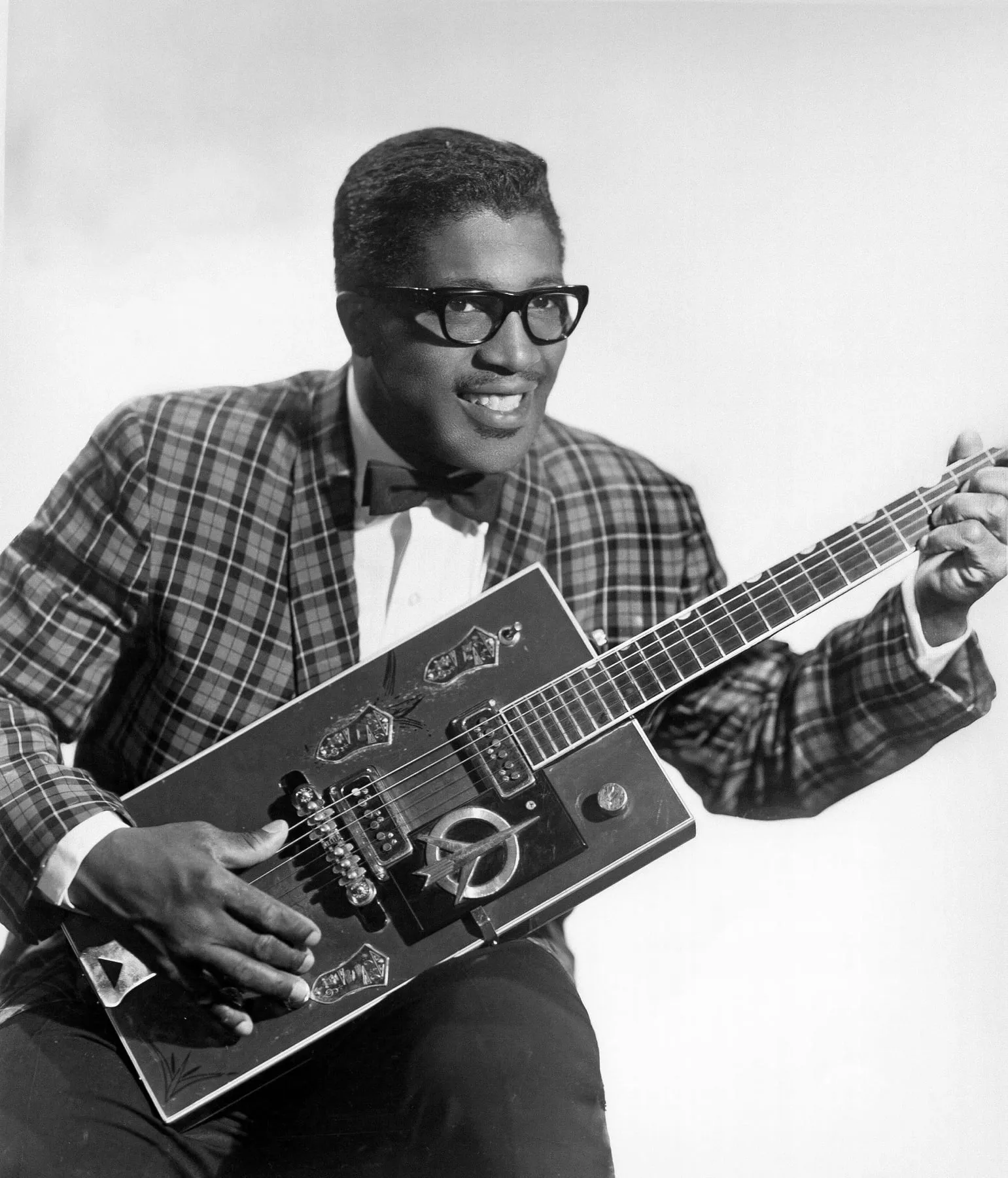
Photo by Published by Chess Records . Photographer unknown. , licensed under Public domain · Wikimedia Commons
Rank #124
Bo Diddley
From Wikipedia
Ellas Otha Bates, known professionally as Bo Diddley, was an American guitarist, singer and songwriter who played a key role in the transition from the blues to rock and roll. He influenced many artists, including Buddy Holly, the Beatles, the Rolling Stones, the Animals, George Thorogood, Syd Barrett, Tom Petty, and the Clash.
Discography & Previews
Browse through and click an album to open and play 30-second previews streamed from Apple Music.

Bo Diddley
1958 · 12 tracks
- 1 Bo Diddley ↗ 2:28
- 2 I'm a Man ↗ 2:45
- 3 Bring It to Jerome ↗ 2:27
- 4 Before You Accuse Me (Take A Look At Yourself) ↗ 3:05
- 5 Hey! Bo Diddley ↗ 2:10
- 6 Dearest Darling ↗ 2:49
- 7 Hush Your Mouth ↗ 2:50
- 8 Say! Boss Man ↗ 2:31
- 9 Diddley Daddy ↗ 2:27
- 10 Diddy Wah Diddy ↗ 2:28
- 11 Who Do You Love ↗ 2:28
- 12 Pretty Thing ↗ 2:46

Go Bo Diddley
1959 · 12 tracks
- 1 Crackin' Up ↗ 2:03
- 2 I'm Sorry ↗ 2:24
- 3 Bo's Guitar ↗ 2:32
- 4 Willie and Lillie ↗ 2:16
- 5 You Don't Love Me (You Don't Care) ↗ 2:46
- 6 Say Man ↗ 3:10
- 7 The Great Grandfather ↗ 2:27
- 8 Oh Yea ↗ 3:05
- 9 Don't Let It Go (Hold On To What You Got) ↗ 2:41
- 10 Little Girl ↗ 2:32
- 11 Dearest Darling ↗ 2:49
- 12 The Clock Strikes Twelve ↗ 2:57

Have Guitar Will Travel
1960 · 11 tracks

Bo Diddley Is a Lover
1961 · 12 tracks

Bo Diddley Is a Gunslinger
1961 · 15 tracks
- 1 Gun Slinger ↗ 1:52
- 2 Ride On Josephine ↗ 3:03
- 3 Doing the Crawdaddy ↗ 3:03
- 4 Cadillac ↗ 2:44
- 5 Somewhere ↗ 2:39
- 6 Cheyenne ↗ 2:00
- 7 Sixteen Tons ↗ 2:25
- 8 Whoa Mule (Shine) ↗ 2:29
- 9 No More Lovin' ↗ 2:22
- 10 Diddling ↗ 2:11
- 11 Working Man ↗ 2:31
- 12 Do What I Say ↗ 2:48
- 13 Prisoner of Love ↗ 2:31
- 14 Googlia Moo ↗ 3:02
- 15 Better Watch Yourself ↗ 2:55

Bo Diddley & Company
1962 · 12 tracks
Bo Diddley
1962 · 12 tracks
- 1 Bo Diddley ↗ 2:28
- 2 I'm a Man ↗ 2:45
- 3 Bring It to Jerome ↗ 2:27
- 4 Before You Accuse Me (Take A Look At Yourself) ↗ 3:05
- 5 Hey! Bo Diddley ↗ 2:10
- 6 Dearest Darling ↗ 2:49
- 7 Hush Your Mouth ↗ 2:50
- 8 Say! Boss Man ↗ 2:31
- 9 Diddley Daddy ↗ 2:27
- 10 Diddy Wah Diddy ↗ 2:28
- 11 Who Do You Love ↗ 2:28
- 12 Pretty Thing ↗ 2:46


-
 Bo DiddleyBo Diddley195812 tracks
 -
 Go Bo DiddleyBo Diddley195912 tracks
 -
 Have Guitar Will TravelBo Diddley196011 tracks
 -
 Bo Diddley Is a LoverBo Diddley196112 tracks
 -
 Bo Diddley Is a GunslingerBo Diddley196115 tracks
 -
 Bo Diddley & CompanyBo Diddley196212 tracks
 - Bo DiddleyBo Diddley196212 tracks
-
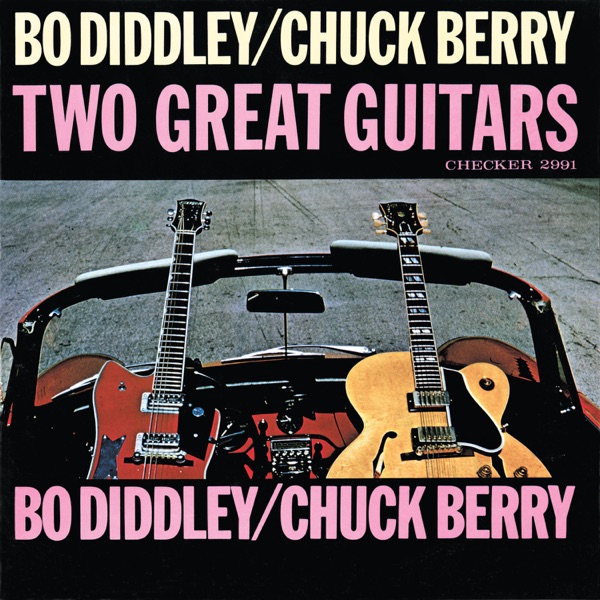
 Two Great GuitarsBo Diddley19648 tracks
 -
 Super BluesBo Diddley19678 tracks
 -
 The Black GladiatorBo Diddley197010 tracks
 -
 Another DimensionBo Diddley19719 tracks
 -
 Where It All BeganBo Diddley19729 tracks
 -
 The London Bo Diddley SessionsBo Diddley19739 tracks
 -
 Big Bad BoBo Diddley19747 tracks
 -
 A Man Amongst MenBo Diddley199610 tracks
Deep Dive
Overview
Ellas Otha Bates, known professionally as Bo Diddley, stands among the most consequential bridge figures in twentieth-century popular music. Born in 1928 and active across five decades until his death in 2008, Diddley played a central role in the transition from post-war blues into rock and roll. His signature guitar style—built on a syncopated, rumbling rhythm pattern that would become inseparable from the emerging rock idiom—shaped generations of musicians who drew directly from his innovations.
Diddley’s reach extended far beyond his own commercial success. Artists as diverse as Buddy Holly, the Beatles, the Rolling Stones, the Animals, George Thorogood, Syd Barrett, Tom Petty, and the Clash all looked to his work as foundational. His presence in the recorded pantheon spans from 1958 through the 2000s, during which he released dozens of albums on Checker Records, the label most closely associated with his career.
Formation Story
Bo Diddley emerged from the American blues tradition in the post-World War II era, a period when electric instruments and urban migration were fundamentally reshaping the genre’s sound. Growing up, he absorbed the techniques and emotional vocabulary of Chicago blues while absorbing the rhythmic innovations and amplified energy that characterized the early 1950s. Unlike many of his blues contemporaries, Diddley recognized that the electric guitar could be deployed not merely as a vehicle for traditional blues phraseology but as a rhythm instrument in its own right—a foundational shift in how rock music would construct its sonic foundation.
By the mid-1950s, Diddley had begun recording and performing, building a regional reputation that would eventually crystallize into a broader industry presence. His move toward recording marked the crystallization of an artistic vision already mature: a blues-rooted but forward-looking approach to the guitar and songwriting that positioned him at the nexus of multiple musical traditions. Checker Records became his primary label, and it was through that relationship that his recorded legacy would unfold.
Breakthrough Moment
Bo Diddley’s arrival as a recorded artist came in 1958 with the release of his self-titled debut album, Bo Diddley. This record introduced audiences to the full scope of his musical identity: a guitarist steeped in blues vocabulary but operating with a rhythmic and sonic palette that announced rock and roll’s arrival. The early albums that followed—Go Bo Diddley (1959) and Have Guitar Will Travel (1960)—consolidated his reputation as a singular voice in the emerging rock landscape. These records made clear that Diddley was not simply a blues musician dabbling in rock trends; rather, he was an architect of the new form itself.
The early 1960s saw Diddley’s productivity and ambition expand considerably. Albums like Bo Diddley Is a Lover (1961) and Bo Diddley Is a Gunslinger (1961) demonstrated the range of his songwriting and his willingness to place his guitar within varied contexts. By the time of The Originator (1966), Diddley had secured his place not merely as an influential performer but as a musician whose innovations were being studied, borrowed from, and built upon by the generation that would define rock’s creative apex in the 1960s.
Peak Era
The period from 1958 through the mid-1960s represents Bo Diddley’s most creatively fertile and culturally resonant span. During these years, he released a flood of records—often multiple albums per year—each one staking out territory within blues, rock, and rhythm-and-blues traditions. Albums such as Bo Diddley & Company (1962), Bo Diddley’s a Twister (1962), and Surfin’ With Bo Diddley (1963) showcase an artist unafraid to experiment with contemporary trends and sonic textures. Even as surf music and other fads seized popular attention, Diddley’s fundamental contribution—the hypnotic, syncopated electric guitar riff as the backbone of rock and roll—remained constant.
Throughout the 1960s, collaborations and live recordings kept Diddley’s name in circulation. Albums like Two Great Guitars (1964), Super Blues (1967), and The Super Super Blues Band (1967) placed him alongside other influential bluesmen and rockers, affirming his elder-statesman status at a moment when rock music was experiencing explosive creative growth. Diddley’s influence on the younger generation—particularly the British Invasion acts—was direct and measurable, as the period’s most celebrated bands acknowledged his centrality to their own sound.
Musical Style
Bo Diddley’s musical identity rests on a deceptively simple foundation: a hypnotic, syncopated rhythm pattern that he played on the electric guitar, paired with a blues-derived harmonic vocabulary and a rough-hewn, authoritative vocal delivery. The “Bo Diddley beat,” as it became known, is neither straight swing nor standard rock-and-roll shuffle but a proprietary rhythmic feel that locks into place with mechanical precision and primitive power. This rhythm became the template for countless rock songs across multiple decades.
Vocally, Diddley favored directness and clarity over melismatic showmanship. His songwriting bent toward concrete storytelling and rhythmic repetition, often employing call-and-response patterns and lyrical games that kept listeners engaged without demanding sophisticated harmonic movement. Instrumentally, his guitar work prioritized the instrument’s percussive and rhythmic properties over virtuosic soloing; the guitar functions as a drummer and bassist as much as a melodic voice. This approach was revolutionary in the blues context, where instrumental elaboration and technical display held high cultural value, and it pointed the way toward rock music’s future emphasis on the band as a unified rhythmic organism rather than a collection of individual soloists.
Major Albums
Bo Diddley (1958)
The self-titled debut established Diddley’s core sound and introduced the world to his signature rhythmic approach, marking his first statement as a recording artist.
Have Guitar Will Travel (1960)
This album expanded Diddley’s sonic palette and songwriting range, consolidating his early success and demonstrating his flexibility within rock and blues idioms.
Bo Diddley Is a Lover (1961)
Released alongside Bo Diddley Is a Gunslinger, this record shows Diddley’s willingness to explore thematic and stylistic variety while maintaining his foundational rhythmic identity.
The Originator (1966)
By the mid-1960s, Diddley had become an acknowledged elder figure in rock, and this album underscored his pioneering role as British rockers and American contemporaries openly credited him as a primary influence.
The London Bo Diddley Sessions (1973)
Recorded in the early 1970s but released as a testament to Diddley’s continued relevance, these sessions demonstrate that his core innovations remained powerful and compelling decades after their inception.
Signature Songs
- “Bo Diddley” — The eponymous track that announced his arrival and codified the rhythm pattern that would bear his name throughout rock history.
- “I’m a Man” — A declarative, blues-rooted performance that became a standard and was later covered across multiple rock and blues traditions.
- “Say Mama” — A rhythmically propulsive number showcasing Diddley’s gift for combining verbal and musical rhythm into a unified whole.
- “Mona” — A track that exemplifies Diddley’s ability to craft memorable, groove-centered songs that transcend simple blues conventions.
- “Who Do You Love” — A song that entered the broader rock repertoire and was recorded by numerous subsequent artists, affirming Diddley’s compositional importance.
Influence on Rock
Bo Diddley’s influence on rock and roll is foundational and verifiable across multiple lines of descent. The rhythmic innovations he introduced—particularly the Bo Diddley beat—became a shared resource for rock musicians, from the British Invasion acts who explicitly acknowledged him to generations of garage rockers, punk musicians, and beyond. Artists like the Rolling Stones and the Animals did not merely borrow his songs; they absorbed his rhythmic and sonic approach into their core identities.
Beyond specific riffs or songs, Diddley modeled a way of thinking about the electric guitar in rock music: as a rhythm instrument as much as a melodic one, as a textural and textural anchor for the band rather than a platform for individual virtuosity. This perspective profoundly influenced how rock bands would organize themselves and distribute musical roles. His career also demonstrated that a blues musician could transition into rock without compromising artistic integrity, providing a template that many others would follow. From punk to garage rock to countless rock and roll traditions, Diddley’s foundational rhythmic and sonic ideas remain active.
Legacy
Bo Diddley remained an active performer and recording artist well into the 2000s, his final studio album appearing in 2013—five years after his death—as Rock ‘N’ Roll Master Blaster: The Essential Collection, a retrospective affirmation of his career’s arc. His presence in the streaming and reissue ecosystem has been consistently strong, with compilations and original recordings remaining accessible to new generations. The breadth and depth of his recorded catalog—spanning from 1958 through the 2000s—offers a remarkable window into decades of musical change and continuity.
Diddley’s status as a pioneer of rock and roll is now beyond dispute. He is remembered not as a historical footnote but as one of the figures who made rock music possible in its modern form. Young musicians continue to discover his records, and his rhythmic innovations remain instantly recognizable and readily deployable. His influence appears in unexpected places: the Bo Diddley beat surfaces in rock, rap, and rhythm-and-blues contexts as a reliable resource for creating groove and forward motion. Though he passed away in 2008, his contributions to the electric guitar, to rhythm-based songwriting, and to rock’s basic vocabulary remain active and vital.
Fun Facts
- Bo Diddley’s real name, Ellas Otha Bates, would appear on record labels and legal documents throughout his career, but the stage name became so central to his identity that it eventually became his legal name.
- The prolific nature of his early career meant that multiple albums appeared in single years during the late 1950s and early 1960s, reflecting both the demand for new product and the rapid pace of his creative output during rock’s early commercial expansion.
- Diddley’s influence extended to artists who might not initially seem connected to his blues-rock lineage, demonstrating the breadth of his impact on twentieth-century popular music.
- His collaborations across the 1960s—with other blues musicians, rock acts, and session players—kept him embedded in the broader rock conversation even as the genre evolved around him.