
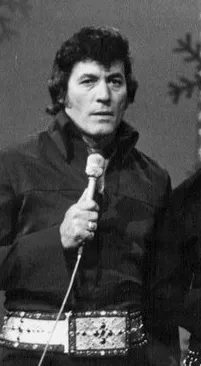
Photo by CBS Television , licensed under Public domain · Wikimedia Commons
Rank #450
Carl Perkins
From Wikipedia
Carl Lee Perkins was an American country, rockabilly, and rock and roll guitarist, singer and songwriter. A rockabilly great and pioneer of rock and roll, he began his recording career at the Sun Studio in Memphis in 1954. Among his best known songs are "Blue Suede Shoes", "Honey Don't", "Matchbox" and "Everybody's Trying to Be My Baby".
Discography & Previews
Browse through and click an album to open and play 30-second previews streamed from Apple Music.

Whole Lotta Shakin’
1958 · 12 tracks
- 1 Whole Lotta Shakin' ↗ 3:00
- 2 Tutti - Frutti ↗ 2:06
- 3 Shake, Rattle and Roll ↗ 3:29
- 4 Sittin' On Top of the World ↗ 2:12
- 5 Ready Teddy ↗ 2:05
- 6 Long Tall Sally ↗ 3:00
- 7 That's All Right ↗ 3:36
- 8 Where the Rio De Rosa Flows ↗ 3:05
- 9 Good Rockin' Tonight ↗ 2:21
- 10 I Got a Woman ↗ 3:13
- 11 Hey, Good Lookin' ↗ 2:42
- 12 Jenny, Jenny ↗ 2:10

Boppin’ the Blues
1970 · 2 tracks

Cane Creek Glory Church
1977 · 10 tracks

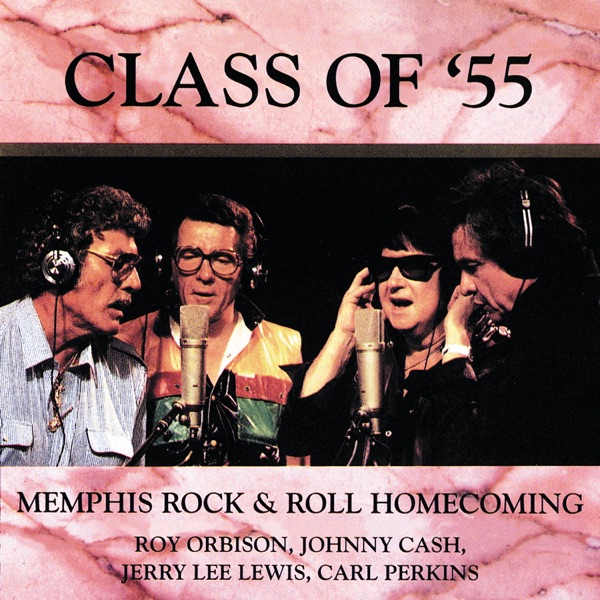
Class of ’55: Memphis Rock & Roll Homecoming
1986 · 10 tracks

Dixie Fried
1986 · 2 tracks

Born to Rock
1989 · 10 tracks
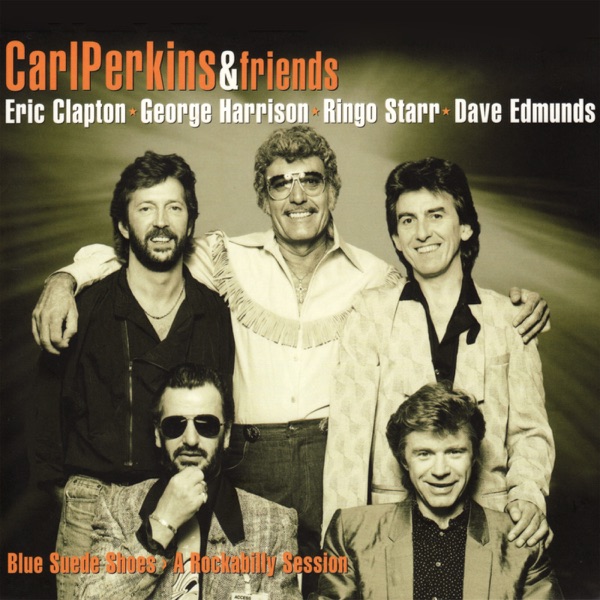
Blue Suede Shoes
1993 · 18 tracks
- 1 Boppin' the Blues (Live) ↗ 2:57
- 2 Put Your Cat Clothes On (Live) ↗ 3:32
- 3 Honey Don't (Live) ↗ 4:06
- 4 Matchbox (Live) ↗ 3:21
- 5 Mean Woman Blues (Live) ↗ 3:10
- 6 Turn Around (Live) ↗ 3:18
- 7 Going to Jackson (Live) ↗ 3:04
- 8 What Kind of Girl (Live) ↗ 2:47
- 9 Everybody's Trying to Be My Baby (Live) ↗ 2:44
- 10 Your True Love (Live) ↗ 4:19
- 11 The World Is Waiting for the Sunrise (Live) ↗ 2:18
- 12 That's Alright Mama / Blue Moon of Kentucky / Night Train to Memphis / Amen (Live) ↗ 5:21
- 13 Glad All Over (Live) ↗ 2:35
- 14 Whole Lotta Shakin' Goin' On (Live) ↗ 2:31
- 15 Gone Gone Gone (Live) ↗ 2:38
- 16 Blue Suede Shoes (Live) ↗ 3:11
- 17 Blue Suede Shoes (Encore) [Live] ↗ 2:54
- 18 Gone Gone Gone (Encore) [Live] ↗ 0:56

Dixie Fried
2011 · 2 tracks

Honey Don't
2022 · 2 tracks

Some Things Never Change
2025 · 10 tracks
- 1 Baby, Bye Bye ↗ 2:24
- 2 Dont'cha Know I Love You ↗ 2:53
- 3 Memphis In The Meantime ↗ 4:55
- 4 Messin' Around With Rock 'n' Roll ↗ 3:37
- 5 Some Things Never Change ↗ 2:45
- 6 Miss Muddy ↗ 4:22
- 7 Where Does Love Go ↗ 3:12
- 8 Get Rhythm ↗ 3:01
- 9 Heart Of My Heart ↗ 3:16
- 10 Baby, Bye Bye (Jackson Demo) ↗ 2:52
-
 Whole Lotta Shakin’Carl Perkins195812 tracks
 -
 Boppin’ the BluesCarl Perkins19702 tracks
 -
 Cane Creek Glory ChurchCarl Perkins197710 tracks
 -
 Carl PerkinsCarl Perkins19851 track
 -
 Class of ’55: Memphis Rock & Roll HomecomingCarl Perkins198610 tracks
 -
 Dixie FriedCarl Perkins19862 tracks
 -
 Born to RockCarl Perkins198910 tracks
 -
 Blue Suede ShoesCarl Perkins199318 tracks
 -
 TennesseeCarl Perkins19942 tracks
 - TennesseeCarl Perkins20062 tracks
- Dixie FriedCarl Perkins20112 tracks
-
 Honey Don'tCarl Perkins20222 tracks
 -
 Some Things Never ChangeCarl Perkins202510 tracks
Deep Dive
Overview
Carl Lee Perkins stands as one of the foundational figures in rock and roll’s emergence from rural American music. Born in 1932 and active in music until his death in 1998, Perkins bridged country tradition and the raw, rhythmic energy that would become rockabilly, establishing himself as both a guitarist of technical distinction and a songwriter of lasting commercial and artistic impact. His influence flows through multiple generations of rock musicians, and his songwriting catalog—anchored by the epochal “Blue Suede Shoes”—remains part of rock’s permanent repertoire.
Formation Story
Carl Perkins was born into a world where country music and blues existed as parallel but distinct traditions, and his early life positioned him to absorb both. Growing up in the rural South, Perkins was shaped by the musical landscape of Depression-era America, absorbing country melodies and the rhythmic innovations emerging from African American musical traditions. His path to rock and roll was not a sudden rupture but a gradual synthesis. By the early 1950s, as the entertainment industry began to recognize the commercial potential of a younger, more energetic sound, Perkins found himself at the intersection of these influences. In 1954, he began his recording career at Sun Studio in Memphis, the legendary label and studio founded by Sam Phillips. This moment positioned Perkins at the birthplace of rock and roll itself—the same facility that would house recordings by Elvis Presley, Johnny Cash, and Jerry Lee Lewis. Sun Records became the incubator for his early sound, a place where the experimental approach to capturing the energy of country, blues, and rhythm and blues collided with technical ambition.
Breakthrough Moment
In 1955, Perkins recorded “Blue Suede Shoes,” a song that became his signature work and one of the most important recordings in early rock and roll history. The track was both a commercial and artistic breakthrough: it captured the exuberance and driving rhythm that defined the emerging rockabilly sound, with Perkins’ distinctive guitar work providing the sonic foundation. The song’s success established him as a major recording artist and demonstrated that rock and roll—still a nascent genre—could sustain substantial sales and radio play. Following this breakthrough, Perkins continued to record prolifically for Sun Records, establishing a catalog that included “Honey Don’t,” “Matchbox,” and “Everybody’s Trying to Be My Baby,” all of which showcased his ability to craft memorable melodies atop rhythmically sophisticated arrangements. His early recordings from this period became foundational texts of the rockabilly genre, influencing how subsequent musicians approached the fusion of country and rock sensibilities.
Peak Era
Perkins’ most creatively fertile and commercially prominent period occurred in the mid-to-late 1950s, when rockabilly itself was at the forefront of popular music innovation. During this time, he released Dance Album of… Carl Perkins in 1957 and Whole Lotta Shakin’ in 1958, both albums capturing the high-energy, guitar-driven sound that defined his artistic identity. These recordings showcased Perkins as a vocalist of genuine character—his voice carried the twang and emotional directness of country tradition while adapting to the rhythmic demands of rock and roll. His guitar playing, meanwhile, was characterized by precise fingerwork, blues-inflected phrasing, and a clear understanding of how to construct memorable melodic lines within the rock and roll framework. During this era, Perkins was recording for some of the most important independent labels of the time, including Sun Records, Decca, Columbia Records, and Mercury Records, a portfolio that reflected both his importance to the industry and the competitive interest labels had in securing his catalog.
Musical Style
Carl Perkins’ sound emerged from a deliberate synthesis of country music’s melodic and narrative traditions with the rhythmic and textural innovations of blues and rhythm and blues. As a guitarist, Perkins favored clear, articulate playing that emphasized single-note lines and percussive rhythm work rather than complex chording; his approach influenced the cleaner, more technical side of rock guitar that would emerge in subsequent decades. His songwriting was grounded in country vernacular—storytelling, plainspoken emotion, and attention to everyday detail—but the arrangements placed his guitar at the center in a way that country music rarely did. Vocally, Perkins retained the nasal, country-inflected timbre of his origins even as he adapted his phrasing to the swung, syncopated rhythms of rock and roll. His influence on rockabilly was substantial: the genre itself can be understood partly as the result of artists like Perkins learning to infuse country music structure with the energy and instrumentation of rhythm and blues. Over his career span, which extended from the 1950s through the 1990s, Perkins’ style remained rooted in these foundational principles, though the specific production techniques and surrounding instrumental textures evolved with changing recording technology and popular taste.
Major Albums
Dance Album of… Carl Perkins (1957)
One of Perkins’ earliest proper album releases, this record consolidated his breakthrough success and showcased the upbeat, guitar-driven rockabilly sound that made him a star.
Whole Lotta Shakin’ (1958)
Released as rockabilly was reaching its cultural apex, this album captured Perkins at the height of his commercial success, with the energy and guitar work that defined his early peak.
Class of ‘55: Memphis Rock & Roll Homecoming (1986)
A later-career collaboration that reunited Perkins with other Memphis legends, this album represented both a retrospective nod to Sun Studio’s legacy and evidence of his continued relevance in rock music.
Dixie Fried (1986)
Perkins returned to his rockabilly roots on this recording, demonstrating his ability to revisit and reinvigorate his foundational sound decades into his career.
Signature Songs
- “Blue Suede Shoes” — The definitive Carl Perkins song and one of the cornerstones of early rock and roll, establishing his reputation as both a songwriter and performer of lasting impact.
- “Honey Don’t” — A showcase for Perkins’ rhythmic guitar work and upbeat vocal delivery, this track exemplified his ability to craft infectious rockabilly standards.
- “Matchbox” — A driving, guitar-centered composition that highlighted Perkins’ skill at building momentum through instrumental interplay.
- “Everybody’s Trying to Be My Baby” — A recording that demonstrated Perkins’ ability to blend country humor with rock and roll energy, becoming one of his most enduring compositions.
Influence on Rock
Carl Perkins’ influence on rock and roll music cannot be overstated. He was one of the architects of rockabilly, a genre that translated country musical traditions into rock and roll terms and in doing so helped establish rock’s fundamental vocabulary. His guitar playing influenced subsequent generations of rock musicians who sought to balance technical clarity with rhythmic sophistication. The songwriting tradition he established—using country narrative and vernacular within rock and roll structures—became a foundational model for country-rock and Americana. His recordings at Sun Studio became touchstones for musicians seeking to understand rock and roll’s origins, and his influence extended far beyond his own era; later artists across multiple genres drew inspiration from his recordings and songwriting. The very concept of “rock and roll” as distinct from but related to country music owes much to Perkins’ work in synthesizing these traditions during the crucial early years of the 1950s.
Legacy
Carl Perkins’ legacy rests on his dual achievement as both an innovator in the crucial early years of rock and roll and as a musician whose fundamental approach to his instrument and songwriting remained consistent throughout a long career spanning from 1954 to his death in 1998. His recordings from the 1950s remain in active circulation and are foundational to any understanding of rock and roll’s origins, studied by musicians and historians alike. His songwriting—particularly “Blue Suede Shoes”—entered the permanent cultural repertoire, recorded and rerecorded by countless artists across multiple genres. The sustained output of later albums, including his 1986 collaboration Class of ‘55: Memphis Rock & Roll Homecoming, demonstrated that Perkins remained active and valued within the music industry well into his later years. His influence can be traced through the careers of musicians who cite him as a foundational influence, and his recordings continue to stream and sell steadily, evidence of the enduring appeal of both his musicianship and songwriting craft.
Fun Facts
- Perkins recorded at Sun Studio in Memphis, the same legendary facility where Elvis Presley, Johnny Cash, and Jerry Lee Lewis captured their breakthrough recordings, placing him at the literal birthplace of rock and roll.
- “Blue Suede Shoes” became so iconic that it entered common cultural parlance, referenced in contexts far beyond music and becoming part of the visual and sartorial language of rock and roll itself.
- Perkins’ recording career spanned multiple decades and record labels—Sun Records, Decca, Columbia Records, Mercury Records, and others—reflecting both his importance to the industry and his continued commercial viability across changing market conditions.