
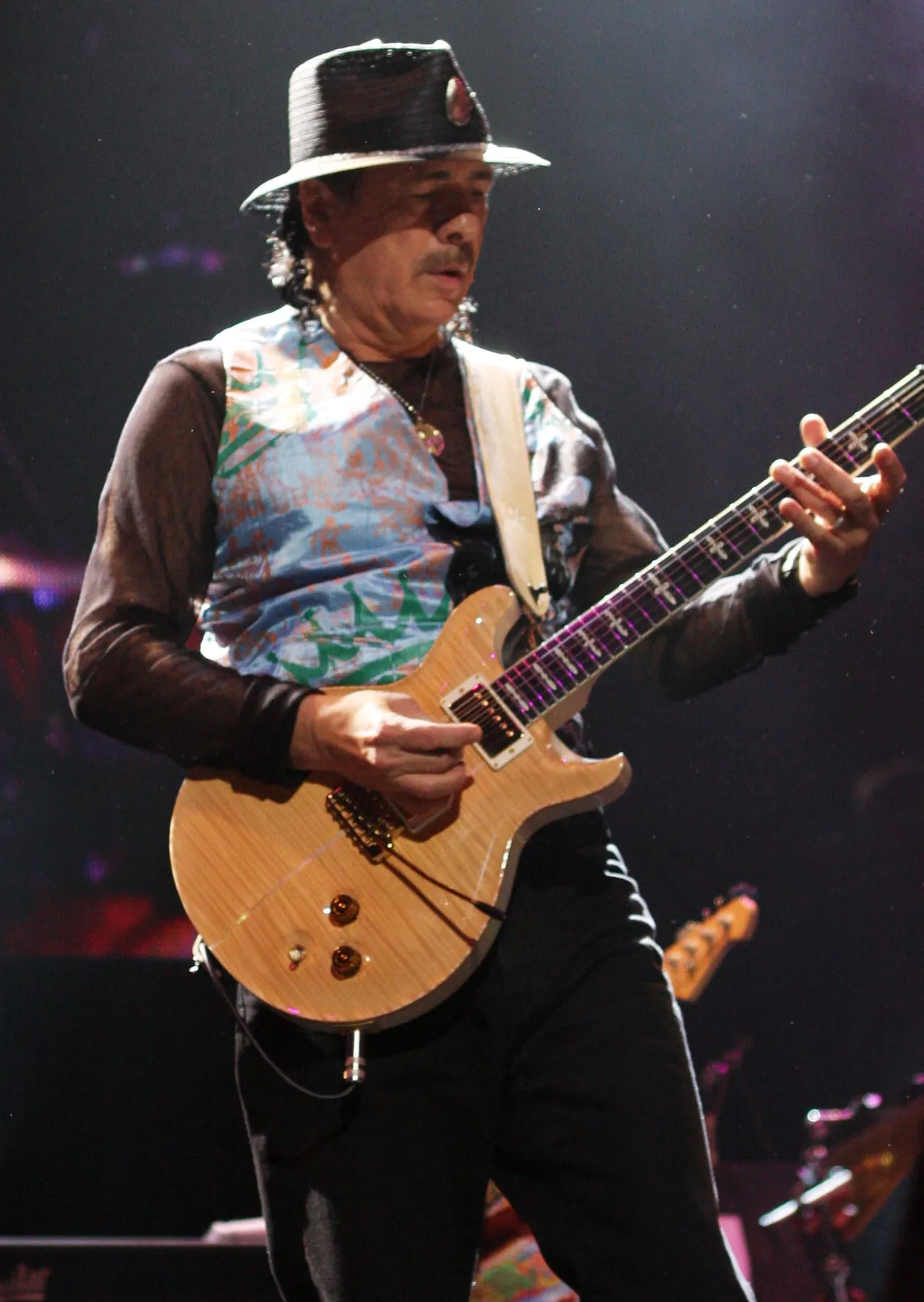
Photo by Eva Rinaldi , licensed under CC BY-SA 2.0 · Wikimedia Commons
Rank #235
Carlos Santana
From Wikipedia
Carlos Humberto Santana Barragán is a Mexican-American guitarist, best known as a founding member of the rock band Santana. Born and raised in Mexico where he developed his musical background, he rose to fame in the late 1960s and early 1970s in the United States with Santana, which pioneered a fusion of rock and roll and Latin American jazz. Its sound featured his melodic, blues-based lines set against Latin American and African rhythms played on percussion instruments not generally heard in rock, such as timbales and congas. He experienced a resurgence of popularity and critical acclaim in the late 1990s.
Discography & Previews
Browse through and click an album to open and play 30-second previews streamed from Apple Music.

Love Devotion Surrender
1973 · 7 tracks
- 1 A Love Supreme (with Mahavishnu Orchestra) ↗ 7:51
- 2 Naima (with Mahavishnu Orchestra) ↗ 3:12
- 3 The Life Divine (with Mahavishnu Orchestra) ↗ 9:29
- 4 Let Us Go Into the House of the Lord (with Mahavishnu Orchestra) ↗ 15:45
- 5 Meditation (with Mahavishnu Orchestra) ↗ 2:45
- 6 A Love Supreme (with Mahavishnu Orchestra) [Alternate - Take 2] ↗ 7:26
- 7 Naima (with Mahavishnu Orchestra) [Alternate - Take 4] ↗ 2:52
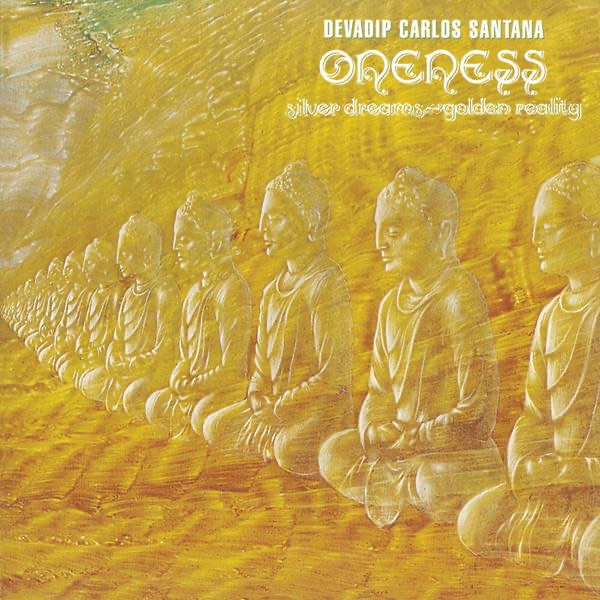
Oneness: Silver Dreams–Golden Reality
1979 · 15 tracks
- 1 The Chosen Hour ↗ 0:35
- 2 Arise Awake ↗ 2:05
- 3 Light Versus Darkness ↗ 0:48
- 4 Jim Jeannie ↗ 3:30
- 5 Transformation (Excerpt from Hovhaness' "Mysterious Mountain") ↗ 3:45
- 6 Victory ↗ 1:10
- 7 Silver Dreams Golden Smiles ↗ 4:09
- 8 Cry of the Wilderness ↗ 3:11
- 9 Guru's Song ↗ 3:06
- 10 Oneness ↗ 6:22
- 11 Life Is Just a Passing Parade ↗ 5:15
- 12 Golden Dawn ↗ 2:17
- 13 Free As the Morning Sun ↗ 3:16
- 14 I Am Free (Excerpt from the Soul-Bird) ↗ 1:27
- 15 Song for Devadip ↗ 5:03


-
 Love Devotion SurrenderCarlos Santana19737 tracks
 -
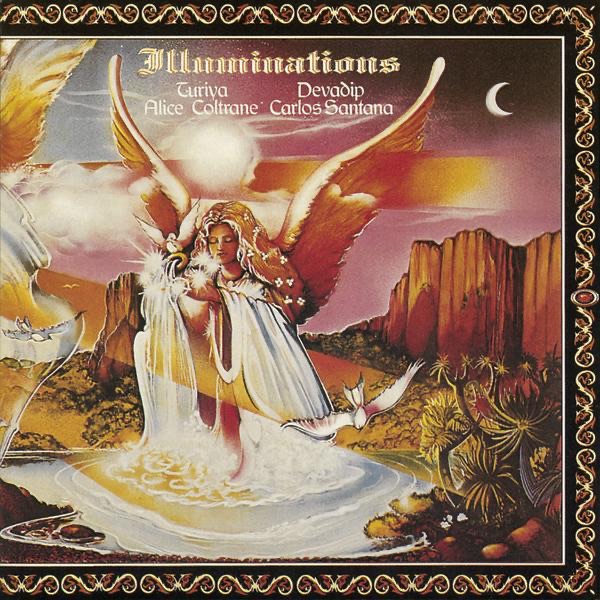
 IlluminationsCarlos Santana19745 tracks
 -
 Oneness: Silver Dreams–Golden RealityCarlos Santana197915 tracks
 -
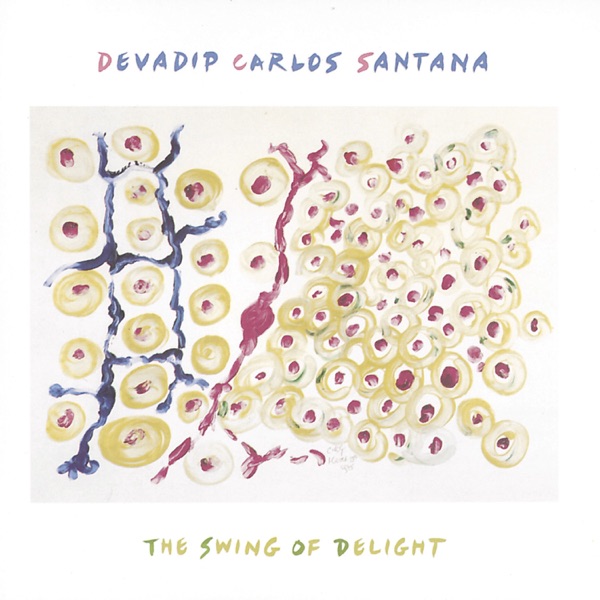
 The Swing of DelightCarlos Santana19809 tracks
 -
 Havana MoonCarlos Santana198311 tracks
 -
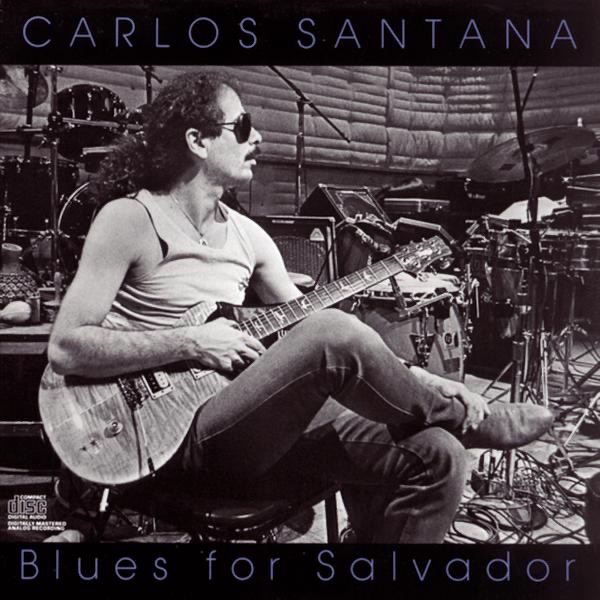
 Blues for SalvadorCarlos Santana19879 tracks
 -
 Santana BrothersCarlos Santana199411 tracks
Deep Dive
Overview
Carlos Humberto Santana Barragán stands as one of rock music’s most distinctive voices—a guitarist who fundamentally altered the sonic landscape of rock by grafting Latin American and African rhythmic traditions onto the blues-based rock framework. Born in 1947 and raised in Mexico, Santana emerged in the late 1960s as the founding member and creative force behind the band Santana, which became synonymous with the fusion of rock and roll and Latin American jazz. His fingertip command of melody, harmonic sophistication, and willingness to let percussion instruments—congas, timbales, and bongos—function as equal partners to the guitar redefined what rock music could be. Beyond the band’s monumental success, his solo career spanning decades demonstrates an artist in constant creative conversation with different genres and collaborators.
Formation Story
Santana’s musical journey began in his native Mexico, where he developed his foundational skills and cultural grounding in both traditional Mexican music and the broader Latin American idiom. The family environment was steeped in music; his father was a violinist, and young Carlos absorbed rhythmic and harmonic traditions that would later become his signature. When his family relocated to San Francisco in the early 1960s, Santana found himself at the convergence of two worlds—the blues-rock explosion of California and the rich Latin American community of the Bay Area. This geographic and cultural positioning proved decisive. San Francisco in the mid-to-late 1960s was a crucible of musical experimentation: rock bands were hybridizing folk, blues, and psychedelia, while the city’s Mexican and Central American populations maintained vibrant traditional and popular music traditions. Santana worked his way through local ensembles before co-founding the band Santana with drummer Mike Shrieve and percussionists Mike Carabello and José Areas, positioning the group to synthesize these currents.
Breakthrough Moment
The band Santana’s self-titled debut in 1969 and especially their second album, Abraxas (1970), catalyzed a seismic shift in rock’s commercial and artistic geography. That album yielded the instrumental standard “Black Magic Woman” and the extended percussion showcase “Oye Como Va,” which became touchstones of the nascent Latin rock movement. By the early 1970s, Santana the band had achieved platinum status and festival dominance, but by the mid-1970s, the group had begun to fragment creatively and commercially. It was during this period that Carlos Santana turned increasingly to solo work, both as an outlet for different artistic directions and as a vehicle for spiritual and musical exploration. His 1973 solo debut, Love Devotion Surrender, marked the beginning of a parallel discography that would allow him to pursue fusion, mysticism, and genre-crossing experimentation independent of the band’s commercial imperatives.
Peak Era
The late 1990s witnessed Carlos Santana’s second major breakthrough, independent of the band’s mid-1990s reunions and projects. This period demonstrated that his appeal and creative vitality had not diminished; rather, he had evolved as both a guitarist and a curator of musical vision. His willingness to work across multiple registers—spiritual fusion albums, blues collaborations, pop-inflected sessions—kept him visible and relevant across generations of listeners. The sustained productivity across labels including Columbia Records, Arista Records, and RCA underscored both his commercial viability and his freedom to move between stylistic and institutional frameworks. Solo albums such as Blues for Salvador (1987) and Santana Brothers (1994) positioned him as an artist uninterested in repeating past formulas, instead using his technical mastery and harmonic sophistication to explore new terrain.
Musical Style
Carlos Santana’s guitar voice is immediately recognizable: singing, lyrical phrasing derived from the blues tradition, but deployed over and within Latin polyrhythmic structures that create a perpetual dynamic tension between melody and rhythm section complexity. His tone favors sustain and vibrato, often employed to blur the boundary between legato vocal phrasing and instrumental articulation. Unlike the harder-edged rock guitar heroes of his era, Santana gravitates toward warm, almost vocal tones achieved through tube amplification and restrained aggression. The band and his solo work made deliberate use of congas, timbales, and bongos—instruments that had appeared peripherally in rock music—as rhythmic and textural equals to drums and bass, a move that legitimized world music instrumentation within the rock idiom. His harmonic language synthesizes blues tonality with jazz reharmonization, and his rhythmic conception sits comfortably at the intersection of straight rock meter and the clave and montuno patterns of Cuban music. Over decades, his sound deepened in sophistication but remained rooted in that initial fusion idea: melody and rhythm from different traditions speaking in counterpoint rather than one dominating the other.
Major Albums
Love Devotion Surrender (1973)
Santana’s solo debut established the template for his spiritual and fusion-oriented work, marking a departure from the commercial rock-radio sound of the band’s greatest hits.
Illuminations (1974)
Following quickly on the heels of his debut, this album continued the exploratory trajectory, deepening his engagement with fusion and mystical themes.
Blues for Salvador (1987)
A direct return to blues foundations, this album demonstrated Santana’s enduring connection to the American blues tradition that had always underpinned his Latin fusion approach.
Havana Moon (1983)
An exploration of his Caribbean and Latin American roots, anchoring his sound in the music of Cuba and the broader pan-Latin tradition.
Santana Brothers (1994)
A collaborative effort that brought together Santana with his brother, showcasing the family musical legacy and reinforcing his identity as both solo artist and bandleader.
Signature Songs
- “Black Magic Woman” — The Santana band’s signature instrumental, a Latin rock staple that defined the fusion aesthetic in the early 1970s.
- “Oye Como Va” — An extended percussion showcase demonstrating the integration of congas and timbales as lead melodic voices.
- “Smooth” — A late-1990s crossover moment that reintroduced Santana to a new generation and cemented his comeback trajectory.
- “Soul Sacrifice” — A high-energy Santana composition featuring dynamic interplay between guitar and percussion.
Influence on Rock
Carlos Santana’s integration of Latin American percussion and rhythmic concepts into rock music expanded the genre’s sonic and cultural boundaries in ways that persist to the present. Before Santana, such instrumentation existed on the margins of rock; after his breakthrough, congas and timbales became legitimate components of the rock toolkit. His success opened pathways for world-music fusion as a commercially viable and artistically serious avenue within rock, influencing subsequent generations of guitarists and bandleaders to pursue cross-cultural synthesis. His emphasis on melody and restraint—playing fewer notes with greater intention—offered an alternative model to the speed-and-technical-display ethos that dominated 1970s rock guitar. Beyond the technical realm, Santana’s spiritual orientation and openness to exploring different musical traditions without subordinating them to Western rock convention helped legitimize a broader pluralism within rock discourse.
Legacy
Carlos Santana’s career, spanning from the late 1960s to the present, documents the full arc of rock’s expansion and global consciousness. He remains one of rock’s best-selling artists, with both the band and his solo work maintaining substantial streaming presence and catalog vitality across platforms. His impact extends beyond chart performance to the permanent alteration of what sounds and instruments qualify as “rock.” The Grammy Awards and other institutions have recognized his technical mastery and cultural significance repeatedly. Most importantly, his work—both within Santana the band and across his diverse solo albums—demonstrates that fusion need not be dilution, that tradition-respecting innovation can resonate across decades, and that a guitarist can remain vital and creatively engaged across a career spanning fifty years and counting.
Fun Facts
- Santana’s father was a trained violinist in Mexico, establishing a classical and folkloric musical foundation that distinguished Carlos’s approach from other blues-rock guitarists of his era.
- The band Santana’s triumphant performance at the Monterey Pop Festival in 1967 launched the group into national prominence before they had yet released a studio album.
- Carlos Santana has recorded solo albums across multiple decades with different record labels—Columbia, Arista, and RCA—demonstrating his freedom to pursue different artistic directions without being locked into a single institutional framework.