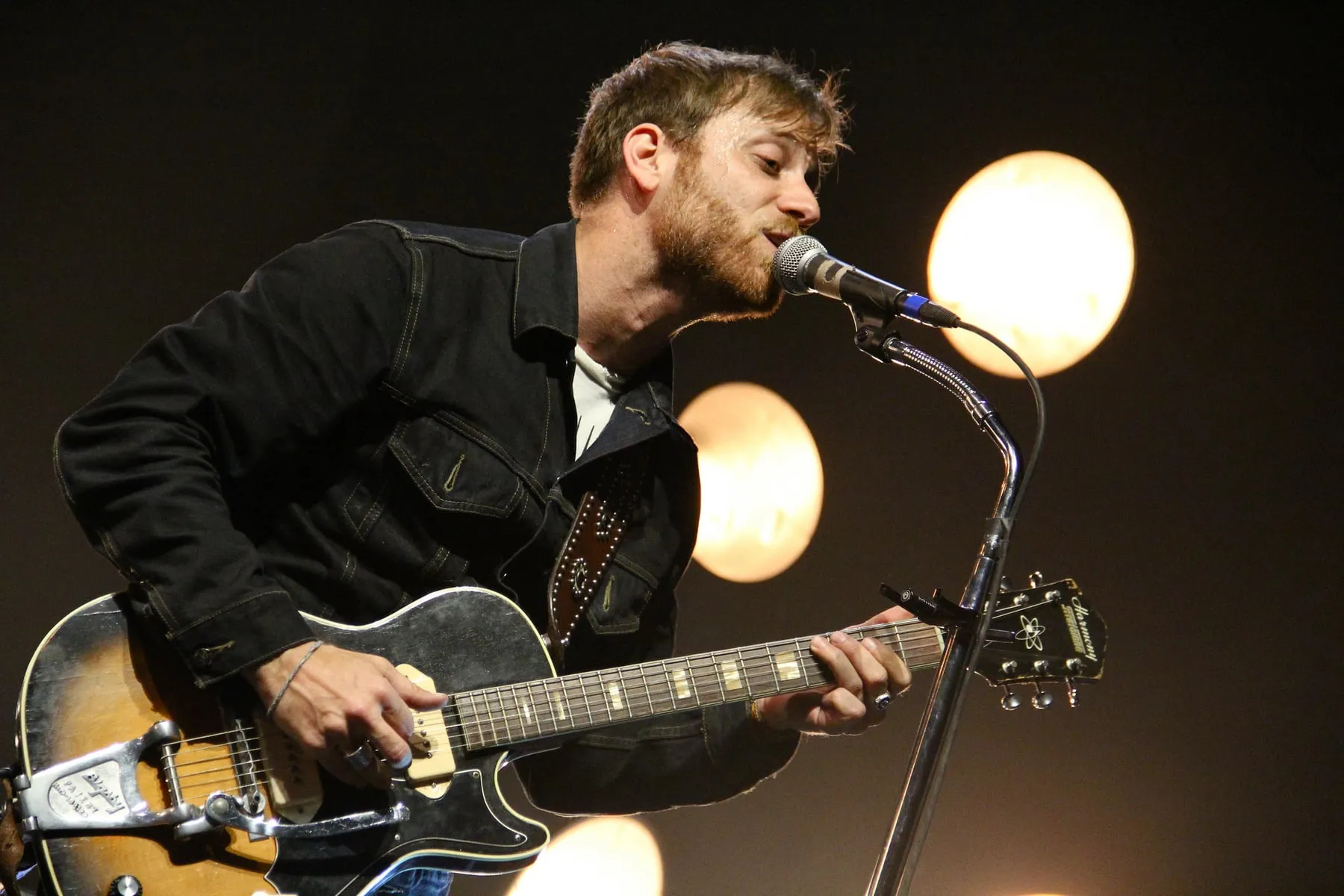
Photo by Sxanthony , licensed under CC BY-SA 3.0 · Wikimedia Commons
Rank #289
Dan Auerbach
From Wikipedia
Daniel Quine Auerbach is an American musician, singer-songwriter, and record producer, best known as the guitarist and vocalist of The Black Keys, an indie rock band from Akron, Ohio. As a member of the group, Auerbach has recorded and co-produced thirteen studio albums with his bandmate Patrick Carney. Auerbach has also released two solo albums, Keep It Hid (2009) and Waiting on a Song (2017), and formed a side project, the Arcs, which released the albums Yours, Dreamily, (2015) and Electrophonic Chronic (2023).
Discography & Previews
Browse through and click an album to open and play 30-second previews streamed from Apple Music.

Keep It Hid
2009 · 14 tracks
- 1 Trouble Weighs A Ton ↗ 2:19
- 2 I Want Some More ↗ 3:49
- 3 Heartbroken, In Disrepair ↗ 3:21
- 4 Because I Should ↗ 0:53
- 5 Whispered Words (Pretty Lies) ↗ 4:06
- 6 Real Desire ↗ 4:26
- 7 When The Night Comes ↗ 4:11
- 8 Mean Monsoon ↗ 3:47
- 9 The Prowl ↗ 3:18
- 10 Keep It Hid ↗ 3:41
- 11 My Last Mistake ↗ 3:14
- 12 When I Left The Room ↗ 4:02
- 13 Street Walkin' ↗ 4:39
- 14 Goin' Home ↗ 4:57

-
 Keep It HidDan Auerbach200914 tracks
 -
 Waiting on a SongDan Auerbach201710 tracks
Deep Dive
Overview
Dan Auerbach is an American guitarist, vocalist, and record producer best known as the creative engine behind The Black Keys, one of the defining garage rock acts of the 21st century. Born Daniel Quine Auerbach, he emerged from Akron, Ohio, a city with deep roots in industrial and working-class rock music. Auerbach’s career spans dual tracks: his prolific work within The Black Keys—where he has recorded and co-produced thirteen studio albums alongside bandmate Patrick Carney—and a parallel pursuit of solo recording and side-project work that has allowed him to explore different sonic territories and production approaches.
Formation Story
Auerbach was born in 1979 in Akron, Ohio, a rust-belt city that had produced notable rock acts and a gritty, blues-inflected musical culture. Growing up in this Midwestern industrial environment, Auerbach gravitated toward guitar and the raw, minimalist ethos of garage rock and blues. His early musical formation was shaped by the sounds of the 1960s garage era and the blues tradition, influences that would remain central to his approach throughout his career. In the early 2000s, Auerbach connected with Patrick Carney, and together they would form The Black Keys, a band that synthesized these foundational influences into a modern garage rock sound that drew heavily on Detroit’s Motown and proto-punk lineages.
Breakthrough Moment
Auerbach’s broader recognition came through The Black Keys rather than as a solo artist initially. The band’s early releases on small labels built a devoted following in the indie rock underground, and by the mid-2000s they had begun to attract mainstream attention. Their trajectory accelerated significantly, establishing them as one of the most commercially successful and critically respected acts in contemporary garage rock. This foundational success as a bandleader and co-producer gave Auerbach the credibility and platform to branch into solo work and other projects, though his primary identity remained rooted in The Black Keys’ output.
Peak Era
Auerbach’s most creatively and commercially significant period spans the 2000s through the 2010s, the era in which The Black Keys released their most acclaimed albums and achieved their widest reach. During this same period, Auerbach also maintained his solo career and engaged in side projects, demonstrating his versatility as a musician and producer. His ability to balance a major band commitment with independent artistic exploration underscored his restless creative energy and deep engagement with the production process.
Musical Style
Auerbach’s sonic signature is built on a foundation of garage rock minimalism and blues tradition. As a guitarist and vocalist, he favors rawness over polish—his tone is often driven through distortion and analog equipment, producing a warm but textured sound that sits somewhere between the Detroit garage sound of the 1960s and the blues-rock lineage of the 1970s. His vocal delivery is conversational and bluesy, without the operatic reach of traditional rock singers; instead, he emphasizes melody and phrasing over vocal range. In his production work, both within The Black Keys and on his own projects, Auerbach has demonstrated a preference for analog recording methods and a careful attention to arrangement, often stripping songs down to their essential elements—drums, bass, guitar, and voice—rather than layering multiple textures. His songwriting tends toward lean, hook-driven compositions that derive their power from repetition and groove rather than structural complexity.
Major Albums
Keep It Hid (2009)
Auerbach’s debut solo album, recorded and released on his own Easy Eye Sound label, presented a more introspective and deliberately paced version of his musical voice compared to The Black Keys’ output. The album established his credibility as a solo artist and producer working independently.
Waiting on a Song (2017)
Auerbach’s second solo album came eight years after his debut, further cementing his identity as both a songwriter in his own right and a curator of his own sound. The album demonstrated his evolution as a musician and his commitment to the solo project as a complementary venture to his primary band work.
Signature Songs
- “Keep It Hid” — The title track and opening statement of his solo debut, establishing his signature minimalist approach.
- Songs from The Black Keys catalog including compositions where Auerbach’s guitar work and vocal performance define the band’s identity.
Influence on Rock
Auerbach’s influence operates primarily through The Black Keys, but his solo and production work has contributed to a broader resurgence of interest in analog recording, garage rock aesthetics, and blues-rooted guitar music in the 21st century. His work as a producer—notably through Easy Eye Sound, his own label—has extended his influence beyond his own recordings, helping to shape the sound of contemporary garage and blues-influenced rock. The Black Keys’ success demonstrated that minimalist, two-piece rock configurations could achieve commercial and critical success without conforming to the production styles or genre boundaries of mainstream rock. This opened pathways for other stripped-down acts and helped validate a return to blues-based, guitar-driven rock after decades in which production-heavy and genre-blended approaches dominated mainstream rock radio.
Legacy
Auerbach’s legacy is inseparable from The Black Keys’ place in contemporary rock history, but his solo work and production activities have expanded his footprint. Through Easy Eye Sound and his production credits, Auerbach has positioned himself as a guardian of analog recording practices and a curator of blues-influenced rock at a moment when such work might otherwise fade from the mainstream. His career demonstrates the viability of parallel creative identities—the bandleader and the solo artist, the performer and the producer—and his commitment to both roles has sustained his relevance across multiple decades and musical contexts. As streaming and digital music have come to dominate consumption, Auerbach has remained devoted to physical formats and vinyl, underscoring his philosophy that the medium shapes the art.
Fun Facts
- Auerbach founded Easy Eye Sound, his own record label, which has served as both a vehicle for his solo and side-project work and as a platform for other artists aligned with his sonic philosophy.
- He formed a side project called the Arcs, which released Yours, Dreamily (2015) and Electrophonic Chronic (2023), allowing him to explore collaborations and sonic directions distinct from The Black Keys.
- Despite achieving mainstream success with The Black Keys, Auerbach has maintained a preference for analog recording techniques and small-scale production methods, resisting the technological trends toward digital recording that have dominated the industry since the 2000s.