
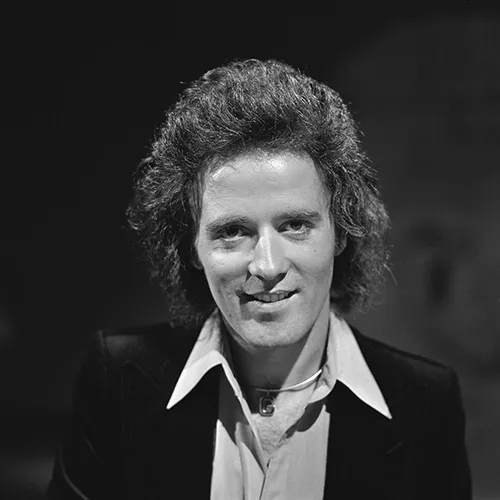
Photo by AVRO , licensed under CC BY-SA 3.0 nl · Wikimedia Commons
Rank #393
Gilbert O'Sullivan
From Wikipedia
Raymond Edward O'Sullivan, known professionally as Gilbert O'Sullivan, is an Irish singer-songwriter who achieved his most significant success during the early 1970s with hits including "Alone Again (Naturally)", "Clair" and "Get Down". His songs are often marked by his distinctive percussive piano playing style and observational lyrics using word play.
Discography & Previews
Browse through and click an album to open and play 30-second previews streamed from Apple Music.

Himself
1971 · 14 tracks
- 1 Intro ↗ 0:24
- 2 January Git ↗ 3:14
- 3 Bye-Bye ↗ 3:22
- 4 Permissive Twit ↗ 4:10
- 5 Matrimony ↗ 3:19
- 6 Independent Air ↗ 5:08
- 7 Nothing Rhymed ↗ 3:27
- 8 Too Much Attention ↗ 2:39
- 9 Susan Van Heusen ↗ 2:59
- 10 If I Don't Get You (Back Again) ↗ 2:44
- 11 Thunder and Lightning ↗ 2:59
- 12 Houdini Said ↗ 5:24
- 13 Doing the Best I Can ↗ 2:35
- 14 Outro ↗ 0:38

Back to Front
1972 · 13 tracks
- 1 Intro / I Hope You'll Stay ↗ 2:49
- 2 In My Hole ↗ 2:46
- 3 Clair ↗ 3:02
- 4 That's Love ↗ 3:02
- 5 Can I Go With You ↗ 2:47
- 6 But I'm Not ↗ 2:34
- 7 I'm In Love With You ↗ 4:25
- 8 Who Was It? ↗ 2:30
- 9 What Could Be Nicer ↗ 3:06
- 10 Out of the Question ↗ 3:02
- 11 The Golden Rule ↗ 2:35
- 12 I'm Leaving / Outro ↗ 3:07
- 13 Alone Again (Naturally) ↗ 3:40

I'm a Writer, Not a Fighter
1973 · 14 tracks
- 1 I'm a Writer, Not a Fighter ↗ 3:18
- 2 A Friend of Mine ↗ 3:23
- 3 They've Only Themselves to Blame ↗ 2:45
- 4 Who Knows, Perhaps Maybe ↗ 3:14
- 5 Where Peaceful Waters Flow ↗ 4:16
- 6 Ooh Baby ↗ 3:45
- 7 I Have Never Loved You as Much as I Love You Today ↗ 2:33
- 8 Not In a Million Years ↗ 3:01
- 9 If You Love Me Like You Love Me ↗ 3:18
- 10 Get Down ↗ 2:45
- 11 A Very Extraordinary Sort of Girl ↗ 2:20
- 12 Good Company ↗ 2:49
- 13 Why Oh Why Oh Why ↗ 3:53
- 14 You Don't Have to Tell Me ↗ 3:15

A Stranger in My Own Back Yard
1974 · 15 tracks
- 1 Number 4 ↗ 1:25
- 2 A Woman's Place ↗ 3:17
- 3 No More ↗ 2:26
- 4 It's so Easy to Be Sad ↗ 4:42
- 5 My Father ↗ 2:43
- 6 The Marriage Machine ↗ 3:28
- 7 If You Ever ↗ 2:33
- 8 The Thing Is ↗ 4:01
- 9 Just Like Me ↗ 3:04
- 10 Victor E ↗ 2:46
- 11 I Wonder Would You Mind ↗ 2:19
- 12 15 Times ↗ 2:21
- 13 Nothing to Do About Much ↗ 3:27
- 14 Can't Get You to Love Me ↗ 2:25
- 15 Always Somebody ↗ 0:53

Southpaw
1977 · 12 tracks
- 1 Intro ↗ 0:47
- 2 You Got Me Going ↗ 2:39
- 3 No Telling Why ↗ 3:36
- 4 Tomorrow Today ↗ 3:12
- 5 The Best Fun I Ever Had ↗ 3:33
- 6 I Remember Once ↗ 5:15
- 7 Intro (Side Two) ↗ 0:23
- 8 I, of Course, Replied ↗ 2:42
- 9 That's Where I Belong ↗ 3:33
- 10 My Love and I ↗ 3:22
- 11 If I Can't Have You All to Myself ↗ 3:04
- 12 Miss My Love Today ↗ 3:56

In the Key of G.
1989 · 14 tracks
- 1 Lost a Friend ↗ 3:06
- 2 At the Very Mention of Your Name ↗ 5:25
- 3 What Am I Doing Here with You ↗ 4:09
- 4 If I Start with the Chorus ↗ 2:39
- 5 So What ↗ 4:18
- 6 The Way Things Used to Be ↗ 4:43
- 7 I Don't Trust Men with Earrings in Their Ears ↗ 4:01
- 8 Gordon Bennett ↗ 4:46
- 9 To the Extreme ↗ 3:40
- 10 Stick in the Mud ↗ 3:39
- 11 I Have My Coat to Keep Me Warm ↗ 3:30
- 12 Forever Wondering ↗ 3:55
- 13 At the Very Mention of Your Name (Single Version) ↗ 4:48
- 14 In a Nutshell ↗ 2:52

By Larry
1994 · 16 tracks
- 1 That's ↗ 2:35
- 2 When to Today ↗ 1:51
- 3 Shy ↗ 3:14
- 4 That's Why I Love You ↗ 2:47
- 5 My Advice to You ↗ 2:49
- 6 Hold On to What You Got ↗ 2:51
- 7 Came to See Me Yesterday (In the Merry Month Of) ↗ 2:35
- 8 Mr and Mrs Regards ↗ 2:14
- 9 It Ain't for Me ↗ 2:03
- 10 I Don't Mind ↗ 2:21
- 11 As a Rule ↗ 2:47
- 12 My Front Door Is ↗ 2:31
- 13 Because of You ↗ 2:30
- 14 The Window Cleaner's Mate ↗ 1:47
- 15 What Am I Doing Here with You? ↗ 2:49
- 16 What You See Is What You Get ↗ 2:29

Sounds of the Loop
1996 · 14 tracks
- 1 Are You Happy? ↗ 3:30
- 2 Not That It Bothers Me ↗ 3:17
- 3 Sometimes ↗ 4:08
- 4 It's Easy to See When You're Blind ↗ 4:01
- 5 Having Said That ↗ 4:00
- 6 Can't Think Straight (Duet with Peggy Lee) ↗ 4:05
- 7 The Best Love I Never Had ↗ 3:42
- 8 Divorce Irish Style ↗ 4:14
- 9 Came and Went ↗ 3:45
- 10 I'm Not Too Young ↗ 4:06
- 11 I Can Give You ↗ 3:41
- 12 Can't Think Straight ↗ 4:05
- 13 Can't Think Straight ↗ 4:06
- 14 What a Way (To Show I Love You) ↗ 4:13

Singer Sowing Machine
1997 · 14 tracks
- 1 Heavens Above ↗ 5:23
- 2 In Bed By Ten ↗ 4:27
- 3 Sex Appeal ↗ 4:44
- 4 You Better Believe It ↗ 5:49
- 5 Please Don't Let My Weakness Show ↗ 4:48
- 6 I'll Be the Lonely One ↗ 2:17
- 7 Con-Lab-Lib ↗ 3:26
- 8 Doesn't It Make You Sick (Mortar and Brick) ↗ 3:33
- 9 Not so Great Britain ↗ 5:16
- 10 I Don't Care ↗ 3:30
- 11 I'm About ↗ 3:50
- 12 Break a Leg ↗ 4:13
- 13 Say Ireland ↗ 3:55
- 14 An End ↗ 0:15

Irlish
2000 · 14 tracks
- 1 Have It ↗ 3:52
- 2 A Sight for Sore Eyes ↗ 3:40
- 3 Where the Hell Have You Been ↗ 4:30
- 4 Me ↗ 4:28
- 5 Say Goodbye ↗ 3:56
- 6 Don't I Know It ↗ 3:22
- 7 How I Say That I Love You ↗ 3:19
- 8 Passport Photos ↗ 3:24
- 9 Water Music ↗ 3:59
- 10 Fine By Me ↗ 2:51
- 11 Two’s Company (Three Is Allowed) ↗ 3:40
- 12 Love Being Faxed By You ↗ 3:48
- 13 Easier Said Than Done ↗ 3:15
- 14 Me (Reprise) ↗ 1:26

The Best Of
2001 · 67 tracks
- 1 Get Down ↗ 2:40
- 2 Matrimony (2017 Remaster) ↗ 3:12
- 3 No Way ↗ 3:15
- 4 Ooh-Wakka-Doo-Wakka-Day ↗ 2:45
- 5 Too Much Attention (2017 Remaster) ↗ 2:30
- 6 Ooh Baby ↗ 3:40
- 7 You Got Me Going ↗ 2:37
- 8 I Don’t Love You, But I Think I Like You ↗ 3:08
- 9 Stick in the Mud ↗ 3:29
- 10 Thunder and Lightning (2017 Remaster) ↗ 2:57
- 11 Call On Me ↗ 3:07
- 12 Where Did You Go To? ↗ 3:28
- 13 A Friend of Mine ↗ 3:17
- 14 Doing What I Know ↗ 4:41
- 15 Victor E ↗ 2:46
- 16 Let Me Know ↗ 2:54
- 17 Take Love (feat. KT Tunstall) ↗ 3:06
- 18 Never Say Di ↗ 3:45
- 19 So What ↗ 4:09
- 20 Doesn't It Make You Sick (Mortar and Brick) ↗ 3:22
- 21 Hablando del Rey de Roma ↗ 4:06
- 22 Say Goodbye ↗ 3:54
- 23 Get Down (Remix) ↗ 1:47
- 24 Alone Again (Naturally) ↗ 3:37
- 25 Nothing Rhymed (2017 Remaster) ↗ 3:21
- 26 Out of the Question ↗ 2:55
- 27 Why Oh Why Oh Why ↗ 3:48
- 28 Miss My Love Today ↗ 3:45
- 29 Lost a Friend ↗ 3:00
- 30 Dear Dream ↗ 3:12
- 31 I Wish I Could Cry ↗ 3:32
- 32 A Minute of Your Time ↗ 3:35
- 33 I'll Never Love Again ↗ 3:31
- 34 Houdini Said (2017 Remaster) ↗ 5:18
- 35 Answers on a Postcard (Please) ↗ 3:31
- 36 Break It to Me Gently ↗ 3:16
- 37 What’s It All Supposed to Mean? ↗ 3:56
- 38 All They Wanted to Say ↗ 4:02
- 39 Let Bygones Be Bygones (feat. Mick Hucknall) ↗ 3:13
- 40 Tomorrow Today ↗ 3:10
- 41 Because of You ↗ 2:22
- 42 You Don't Have to Tell Me ↗ 3:12
- 43 Parrish ↗ 2:50
- 44 Where Would We Be (Without Tea) ↗ 3:11
- 45 One Door Closes ↗ 3:20
- 46 What's In a Kiss? ↗ 2:34
- 47 Clair ↗ 3:00
- 48 No Matter How I Try ↗ 2:59
- 49 Who Was It? ↗ 2:25
- 50 We Will ↗ 3:53
- 51 That's Love ↗ 2:59
- 52 Can I Go With You ↗ 2:42
- 53 I Hope You'll Stay ↗ 2:24
- 54 You Are You ↗ 3:16
- 55 Can't Think Straight (Duet with Peggy Lee) ↗ 4:01
- 56 Taking a Chance On Love ↗ 3:21
- 57 Can’t Get Enough of You ↗ 3:32
- 58 Missing You Already ↗ 3:55
- 59 Happiness Is Me and You ↗ 3:06
- 60 The Niceness of It All ↗ 5:47
- 61 I Guess I’ll Always Love You ↗ 3:35
- 62 That’s the Kind of Love I Need ↗ 4:47
- 63 At the Very Mention of Your Name (Single Version) ↗ 4:41
- 64 Young at Heart (We'll Always Remain) ↗ 4:56
- 65 The Marriage Machine ↗ 3:24
- 66 That's Why I Love You ↗ 2:41
- 67 Christmas Song (I'm Not Dreaming of a White Christmas) ↗ 2:43

Piano Foreplay
2003 · 13 tracks
- 1 It Never Rains But It Pours ↗ 4:28
- 2 Barking Up the Wrong Tree (Such Is Life) ↗ 4:02
- 3 Make My Day ↗ 3:03
- 4 God Forbid ↗ 3:14
- 5 Conversation with the Flying Plates ↗ 4:34
- 6 I Gave Mine to You ↗ 3:14
- 7 A Love So ↗ 2:51
- 8 You Me and the Garden Post ↗ 4:14
- 9 Parrish ↗ 2:52
- 10 What’s It All Supposed to Mean? ↗ 4:00
- 11 Answers on a Postcard (Please) ↗ 3:34
- 12 Will I Do? ↗ 3:03
- 13 World of Work ↗ 3:59

A Scruff at Heart
2006 · 14 tracks
- 1 Take Your Foot Off My Toe ↗ 4:24
- 2 A Proper Fool ↗ 3:19
- 3 My Place or Yours ↗ 3:49
- 4 Don't Let It Get to You ↗ 3:22
- 5 You Can't Con-crete ↗ 3:12
- 6 Taking Sides ↗ 3:11
- 7 I'm in Love With Love (Again) ↗ 3:40
- 8 Force of Habit ↗ 2:31
- 9 One Door Closes ↗ 3:23
- 10 Just so You Know ↗ 3:53
- 11 Let's Not Go There ↗ 3:46
- 12 Can't Say Fairer Than That ↗ 2:48
- 13 Love You Out of Trouble ↗ 3:01
- 14 Know What, You're Right ↗ 3:55

Gilbertville
2011 · 15 tracks
- 1 Can I Leave the Rest Up To You ↗ 3:30
- 2 Missing You Already ↗ 3:55
- 3 Here's Why (feat. Hayley Sanderson) ↗ 3:38
- 4 All They Wanted to Say ↗ 4:05
- 5 One Drink Too Many (Too Few) ↗ 3:30
- 6 The Allergy Song ↗ 3:25
- 7 Where Would We Be (Without Tea) ↗ 3:11
- 8 Interlude (Poem Read by Harry Hill) [feat. Harry Hill] ↗ 1:01
- 9 I Wanna Know ↗ 4:02
- 10 Down Down Here ↗ 3:22
- 11 Private Eye ↗ 3:05
- 12 I Wish Something Good ↗ 3:22
- 13 Could Have Made It with You ↗ 2:44
- 14 Talking of Murder ↗ 4:21
- 15 School Meals (Bonus Track) ↗ 3:55

Latin ala G!
2015 · 12 tracks
- 1 Made in Love ↗ 3:25
- 2 I Guess I'll Always Love You ↗ 4:17
- 3 Hell No ↗ 4:09
- 4 If You Want Me To ↗ 3:51
- 5 That's the Kind of Love I Need ↗ 4:56
- 6 Let's See ↗ 3:25
- 7 Hablando del Rey de Roma ↗ 4:09
- 8 No Way ↗ 3:56
- 9 Love I You ↗ 3:12
- 10 You Heard ↗ 3:38
- 11 Speaking of Which ↗ 3:11
- 12 Singapore ↗ 2:41

Gilbert O’Sullivan
2018 · 12 tracks
- 1 At the End of the Day ↗ 3:11
- 2 The Same the Whole World Over ↗ 3:16
- 3 Love How You Leave Me ↗ 2:51
- 4 What Is It About My Girl ↗ 3:40
- 5 I'll Never Love Again ↗ 3:35
- 6 Where Did You Go To? ↗ 3:35
- 7 Dansette Dreams and 45's ↗ 5:52
- 8 No Head for Figures but Yours ↗ 2:45
- 9 Penny Drops ↗ 2:43
- 10 This Riff ↗ 2:49
- 11 The Mind Boggles ↗ 3:39
- 12 For the Record ↗ 2:39

Driven
2022 · 13 tracks
- 1 Love Casualty ↗ 3:45
- 2 Blue Anchor Bay ↗ 3:42
- 3 Let Bygones Be Bygones (feat. Mick Hucknall) ↗ 3:19
- 4 Body and Mind ↗ 3:48
- 5 What Are You Waiting For? ↗ 3:18
- 6 Let Me Know ↗ 2:57
- 7 Take Love (feat. KT Tunstall) ↗ 3:11
- 8 Back and Forth ↗ 3:42
- 9 If Only Love Had Ears ↗ 3:50
- 10 You Can't Say I Didn't Try ↗ 3:19
- 11 You and Me Babe ↗ 3:25
- 12 Hey Man ↗ 3:01
- 13 Don't Get Under Each Other's Skin ↗ 2:52
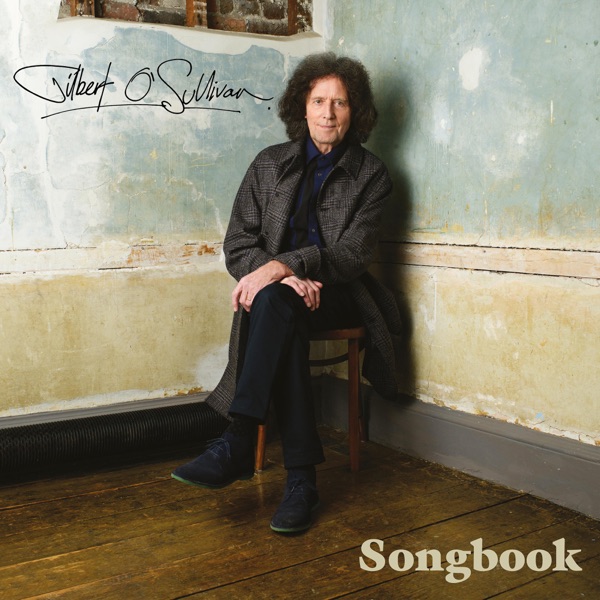
Songbook
2024 · 12 tracks
- 1 Nothing Rhymed (Songbook Version) ↗ 3:08
- 2 Clair (Songbook Version) ↗ 2:47
- 3 We Will (Songbook Version) ↗ 3:35
- 4 Blue Anchor Bay (Songbook Version) ↗ 3:36
- 5 Happiness Is Me and You (Songbook Version) ↗ 3:45
- 6 Alone Again (Naturally) [Songbook Version] ↗ 3:33
- 7 What's in a Kiss (Songbook Version) ↗ 2:32
- 8 I'll Never Love Again (Songbook Version) ↗ 3:49
- 9 Why Oh Why Oh Why (Songbook Version) ↗ 3:33
- 10 No Matter How I Try (Songbook Version) ↗ 2:57
- 11 Dansette Dreams and 45s (Songbook Version) ↗ 5:46
- 12 A Kiss Is a Kiss ↗ 2:39
-
 HimselfGilbert O'Sullivan197114 tracks
 -
 Back to FrontGilbert O'Sullivan197213 tracks
 -
 I'm a Writer, Not a FighterGilbert O'Sullivan197314 tracks
 -
 A Stranger in My Own Back YardGilbert O'Sullivan197415 tracks
 -
 SouthpawGilbert O'Sullivan197712 tracks
 -
 In the Key of G.Gilbert O'Sullivan198914 tracks
 -
 By LarryGilbert O'Sullivan199416 tracks
 -
 Sounds of the LoopGilbert O'Sullivan199614 tracks
 -
 Singer Sowing MachineGilbert O'Sullivan199714 tracks
 -
 IrlishGilbert O'Sullivan200014 tracks
 -
 The Best OfGilbert O'Sullivan200167 tracks
 -
 Piano ForeplayGilbert O'Sullivan200313 tracks
 -
 A Scruff at HeartGilbert O'Sullivan200614 tracks
 -
 GilbertvilleGilbert O'Sullivan201115 tracks
 -
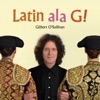 Latin ala G!Gilbert O'Sullivan201512 tracks
 -
 Gilbert O’SullivanGilbert O'Sullivan201812 tracks
 -
 DrivenGilbert O'Sullivan202213 tracks
 -
 SongbookGilbert O'Sullivan202412 tracks
Deep Dive
Overview
Gilbert O’Sullivan is an Irish singer-songwriter born in 1946 who emerged as a major commercial and artistic force in the early 1970s. Known professionally by his stage name since the start of his recording career, O’Sullivan crafted a distinctive body of work anchored by observational, wordplay-heavy lyrics and an equally signature approach to percussive piano playing. His hits “Alone Again (Naturally),” “Clair,” and “Get Down” established him as one of the era’s most recognizable voices in soft rock and pop, and his prolific output—spanning more than five decades from his 1971 debut through the 2020s—has sustained a devoted international following.
Formation Story
Raymond Edward O’Sullivan grew up in Ireland during the post-war era, absorbing the musical traditions of his native country while developing an early affinity for piano. By the late 1960s, as singer-songwriter models proliferated in folk and rock music, O’Sullivan found his own idiom: a pop-oriented vehicle for clever, character-driven narratives delivered with harmonic sophistication and rhythmic precision at the piano. He began recording in the early 1970s, quickly signing to MAM Records, an independent label that proved instrumental in launching his chart breakthrough. His approach—self-contained at the keyboard, lyrical rather than bombastic—set him apart from the louder rock orthodoxy of the time and positioned him as a serious artist rather than a manufactured pop confection.
Breakthrough Moment
O’Sullivan’s breakthrough came swiftly after his debut album Himself in 1971. The follow-up, Back to Front (1972), yielded “Alone Again (Naturally),” a melancholic yet intricately structured pop song that climbed international charts and became his signature piece. The track’s success established O’Sullivan as a distinctive voice in early-1970s pop and proved there was substantial audience appetite for his brand of cerebral, piano-driven songwriting. “Clair” and “Get Down” consolidated his commercial position, confirming that his early-70s moment represented genuine artistic momentum rather than a one-hit phenomenon.
Peak Era
The years 1971 to 1974 constitute O’Sullivan’s peak creative and commercial period. During this run, he released Himself, Back to Front, I’m a Writer, Not a Fighter (1973), and A Stranger in My Own Back Yard (1974)—four albums in four years that captured the public imagination while showcasing his evolution as both a lyricist and an arranger. The observational humor and emotional specificity of his songwriting found maximum resonance during this window, and his percussive, almost rhythmic approach to piano accompaniment became more refined and varied with each release. By the mid-1970s, though mainstream radio attention began to recede, O’Sullivan had established himself as a credible and enduring recording artist with a distinctive voice that transcended ephemeral chart cycles.
Musical Style
O’Sullivan’s sound is defined by his command of the piano as both a melodic and percussive instrument. Rather than employing it as a lush, orchestral backdrop, he treats the keyboard as the principal voice—driving rhythm, establishing harmony, and carrying the weight of arrangement. This approach places him in the soft-rock and piano-pop lineage but with a harder edge and more disciplined compositional framework than many contemporaries. His vocals, delivered in a measured, often understated manner, prioritize lyrical clarity and narrative delivery; the songs frequently employ clever wordplay, observational humor, and character sketches that demand close listening. The production across his early-1970s work is clean and relatively sparse, allowing the piano and vocals to dominate. Over subsequent decades, O’Sullivan has experimented with different instrumental textures and production styles, but the piano-centric approach and lyrical specificity remain constants.
Major Albums
Himself (1971)
O’Sullivan’s debut established the template for his career: piano-driven arrangements, observational lyrics, and a warm but unsentimental vocal delivery that prioritized storytelling.
Back to Front (1972)
The album containing “Alone Again (Naturally),” which became his signature song and international hit, securing his place in early-1970s pop history.
I’m a Writer, Not a Fighter (1973)
Reflecting the album’s title, O’Sullivan doubled down on lyrical sophistication and narrative complexity, further refining his trademark observational style.
A Stranger in My Own Back Yard (1974)
The final album of his initial peak period, demonstrating the breadth and maturity he had achieved in four years of intense recording activity.
Signature Songs
- “Alone Again (Naturally)” — His breakthrough hit and most enduring composition, a structurally complex pop song that marries melancholy lyrics with infectious melody.
- “Clair” — A whimsical, wordplay-heavy piece showcasing O’Sullivan’s gift for clever observational humor within a accessible pop framework.
- “Get Down” — An uptempo showcase for his rhythmic piano playing and rhythmic vocal delivery.
- “Matrimonial Ties” — A track reflecting O’Sullivan’s fascination with character-driven narrative and domestic observation.
Influence on Rock
While O’Sullivan occupies a narrower commercial footprint than some of his 1970s contemporaries, his influence on the lineage of piano-based pop and soft rock remains significant. His refusal to dilute the piano’s role in favor of guitar-based production anticipated later singer-songwriter trends emphasizing instrumental minimalism and lyrical precision. The observational, wordplay-heavy approach to pop songwriting he pioneered—treating the form as a vehicle for character sketches and subtle humor rather than romantic earnestness—influenced subsequent generations of piano-pop artists. His sustained career output, particularly through the 1980s and beyond, demonstrated that artistic identity and technical consistency could sustain a recording career independent of mainstream chart dominance.
Legacy
Gilbert O’Sullivan’s legacy rests primarily on his early-1970s achievements and the enduring cultural footprint of “Alone Again (Naturally),” which has appeared in numerous film and television contexts and remains familiar across generational and geographical boundaries. His prolific recording activity—evidenced by releases in nearly every decade from the 1970s through the 2020s, including Gilbertville (2011), Latin ala G! (2015), and Driven (2022)—demonstrates his continued engagement with the medium and his refusal to rest on early success. The catalog has sustained interest through streaming and reissue contexts, keeping his early work accessible to contemporary audiences while allowing longtime listeners to track his ongoing evolution. As a distinctly Irish contribution to 1970s Anglo-American pop music, O’Sullivan’s body of work remains a credible testament to the durability of piano-based songwriting and the commercial viability of lyrical intelligence in mainstream popular music.
Fun Facts
- O’Sullivan released The Best of Gilbert O’Sullivan in 1991, then issued another compilation titled The Best Of in 2001, reflecting the multiple phases of catalog reassessment and re-engagement across his career.
- His 1995 release The Best Of Gilbert O’Sullivan: Live In Japan underscores the substantial and enduring popularity of his early work in Asian markets, particularly Japan.
- The album By Larry (1994) and subsequent works demonstrate O’Sullivan’s willingness to explore different production approaches and thematic directions throughout the 1990s and beyond.
- His 2018 self-titled album Gilbert O’Sullivan marked a return to self-identification by name alone, a full circle moment from his early-1970s debut Himself.