
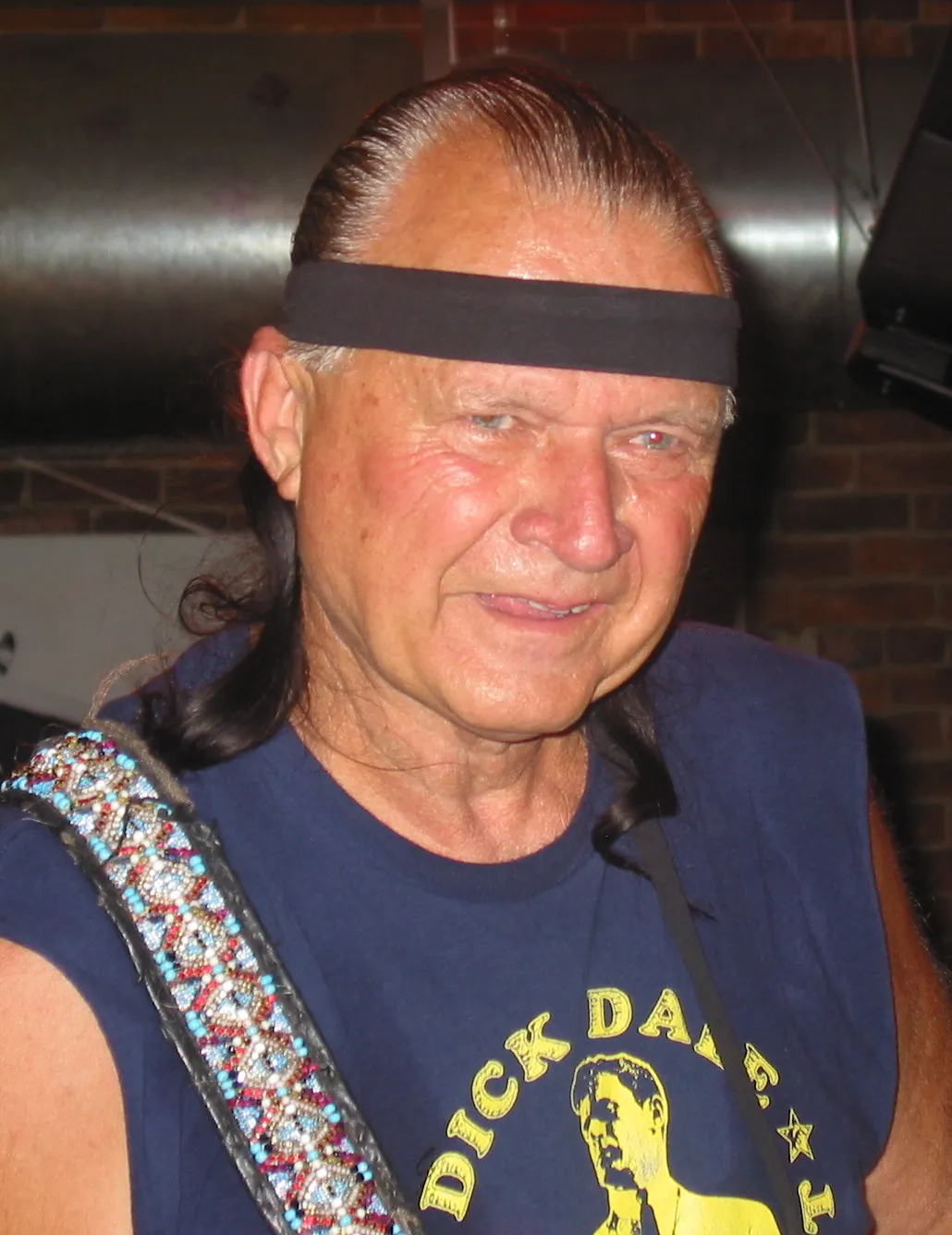
Photo by Eric Frommer from Everett, WA, United States , licensed under CC BY-SA 2.0 · Wikimedia Commons
Rank #480
Dick Dale
From Wikipedia
Richard Anthony Monsour, known professionally as Dick Dale, was an American rock guitarist. He was a pioneer of surf music, drawing on Middle Eastern music scales and experimenting with reverb. Dale was known as "The King of the Surf Guitar," which was also the title of his second studio album.
Discography & Previews
Browse through and click an album to open and play 30-second previews streamed from Apple Music.

Tribal Thunder
1993 · 12 tracks

Unknown Territory
1994 · 13 tracks

Calling Up Spirits
1996 · 13 tracks

Mr Eliminator
2006 · 13 tracks

At the Drags
2012 · 20 tracks
- 1 Wild, Wild Mustang ↗ 1:52
- 2 The Victor ↗ 3:14
- 3 Mag Wheels ↗ 1:52
- 4 Mr. Eliminator ↗ 2:00
- 5 Blond In The 406 ↗ 1:57
- 6 Surf Buggy ↗ 2:06
- 7 Taco Wagon ↗ 2:08
- 8 Nitro Fuel ↗ 2:01
- 9 The Scavenger ↗ 1:53
- 10 Firing Up ↗ 2:36
- 11 Hot Rod Racer ↗ 2:19
- 12 426 Super Stock ↗ 1:51
- 13 Big Black Cad ↗ 1:39
- 14 Ho - Dad Machine ↗ 2:05
- 15 50 Miles to Go ↗ 2:14
- 16 My X - Ke ↗ 1:51
- 17 Hot Rod Alley ↗ 2:12
- 18 Flashing Eyes ↗ 1:46
- 19 Night Rider ↗ 1:46
- 20 The Lonesome Road ↗ 3:15
-
 Tribal ThunderDick Dale199312 tracks
 -
 Unknown TerritoryDick Dale199413 tracks
 -
 Calling Up SpiritsDick Dale199613 tracks
 -
 Mr EliminatorDick Dale200613 tracks
 -
 At the DragsDick Dale201220 tracks
Deep Dive
Overview
Dick Dale, born Richard Anthony Monsour, stands as the foundational figure in surf rock guitar. Emerging in the late 1950s, he transformed the electric guitar into an instrument capable of evoking both the power of ocean waves and the textural complexity of non-Western musical traditions. Dale’s pioneering work with reverb technology and his incorporation of Middle Eastern scales into rock instrumentation established templates that would define not only surf music but broader approaches to effects-driven rock guitar throughout the 1960s and beyond.
Formation Story
Dale was born in Boston in 1937 and grew up in a family steeped in music—his father was a musician himself. The family’s Lebanese heritage exposed young Dale to Middle Eastern melodic and harmonic traditions from an early age, an exposure that would later become central to his musical identity. In his teens, Dale relocated to Southern California, where he encountered the emerging surf culture of the 1950s. The convergence of his Middle Eastern musical vocabulary, his natural affinity for electric guitar, and the visual and sonic energy of the California surf scene created the conditions for his artistic breakthrough. By the late 1950s, Dale had begun performing in the clubs and ballrooms of Orange County, developing the instrumental style that would soon captivate a national audience.
Breakthrough Moment
Dale’s national breakthrough arrived with the release of his second studio album, King of the Surf Guitar, which also became his most enduring professional epithet. The album showcased his distinctive approach: searing guitar lines backed by driving rhythmic arrangements, all processed through the reverb chambers he had pioneered in his live performances. This reverb-drenched sound became inseparable from the visual and cultural mythology of surf rock, even as Dale’s instrumental compositions ranged far beyond simple wave-riding fantasias. His live shows, particularly at Southern California venues, became legendary for their intensity and technical virtuosity, establishing him as the dominant figure in instrumental surf rock during the early 1960s.
Peak Era
The early to mid-1960s represented Dale’s creative and commercial peak. During these years, he recorded extensively for Capitol Records, defining the sonic vocabulary of surf rock at a moment when the genre was achieving mass popularity in the United States. His ability to execute rapid, fluid passages on the electric guitar while maintaining melodic coherence distinguished him from contemporaries. Dale’s use of the Fender Stratocaster—which he pushed to its technical limits—and his partnership with recording engineers who understood his vision of reverb as a compositional element made his studio recordings distinctive. Even as the British Invasion and psychedelic rock shifted popular attention away from instrumental surf music in the mid-1960s, Dale’s recordings remained influential among musicians seeking to expand the expressive range of the electric guitar.
Musical Style
Dale’s sound fused three primary elements: the harmonic and melodic vocabulary of Middle Eastern music, particularly the use of scales and ornamentation drawn from Lebanese and broader Arab traditions; the rhythmic drive and instrumental lineup of rock and roll; and the spatial, echo-laden production techniques enabled by studio reverb technology. His lead lines often moved rapidly across the fretboard, combining rock-oriented phrasing with intervallic leaps and modal inflections drawn from non-Western sources. The reverb processing that defined his sound was not mere decoration but rather a core compositional choice, creating a sense of spatial depth and mystery that became foundational to surf rock aesthetics. Dale’s approach to the electric guitar demonstrated that rock instrumentation could accommodate influences and harmonic languages far outside the blues and country traditions that had initially shaped rock and roll, a principle that would inform experimental rock throughout the subsequent decades.
Major Albums
King of the Surf Guitar (1963)
Dale’s definitive statement and commercial flagship, this album established the sonic template for instrumental surf rock and featured his most celebrated and frequently covered compositions. The album’s success confirmed his status as the genre’s leading figure.
Misirlou (2012)
A late-career exploration of his signature themes, this album revisited the instrumental rock and surf material that had defined his career while incorporating the accumulated experience of decades as a performing musician.
Tribal Thunder (1993)
Recorded for HighTone Records, this album marked a return to recording after an extended absence and demonstrated Dale’s continued investment in instrumental rock composition and innovation.
Calling Up Spirits (1996)
This mid-1990s release showcased Dale’s ongoing commitment to exploring the intersection of reverb-driven guitar work and compositional complexity, maintaining the experimental spirit of his earlier work.
Signature Songs
- “Misirlou” — Dale’s most iconic instrumental, a Middle Eastern-influenced composition that became synonymous with surf rock and featured some of his most celebrated guitar work.
- “Let’s Go Tripendicular” — A high-energy instrumental showcase for Dale’s technical facility and his ability to construct complex, multi-section compositions within the rock idiom.
- “Nitro” — A propulsive instrumental that exemplified Dale’s approach to rhythm and speed in service of melodic clarity and harmonic sophistication.
- “Secret Surfing Spot” — A representative example of Dale’s ability to evoke oceanic imagery through purely instrumental means, combining rapid melodic passages with reverb-processed textures.
Influence on Rock
Dick Dale’s influence extended far beyond surf rock proper. His demonstration that the electric guitar could be processed, reverberated, and manipulated in service of artistic vision anticipated the experimental approaches of 1960s psychedelic rock. His use of non-Western scales and his willingness to draw on his Lebanese heritage established a template for rock musicians interested in cross-cultural musical fusion—an approach that would resurface throughout rock’s history. Guitarists from the psychedelic and hard rock traditions acknowledged Dale’s technical innovations and his expansion of the instrument’s sonic palette. The reverb-heavy guitar sound he pioneered became a staple of rock production, influencing producers and engineers across multiple genres. His emphasis on instrumental composition and his rejection of the pop-song structure in favor of extended, developed arrangements represented an early assertion of rock music’s potential as serious instrumental art.
Legacy
Dick Dale remained active as a performer and recording artist throughout his life, releasing new material as late as 2022 with King of Surf Guitar Live!—a title that circled back to the professional epithet he had carried for nearly seventy years. His recordings remained fixtures of surf culture, appearing in films and media associated with that aesthetic tradition. HighTone Records and Capitol Records both maintained his catalog in circulation, ensuring that new generations of listeners could encounter his innovations in reverb-driven guitar work and instrumental rock composition. Dale’s passing in 2019 at age eighty-one marked the end of a career that had spanned more than six decades, during which he had fundamentally shaped how rock musicians understood the expressive and technical possibilities of the electric guitar.
Fun Facts
- Dale’s surname, Monsour, reflects his Lebanese heritage; he was one of the few major rock figures of the 1950s and 1960s to openly draw on non-Western musical traditions as a primary compositional source.
- His signature Fender Stratocaster was often strung with heavier-gauge strings than standard guitar sets, a modification necessary to withstand the intensity of his playing technique.
- Dale’s work predated the broader psychedelic rock movement’s experiments with reverb and spatial production by several years, making him an unrecognized pioneer of studio innovation in rock music.
- His official website, maintained as part of his legacy, remains a primary source for information about his career and recording history.