
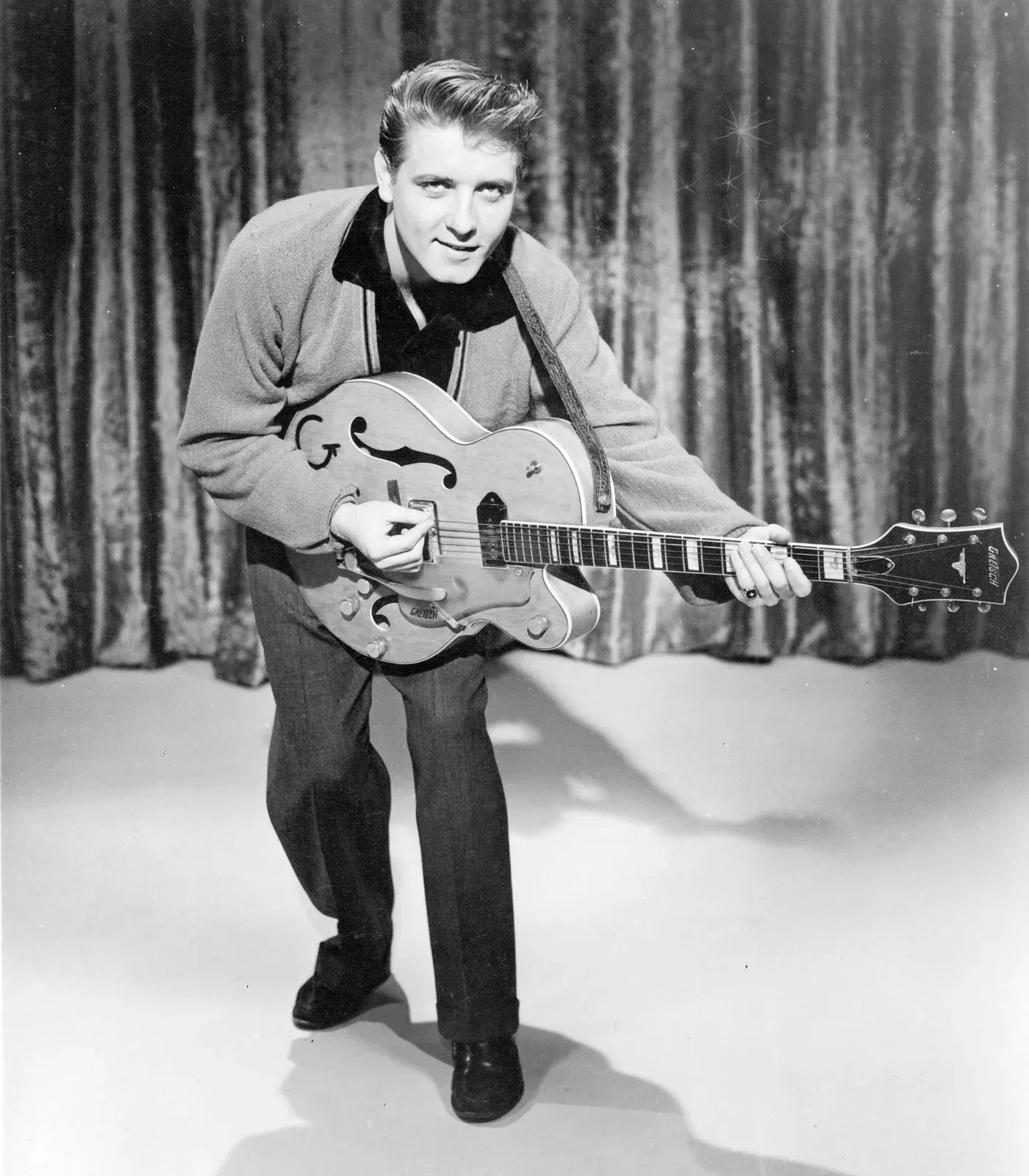
Photo by Michael Ochs Archives , licensed under Public domain · Wikimedia Commons
Rank #411
Eddie Cochran
From Wikipedia
Edward Ray Cochran was an American rock and roll musician. His songs, such as "Twenty Flight Rock", "Summertime Blues", "C'mon Everybody" and "Somethin' Else", captured teenage frustration and desire in the mid-1950s and early 1960s. He experimented with multitrack recording, distortion techniques and overdubbing, even on his earliest singles. Cochran played the guitar, piano, bass, and drums. His image as a sharply dressed and attractive young man with a rebellious attitude epitomized the stance of the 1950s rocker, and in death, he achieved iconic status.
Discography & Previews
Browse through and click an album to open and play 30-second previews streamed from Apple Music.

Singin' to My Baby
1957 · 12 tracks
- 1 Sittin' In the Balcony ↗ 2:00
- 2 Completely Sweet ↗ 2:22
- 3 Undying Love ↗ 2:09
- 4 I'm Alone Because I Love You ↗ 2:23
- 5 Lovin' Time ↗ 2:07
- 6 Proud of You ↗ 1:59
- 7 Mean When I'm Mad ↗ 1:54
- 8 Stockings and Shoes ↗ 2:13
- 9 Tell Me Why ↗ 2:17
- 10 Have I Told You Lately That I Love You ↗ 2:36
- 11 Cradle Baby ↗ 1:48
- 12 One Kiss ↗ 1:54

Never to Be Forgotten
1962 · 12 tracks
-
 Singin' to My BabyEddie Cochran195712 tracks
 -
 Never to Be ForgottenEddie Cochran196212 tracks
Deep Dive
Overview
Eddie Cochran was an American rock and roll pioneer whose career, though cut short by a fatal car accident at age twenty-one, left an indelible mark on the sound and spirit of 1950s rock music. His songs—“Twenty Flight Rock,” “Summertime Blues,” “C’mon Everybody,” and “Somethin’ Else”—articulated teenage frustration and desire at a moment when rock was still finding its voice. Cochran stood apart from his contemporaries through his restless experimentation with recording techniques: multitrack recording, distortion, and overdubbing appeared on his earliest singles, innovations that would become foundational to rock production decades later. He was not merely a performer but a studio musician and multi-instrumentalist who shaped the genre’s technical vocabulary while its commercial era was still in its infancy.
Formation Story
Edward Ray Cochran was born in 1938 and came of age in the American South during the postwar boom. He grew up in an era when country music, R&B, and emerging rock and roll were beginning to blend in the recording studios and radio stations of the mid-South. From an early age, Cochran showed exceptional musicianship, mastering guitar, piano, bass, and drums—a versatility that would define his approach to songwriting and studio work. The teenage years of the 1950s saw rock and roll explode from novelty to generational force, and Cochran entered the music world at the precise moment when young performers could capture the sound and attitude of their own peer group. His image—sharply dressed, attractive, and visibly rebellious—embodied the persona of the 1950s rocker, a template that would influence rock musicians far beyond his own era.
Breakthrough Moment
Cochran’s breakthrough came with recordings that captured the specificity of teenage life in the 1950s. “Twenty Flight Rock” and “Summertime Blues” were not generic pop confections but detailed narratives of youthful desire and social constraint—the latter a song about a teenager working a summer job and too exhausted to date, set to a driving, guitar-forward arrangement. These early singles released on various labels—Ekko, Crest, and Cash Records—demonstrated Cochran’s willingness to push beyond conventional recording methods. His work on Liberty Records solidified his reputation as both a hitmaker and an innovator. By the late 1950s, Cochran had established himself as one of the defining voices of the rock and roll generation, capable of writing and performing songs that spoke directly to teenage experience while employing studio techniques that challenged the limits of contemporary recording technology.
Peak Era
The years from the mid-1950s through 1959 represented Cochran’s peak creative period, when he refined the sound that would define his legacy. During this stretch, he continued to record songs that balanced commercial appeal with technical ambition. The period saw him work extensively in the studio, where his multi-instrumental skills allowed him to overdub parts and layer textures in ways that were remarkable for the era. Songs like “C’mon Everybody” became anthems of youthful rebellion, their simplicity and directness masking the care and experimentation that went into their production. Cochran’s willingness to use distortion and unconventional recording techniques on records intended for mass radio play set him apart from safer contemporaries and anticipated the studio-centric approach that would define rock music in subsequent decades.
Musical Style
Eddie Cochran’s sound merged country music traditions with the emerging language of rock and roll, creating a hybrid idiom that emphasized rhythmic drive and vocal directness. His guitar playing was fluid and inventive, capable of both melodic sophistication and the kind of raw, overdriven textures that would later become synonymous with rock. The multitrack recording techniques he employed—overdubbing his own voice and instruments, layering guitars, and experimenting with distortion—were not mere technical flourishes but integral to his songwriting approach. His vocal delivery combined the twang of country tradition with the urgent phrasing of rock and roll, a blend that made his teenage anthems feel both culturally specific and timeless. Cochran played not as a specialist in one instrument but as a complete musician, which allowed him to conceptualize arrangements holistically rather than as a collection of parts added in sequence.
Major Albums
Singin’ to My Baby (1957)
Cochran’s debut album established the template for his career: a collection of songs that married rock and roll energy to carefully crafted studio production, showcasing his multi-instrumental abilities.
The Eddie Cochran Memorial Album (1960)
Released after his death in 1960, this compilation gathered some of his most celebrated recordings and helped cement his legacy during a period of renewed interest in his catalog.
Never to Be Forgotten (1962)
A posthumous assembly of previously unreleased material and alternate takes, this album documented the breadth of Cochran’s studio work and highlighted songs that had not received wide commercial circulation during his lifetime.
Signature Songs
- “Twenty Flight Rock” — A song that captured the specificity of teenage urban life and became one of Cochran’s calling cards, demonstrating his gift for narrative songwriting.
- “Summertime Blues” — An anthem of teenage frustration, structured around a summer job and romantic constraint, defined by its propulsive guitar work and relatable lyrical detail.
- “C’mon Everybody” — A rallying cry of youthful rebellion that became emblematic of the spirit Cochran embodied, driven by infectious rhythm and Cochran’s energetic vocal delivery.
- “Somethin’ Else” — A showcase for Cochran’s vocal range and his ability to blend rock and roll urgency with melodic sophistication.
Influence on Rock
Eddie Cochran’s impact on rock music extended far beyond his brief career span. His experimentation with multitrack recording and distortion techniques anticipated the studio-centric innovations of the 1960s and beyond, influencing how rock musicians conceptualized the recording process itself. Cochran demonstrated that the studio was not merely a tool for capturing live performance but an instrument in its own right, a lesson that would shape the work of progressive and experimental rock musicians in later decades. His songwriting—focused on the specifics of teenage life and desire—created a template for rock and roll as a vehicle for youth expression, a role the genre would occupy for generations. The combination of technical ambition and commercial accessibility in his records showed that innovation and accessibility were not mutually exclusive, a principle that would define successful rock music throughout its history.
Legacy
Eddie Cochran died in a car accident on April 17, 1960, at the age of twenty-one, a tragedy that cut short a career of unmeasured potential. In death, he achieved an iconic status that his early career success alone might not have secured. Posthumous compilations and reissues have ensured that his recordings remain in circulation, introducing new generations to his innovations and his gift for capturing the teenage voice in rock and roll. His influence extends through multiple lineages in rock music—from the technical experimentation of 1960s studio rock to the rebellious attitude that would define punk and beyond. Cochran’s status as a pioneer of both songwriting and recording technique has secured his place in rock history as one of the foundational figures of the genre, a musician who helped establish both what rock and roll could express and how it could be made.
Fun Facts
- Cochran was proficient on multiple instruments—guitar, piano, bass, and drums—allowing him to play nearly every part on his recordings, a degree of self-sufficiency unusual for rock musicians of the 1950s.
- His record label history spanned several independent and emerging labels—Ekko, Crest, Cash, and Liberty—reflecting the fragmented landscape of early rock and roll recording before the major labels consolidated control.
- “Summertime Blues” remains one of the most covered songs in rock history, a testament to the enduring appeal of both its melody and its lyrical specificity about teenage constraint.
- Cochran’s career was documented through reissue campaigns decades after his death, including compilations released in 1987 and beyond, ensuring his studio innovations reached audiences unfamiliar with 1950s rock history.