
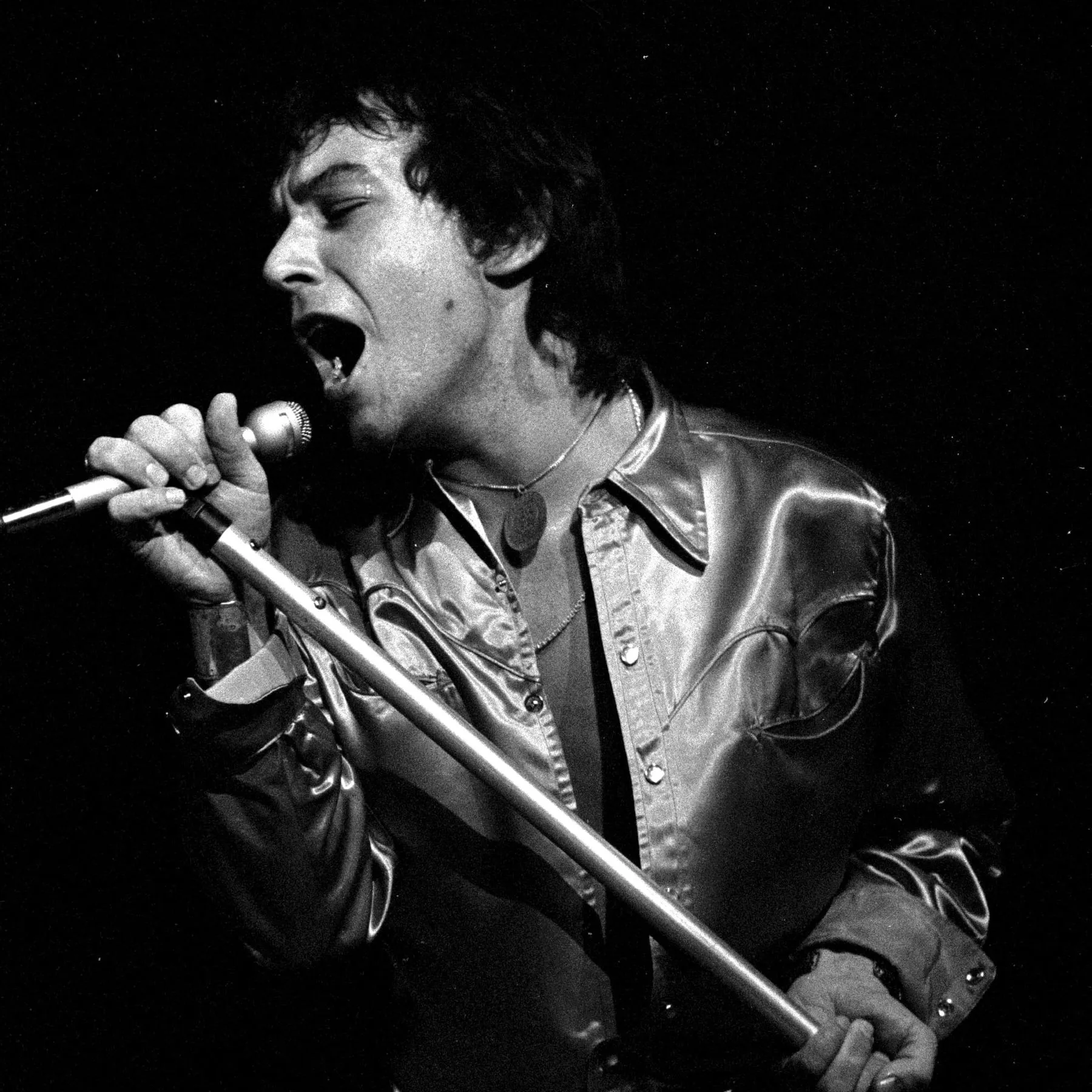
Photo by Heinrich Klaffs , licensed under CC BY-SA 2.0 · Wikimedia Commons
Rank #290
Eric Burdon
From Wikipedia
Eric Victor Burdon is an English singer and songwriter. He was previously the lead vocalist of the original lineup of the R&B and rock band the Animals and the funk band War. He is currently the lead vocalist of the present day lineup of Eric Burdon & the Animals. Burdon is regarded as one of the British Invasion's most distinctive singers with his deep, powerful blues-rock voice and is known for his intense stage performances.
Discography & Previews
Browse through and click an album to open and play 30-second previews streamed from Apple Music.


My Secret Life
2004 · 13 tracks
- 1 Once Upon a Time ↗ 3:51
- 2 Motorcycle Girl ↗ 3:53
- 3 Over the Border ↗ 4:28
- 4 The Secret ↗ 5:48
- 5 Factory Girl ↗ 4:41
- 6 Highway 62 ↗ 5:30
- 7 Jazzman ↗ 3:48
- 8 Black and White World ↗ 3:29
- 9 Heaven ↗ 4:44
- 10 Devil Slide ↗ 3:35
- 11 Broken Records ↗ 3:25
- 12 Can't Kill the Boogieman ↗ 3:59
- 13 My Secret Life ↗ 5:51

Soul of a Man
2006 · 14 tracks
- 1 Soul of a Man ↗ 4:16
- 2 Kingsize Jones ↗ 3:35
- 3 Red Cross Store ↗ 4:18
- 4 Como Se Llama Mama ↗ 3:39
- 5 Forty Days and Forty Nights ↗ 3:01
- 6 Feeling Blue ↗ 4:49
- 7 Never Give Up Blues ↗ 4:14
- 8 Gto ↗ 5:33
- 9 Forty-Four ↗ 4:30
- 10 Slow Moving Train ↗ 5:26
- 11 Don't Ever Let Nobody Drag Your Spirit Down ↗ 4:55
- 12 Devil Run ↗ 3:22
- 13 I Don't Mind ↗ 5:28
- 14 Circuit Rider ↗ 3:43

’Til Your River Runs Dry
2013 · 12 tracks
-
 I Used to Be an AnimalEric Burdon19889 tracks
 -
 My Secret LifeEric Burdon200413 tracks
 -
 Soul of a ManEric Burdon200614 tracks
 -
 ’Til Your River Runs DryEric Burdon201312 tracks
Deep Dive
Overview
Eric Burdon is an English singer and songwriter whose deep, powerful voice became one of the defining instruments of the British Invasion. Born in 1941, he first gained international prominence as the lead vocalist of the R&B and rock band the Animals before embarking on a prolific solo career that spanned multiple genres—from psychedelic rock and blues to funk, Latin rock, and jazz fusion. His work across five decades has established him as a vocalist of rare emotional range and intensity, capable of inhabiting everything from gutsy R&B to experimental studio settings with equal conviction.
Formation Story
Burdon emerged from post-war Newcastle, a industrial port city with deep roots in American blues and rhythm and blues. Growing up in the 1950s, he absorbed the raw energy of blues records imported from across the Atlantic, which shaped his musical sensibility long before he stepped onstage. His pathway into rock came through the thriving British R&B scene of the late 1950s and early 1960s, where American blues standards were being reinterpreted by a generation of young British musicians hungry to make the music their own. By his early twenties, Burdon had become a commanding live performer whose physical intensity and vocal power set him apart from his contemporaries. This intensity would define not only his work with the Animals but his entire subsequent career as a solo artist.
Breakthrough Moment
While Burdon’s solo career began in earnest in the early 1970s, his initial chart success and industry visibility came through his fronting of the Animals, a band that reshaped British blues-rock in the mid-1960s. After that chapter closed, he stepped into the spotlight as a solo recording artist, releasing his debut solo album Guilty! in 1971. This record marked his transition from a band-context interpreter of blues material into a more adventurous solo voice willing to explore contemporary rock and funk territories. The album’s release signaled that Burdon intended to remain a major recording artist independent of any single ensemble.
Peak Era
Burdon’s most creatively restless period spanned the 1970s and 1980s, a time when he explored a widening palette of styles without settling into a single formulaic approach. Following Guilty! came Survivor in 1977, then a string of albums including Darkness - Darkness (1980), Power Company (1983), and I Used to Be an Animal (1988). During this span, he continued to tour and record, maintaining a presence across rock radio and live circuits even as musical trends shifted around him. This era demonstrated his refusal to be confined to a single sound or audience demographic; rather than repeating the blues-rock formula that had served him well, he continued to absorb and incorporate influences from funk, Latin music, and contemporary production techniques.
Musical Style
Burdon’s voice is his primary instrument: a deep, gravelly baritone with tremendous emotional reach, capable of conveying both menace and vulnerability within a single phrase. His phrasing owes much to American blues singers, particularly those who emphasized emotional storytelling over technical display. Across his solo career, he has worked with musicians and producers across multiple genres, which gave his recordings a stylistic fluidity uncommon among rock vocalists of his generation. He could perform over funk rhythms and Latin percussion as credibly as over traditional blues progressions, a flexibility rooted in his foundational understanding of rhythm and blues as a physical, dance-oriented music rather than as a museum piece. His stage performances have remained equally intense throughout his career, characterized by a commitment to full emotional engagement that influenced rock singers concerned with authenticity and presence.
Major Albums
Guilty! (1971)
Burdon’s solo debut marked an immediate declaration of artistic independence, establishing him as a vocalist capable of fronting his own recording sessions and maintaining the intensity audiences expected from the former Animals frontman.
Survivor (1977)
This album came at a moment when Burdon was fully embracing experimentation beyond straightforward blues-rock, exploring the grooves and instrumentation that would define funk and Latin-influenced rock of the era.
I Used to Be an Animal (1988)
The album’s title alone signaled Burdon’s relationship to his own past, a tongue-in-cheek acknowledgment of how his identity had become inseparable from his most famous band while asserting his ongoing relevance as a solo creator.
My Secret Life (2004)
A late-career solo statement that found Burdon returning to recording with renewed energy, capturing his voice at a stage where decades of live performance had refined rather than diminished its emotional power.
Soul of a Man (2006)
This album represented a return to blues foundations, a natural choice for an artist whose entire career had been rooted in the genre even as he explored stylistic detours.
Signature Songs
- “We Gotta Get Out of This Place” — An Animals classic that Burdon frequently revisited in solo arrangements, the song became synonymous with his commitment to emotional directness.
- “House of the Rising Sun” — The Animals’ signature cover that Burdon brought to legendary status and continued to perform throughout his solo career.
- “Sky Pilot” — A psychedelic-era Animals track that displayed his range beyond pure blues interpretation.
- “Don’t Let Me Be Misunderstood” — A showcase for Burdon’s vocal sophistication and ability to convey emotional complexity.
Influence on Rock
Burdon’s solo career maintained the trajectory established by his work with the Animals: demonstrating that American blues could be authentically interpreted by British musicians and that a vocalist’s power came not from technical perfection but from emotional commitment and physical presence. His willingness to explore funk and Latin influences alongside blues showed rock musicians that genre boundaries were porous and that an artist could remain credible while working in multiple styles. His intense live performances influenced generations of rock singers who understood that stage presence was not optional flourish but central to rock music’s artistic identity. Younger blues-rock and funk-influenced artists in the 1970s and 1980s absorbed lessons from his fearlessness in crossing genre lines while maintaining artistic integrity.
Legacy
Eric Burdon has remained active as a recording and performing artist into the twenty-first century, a rarity among his generation. His discography spanning from 1971 through ‘Til Your River Runs Dry in 2013 documents an artist who never retreated into nostalgia or self-repetition, even as he occasionally revisited his most famous material with the reformed Animals lineup. His place in rock history rests equally on his work as a solo artist and his foundational role in the Animals, a dual legacy that speaks to his capacity to remain creatively vital across different contexts and eras. The combination of his instantly recognizable voice, his intense interpretive approach to blues material, and his willingness to absorb contemporary influences has ensured his recordings remain in circulation and his live performances continue to draw audiences who value authenticity and emotional directness in rock music.
Fun Facts
- Burdon’s solo output demonstrates a commitment to regular recording across multiple decades, with studio albums appearing steadily from 1971 through 2013, reflecting a work ethic uncommon among classic rock-era artists.
- His exploration of funk and Latin music in the 1970s and 1980s anticipated the genre-blending approach that would become mainstream in rock and alternative music decades later.
- The title I Used to Be an Animal served as a metacommentary on Burdon’s relationship to his most famous previous group, simultaneously acknowledging and transcending that identity.