
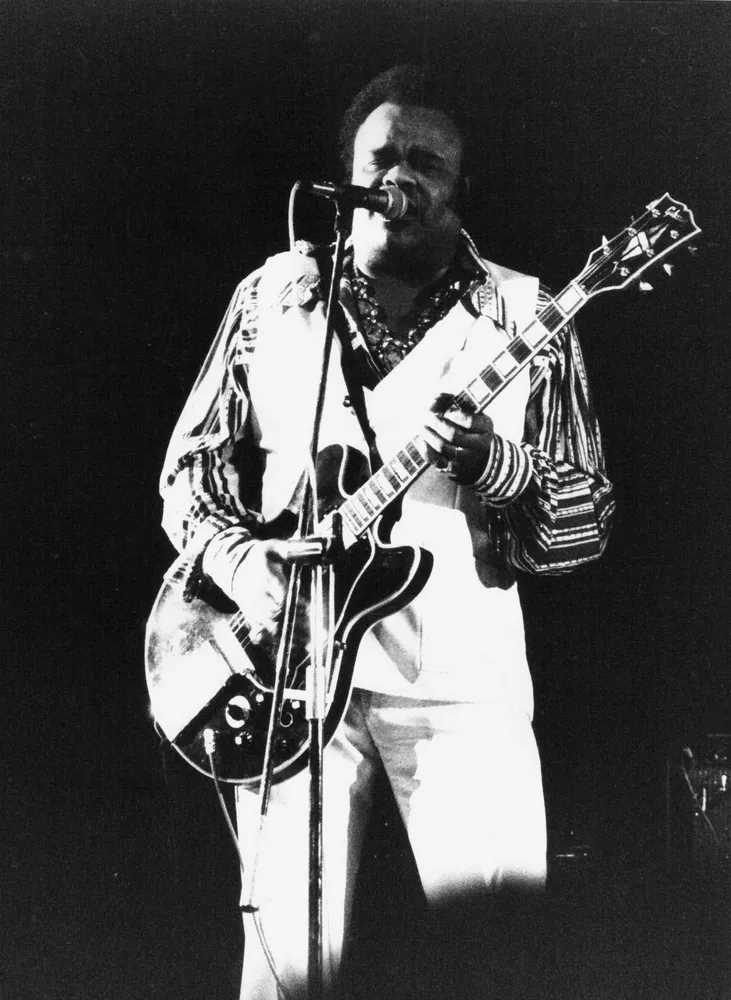
Photo by Lionel Decoster , licensed under CC BY-SA 4.0 · Wikimedia Commons
Rank #401
Freddie King
From Wikipedia
Freddie King, also billed as Freddy King, was an American blues guitarist, singer and songwriter. He is considered one of the "Three Kings of the Blues Guitar". Known for his soulful and powerful voice and distinctive guitar playing, King had a major influence on electric blues music and on many later blues guitarists.
Discography & Previews
Browse through and click an album to open and play 30-second previews streamed from Apple Music.
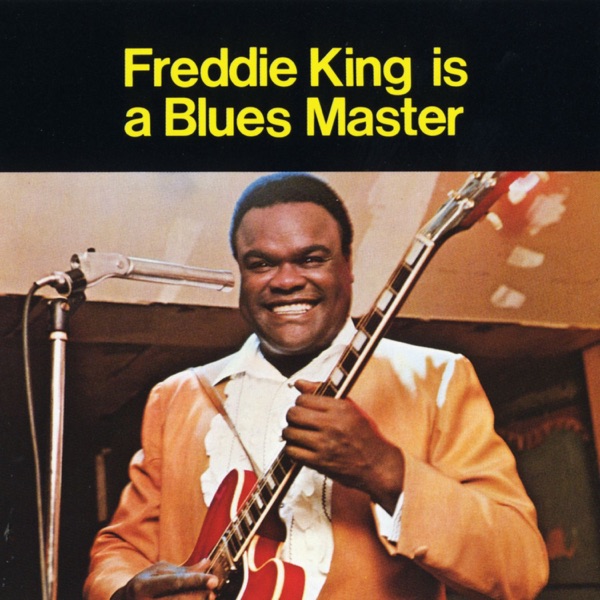
Freddie King Is a Blues Master
1969 · 12 tracks
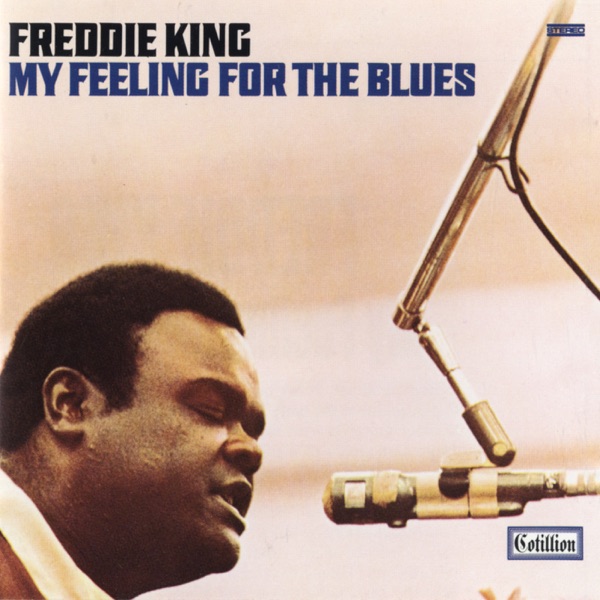
My Feeling for the Blues
1970 · 11 tracks

Texas Cannonball
1972 · 10 tracks

Woman Across the River
1973 · 11 tracks
- 1 Woman Across the River ↗ 2:50
- 2 I'm Your Hoochie Coochie Man ↗ 4:51
- 3 The Danger Zone ↗ 4:34
- 4 Boogie Man ↗ 3:47
- 5 Leave My Woman Alone ↗ 3:36
- 6 Just a Little Bit ↗ 2:31
- 7 Look On Yonder Wall ↗ 2:28
- 8 Help Me Through the Day ↗ 4:31
- 9 I'm Ready ↗ 3:47
- 10 Trouble In Mind ↗ 3:44
- 11 You Don't Have to Go ↗ 2:56

Burglar
1974 · 10 tracks
- 1 Pack It Up (feat. Steve Ferrone, Bobby Tench & Mike Vernon) ↗ 4:10
- 2 My Credit Didn't Go Through ↗ 4:10
- 3 I Got the Same Old Blues (feat. Steve Ferrone, Bobby Tench & Mike Vernon) ↗ 3:25
- 4 Only Getting Second Best (feat. Brian Auger, Steve Ferrone & Bobby Tench) ↗ 3:50
- 5 Texas Flyer (feat. Steve Ferrone, Bobby Tench & Mike Vernon) ↗ 3:48
- 6 Pulp Wood (feat. Steve Ferrone, Bobby Tench & Mike Vernon) ↗ 3:13
- 7 She's a Burglar (feat. Steve Ferrone, Brian Auger, Bobby Tench & Pete Wingfield) ↗ 3:52
- 8 Sugar Sweet (feat. Eric Clapton And His Band) ↗ 2:53
- 9 I Had a Dream (feat. Brian Auger, Steve Ferrone, Bobby Tench & Pete Wingfield) ↗ 5:02
- 10 Let the Good Times Roll ↗ 3:30

Larger Than Life
1975 · 9 tracks

Alive In America
2023 · 14 tracks
- 1 I'm Ready ↗ 5:46
- 2 Ain't No Sunshine ↗ 5:31
- 3 Ghetto Woman ↗ 11:36
- 4 Come On (Let the Good Times Roll) ↗ 9:01
- 5 Pack It Up ↗ 3:44
- 6 Have You Ever Loved a Woman ↗ 12:00
- 7 #4 Blues ↗ 9:55
- 8 Tv Mama ↗ 12:59
- 9 Goin' Down ↗ 6:21
- 10 Wee Baby Blues ↗ 9:03
- 11 Freddie's Blues ↗ 3:56
- 12 That's Alright ↗ 7:10
- 13 Big Legged Woman ↗ 5:13
- 14 Sweet Home Chicago ↗ 6:40
-
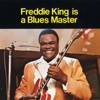 Freddie King Is a Blues MasterFreddie King196912 tracks
 -
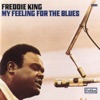 My Feeling for the BluesFreddie King197011 tracks
 -
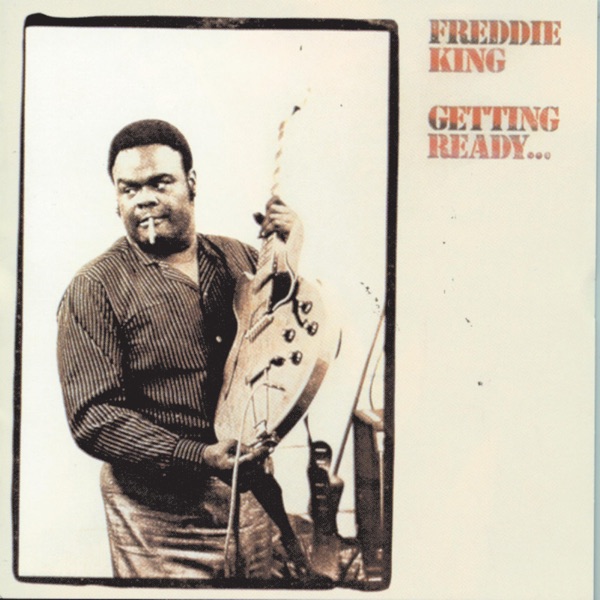
 Getting Ready…Freddie King197110 tracks
 -
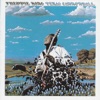 Texas CannonballFreddie King197210 tracks
 -
 Woman Across the RiverFreddie King197311 tracks
 -
 BurglarFreddie King197410 tracks
 -
 Larger Than LifeFreddie King19759 tracks
 -
 Alive In AmericaFreddie King202314 tracks
Deep Dive
Overview
Freddie King, also billed as Freddy King, stands as one of the three defining voices of the electric blues guitar, a legacy that persists decades after his death in 1976. His career, spanning from the early 1950s through the mid-1970s, intersected blues tradition with emerging rock sensibilities, producing music that bridged generations of listeners. Known for both a soulful, commanding singing voice and a distinctive, incisive guitar style, King became a foundational influence on electric blues and shaped the playing of countless guitarists who followed.
Formation Story
Freddie King was born in 1934 in the heart of American blues country, where he absorbed the traditions of blues guitar and vocal tradition from an early age. His entry into professional music came during the golden age of electric blues, when amplification was beginning to transform the sound of the tradition from acoustic intimacy into something louder, more aggressive, and more suitable for urban venues. King emerged as a recording artist in the early 1950s, signing with Apex and then Federal Records before establishing a long relationship with King Records, a pairing that proved artistically and commercially productive. His style synthesized the influence of earlier blues masters with the energy of contemporary R&B and early rock and roll, creating a sound that felt both rooted in blues tradition and oriented toward modern audiences.
Breakthrough Moment
King’s commercial ascent came during the early 1960s, when his instrumental prowess began to earn him wider recognition beyond regional blues circuits. His albums from this period—including Freddy King Sings and Let’s Hide Away and Dance Away with Freddie King (both 1961)—established his dual reputation as a vocalist and instrumentalist. The early 1960s proved especially productive, with releases such as Boy‐Girl‐Boy (1962) and the eclectic Freddy King Goes Surfin’ (1963) showing his willingness to experiment with contemporary styles and themes. By the mid-1960s, King had secured his position as a major force in blues guitar, with an expanding discography that demonstrated both consistency and creative ambition.
Peak Era
The late 1960s and early 1970s represented King’s most sustained period of artistic output and commercial visibility. Albums such as Freddie King Is a Blues Master (1969), My Feeling for the Blues (1970), Getting Ready… (1971), and Texas Cannonball (1972) showcased a maturing artist who had synthesized decades of blues tradition into a distinctive personal voice. The title Texas Cannonball, released in 1972, captured King’s regional identity and the explosive power of his playing. During these years, King continued to record prolifically, maintaining his presence in blues and R&B markets while also reaching audiences interested in the blues-rock crossover. His energy and technical facility remained undiminished, and his recordings from this period continue to stand as benchmarks for electric blues guitar and singing.
Musical Style
Freddie King’s sound fused Chicago blues electric tradition with elements drawn from funk, soul, and rock and roll. His guitar playing was characterized by incisive single-note lines, heavy bending, and a tone that was both warm and cutting—capable of both delicate expression and raw power. His voice carried authority and emotional depth, ranging from tender phrasing to urgent, blues-shouted passages that drove his performances forward. King worked across multiple formats: soulful vocal performances, instrumental showcases, and blues-rock fusion, demonstrating fluency across blues subgenres from traditional twelve-bar structures to contemporary rhythmic experiments. His willingness to record in varied styles—as evidenced by albums like Bossa Nova and Blues (1963), Freddy King Gives You a Bonanza of Instrumentals (1965), and Freddy King Goes Surfin’ (1963)—showed an artist unafraid to test blues tradition against contemporary popular idioms, even when those experiments proved commercially modest.
Major Albums
Freddy King Sings (1961)
King’s debut vocal album introduced his full range of emotional expression and established him as more than an instrumentalist, revealing a singer of genuine soul and phrasing.
Let’s Hide Away and Dance Away with Freddie King (1961)
Released the same year as his vocal debut, this album balanced instrumental showmanship with accessible R&B and proto-rock material, appealing to both blues and rock audiences.
Boy‐Girl‐Boy (1962)
This release continued King’s exploration of vocal material with contemporary themes, demonstrating his adaptability to early 1960s pop-influenced blues.
Freddie King Is a Blues Master (1969)
Recorded after a period of relative chart quietude, this album reasserted King’s authority and craftsmanship, featuring mature interpretations of blues standards and original material.
My Feeling for the Blues (1970)
A direct, unadorned showcase of King’s blues understanding, recorded at the Fillmore West and capturing the energy of his live performance.
Texas Cannonball (1972)
Named after King’s hometown tradition and his explosive playing style, this album crystallized his mature artistry and regional identity, marking a creative high point in his later career.
Signature Songs
- “Hide Away” — An instrumental that became King’s most enduring calling card, demonstrating his gift for melodic invention and guitar tone.
- “Let’s Hide Away and Dance Away” — A dance-oriented R&B number that showcased King’s crossover appeal and rhythmic sophistication.
- “Have You Ever Loved a Woman” — A soulful ballad that revealed King’s emotional depth as a vocalist.
- “Going Down” — A blues-rock workout that captured the raw energy of King’s live performances.
Influence on Rock
Freddie King’s role in the development of electric blues and blues-rock cannot be overstated. His balanced mastery of both guitar and vocals established a template for blues musicians who sought to reach audiences beyond traditional blues venues. His guitar playing—economical, focused, and emotionally direct—influenced a generation of rock and blues guitarists who came of age in the 1960s and 1970s. King’s recordings circulated widely among musicians and listeners in Britain and North America, where his work intersected with the blues-rock boom. Rock musicians borrowed directly from his instrumental vocabulary and adapted his songs, ensuring that his influence flowed through rock music as well as blues traditions. His contemporary status as one of the “Three Kings of the Blues Guitar” reflected the widespread recognition of his importance to the electric blues idiom and its evolution toward rock.
Legacy
Freddie King’s death in 1976 marked the end of an active recording career that had spanned more than two decades, but his musical legacy remained influential. Posthumous reissues and compilations have kept his work in circulation, allowing successive generations of blues and rock listeners to encounter his recordings. His contributions to electric blues guitar technique and his synthesis of blues, R&B, and rock continue to resonate in contemporary blues and rock music. Streaming platforms have made his extensive discography more accessible than ever, introducing his music to audiences who might otherwise have encountered only his most famous instrumental work. King’s place in blues history as a technician, vocalist, and bridge between blues tradition and popular music remains secure, and his influence persists in the work of contemporary blues and rock musicians who continue to draw on the innovations he pioneered.
Fun Facts
- King recorded under both “Freddie King” and “Freddy King” billing throughout his career, with the variations appearing on different labels and releases.
- His prolific output during the early 1960s—multiple full-length albums released in single years—reflected both the recording practices of the era and King’s relentless creative energy.
- King’s willingness to record concept-adjacent albums like Freddy King Goes Surfin’ and Bossa Nova and Blues demonstrated his openness to contemporary musical trends, even as he remained grounded in blues tradition.
- His later recordings, including Woman Across the River (1973), Burglar (1974), and Larger Than Life (1975), show an artist who continued recording and performing actively until his death.