
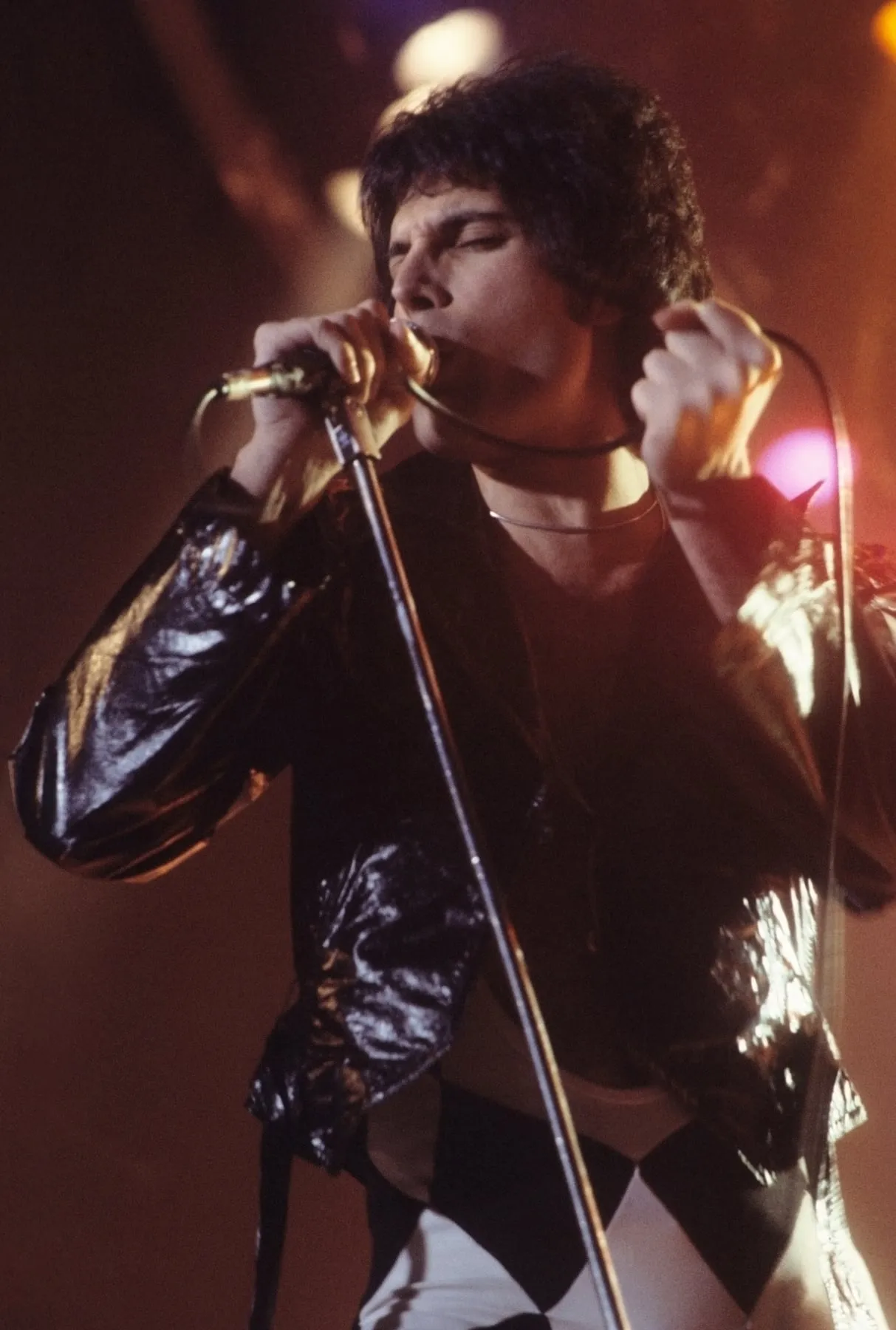
Photo by Carl Lender , licensed under CC BY-SA 3.0 · Wikimedia Commons
Rank #110
Freddie Mercury
From Wikipedia
Freddie Mercury was a British singer and songwriter who achieved global fame as the lead vocalist and pianist of the rock band Queen. Regarded as one of the greatest singers in the history of rock music, he is known for his flamboyant stage persona and four-octave vocal range. Mercury defied the conventions of a rock frontman with his theatrical style, influencing the artistic direction of Queen.
Discography & Previews
Browse through and click an album to open and play 30-second previews streamed from Apple Music.

Mr. Bad Guy
1985 · 11 tracks
- 1 Let's Turn It On (Special Edition) ↗ 3:42
- 2 Made In Heaven (Special Edition) ↗ 4:07
- 3 I Was Born To Love You (Special Edition) ↗ 3:39
- 4 Foolin' Around (Special Edition) ↗ 3:30
- 5 Your Kind Of Lover (Special Edition) ↗ 3:35
- 6 Mr. Bad Guy (Special Edition) ↗ 4:10
- 7 Man Made Paradise (Special Edition) ↗ 4:10
- 8 There Must Be More To Life Than This (Special Edition) ↗ 3:02
- 9 Living On My Own (Special Edition) ↗ 3:24
- 10 My Love Is Dangerous (Special Edition) ↗ 3:44
- 11 Love Me Like There's No Tomorrow (Special Edition) ↗ 3:45

Barcelona
1988 · 9 tracks
- 1 Barcelona (New Orchestrated Version) ↗ 5:45
- 2 La Japonaise (New Orchestrated Version) ↗ 4:52
- 3 The Fallen Priest (New Orchestrated Version) ↗ 5:47
- 4 Ensueño (New Orchestrated Version) ↗ 4:23
- 5 The Golden Boy (New Orchestrated Version) ↗ 6:04
- 6 Guide Me Home (New Orchestrated Version) ↗ 2:50
- 7 How Can I Go On (New Orchestrated Version) ↗ 3:50
- 8 Exercises In Free Love (New Orchestrated Version) ↗ 3:57
- 9 Overture Piccante (New Orchestrated Version) ↗ 6:43
-
 Mr. Bad GuyFreddie Mercury198511 tracks
 -
 BarcelonaFreddie Mercury19889 tracks
Deep Dive
Overview
Freddie Mercury stands as one of the most distinctive voices in rock history, revered not only for his work as the lead vocalist and pianist of Queen but also for a bold solo career that demonstrated his artistic range beyond the band’s framework. Born Farrokh Bulsara in the Sultanate of Zanzibar in 1946, Mercury eventually became a British rock icon whose four-octave vocal range and fearless theatrical presence redefined what a rock frontman could be. His solo work, though smaller in scale than his Queen output, revealed an artist unafraid to pursue operatic ambition and pop experimentation in parallel.
Formation Story
Mercury’s path to rock music began in Zanzibar before his family relocated to India and later to London. He developed his musical education formally, studying piano and graphic design, skills that would inform both his compositional sensibility and his visual aesthetic on stage. The theatrical instincts that would later define Queen’s presentation were evident from his early years—Mercury was a performer first, and his transition into rock was driven by a desire to marry classical training with the raw energy of contemporary popular music. By the mid-1970s, as Queen achieved international prominence, Mercury had already established himself as a vocalist of uncommon technical ability and an entertainer who rejected the rock conventions of his era in favor of something more flamboyant and visually conceptualized.
Breakthrough Moment
While Mercury’s primary fame derived from Queen, his solo ambitions crystallized in the mid-1980s during the band’s most commercially dominant period. His venture into solo recording represented not a departure from rock but an expansion of it—an opportunity to explore musical territories that Queen, as a collaborative entity, might not have ventured into. The solo albums that followed were therefore not retreats from his main career but parallel expressions of an artist whose interests had grown more diverse and whose confidence in his own creative vision had deepened.
Peak Era
Mercury’s solo recording career spanned the mid-to-late 1980s, a period when he was simultaneously sustaining Queen’s momentum and pursuing independent projects. This duality reflected his tireless work ethic and his refusal to be constrained by a single artistic framework. The albums he released during this time existed within the commercial mainstream while still bearing his unmistakable artistic stamp—a balance that few artists of that stature managed to achieve.
Musical Style
Mercury’s voice was his defining instrument: a four-octave soprano that could shift from delicate whisper to soaring operatic tenor within a single phrase. His piano playing, formally trained and often intricate, provided the foundation for many of his compositions. As a solo artist, Mercury gravitated toward material that emphasized his classical influences and his fascination with pop sensibility—a combination that reflected the eclectic range of his musical taste. His arrangements frequently incorporated orchestral elements, string sections, and production techniques that elevated pop songwriting into something more elaborate and ambitious. Unlike the rock-band foundation that characterized much of Queen’s sound, Mercury’s solo recordings allowed him to foreground his interest in theatrical production and genre-crossing experimentation.
Major Albums
Mr. Bad Guy (1985)
Mercury’s first solo album presented a portrait of an artist exploring dance music, funk, and pop with the same theatrical flair that defined Queen. The record showcased his willingness to engage with contemporary production styles while maintaining his distinctive vocal presence.
Barcelona (1988)
A collaboration that paired Mercury with operatic soprano Montserrat Caballé, Barcelona represented the apex of Mercury’s classical ambitions. The title track, recorded specifically for the 1992 Olympic Games, became one of his most celebrated solo works and demonstrated his capacity to operate successfully in operatic and pop contexts simultaneously.
Signature Songs
- Barcelona — The celebrated duet with Montserrat Caballé that merged operatic grandeur with contemporary pop production.
- Living On My Own — A solo reinterpretation that showcased Mercury’s gift for infectious pop melody.
- The Great Pretender — Mercury’s interpretation revealed his sophisticated approach to standard songwriting.
Influence on Rock
Mercury’s solo work reinforced a lesson he had already taught through Queen: that rock music need not confine itself to traditional rock instrumentation or conventions. His willingness to collaborate across genres—particularly his partnership with Caballé—demonstrated that rock vocalists could achieve credibility in operatic contexts and that classical training was not antithetical to rock authenticity. This openness to cross-genre collaboration influenced subsequent artists who sought to bridge popular and classical music, establishing a template for theatrical pop that persisted beyond his lifetime.
Legacy
Mercury’s solo recordings, though less numerous than his output with Queen, remain testaments to his refusal to be confined by a single identity. His death in 1991 occurred during a period when solo artists of rock credentials were exploring classical music with increasing frequency, and Mercury’s pioneering work in that direction was already influencing emerging trends. The albums remain in circulation through major label reissues and digital platforms, accessible to listeners discovering his artistry beyond Queen. His solo work has been reassessed by subsequent generations as evidence of an artist whose ambitions extended far beyond the rock band format, and whose classical training and theatrical sensibility positioned him as a figure who transcended conventional genre boundaries.
Fun Facts
- Mercury maintained close personal relationships throughout his life that influenced his artistic output, with his songwriting often reflecting emotional and romantic themes.
- His formal training in graphic design informed his meticulous approach to album artwork and visual presentation.
- The Barcelona Olympic theme became one of his most enduring legacies outside of Queen, demonstrating his capacity to create music with global cultural reach.