
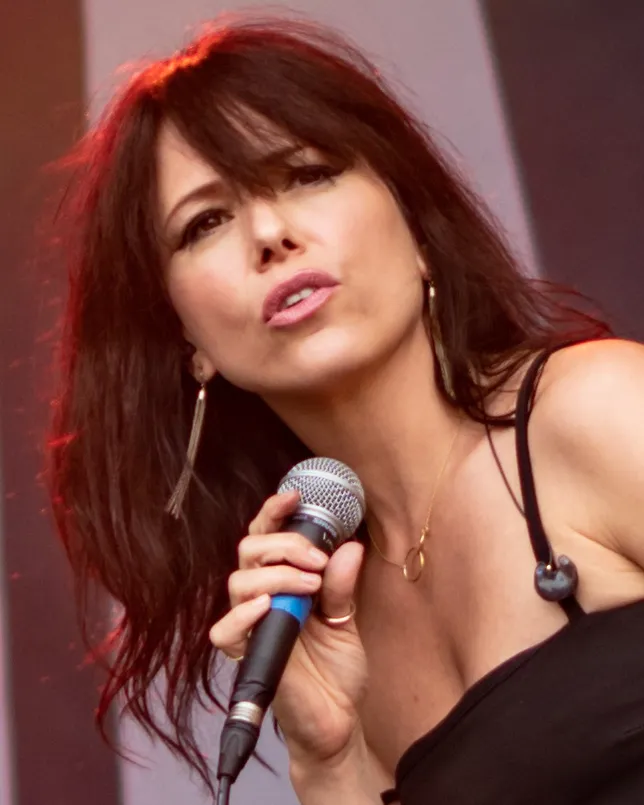
Photo by Raph_PH , licensed under CC BY 2.0 · Wikimedia Commons
Rank #459
Imelda May
From Wikipedia
Imelda Mary Higham, professionally known as Imelda May, is an Irish singer, songwriter, television presenter and multi-instrumentalist. She became known for her musical style of rockabilly revival and has also been compared to female jazz musicians such as Billie Holiday.
Discography & Previews
Browse through and click an album to open and play 30-second previews streamed from Apple Music.

No Turning Back
2003 · 15 tracks
- 1 Dealing with the Devil ↗ 2:19
- 2 Flame of Love ↗ 2:09
- 3 Cry for Me Baby ↗ 3:16
- 4 Till I Kissed You ↗ 2:41
- 5 What Am I Gonna Do ↗ 3:20
- 6 Once More ↗ 2:09
- 7 Wild About My Lovin' ↗ 2:52
- 8 No Turning Back ↗ 2:50
- 9 End of the World ↗ 2:51
- 10 Y'hoo ↗ 2:29
- 11 Don't Do Me No Wrong ↗ 2:36
- 12 Forever You and Me ↗ 3:14
- 13 Bring My Cadillac Back ↗ 2:19
- 14 Lovey Dovey Lovely One ↗ 2:21
- 15 Let Us Sing ↗ 2:57

Love Tattoo
2008 · 20 tracks
- 1 Johnny Got a Boom Boom ↗ 2:59
- 1 My Babe (Live) ↗ 3:05
- 2 Feel Me ↗ 2:58
- 2 Don't Do Me No Wrong (Live) ↗ 3:07
- 3 Knock 123 ↗ 5:28
- 3 Big Bad Handsome Man (Live) ↗ 3:03
- 4 Wild About My Lovin' ↗ 3:15
- 4 Wild About My Lovin' (Live) ↗ 3:11
- 5 Big Bad Handsome Man ↗ 2:44
- 5 Falling In Love With You Again (Live) ↗ 5:22
- 6 Love Tattoo ↗ 2:56
- 6 Watcha Gonna Do (Live) ↗ 3:43
- 7 Meet You At the Moon ↗ 2:47
- 7 Johnny Got a Boom Boom (Live) ↗ 3:05
- 8 Smokers' Song ↗ 2:37
- 8 Rollin' and Tumblin' (Live) ↗ 5:39
- 9 Smotherin' Me ↗ 2:43
- 10 Falling In Love With You Again ↗ 4:07
- 11 It's Your Voodoo Working ↗ 3:12
- 12 Watcha Gonna Do ↗ 3:42

Mayhem
2010 · 16 tracks
- 1 Pulling the Rug ↗ 3:54
- 2 Psycho ↗ 2:53
- 3 Mayhem ↗ 2:47
- 4 Kentish Town Waltz ↗ 4:50
- 5 All for You ↗ 2:51
- 6 Eternity ↗ 3:16
- 7 Inside Out ↗ 3:28
- 8 Proud and Humble ↗ 4:01
- 9 Sneaky Freak ↗ 3:05
- 10 Bury My Troubles ↗ 3:07
- 11 Too Sad to Cry ↗ 4:29
- 12 I'm Alive ↗ 3:52
- 13 Let Me Out ↗ 3:22
- 14 Tainted Love ↗ 2:46
- 15 Johnny Got a Boom Boom (Radio Edit) ↗ 2:34
- 16 Kentish Town Waltz (feat. Lou Reed) ↗ 3:28
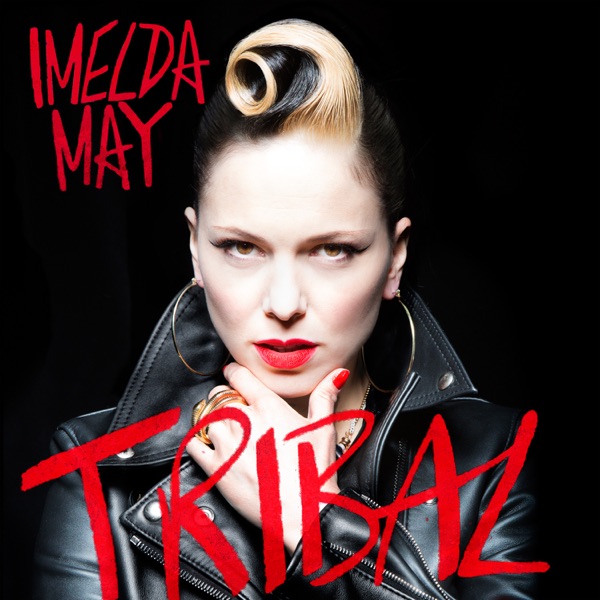
Tribal
2014 · 12 tracks

Life Love Flesh Blood
2017 · 11 tracks


11 Past the Hour
2021 · 11 tracks
- 1 11 Past the Hour ↗ 3:59
- 2 Breathe ↗ 3:24
- 3 Made to Love (feat. Ron Wood, Gina Martin & Dr Shola Mos-Shogbamimu) ↗ 3:25
- 4 Different Kinds of Love ↗ 3:02
- 5 Diamonds ↗ 3:00
- 6 Don’t Let Me Stand on My Own (feat. Niall McNamee) ↗ 3:38
- 7 What We Did in the Dark (feat. Miles Kane) ↗ 3:34
- 8 Can't Say ↗ 3:47
- 9 Just One Kiss (feat. Ron Wood) ↗ 3:23
- 10 Solace ↗ 3:35
- 11 Never Look Back ↗ 3:27
-
 No Turning BackImelda May200315 tracks
 -
 Love TattooImelda May200820 tracks
 -
 MayhemImelda May201016 tracks
 -
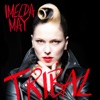 TribalImelda May201412 tracks
 -
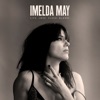 Life Love Flesh BloodImelda May201711 tracks
 -
 Slip of the TongueImelda May20209 tracks
 -
 11 Past the HourImelda May202111 tracks
Deep Dive
Overview
Imelda May is an Irish singer, songwriter, television presenter, and multi-instrumentalist who has anchored the contemporary rockabilly revival since the early 2000s. Born in Dublin in 1974, May emerged as one of the defining figures in rockabilly’s late-twentieth and early-twenty-first-century resurgence, a movement that excavated the raw energy and swagger of 1950s rock and roll while applying modern production and songwriting sensibilities. Her career has been marked by a distinctive vocal presence and an unflinching commitment to the rockabilly idiom across more than two decades of recording and touring.
Formation Story
Imelda Mary Higham was born in Dublin, Ireland, in 1974, growing up in a musical household that exposed her to a wide range of styles. Her early years unfolded during a period when rockabilly, the sound that had powered 1950s American rock and roll—a fusion of country twang, rhythm-and-blues shuffle, and raw electric guitar—existed largely as a historical footnote rather than a living genre. By the 1990s and early 2000s, a small but dedicated community of musicians and fans worldwide had begun dusting off the template of rockabilly and adapting it to contemporary contexts. May aligned herself with this movement, mastering multiple instruments and honing a performance aesthetic that drew from the visual and sonic traditions of rockabilly’s golden age while remaining distinctly modern. Her entry into professional recording came with the release of her debut album, No Turning Back, in 2003, a statement that announced both her technical proficiency and her unwillingness to compromise with mainstream pop tastes.
Breakthrough Moment
The years immediately following No Turning Back positioned May as a serious artistic voice within rockabilly circles, but her wider audience expanded substantially with the release of Love Tattoo in 2008. This album consolidated her reputation as a vocalist of real power and emotional depth, and it demonstrated that rockabilly, in her hands, was neither nostalgic pastiche nor novelty. The record’s success—driven by both critical appreciation and growing fan engagement—established May as the primary contemporary figure in Irish rockabilly and one of the most visible rockabilly artists internationally. Her presence on both recording and touring platforms grew throughout the late 2000s, making her a fixture at both rock-oriented and alternative music festivals.
Peak Era
The decade spanning 2008 to 2017 represented May’s creative and commercial zenith. Mayhem (2010) deepened her artistic reach, followed by Almost Grown (2012), which further expanded her audience and established her as a consistent album-maker. Tribal (2014) continued this trajectory, each record demonstrating a willingness to evolve the rockabilly formula while maintaining fidelity to its core elements. Life Love Flesh Blood (2017) marked a milestone in her career, arriving more than a decade and a half after her debut and cementing her status as a significant voice in contemporary rock. Throughout this period, May balanced studio recording with an active touring schedule and television presenting work, maintaining a multifaceted public presence across entertainment media.
Musical Style
Imelda May’s rockabilly revival sits squarely in the lineage established by artists like Carl Perkins and Jerry Lee Lewis—music built on the tension between country instrumentation and rhythm-and-blues rhythmic drive. Her vocal approach, however, owes as much to jazz singers as to rock and roll; comparisons to Billie Holiday have been apt, capturing both her mezzo-alto timbre and her interpretive sensibility, her ability to wring emotional nuance from lyrical content. Lyrically, May writes from a contemporary perspective, addressing themes of desire, independence, and relationship dynamics in language that feels grounded and direct rather than retro. Her multi-instrumentalist skills—spanning guitar, upright bass, and other instruments—inform her compositional approach; her records tend to feature live-sounding arrangements that prioritize the interplay between voice and instrument over excessive production layering. The rockabilly rhythm section—the slapped upright bass and the kick-and-snare backbeat—remains a constant, but May’s modern production choices (evident across her 2010s albums) ensure that her sound remains engaged with contemporary rock rather than hermetically sealed in period pastiche.
Major Albums
No Turning Back (2003)
May’s debut announced a fully formed artistic vision: a rockabilly purist with contemporary songwriting chops and a vocalist of genuine authority, establishing the template that would define her subsequent work.
Love Tattoo (2008)
This album widened May’s reach beyond rockabilly specialists, revealing the emotional depth and vocal control that would define her commercial breakthrough and international recognition.
Mayhem (2010)
Building on Love Tattoo’s success, Mayhem deepened her artistic exploration, balancing the energy of rockabilly tradition with sophisticated songwriting and production.
Life Love Flesh Blood (2017)
After more than a decade of recording, this album represented a creative statement of maturity, consolidating May’s position as one of the most significant contemporary rockabilly artists.
Slip of the Tongue (2020)
Released during a period of global cultural upheaval, this record continued May’s artistic evolution and demonstrated her ongoing creative engagement with the rockabilly form.
Signature Songs
- Establishing her vocal and interpretive authority, these tracks typically showcase May’s ability to inhabit rockabilly’s traditional lyrical territory—desire, defiance, independence—with contemporary emotional intelligence.
- Her recorded catalog emphasizes original compositions that respect rockabilly’s formal traditions while expanding its thematic and emotional range.
- Live performance has been central to May’s artistic reputation; her touring presence reinforces the visceral, guitar-driven energy that defines rockabilly at its core.
Influence on Rock
Imelda May’s significance lies in her role as a primary figure in rockabilly’s contemporary revival, a movement that has reasserted the genre’s relevance in twenty-first-century rock. By treating rockabilly not as historical costume but as a living, evolving musical language, May has influenced younger artists exploring roots-based rock traditions. Her success—sustained across multiple decades and across both recording and live platforms—has demonstrated that rockabilly audiences exist beyond nostalgia-driven demographics, that the form can address contemporary subject matter and emotional registers. In a broader context, May’s career exemplifies how rock and roll lineages remain productive, how artists can draw from mid-twentieth-century traditions while creating something genuinely contemporary.
Legacy
As of the early 2020s, Imelda May remains actively engaged in recording and touring, with 11 Past the Hour (2021) extending her catalog into the third decade of her professional career. Her sustained presence on major record labels (Decca, Universal Music Group) and her continued touring schedule attest to her durability as a working artist. Beyond music, her work as a television presenter has positioned her as a multifaceted entertainer, a standing that reflects both her technical versatility and her public appeal. May’s career arc—from 2003 debut to consistent recording and touring presence through the 2020s—represents a significant contribution to contemporary rockabilly and a testament to the enduring commercial and artistic viability of roots-based rock traditions in the modern era.
Fun Facts
- May was born in 1974, making her a contemporary of grunge and alternative rock’s dominant period, yet she chose to orient her artistic practice toward a genre that had largely faded from mainstream attention.
- Her multi-instrumentalist capabilities—spanning guitar, upright bass, and other instruments—inform both her recording and live performances, allowing her to maintain direct creative control over arrangements and interpretations.
- Throughout her career, May has balanced recording and touring with television presenting work, maintaining a multidimensional public profile across entertainment media.