
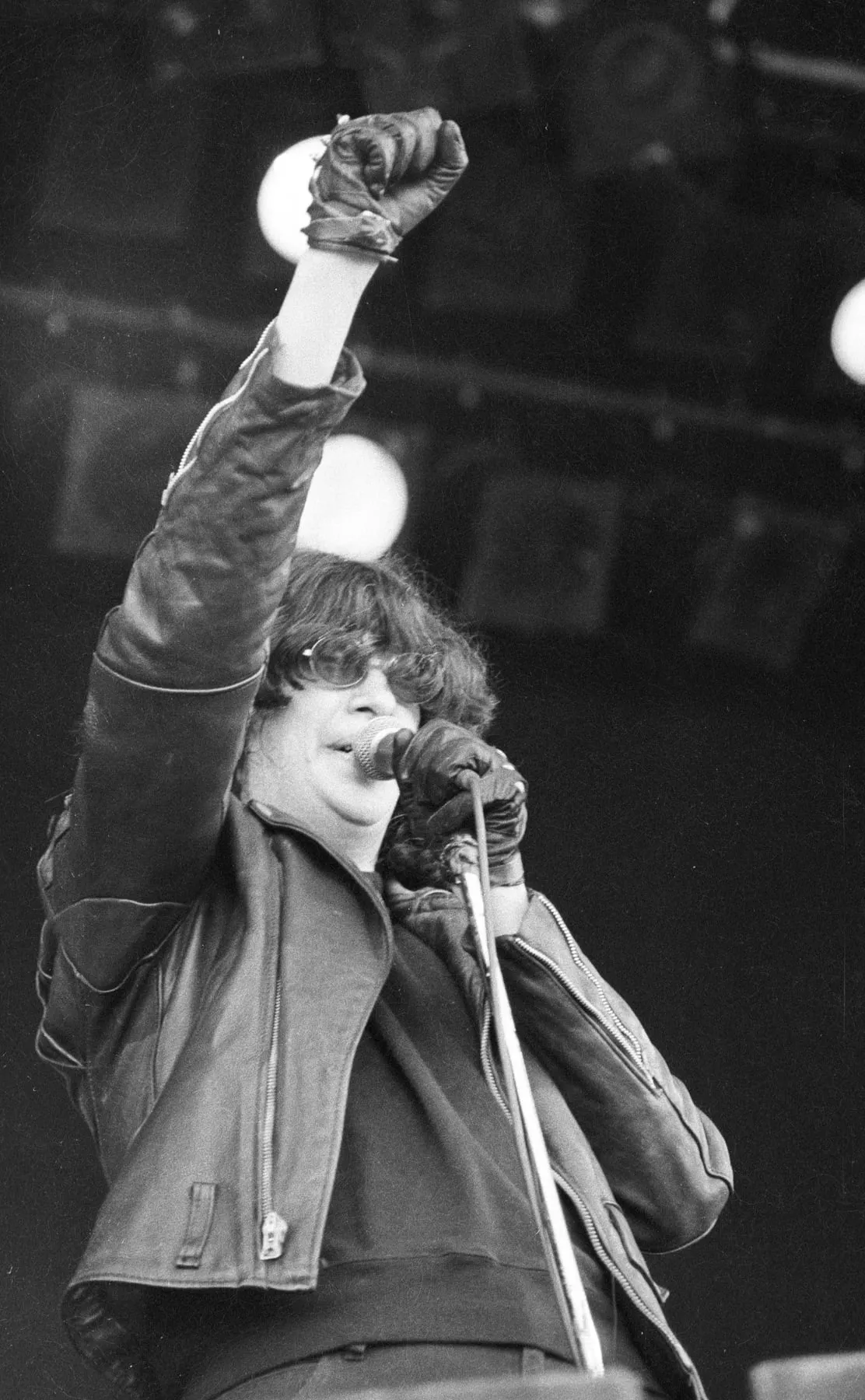
Photo by Yves Lorson , licensed under CC BY 2.0 · Wikimedia Commons
Rank #476
Joey Ramone
From Wikipedia
Jeffrey Ross Hyman, known professionally as Joey Ramone, was an American singer, songwriter, and the lead vocalist and founding member of the punk rock band Ramones, with Johnny Ramone and Dee Dee Ramone. His image, voice, and tenure with the Ramones made him a countercultural icon.
Discography & Previews
Browse through and click an album to open and play 30-second previews streamed from Apple Music.

Don’t Worry About Me
2002 · 11 tracks
- 1 What a Wonderful World ↗ 2:23
- 2 Stop Thinking About It ↗ 2:58
- 3 Mr. Punchy ↗ 2:36
- 4 Maria Bartiromo ↗ 3:58
- 5 Spirit In My House ↗ 2:02
- 6 Venting (It's a Different World Today) ↗ 3:18
- 7 Like a Drug I Never Did Before ↗ 2:03
- 8 Searching for Something ↗ 4:12
- 9 I Got Knocked Down (But I'll Get Up) ↗ 3:40
- 10 1969 ↗ 3:38
- 11 Don't Worry About Me ↗ 3:55
-
 Don’t Worry About MeJoey Ramone200211 tracks
Deep Dive
Overview
Joey Ramone was the lead vocalist and founding member of the Ramones, the seminal punk rock band that emerged in 1970s New York and became one of the most influential acts in rock history. Born Jeffrey Ross Hyman, Joey became synonymous with punk rock through his distinctive voice, commanding stage presence, and role in shaping the genre’s aesthetic and sonic foundations. His image—tall, rail-thin, and clad in torn jeans, leather jackets, and dark sunglasses—became as iconic as his vocal performances, making him a countercultural figure whose influence extended far beyond music into fashion, attitude, and the broader cultural rebellion of his era.
Joey Ramone’s career with the Ramones spanned decades, making him one of punk rock’s most enduring voices. After the band’s initial dissolution, he pursued a solo recording career that allowed him to explore different musical territories while maintaining the punk ethos that had defined his life’s work. His contributions to rock music—both as the frontman of a revolutionary band and as a solo artist—cemented his place as a foundational figure in the genre.
Formation Story
Jeffrey Ross Hyman grew up in New York City during the 1950s and 1960s, a period when rock and roll was establishing itself as the dominant popular music form. His path to punk rock emerged organically from the New York underground scene of the early 1970s, where artistic experimentation and raw energy defined the emerging rock counterculture. In the mid-1970s, Hyman joined forces with Johnny Ramone and Dee Dee Ramone to form the Ramones, adopting the stage name Joey Ramone as part of the band’s collective identity. The three founded the group in New York City, tapping into the city’s vibrant and rebellious music scene that was simultaneously producing other influential acts and fostering an environment where punk rock could take root and flourish.
The Ramones’ formation marked a deliberate break from the complex, lengthy arrangements and polished production of 1970s rock. Instead, the band committed to short, sharp, minimalist songs built on power chords, steady drum beats, and Joey’s distinctive, often nasal vocal delivery. This formula—simplicity as artistic statement—became the template for punk rock worldwide and distinguished the Ramones from their contemporaries in the classic rock establishment.
Breakthrough Moment
The Ramones achieved their breakthrough through relentless touring and the gradual build of an underground following that eventually crossed into mainstream recognition. Their early albums for Sire Records, beginning in the mid-1970s, established the band’s signature sound and aesthetic. The period between their debut and the late 1970s saw the Ramones transition from a cult phenomenon to a band that had proven punk rock could sustain a recording career and touring presence. While the Ramones never achieved the chart dominance of some classic rock acts, their impact on popular culture and the music industry was profound, as radio stations and critics began to recognize punk rock as a legitimate and enduring force rather than a passing fad.
Joey Ramone’s presence was central to this breakthrough. His vocal style—distinctive, often abrasive, yet unexpectedly affecting—made the band immediately recognizable. Live performances showcased his ability to command an audience and embody punk rock’s confrontational energy, helping the Ramones build a devoted fanbase that extended from New York across North America and eventually worldwide.
Peak Era
The peak period of Joey Ramone’s career with the Ramones extended through the 1970s and 1980s, when the band released its most celebrated and historically significant recordings. During these decades, the Ramones refined their songwriting craft while maintaining the raw power that had defined their early work. The band’s ability to produce catchy, memorable songs with punk rock’s aggression and speed became their hallmark, influencing countless subsequent artists across multiple genres. The Ramones’ sustained output and touring schedule during this era established them as one of rock’s most consistent and important live acts, with Joey Ramone’s performances becoming legendary for their intensity and commitment.
The band’s longevity during this period set them apart from many punk rock contemporaries. While other punk acts either broke up, evolved into post-punk or new wave, or faded from public view, the Ramones maintained their core identity and continued recording and touring. This persistence, under Joey Ramone’s leadership as frontman, helped ensure that punk rock remained a vital and evolving force in rock music throughout the 1980s and beyond.
Musical Style
Joey Ramone’s vocal approach was unconventional within the broader landscape of rock singing. His voice possessed a nasal, sometimes strained quality that could sound harsh or abrasive on first listen, yet this very distinctiveness made the Ramones instantly recognizable and gave their songs an unusual emotional resonance. Unlike the technically polished singers of classic rock, Joey’s delivery was rooted in punk rock’s ethos of authenticity and raw expression over technical virtuosity. His vocal lines were typically simple and repetitive, following the band’s minimalist song structures that favored directness and memorable hooks over complexity.
The Ramones’ musical style—and Joey’s role within it—drew from 1950s rock and roll, garage rock, and early British Invasion bands, yet synthesized these influences into something entirely new. Fast, loud, stripped-down arrangements became the punk rock standard, and the Ramones were among the first and most influential practitioners of this approach. Joey’s singing fit seamlessly into this aesthetic: his voice was another instrument in the band’s arsenal, adding texture and character rather than dominating the mix. Over time, even as the Ramones experimented with different production approaches and songwriting themes, Joey’s vocal signature remained consistent, a unifying element that defined the band’s identity across changing musical landscapes.
Major Albums
Don’t Worry About Me (2002)
Released posthumously, this solo album showcased Joey Ramone’s musical range and allowed him to explore directions beyond the Ramones’ established formula. The album demonstrated his abilities as a songwriter and interpreter of material, featuring interpretations and original songs that reflected his continued artistic engagement with rock music.
…Ya Know? (2012)
This later solo release further established Joey Ramone’s independent recording legacy, demonstrating his sustained presence in rock music beyond his primary association with the Ramones. The album represented his continued creative output and artistic vision.
Signature Songs
- “Blitzkrieg Bop” — The Ramones’ most recognizable anthem, featuring the iconic chant that became a template for punk rock crowd participation and energy.
- “I Wanna Be Sedated” — A deceptively catchy song about numbness and alienation, showcasing the Ramones’ ability to combine pop sensibility with punk attitude.
- “Teenage Lobotomy” — A rapid-fire excoriation of American cultural institutions, exemplifying the band’s satirical edge and Joey’s delivery of pointed social commentary.
- “Rock and Roll Radio” — A love letter to rock and roll itself, demonstrating the Ramones’ reverence for the genre’s history while updating it for the punk era.
Influence on Rock
Joey Ramone’s influence on rock music extends far beyond punk rock, though that genre remains his primary legacy. The Ramones, with Joey as frontman, proved that simplicity, rawness, and energy could be more compelling than technical proficiency or lengthy arrangements. This lesson reverberated through subsequent punk, post-punk, new wave, and alternative rock movements. Bands across genres adopted the Ramones’ approach to songwriting and performance, recognizing that directness and emotional authenticity could connect with audiences more powerfully than complexity.
The band’s influence also shaped rock’s visual culture and attitude. Joey Ramone’s image—the look, the swagger, the defiant stance—became a blueprint for punk rock identity. His refusal to adopt mainstream rock’s codes of polish and presentation, and his embodiment of punk’s countercultural rejection of such codes, influenced how rock musicians understood and performed identity itself. The Ramones’ impact on alternative rock, grunge, and subsequent indie rock movements cannot be overstated; nearly every rock musician working in the post-1970s era had to reckon with the Ramones’ achievement and Joey Ramone’s role in it.
Legacy
Joey Ramone’s legacy is inseparable from the Ramones’ historical significance as one of rock music’s most important bands. Though he died in 2001, his influence has only grown, with the Ramones now recognized as foundational figures in rock history. Streaming services, reissues, and critical reappraisals have ensured that new generations of listeners discover Joey Ramone’s voice and the Ramones’ catalog. His countercultural icon status remains intact, with his image and sound continuing to inspire musicians, fashion designers, and cultural figures.
The posthumous release of Don’t Worry About Me introduced listeners to Joey as a solo artist, revealing different facets of his musicianship and artistic vision. His work remains relevant to contemporary rock and punk scenes, where the band’s influence is constant and acknowledged. Joey Ramone’s contribution to rock music—both as a vocalist and as a symbolic figure representing punk rock’s values and aesthetics—ensures his place among the most important figures in the genre’s history.
Fun Facts
- Joey Ramone’s real name, Jeffrey Ross Hyman, was replaced by his professional stage name as part of the Ramones’ collective reimagining of identity, with all four band members adopting the Ramone surname.
- His distinctive appearance, including his tall frame and dark sunglasses, became so iconic that the image became synonymous with punk rock itself, influencing how rock musicians understood visual presentation and identity.
- Joey Ramone’s official website remains active, serving as a repository for his legacy and information about his solo work and the Ramones’ continuing cultural impact.