
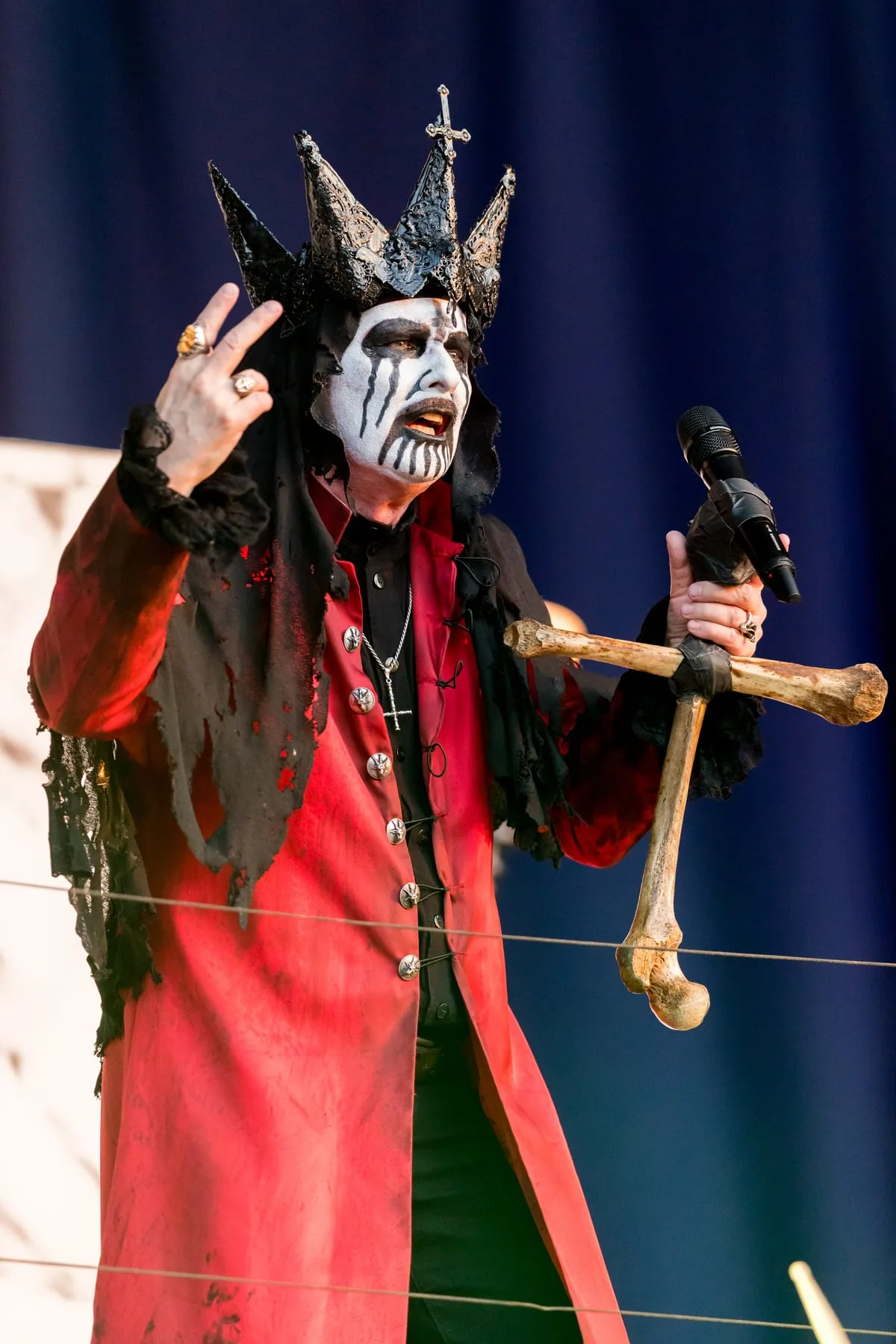
Photo by Sven Mandel , licensed under CC BY-SA 4.0 · Wikimedia Commons
Rank #341
King Diamond
From Wikipedia
Kim Bendix Petersen, better known by his stage name King Diamond, is a Danish rock musician. As a vocalist, he is known for his powerful and wide-ranging countertenor singing voice, in particular his far-reaching falsetto screams. He is the lead vocalist and lyricist for both Mercyful Fate and the eponymous King Diamond. He also plays keyboards and guitars on studio recordings but uses live shows to focus solely on his vocal performance. Diamond is renowned for his dark lyrical content and his story concepts. He is also known for his distinctive shock stage persona. He has been an influence for other rock and metal artists, including Metallica, Slayer and Cradle of Filth.
Deep Dive
Overview
King Diamond—born Kim Bendix Petersen in Denmark—stands as one of heavy metal’s most distinctive and technically accomplished vocalists. His countertenor voice, capable of producing far-reaching falsetto screams and a powerful dynamic range, became his defining trademark. Beyond pure vocal prowess, Diamond established himself as a conceptual storyteller and theatrical performer whose dark lyrical sensibilities and shock stage presence left an indelible mark on rock and metal music across multiple decades. His work as both the lead vocalist and lyricist for Mercyful Fate and later his eponymous solo project positioned him as a crucial figure linking traditional heavy metal with the darker aesthetic movements that would follow.
Formation Story
King Diamond emerged from Denmark during an era when Scandinavian heavy metal was still finding its voice within the broader rock landscape. Beginning his career in the mid-1950s, he developed his craft within the Northern European rock and metal scene, gradually honing the vocal techniques and theatrical sensibilities that would define his artistic identity. His path into rock music reflected the broader cultural expansion of the genre across Europe, where musicians found opportunity to synthesize local influences with the heavy metal vocabulary emerging from Britain and America. Denmark’s position as a culturally engaged Nordic nation provided the backdrop for his artistic development, though his ambitions and vocal gift would eventually propel him far beyond regional boundaries.
Breakthrough Moment
King Diamond’s ascent to broader recognition came through his work with Mercyful Fate, where he served as the lead vocalist and primary songwriter. The band’s output established him as a major voice in heavy metal, demonstrating that his virtuosic vocal range and conceptual storytelling could anchor ambitious, musically sophisticated projects. His ability to shift between powerful mid-range delivery and piercing falsetto screams set him apart from his contemporaries, and his lyrics—featuring dark, often horror-influenced narratives—gave the music a literary dimension that elevated it beyond standard metal fare. This dual reputation as both a technically exceptional vocalist and a conceptual artist prepared the ground for his solo work, which would allow him greater control over the thematic and musical direction of his output.
Peak Era
King Diamond’s most creatively significant period spanned his work with Mercyful Fate and the establishment of his solo career, during which he consolidated his reputation as one of metal’s most commanding frontmen. The consistency of his output and the loyalty of his fanbase demonstrated the depth of his influence within the metal community. His ability to balance theatrical shock presentation with genuine musical complexity—playing keyboards and guitars on studio recordings while commanding the stage solely as a vocalist—showed an artist in full command of his craft. This era solidified his status not merely as a vocalist but as a complete artistic entity capable of shaping entire sonic landscapes through performance, composition, and conceptual vision.
Musical Style
King Diamond’s vocal approach represents a unique deployment of countertenor range within heavy metal, a genre typically dominated by baritones and mid-range singers. His far-reaching falsetto screams became a signature technique, allowing him to access emotional and sonic registers unavailable to most metal vocalists. The power and precision of his voice—its ability to sustain high notes with dramatic intensity while dropping into lower registers with equal command—gave his performances an operatic quality that metal audiences had seldom encountered. Beyond vocals, his work on keyboards and guitars during studio sessions revealed an artist with broad instrumental competency, though his live focus remained on vocal performance. His lyrical content consistently explored dark themes and narrative structures, often building concept albums around horror, occult, or psychological storytelling. This combination of technical vocal mastery, conceptual ambition, and theatrical presentation created a coherent artistic voice that transcended standard heavy metal convention.
Major Albums
King Diamond’s discography spans both his collaborative work with Mercyful Fate and his extensive solo output. His recordings consistently demonstrate his commitment to conceptual storytelling and vocal showcase, with each project carefully crafted to highlight his range and his ability to anchor complex musical narratives. The consistency of his artistic vision across multiple projects speaks to his clarity of purpose as both a vocalist and songwriter. His body of work has remained in circulation among serious metal audiences, testament to the durability of his creative choices and the technical demand of his vocal performances.
Signature Songs
- His vocals on Mercyful Fate material showcase the full range of his countertenor ability, from powerful full-voice delivery to piercing falsetto screams.
- King Diamond’s solo work features extended vocal performances that emphasize his storytelling gift and technical control.
- Dark-themed compositions bearing his lyrical stamp became templates for horror and occult aesthetics in metal.
- Live performances highlight his ability to sustain complex vocal gymnastics while commanding an audience’s full attention through theatrical presence.
Influence on Rock
King Diamond’s influence on heavy metal and rock music extends far beyond technical vocal instruction, though his countertenor approach inspired subsequent generations of metal singers to explore their full range capabilities. Artists including Metallica, Slayer, and Cradle of Filth all drew inspiration from his work, incorporating elements of his dark conceptual approach and theatrical sensibility into their own output. His demonstration that metal could accommodate both extreme vocal technique and intellectual ambition—that shock value and artistic substance were not mutually exclusive—altered the expectations for what a metal frontman could be and accomplish. The theatrical, horror-influenced aesthetic that became increasingly prominent in metal from the 1990s forward owes a direct debt to his pioneering work in combining shock presentation with genuine musical complexity.
Legacy
King Diamond’s long career and continued active status—maintaining his performances and artistic vision into the present era—speaks to the enduring power of his original concept. His influence appears not merely in direct imitation but in the broader acceptance within metal culture of theatrical presentation, conceptual albums, and vocal virtuosity as legitimate artistic goals. Younger musicians and bands continue to reference his work, and his reputation as a technical and conceptual innovator remains secure within metal circles and among serious rock audiences. The combination of shock presentation and genuine musical substance that he pioneered has become a recognizable lineage within metal, influencing everything from symphonic metal to theatrical death metal. His continued touring and creative engagement demonstrate an artist who never compromised his vision despite changing fashions in the broader rock landscape.
Fun Facts
- King Diamond plays keyboards and guitars during studio recording sessions, though he dedicates himself entirely to vocal performance in live settings.
- His countertenor voice places him in a rare category among metal vocalists, making direct vocal comparison to his peers difficult and his technique particularly distinctive.
- His shock stage persona and dark lyrical content were developed as integral artistic choices rather than marketing gimmicks, reflecting a genuine commitment to horror-influenced storytelling within rock music.
- The breadth of his musical influence—spanning from traditional heavy metal acts to modern symphonic and theatrical metal—demonstrates the lasting power of his original artistic vision.