
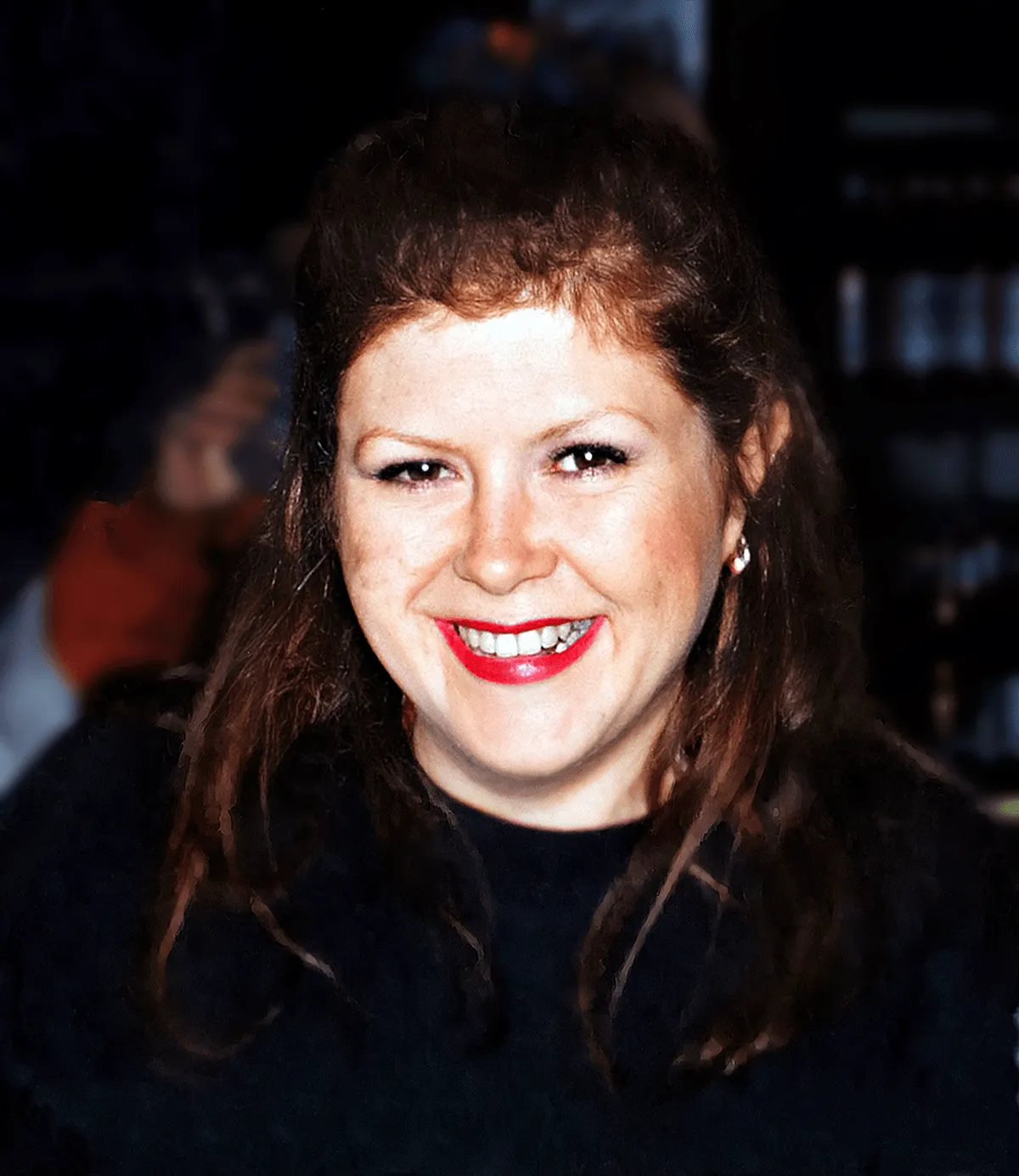
Photo by K8 fan at English Wikipedia , licensed under Public domain · Wikimedia Commons
Rank #402
Kirsty MacColl
From Wikipedia
Kirsty Anna MacColl was a British singer and songwriter. The daughter of folk singer Ewan MacColl, she recorded several pop hits in the 1980s and 1990s, including "There's a Guy Works Down the Chip Shop Swears He's Elvis" and cover versions of Billy Bragg's "A New England" and the Kinks' "Days". She also sang on a number of recordings produced by her husband Steve Lillywhite, most notably "Fairytale of New York" by the Pogues. Her first single, "They Don't Know", would have chart success a few years later when covered by Tracey Ullman. Her death in 2000 led to the "Justice for Kirsty" campaign.
Discography & Previews
Browse through and click an album to open and play 30-second previews streamed from Apple Music.

Desperate Character
1981 · 12 tracks
- 1 Clock Goes Round ↗ 2:36
- 2 See That Girl ↗ 3:02
- 3 There's A Guy Works Down The Chip Shop Swears He's Elvis ↗ 3:09
- 4 Teenager In Love ↗ 2:38
- 5 Mexican Sofa ↗ 3:18
- 6 Until The Night ↗ 3:14
- 7 Falling For Faces ↗ 2:34
- 8 Just One Look ↗ 2:24
- 9 The Real Ripper ↗ 3:29
- 10 Hard To Believe ↗ 2:22
- 11 He Thinks I Still Care ↗ 2:58
- 12 There’s A Guy Works Down The Chip Shop Swears He’s Elvis (Country Version) ↗ 3:48

Kite
1989 · 12 tracks
- 1 Innocence ↗ 4:10
- 2 Free World ↗ 2:37
- 3 Mother's Ruin ↗ 3:57
- 4 Days ↗ 3:00
- 5 No Victims ↗ 3:50
- 6 Fifteen Minutes ↗ 3:12
- 7 Don't Come the Cowboy with Me, Sonny Jim! ↗ 3:47
- 8 Tread Lightly ↗ 3:20
- 9 What Do Pretty Girls Do? ↗ 2:38
- 10 Dancing in Limbo ↗ 2:51
- 11 The End of a Perfect Day ↗ 3:22
- 12 You & Me Baby ↗ 2:38

Electric Landlady
1991 · 12 tracks
- 1 Walking Down Madison ↗ 6:36
- 2 All I Ever Wanted ↗ 3:50
- 3 Children of the Revolution ↗ 3:58
- 4 Halloween ↗ 3:39
- 5 My Affair ↗ 5:24
- 6 Lying Down ↗ 4:49
- 7 He Never Mentioned Love ↗ 3:52
- 8 We'll Never Pass This Way Again ↗ 4:26
- 9 The Hardest Word ↗ 4:37
- 10 Maybe It's Imaginary ↗ 2:13
- 11 My Way Home ↗ 4:27
- 12 The One & Only ↗ 3:45

Titanic Days
1993 · 11 tracks

Tropical Brainstorm
2000 · 13 tracks
- 1 Mambo de la Luna ↗ 4:38
- 2 In These Shoes? ↗ 3:39
- 3 Treachery ↗ 3:51
- 4 Here Comes That Man Again ↗ 4:50
- 5 Autumngirlsoup ↗ 3:54
- 6 Celestine ↗ 3:34
- 7 England 2 Colombia 0 ↗ 3:46
- 8 Nao Esperando ↗ 4:04
- 9 Alegria ↗ 2:01
- 10 US Amazonians ↗ 4:09
- 11 Wrong Again ↗ 4:15
- 12 Designer Life ↗ 2:34
- 13 Head ↗ 3:57

Real
2023 · 12 tracks
-
 Desperate CharacterKirsty MacColl198112 tracks
 -
 KiteKirsty MacColl198912 tracks
 -
 Electric LandladyKirsty MacColl199112 tracks
 -
 Titanic DaysKirsty MacColl199311 tracks
 -
 Tropical BrainstormKirsty MacColl200013 tracks
 -
 RealKirsty MacColl202312 tracks
Deep Dive
Overview
Kirsty MacColl was a British singer and songwriter who emerged as a significant voice in new wave and pop music during the 1980s and 1990s. Born in 1959 to folk singer Ewan MacColl, she bridged the gap between her father’s acoustic traditions and the electric pop sensibilities of her era, carving out a distinctive career marked by clever original compositions and reinterpretations of songs by established artists. Her death in 2000 at the age of 41 cut short a recording life that had produced five studio albums and established her as a respected figure in British popular music.
Formation Story
Kirsty MacColl grew up in London as the daughter of Ewan MacColl, a prominent figure in the British folk revival and political songwriting tradition. Immersed in music from childhood, she was exposed to both folk music’s lyrical sophistication and its commitment to storytelling. Rather than follow her father’s folk path directly, MacColl gravitated toward the emerging sounds of new wave and pop during the late 1970s, absorbing the energy and production techniques of contemporary British music. She began her recording career in the early 1980s, signing to Stiff Records and releasing her debut album Desperate Character in 1981, establishing herself as a performer in her own right while carrying forward her family’s legacy of strong, literate songwriting.
Breakthrough Moment
MacColl’s first commercial breakthrough came through an unexpected route. Her early single “They Don’t Know”, while not achieving major chart success in its original form, would gain substantial recognition when cover artist Tracey Ullman recorded and released it as a hit a few years later. However, MacColl’s own ascent to broader recognition came through her work as a featured vocalist on high-profile recordings and through her own pop singles during the 1980s. Her interpretations of existing songs—most notably her cover of the Kinks’ “Days”—demonstrated her ability to inhabit material with intelligence and emotional depth. The most iconic of these collaborations came when she lent her voice to “Fairytale of New York” by the Pogues, a recording produced by her husband Steve Lillywhite that would become one of the most celebrated Christmas songs in British popular culture.
Peak Era
MacColl’s most sustained creative period occurred between 1989 and 1993, during which she released three studio albums: Kite (1989), Electric Landlady (1991), and Titanic Days (1993). During this span, she solidified her reputation as both a sophisticated songwriter and a compelling interpreter, balancing original compositions with carefully chosen covers. The album Electric Landlady in particular showcased her matured artistic voice, pairing her own material with a cover of Billy Bragg’s “A New England”, a choice that highlighted her roots in socially conscious songwriting while asserting her distinct pop sensibility. Throughout this period, her work was increasingly shaped by her collaborations with producer Steve Lillywhite, whose production philosophy complemented MacColl’s clear vocal delivery and rhythmic sensibility.
Musical Style
Kirsty MacColl’s music occupied a space between new wave’s angular energy and pop music’s accessibility and melodic tradition. Her voice—clear, direct, and capable of both vulnerability and wit—became her signature instrument, often deployed over arrangements that favored clean production, prominent drums, and guitar work that moved between jangly new-wave textures and more straightforward pop instrumentation. Her songwriting inherited the lyrical specificity and social observation of her father’s folk tradition but applied it to contemporary pop contexts; songs like “There’s a Guy Works Down the Chip Shop Swears He’s Elvis” demonstrated her ear for character detail and humor. As her career progressed through the late 1980s and 1990s, her arrangements grew more expansive while maintaining clarity, with production choices reflecting the shift toward fuller, more layered pop sounds of the era. Her gift for reinterpreting material by others—from folk standards to contemporary rock songs—revealed an understanding of melody, phrasing, and emotional architecture that transcended genre boundaries.
Major Albums
Desperate Character (1981)
MacColl’s debut album introduced her as a songwriter and performer, establishing the sharp observational style and pop sensibility that would define her career. Released on Stiff Records, it featured her early single “They Don’t Know” and signaled her intention to forge an identity distinct from her famous father.
Kite (1989)
After a period away from recording, MacColl returned with Kite, an album that demonstrated artistic maturation and refined production aesthetics. The album marked the beginning of her creative partnership with Steve Lillywhite and established her as a major recording artist in her own right during the post-punk pop landscape.
Electric Landlady (1991)
This album represented MacColl at her commercial and creative peak, featuring both strong original compositions and her acclaimed cover of Billy Bragg’s “A New England”. The production and sequencing showcased her range as an interpreter and songwriter, making it her strongest statement of artistic identity.
Titanic Days (1993)
MacColl’s final album of the 1990s continued her balancing act between original material and covers, maintaining the pop sensibility and production clarity that had become her trademark. The album underscored her sustained relevance in British pop music during a period of rapid stylistic change.
Signature Songs
- “There’s a Guy Works Down the Chip Shop Swears He’s Elvis”—MacColl’s most famous original composition, demonstrating her gift for character-driven narrative songwriting with humor and specificity.
- “Days”—Her cover of the Kinks’ classic revealed her ability to inhabit existing material with fresh vocal interpretation and arrangement.
- “A New England”—A reinterpretation of Billy Bragg’s song that became closely associated with MacColl and showcased her understanding of the socially conscious pop tradition.
- “Fairytale of New York”—Her collaboration with the Pogues on this festive composition became one of the most enduring and beloved recordings in British popular culture.
- “They Don’t Know”—Her early single, later made famous by Tracey Ullman’s cover version, established her songwriting voice and commercial potential.
Influence on Rock
While primarily a pop artist, Kirsty MacColl’s work exerted influence within the broader new wave and alternative music landscape of the 1980s and 1990s. Her approach to songwriting—drawing on folk tradition’s lyrical specificity while embracing contemporary pop production—provided a model for artists seeking to bridge acoustic and electric sensibilities. Her prominence as a female recording artist during a period when new wave offered visibility to women performers helped establish pathways for other singer-songwriters in the genre. Her collaborations with Steve Lillywhite and her association with the Pogues connected her to broader networks of British alternative music, influencing how producers and artists approached the intersection of pop accessibility and artistic ambition. Her intelligence as an interpreter of existing material—choosing covers that revealed new dimensions in songs—demonstrated an approach to the cover song as artistic statement rather than commercial expedient.
Legacy
Kirsty MacColl’s death in 2000 at age 41 prompted the “Justice for Kirsty” campaign, reflecting the enduring affection and respect in which she was held by fans and fellow musicians. Her five studio albums remain in circulation, with her work periodically rediscovered by new audiences through streaming platforms and reissues. “Fairytale of New York” continues to receive substantial radio play during the holiday season, keeping her voice present in contemporary popular culture and introducing her artistry to listeners unfamiliar with her broader catalog. Her career trajectory—from the daughter of a folk legend to an independent artist navigating new wave and pop on her own terms—established a template for how family legacy could be honored while forging distinct artistic identity. The combination of her songwriting intelligence, her interpretive gifts, and her clear vocal presence ensures her continued recognition within British pop music history.
Fun Facts
- Kirsty MacColl was the daughter of Ewan MacColl, a towering figure in the British folk revival and political songwriting tradition, yet she chose to pursue a fundamentally different musical path in new wave and pop.
- She was married to producer Steve Lillywhite, who became instrumental in shaping the sound of her most successful recordings, creating a professional and personal partnership that lasted through much of her career.
- “Fairytale of New York”, the Pogues recording on which she performed, became a staple of Christmas programming in the United Kingdom and remains one of the most-played holiday songs in British radio history.
- Her first single, “They Don’t Know”, found its widest audience not through her own recording but through Tracey Ullman’s later cover version, which became a significant hit and introduced MacColl’s songwriting to a broader mainstream audience.