
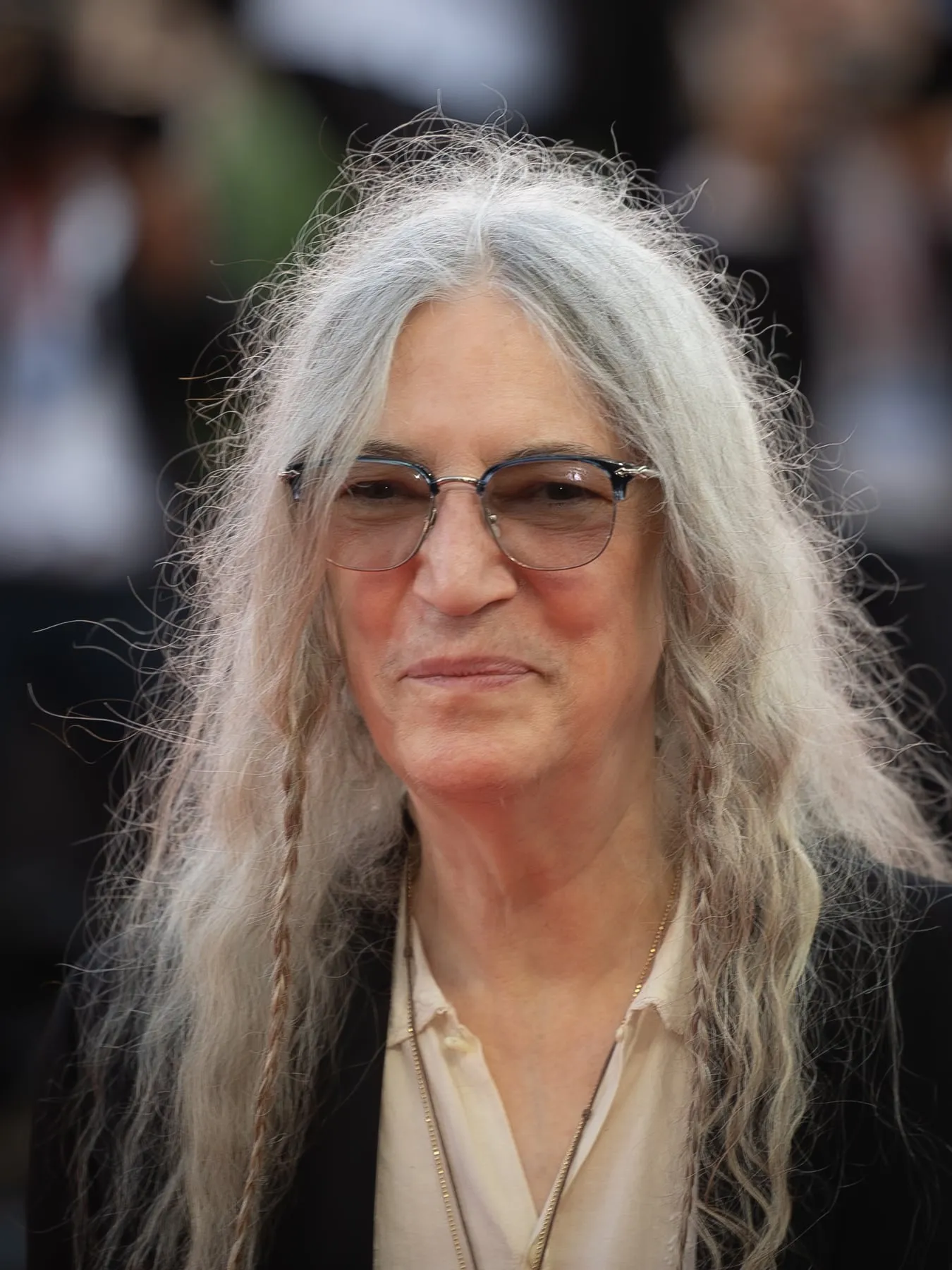
Photo by Harald Krichel , licensed under CC BY-SA 4.0 · Wikimedia Commons
Rank #19
Patti Smith
From Wikipedia
Patricia Lee Smith is an American singer, songwriter, poet, painter, author, and photographer. Her 1975 debut album Horses made her an influential member of the New York City–based punk rock movement. Smith has fused rock and poetry in her work. In 1978, her most widely known song, "Because the Night," co-written with Bruce Springsteen, reached number 13 on the Billboard Hot 100 chart and number five on the UK Singles Chart.
Discography & Previews
Browse through and click an album to open and play 30-second previews streamed from Apple Music.


Gung Ho
2000 · 13 tracks


Twelve
2007 · 12 tracks
- 1 Are You Experienced? ↗ 4:46
- 2 Everybody Wants to Rule the World ↗ 4:07
- 3 Helpless ↗ 4:02
- 4 Gimme Shelter ↗ 5:01
- 5 Within You Without You ↗ 4:51
- 6 White Rabbit ↗ 3:55
- 7 Changing of the Guards ↗ 5:48
- 8 The Boy in the Bubble ↗ 4:31
- 9 Soul Kitchen ↗ 3:45
- 10 Smells Like Teen Spirit ↗ 6:32
- 11 Midnight Rider ↗ 4:03
- 12 Pastime Paradise ↗ 5:26


Killer Road
2016 · 9 tracks
- 1 Killer Road (feat. Patti Smith) ↗ 4:29
- 2 My Heart Is Empty (feat. Patti Smith) ↗ 6:52
- 3 Evening of Light (feat. Patti Smith) ↗ 5:02
- 4 Saeta (feat. Patti Smith) ↗ 4:46
- 5 Secret Side (feat. Patti Smith) ↗ 4:00
- 6 Fearfully in Danger (feat. Patti Smith) [Live] ↗ 6:43
- 7 I Will Be Seven (feat. Patti Smith) [Live] ↗ 6:19
- 8 The Sphinx (feat. Patti Smith) [Live] ↗ 7:08
- 9 My Only Child (feat. Patti Smith) ↗ 4:48

Mummer Love
2019 · 8 tracks
- 1 Aw Abadir ↗ 1:16
- 2 La Maison de Rimbaud (feat. Philip Glass) ↗ 10:02
- 3 Eternity (feat. Philip Glass & Sufi group of Sheikh Ibrahim) ↗ 6:48
- 4 Song of the Highest Tower (feat. Mulatu Astatke & Sufi group of Sheikh Ibrahim) ↗ 4:38
- 5 Mummer Love ↗ 8:36
- 6 Farewell ↗ 8:19
- 7 Bad Blood (feat. Philip Glass & Sufi group of Sheikh Ibrahim) ↗ 7:53
- 8 Sensation (feat. Mulatu Astatke & Sufi group of Sheikh Ibrahim) ↗ 3:58

The Peyote Dance
2019 · 8 tracks
- 1 Una Nota Sobre El Peyote (feat. Gael García Bernal) ↗ 4:27
- 2 Indian Culture (feat. Patti Smith) ↗ 9:39
- 3 Tutuguri: The Rite of the Black Sun (feat. Patti Smith) ↗ 5:00
- 4 Tutuguri: The Rite of Black Night (feat. Patti Smith) ↗ 9:57
- 5 The New Revelations of Being (feat. Patti Smith) ↗ 3:37
- 6 Alienation and Black Magic (feat. Patti Smith) ↗ 10:43
- 7 Ivry (feat. Patti Smith) ↗ 6:47
- 8 Basalówala Aminá Ralámuli Paísila (feat. Patti Smith) ↗ 4:39

Peradam
2020 · 9 tracks
- 1 Nanda Devi (feat. Anoushka Shankar, Tenzin Choegyal & Charlotte Gainsbourg) ↗ 3:49
- 2 Peradam (feat. Anoushka Shankar, Tenzin Choegyal & Charlotte Gainsbourg) ↗ 7:47
- 3 Knowledge of the Self (feat. Anoushka Shankar, Tenzin Choegyal & Charlotte Gainsbourg) ↗ 5:47
- 4 Dawn in Rishikesh (feat. Anoushka Shankar, Tenzin Choegyal & Charlotte Gainsbourg) ↗ 4:56
- 5 Spiritual Death (feat. Anoushka Shankar, Tenzin Choegyal & Charlotte Gainsbourg) ↗ 7:47
- 6 The Four Cardinal Times (feat. Anoushka Shankar, Tenzin Choegyal & Charlotte Gainsbourg) ↗ 4:44
- 7 Hymn To the Liquid (feat. Anoushka Shankar, Tenzin Choegyal & Charlotte Gainsbourg) ↗ 4:26
- 8 Vera (feat. Anoushka Shankar, Tenzin Choegyal & Charlotte Gainsbourg) ↗ 7:29
- 9 The Rat (feat. Anoushka Shankar, Tenzin Choegyal & Charlotte Gainsbourg) ↗ 7:51

Correspondences, Vol. 1
2024 · 2 tracks
-
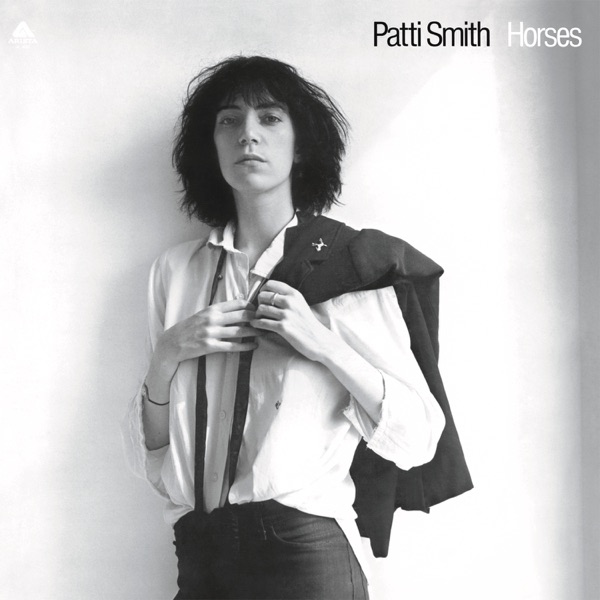
 HorsesPatti Smith19758 tracks
 -
 Dream of LifePatti Smith19888 tracks
 -
 Gone AgainPatti Smith199611 tracks
 -
 Peace and NoisePatti Smith199710 tracks
 -
 Gung HoPatti Smith200013 tracks
 -
 Trampin’Patti Smith200311 tracks
 -
 TwelvePatti Smith200712 tracks
 -
 BangaPatti Smith201212 tracks
 -
 Killer RoadPatti Smith20169 tracks
 -
 Mummer LovePatti Smith20198 tracks
 -
 The Peyote DancePatti Smith20198 tracks
 -
 PeradamPatti Smith20209 tracks
 -
 Correspondences, Vol. 1Patti Smith20242 tracks
Deep Dive
Overview
Patti Smith stands as one of the most consequential figures in post-punk and art rock history. Born in 1946, she emerged in the mid-1970s New York City punk movement as a singular talent: a poet who brought literary ambition and raw emotional intensity to rock music, fundamentally reshaping what the genre could be. Her 1975 debut album Horses announced her arrival as an influential voice, one who would fuse the aesthetics of avant-garde poetry with the urgency of punk, creating a sound both immediately recognizable and fundamentally uncompromising.
Smith’s career trajectory—from punk insurgent to elder statesman of rock—reflects a decades-long commitment to artistic integrity. Her work across five decades has earned her recognition as a painter, author, and photographer alongside her musical output, embodying the cross-disciplinary sensibility that defined the most ambitious rock artists of her generation.
Formation Story
Patti Smith’s path to rock music emerged from the artistic ferment of New York City in the early 1970s. A poet and visual artist first, Smith came to rock as an idiom capable of holding the complexity and transgression she sought in her work. She was not born into a musical family nor trained as a classically disciplined musician; instead, she approached the guitar and microphone as tools for poetry, much as she might approach paint or photography. Her artistic sensibility—shaped by modernist poetry, photography, and the visual avant-garde—crystallized into a new form when she began performing her poetry with musical accompaniment, blending the spoken and sung word in ways that challenged the boundaries between poetry readings and rock performances.
This hybrid approach positioned her at the vanguard of New York’s emerging punk scene, a movement that in the mid-1970s was coalescing around venues like CBGB in the Lower East Side. Smith became a focal point of that movement without being fully defined by punk’s three-chord simplicity; her music incorporated punk’s raw energy and stripped-down production while retaining the literary ambition and improvisational spirit that set her apart from contemporaries.
Breakthrough Moment
Smith’s breakthrough came with her debut album Horses in 1975, a record that announced a fully formed artistic voice. Sparse, guitar-driven, and dominated by her distinctive vocals—conversational one moment, incantatory the next—Horses introduced listeners to a poet-musician who refused easy categorization. The album’s opening track, a reimagining of “Gloria” by Van Morrison’s proto-punk group Them, became her calling card: Smith’s reading of the lyrics as sexual and spiritual autobiography transformed the song into a statement of artistic intent.
Wider recognition came in 1978 with “Because the Night,” co-written with Bruce Springsteen. The song reached number 13 on the Billboard Hot 100 chart and number five on the UK Singles Chart, bringing Smith’s music to mainstream audiences while maintaining its emotional directness and lyrical sophistication. The collaboration underscored Smith’s standing among rock’s most serious artists; Springsteen’s willingness to work with her, and her reciprocal willingness to shape a song for radio play, marked her as a bridge between punk’s aesthetic uncompromise and rock’s larger cultural presence.
Peak Era
The late 1970s represented Smith’s initial peak, a period when her artistic vision achieved its fullest early expression across consecutive albums. Following Horses with Superbunny in 1976, she consolidated her position within rock’s avant-garde while her musical reach expanded. This era established the core of her aesthetic: the integration of poetry, rock instrumentation, and visual presentation; the use of her voice as an instrument capable of multiple registers and emotional intensities; and a refusal to separate “high” art from popular music.
After a long hiatus from recording, Smith returned to the studio with Dream of Life in 1988, beginning a second phase of her career. The subsequent decades saw her continue recording and performing, with albums including Gone Again (1996), Peace and Noise (1997), Gung Ho (2000), and Trampin’ (2003) anchoring her presence in contemporary rock. This later work demonstrated that Smith’s approach remained vital; she continued to fuse poetry and rock, to explore lyrical and musical complexity, and to refuse the diminishment that often accompanies aging within popular music.
Musical Style
Smith’s sound is fundamentally characterized by the integration of spoken and sung vocals, often within the same song or even the same phrase. Her voice operates across a wide range of timbral and emotional registers—conversational and intimate in one moment, visceral and transgressive in another. Lyrically, she draws on modernist poetry and autobiography, employing dense imagery, fragmented narratives, and philosophical inquiry rather than conventional songwriting structures.
Musically, her guitar-based approach evolved from the spare, feedback-driven sound of her early work toward greater textural variety in her later recordings. Horses, for instance, relies on skeletal arrangements that foreground vocal delivery; subsequent albums incorporated fuller instrumental textures while maintaining the directness that characterizes her work. Her approach to production—whether stripped-down or more elaborately arranged—always prioritizes clarity of vocal delivery and lyrical meaning. Thematically, Smith’s songwriting engages with love, mortality, spirituality, social justice, and artistic creation, treating these subjects with the seriousness of poetry while retaining rock’s emotional immediacy.
Major Albums
Horses (1975)
Her debut album announced a fully realized artistic voice: sparse, poetic, and musically urgent. The reimagining of “Gloria” and the extended meditation “Birdland” established Smith as a poet-musician working at the intersection of avant-garde and punk sensibilities.
Superbunny (1976)
Smith’s follow-up consolidated her position as a major voice in punk and art rock, continuing to fuse literary ambition with rock’s directness and demonstrating her artistic range across multiple songs.
Dream of Life (1988)
Marking her return to recording after a decade’s hiatus, Dream of Life demonstrated that Smith’s artistic vision remained vital and uncompromised, reestablishing her presence in contemporary rock.
Gone Again (1996)
This album reflected Smith’s mature artistic perspective, addressing loss and memory while maintaining the lyrical sophistication and musical directness that define her work.
Peace and Noise (1997)
Released the year after Gone Again, this album continued Smith’s exploration of contemporary themes, affirming her role as a serious artist addressing the world around her.
Trampin’ (2003)
This late-period album showcased Smith’s undiminished artistic vitality, combining the literary ambition of her early work with the sonic sophistication of her mature style.
Signature Songs
- “Gloria” — Her reimagining of Van Morrison’s song became her signature performance and a statement of artistic intent, transforming the original through Smith’s poetic reinterpretation.
- “Because the Night” — Co-written with Bruce Springsteen, this widely known song reached the top 15 in the U.S. and brought Smith’s music to mainstream audiences.
- “Birdland” — An extended meditation from Horses, the song showcases Smith’s ability to sustain lyrical and musical intensity across an extended form.
- “People Have the Power” — A later composition that affirms Smith’s commitment to socially conscious songwriting and collective action.
Influence on Rock
Smith’s integration of poetry and rock fundamentally altered what rock music could be. By refusing the separation between “serious” literary art and popular music, she opened space for subsequent artists to pursue hybrid approaches, combining textual sophistication with musical directness. Post-punk and art rock movements that followed her initial emergence drew extensively from her model: the idea that rock could be intellectual and visceral simultaneously, that lyrics could aspire to literary complexity without sacrificing emotional immediacy.
Beyond music, Smith’s example—as a visual artist, photographer, author, and poet who also made rock music—challenged the compartmentalization of artistic disciplines. Her insistence on cross-media practice influenced how subsequent musicians understood artistic identity, demonstrating that excellence in one medium could coexist with serious work in others.
Legacy
Smith’s career, now spanning five decades, has earned her recognition as one of rock’s defining figures. Her influence extends across generations of musicians who have encountered her work—both through her pioneering albums of the 1970s and through her continued recording and touring in subsequent decades. The consistency of her artistic vision, the refusal to compromise or chase commercial trends, and the depth of her engagement with poetry, visual art, and photography have cemented her status as a major cultural figure beyond the narrow confines of rock history.
Her ongoing recording activity—including Banga (2012), Killer Road (2016), and the Correspondences series beginning in 2024—demonstrates that her artistic engagement remains vital. Smith stands as a model of artistic integrity and creative longevity, a figure whose fundamental contribution to rock music was the insistence that the genre could accommodate poetry, ambition, and uncompromising artistic vision.
Fun Facts
- Smith is also an accomplished photographer and visual artist, having exhibited her work independently of her music career and published several photography collections.
- She has authored multiple books beyond her musical output, including memoirs and essay collections, maintaining a parallel career as a writer.
- Her 2007 album Covers The Rolling Stones demonstrates her ongoing engagement with rock history and her ability to reinterpret canonical works through her distinctive artistic lens.
- Smith has maintained deep artistic relationships across disciplines, collaborating with visual artists, filmmakers, and musicians throughout her career, embodying the cross-media sensibility she championed since the 1970s.