

Photo by Stefan Brending ( 2eight ) , licensed under CC BY-SA 3.0 de · Wikimedia Commons
Rank #326
Suzi Quatro
From Wikipedia
Susan Kay Quatro is an American-British singer, bass guitarist, songwriter, and actress. In the 1970s, she scored a string of singles that found success in Europe and Australia, with both "Can the Can" (1973) and "Devil Gate Drive" (1974) reaching number one in several countries.
Discography & Previews
Browse through and click an album to open and play 30-second previews streamed from Apple Music.
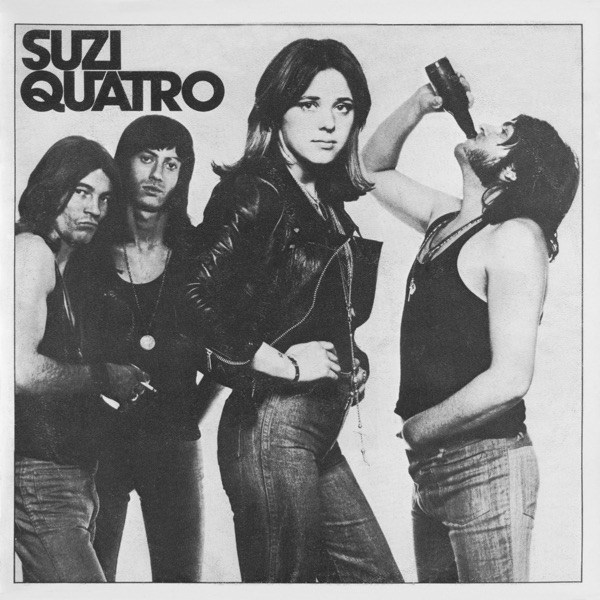
Suzi Quatro
1973 · 20 tracks
- 1 48 Crash ↗ 3:53
- 2 Glycerine Queen ↗ 3:49
- 3 Shine My Machine ↗ 3:51
- 4 Official Suburbian Superman ↗ 3:08
- 5 I Wanna Be Your Man ↗ 3:20
- 6 Primitive Love ↗ 4:15
- 7 All Shook Up ↗ 3:51
- 8 Sticks & Stones ↗ 3:42
- 9 Skin Tight Skin ↗ 4:22
- 10 Get Back Mamma ↗ 5:57
- 11 Rockin' Moonbeam ↗ 2:55
- 12 Shakin' All Over ↗ 3:34
- 13 Rolling Stone ↗ 2:47
- 14 Brain Confusion (For All the Lonely People) ↗ 3:12
- 15 Can the Can ↗ 3:34
- 16 Ain't Ya Somethin' Honey ↗ 4:08
- 17 Little Bitch Blue ↗ 3:27
- 18 Daytona Demon ↗ 4:03
- 19 Roman Fingers ↗ 3:49
- 20 Ain't Got No Home ↗ 2:19

Quatro
1974 · 16 tracks
- 1 The Wild One ↗ 3:47
- 2 Keep a Knockin' ↗ 3:14
- 3 Too Big ↗ 3:20
- 4 Klondyke Kate ↗ 3:30
- 5 Savage Silk ↗ 3:36
- 6 Move It ↗ 3:38
- 7 Hit the Road Jack ↗ 3:57
- 8 Trouble ↗ 3:46
- 9 Cat Size ↗ 4:37
- 10 A Shot of Rhythm and Blues ↗ 4:53
- 11 Friday ↗ 3:52
- 12 Devil Gate Drive ↗ 3:48
- 13 In the Morning ↗ 2:38
- 14 I Wanna Be Free ↗ 3:12
- 15 Shake My Sugar ↗ 3:59
- 16 The Wild One (Single Version) ↗ 2:52

Your Mamma Won’t Like Me
1975 · 10 tracks
- 1 I Bit off More Than I Could Chew (2017 Remaster) ↗ 3:46
- 2 Strip Me (2017 Remaster) ↗ 3:11
- 3 Paralysed (2017 Remaster) ↗ 2:46
- 4 Prisoner of Your Imagination (2017 Remaster) ↗ 4:53
- 5 Your Mama Won't Like Me (2017 Remaster) ↗ 4:00
- 6 Can't Trust Love (2017 Remaster) ↗ 3:43
- 7 New Day Woman (2017 Remaster) ↗ 3:33
- 8 Fever (2017 Remaster) ↗ 3:41
- 9 You Can Make Me Want You (2017 Remaster) ↗ 3:35
- 10 Michael (2017 Remaster) ↗ 3:43

Aggro-Phobia
1976 · 10 tracks
- 1 Heartbreak Hotel (2017 Remaster) ↗ 3:53
- 2 Don't Break My Heart (2017 Remaster) ↗ 2:57
- 3 Make Me Smile (Come up and See Me) [2017 Remaster] ↗ 3:47
- 4 What's It Like to Be Loved (2017 Remaster) ↗ 3:17
- 5 Tear Me Apart (2017 Remaster) ↗ 3:02
- 6 The Honky Tonk Downstairs (2017 Remaster) ↗ 3:03
- 7 Half as Much as Me (2017 Remaster) ↗ 4:16
- 8 Close the Door (2017 Remaster) ↗ 3:50
- 9 American Lady (2017 Remaster) ↗ 3:44
- 10 Wake up Little Susie (2017 Remaster) ↗ 2:52

If You Knew Suzi…
1978 · 10 tracks
- 1 Don't Change My Luck (2017 Remaster) ↗ 3:46
- 2 Tired of Waiting (2017 Remaster) ↗ 3:32
- 3 Suicide (2017 Remaster) ↗ 4:07
- 4 Evie (2017 Remaster) ↗ 4:37
- 5 The Race Is On (2017 Remaster) ↗ 4:04
- 6 If You Can't Give Me Love (2017 Remaster) ↗ 3:53
- 7 Breakdown (2017 Remaster) ↗ 3:26
- 8 Non - Citizen (2017 Remaster) ↗ 3:19
- 9 Rock and Roll Hoochie Koo (2017 Remaster) ↗ 3:27
- 10 Wiser Than You (2017 Remaster) ↗ 3:54

Suzi… and Other Four Letter Words
1979 · 10 tracks
- 1 I've Never Been in Love (2017 Remaster) ↗ 3:03
- 2 Mind Demons (2017 Remaster) ↗ 2:28
- 3 She's in Love with You (2017 Remaster) ↗ 3:33
- 4 Hollywood (2017 Remaster) ↗ 3:00
- 5 Four Letter Words (2017 Remaster) ↗ 3:30
- 6 Mama's Boy (2017 Remaster) ↗ 3:38
- 7 Starlight Lady (2017 Remaster) ↗ 3:39
- 8 You Are My Lover (2017 Remaster) ↗ 3:15
- 9 Space Cadets (2017 Remaster) ↗ 4:22
- 10 Love Hurts (2017 Remaster) ↗ 2:48


Annie Get Your Gun
1986 · 18 tracks
- 1 Overture ↗ 2:09
- 2 Colonel Buffalo Bill ↗ 3:15
- 3 I'm A Bad, Bad Man ↗ 2:27
- 4 Doin' What Comes Natur'lly ↗ 3:35
- 5 The Girl That I Marry ↗ 1:08
- 6 You Can't Get A Man With A Gun ↗ 2:44
- 7 There's No Business Like Show Business ↗ 4:13
- 8 They Say It's Wonderful ↗ 4:29
- 9 Moonshine Lullaby ↗ 3:47
- 10 My Defences Are Down ↗ 3:26
- 11 Wild Horse Ceremonial Dance ↗ 4:04
- 12 I'm An Indian Too ↗ 3:20
- 13 I Got Lost In His Arms ↗ 3:05
- 14 I Got The Sun In The Morning ↗ 4:54
- 15 Old Fashioned Wedding ↗ 2:28
- 16 Anything You Can Do ↗ 3:22
- 17 They Say It's Wonderful ↗ 1:36
- 18 There's No Business Like Show Business (Reprise) ↗ 2:03

Unreleased Emotion
1998 · 14 tracks
- 1 Pardon Me ↗ 3:27
- 2 There She Goes ↗ 2:47
- 3 Can I Be Your Girl ↗ 3:52
- 4 I'm a Rocker ↗ 3:06
- 5 Strange Encounters ↗ 3:06
- 6 Comes the Night ↗ 3:53
- 7 Starry Night ↗ 3:44
- 8 Good Girl (Looking for a Bad Time) ↗ 3:32
- 9 Everything I Ever Wanted ↗ 3:17
- 10 Secret Hideaway ↗ 3:43
- 11 Just Like Momma ↗ 3:32
- 12 Suzi Q ↗ 1:17
- 13 I Go Wild (Bonus Track) ↗ 3:40
- 14 Tonight (I Could Fall in Love) [Bonus Track] ↗ 4:00

Back to the Drive
2005 · 12 tracks
- 1 Back To The Drive (First Version) ↗ 4:34
- 2 15 Minutes Of Fame ↗ 3:52
- 3 Duality ↗ 5:02
- 4 I Don't Do Gentle ↗ 4:25
- 5 I'Ll Walk Through The Fire With You ↗ 4:30
- 6 Wasted Moments ↗ 5:03
- 7 Rockin' In The Free World ↗ 4:59
- 8 No Choice ↗ 5:33
- 9 Sometimes Love Is Letting Go ↗ 4:36
- 10 Dancing In The Wind ↗ 4:54
- 11 Free The Butterfly ↗ 4:57
- 12 Born Making Noise ↗ 4:46


The Devil in Me
2021 · 12 tracks
- 1 The Devil in Me ↗ 3:26
- 2 Hey Queenie ↗ 4:09
- 3 Betty Who? ↗ 3:58
- 4 You Can't Dream It ↗ 3:11
- 5 My Heart and Soul (Long Version) ↗ 5:13
- 6 Get Outta Jail ↗ 3:18
- 7 Do Ya Dance ↗ 2:45
- 8 Isolation Blues ↗ 3:36
- 9 I Sold My Soul Today ↗ 2:38
- 10 Love's Gone Bad ↗ 4:26
- 11 In the Dark ↗ 3:09
- 12 Motor City Riders ↗ 3:54


Freedom
2026 · 12 tracks
- 1 Freedom (Single Version) ↗ 3:15
- 2 Little Miss Lovely ↗ 3:13
- 3 Choose Yourself ↗ 4:43
- 4 Going Down ↗ 4:14
- 5 Hanging over Me ↗ 2:23
- 6 Here's Ya Boots ↗ 3:11
- 7 Can't Let It Go ↗ 3:03
- 8 Nobody Held My Hand ↗ 4:49
- 9 Shakedown ↗ 3:36
- 10 Take It or Leave It ↗ 3:22
- 11 Woman's Song ↗ 3:00
- 12 Kick out the Jams ↗ 3:41
-
 Suzi QuatroSuzi Quatro197320 tracks
 -
 QuatroSuzi Quatro197416 tracks
 -
 Your Mamma Won’t Like MeSuzi Quatro197510 tracks
 -
 Aggro-PhobiaSuzi Quatro197610 tracks
 -
 If You Knew Suzi…Suzi Quatro197810 tracks
 -
 Suzi… and Other Four Letter WordsSuzi Quatro197910 tracks
 -
 Rock HardSuzi Quatro198011 tracks
 -
 Annie Get Your GunSuzi Quatro198618 tracks
 -
 Unreleased EmotionSuzi Quatro199814 tracks
 -
 Back to the DriveSuzi Quatro200512 tracks
 -
 In the SpotlightSuzi Quatro201111 tracks
 -
 No ControlSuzi Quatro201911 tracks
 -
 The Devil in MeSuzi Quatro202112 tracks
 -
 Face to FaceSuzi Quatro202310 tracks
 -
 FreedomSuzi Quatro202612 tracks
Deep Dive
Overview
Suzi Quatro is an American-British singer, bass guitarist, songwriter, and actress who emerged in the 1970s as one of rock music’s most distinctive and commercially successful performers. Born in 1950, Quatro built her career on the foundation of an exceptional bass player with genuine songwriting prowess and a stage presence rooted equally in glam rock attitude and hard-hitting musical credibility. Her string of European and Australian hits—most notably “Can the Can” (1973) and “Devil Gate Drive” (1974), both of which reached number one in multiple countries—established her as a major commercial force during an era when female rock musicians remained comparatively rare in the mainstream spotlight.
Formation Story
Suzi Quatro’s path to rock music began in the United States, where she was born into a musical family that exposed her to performance and instrumentation from an early age. She gravitated toward the bass guitar and developed into an accomplished player, positioning herself in the rock idiom during the late 1960s and early 1970s—a period when the genre was rapidly expanding and becoming more commercially diverse. The combination of her technical proficiency on bass, her vocal ability, and her instinctive understanding of popular songcraft made her an ideal candidate for the emerging glam rock wave. By the early 1970s, she had refined her approach and was ready to present herself as a fully realized artist rather than a session musician or backing player. Her entry into the recording world came at precisely the moment when glam rock was beginning to dominate the charts, allowing her strong bass lines and authoritative vocal delivery to resonate with audiences primed for a new sound.
Breakthrough Moment
Quatro’s commercial breakthrough came swiftly with her debut album, Suzi Quatro (1973), which introduced her fully formed artistic identity to the world. “Can the Can,” released that same year, became a watershed moment—a number-one hit that proved a female bass guitarist fronting a rock act could achieve massive commercial success without compromising musical credibility. The song’s infectious energy and Quatro’s confident vocal performance established her instantly on the international stage, particularly in Europe and Australia. Her follow-up album Quatro (1974) cemented this breakthrough, generating the hit “Devil Gate Drive,” which replicated and surpassed the commercial success of its predecessor by reaching number one in several countries. Within eighteen months, Quatro had transformed from a promising newcomer into a bona fide chart force, with her records selling strongly and her concerts drawing substantial crowds.
Peak Era
The years spanning 1973 to 1975 represent Quatro’s peak commercial period, during which she released three studio albums—Suzi Quatro, Quatro, and Your Mamma Won’t Like Me (1975)—all of which capitalized on the momentum she had established with her breakthrough singles. Her sound during this period married the glam rock sensibility (theatrical presentation, polished production, accessible hooks) with genuine rock musicianship, particularly her confident bass playing and commanding vocal presence. Her commercial reach extended across North America, Europe, and Australia, making her one of the few female rock performers of the era to achieve consistent international chart success. Beyond this immediate window, she sustained a career well into the 1980s and beyond, releasing albums such as Rock Hard (1980) and Main Attraction (1982), which demonstrated her ability to evolve with shifting musical fashions while maintaining her core identity as a rock performer.
Musical Style
Suzi Quatro’s musical identity rests fundamentally on her work as a bass guitarist—an instrument she wielded with precision, driving melodic sense, and rhythmic authority that set her apart from most contemporary rock performers, male or female. Her bass lines are characteristically bold and prominent in the mix, often functioning as a lead voice rather than a purely rhythmic accompaniment. Her vocal approach blends rock attitude with genuine tonal control, capable of delivering both soft, nuanced verses and powerful, driving choruses that command attention. The glam rock designation fits her work appropriately: her songs favor memorable hooks, direct lyrical content, and polished production that emphasized radio appeal without sacrificing instrumental credibility. Her songwriting tends toward straightforward rock narratives and themes of independence and confidence, often delivered with a winking sense of humor and theatrical flair. Over her extended career, she has demonstrated flexibility in production styles and arrangement choices, moving from the punchy, simplified arrangements of her early singles to more expansive configurations in subsequent releases, while her fundamental strengths—assertive bass playing and assured vocals—have remained constant.
Major Albums
Suzi Quatro (1973)
Her debut album introduced the hit “Can the Can” and established Quatro’s signature sound: driving bass, punchy arrangements, and confident vocals over radio-friendly rock structures.
Quatro (1974)
This follow-up deepened her commercial dominance with the smash hit “Devil Gate Drive” and demonstrated that her initial breakthrough was built on genuine artistry rather than novelty.
Your Mamma Won’t Like Me (1975)
Released during her peak commercial period, this album sustained her momentum through the mid-1970s and solidified her position as a major international recording artist.
Rock Hard (1980)
A later album that showed Quatro adapting to the harder-edged rock trends of the early 1980s while maintaining her distinctive bass-forward approach and commanding presence.
Signature Songs
- “Can the Can” (1973) — The international breakthrough single that proved female-led rock could dominate global charts; a landmark moment for women in rock.
- “Devil Gate Drive” (1974) — Follow-up smash that replicated and extended her commercial success across Europe and Australia.
- “Daytona Demon” — A high-energy rock number showcasing her energetic vocal delivery and assertive musical personality.
- “48 Crash” — A hard-hitting track that exemplified her ability to merge glam presentation with genuine rock credibility.
Influence on Rock
Suzi Quatro’s career opened pathways for female rock musicians operating at the highest commercial levels during an era when such visibility remained limited. Her success proved that women could front rock acts as primary performers and instrumentalists without requiring a male frontman or relegation to vocal-only roles. Her bass playing, in particular, served as a visible example of female technical mastery in an instrument historically coded as male territory. Her work influenced subsequent generations of female rock and pop musicians who saw in her example the possibility of commercial success built on genuine musicianship and confident stage presence. While glam rock itself was an ephemeral movement, Quatro’s impact extended beyond the stylistic moment; she demonstrated that authenticity as a rock performer could coexist with mainstream commercial appeal and theatrical presentation.
Legacy
Suzi Quatro has maintained an active recording and performance career from the 1970s into the 2020s, with her discography extending to releases including Back to the Drive (2005), In the Spotlight (2011), No Control (2019), The Devil in Me (2021), and Face to Face (2023). Her longevity alone distinguishes her within rock history—few artists from the 1970s glam rock wave sustained meaningful creative output across subsequent decades. Her work as an actress further extended her cultural footprint and demonstrated the breadth of her entertainment capabilities. Her records remain in circulation across streaming platforms, introducing her 1970s hits to subsequent generations and preserving her status as a significant figure in popular music history. The baseline historical fact of her international chart success during the 1970s—achieving multiple number-one singles in an era dominated by male rock performers—secures her place as a pioneering figure in rock music.
Fun Facts
- Quatro has maintained her own official website (suziquatro.com) and has been notably engaged in her own career management and promotion across multiple decades.
- She has continued to release new studio albums well into the 2020s, demonstrating sustained creative energy and engagement with recording throughout her five-decade career.
- Her 1986 album Annie Get Your Gun demonstrated her willingness to explore different material and production approaches, adapting to changing musical landscapes while maintaining her identity.