
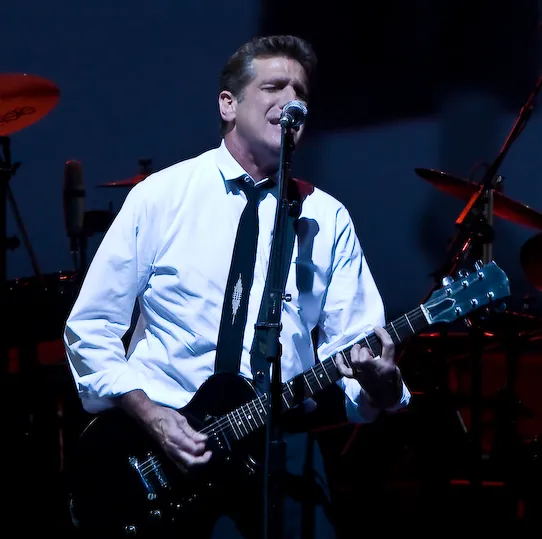
Photo by Steve Alexander , licensed under CC BY-SA 2.0 · Wikimedia Commons
Rank #273
Glenn Frey
From Wikipedia
Glenn Lewis Frey was an American musician. He was a founding member of the rock band Eagles, for whom he was the co-lead singer and frontman, roles he came to share with fellow member Don Henley, with whom he wrote most of Eagles' material. Frey played guitar and keyboards as well as singing lead vocals on songs such as "Take It Easy", "Peaceful Easy Feeling", "Tequila Sunrise", "Already Gone", "James Dean", "Lyin' Eyes", "New Kid in Town", and "Heartache Tonight".
Discography & Previews
Browse through and click an album to open and play 30-second previews streamed from Apple Music.


Strange Weather
1992 · 15 tracks
- 1 Silent Spring (Instrumental Prelude) ↗ 0:40
- 2 Long Hot Summer ↗ 5:18
- 3 Strange Weather ↗ 5:04
- 4 Agua Tranquillo (Instrumental) ↗ 0:51
- 5 Love In the 21st Century ↗ 6:12
- 6 He Took Advantage (Blues for Ronald Reagan) ↗ 4:43
- 7 River of Dreams ↗ 6:07
- 8 I've Got Mine ↗ 5:36
- 9 Rising Sun ↗ 0:38
- 10 Brave New World ↗ 6:21
- 11 Delicious ↗ 3:48
- 12 A Walk In the Dark ↗ 5:19
- 13 Before the Ship Goes Down ↗ 4:31
- 14 Big Life ↗ 4:19
- 15 Part of Me, Part of You ↗ 5:58

After Hours
2012 · 11 tracks
-
 No Fun AloudGlenn Frey198210 tracks
 -
 The AllnighterGlenn Frey198410 tracks
 -
 Soul Searchin'Glenn Frey198810 tracks
 -
 Strange WeatherGlenn Frey199215 tracks
 -
 After HoursGlenn Frey201211 tracks
Deep Dive
Overview
Glenn Lewis Frey was an American musician whose impact on rock music extended far beyond his most famous role: co-founder, co-lead singer, and principal songwriter of the Eagles, one of the bestselling rock bands in history. Over a four-decade career spanning from the 1970s through the early 2010s, Frey established himself as both a collaborative architect of some of rock’s most enduring songs and, during his solo years, a capable solo artist who explored pop-rock and soft-rock territory on his own terms. His voice—intimate yet commanding—and his gift for melody and songwriting made him a central figure in the soft-rock and country-rock movements that dominated American radio from the mid-1970s onward.
Formation Story
Frey emerged from the Los Angeles rock scene of the early 1970s, a city and era that nurtured a particular strain of melodic, harmony-driven rock rooted in country, folk, and Californian pop sensibilities. He came of age as a musician during a transformative period, absorbing influences from rock’s first generation while developing the songwriting and arranging skills that would define his career. It was in Los Angeles that Frey’s path intersected with Don Henley and other musicians who shared a vision of blending country-music storytelling and chord structures with rock energy and studio sophistication. This shared aesthetic became the template for what would emerge as the Eagles, though Frey’s solo work, which began in earnest in the 1980s, allowed him to explore variations on the same sensibility—polished, introspective pop-rock that prioritized melody and production craft.
Breakthrough Moment
Frey’s prominence in rock culture was largely forged through the Eagles, where his songwriting partnership with Don Henley produced some of the 1970s’ most significant rock songs. However, his transition to a solo career coincided with a shift in the pop-rock landscape. His debut solo album, No Fun Aloud, released in 1982, established him as a credible solo artist in his own right. The album arrived at a moment when the Eagles were in hiatus, allowing Frey to step into the spotlight without the band’s shadow. Though not as culturally omnipresent as his Eagles work, the solo album confirmed that his songwriting and interpretive abilities could sustain an independent recording career.
Peak Era
Frey’s most artistically active solo period spanned the 1980s and early 1990s, with releases including The Allnighter (1984) and Soul Searchin’ (1988). These albums represented Frey operating within a pop-rock and soft-rock framework that was comfortable and familiar to both him and his audience. By the 1990s, with Strange Weather (1992), Frey continued to refine his approach to production-forward rock, working within the changing sonic landscape of that decade. His solo output during this era showcased a matured artist who was content to work within the melodic, harmonic traditions he had helped establish, rather than chasing trends or reinventing himself.
Musical Style
Frey’s musical identity was rooted in the convergence of rock, country, and pop aesthetics that characterized West Coast rock of the 1970s and beyond. As a guitarist and keyboardist in addition to vocalist, he favored carefully arranged, harmonically sophisticated compositions that emphasized melody and lyrical storytelling over raw power or virtuosity. His voice—warm, conversational, and emotionally present without histrionics—suited the introspective, character-driven narratives he favored in songwriting. In his solo work, Frey maintained these core sensibilities while embracing contemporary studio production techniques; the result was polished, radio-friendly pop-rock that shared DNA with both the Eagles’ sound and the broader soft-rock and contemporary-pop-rock traditions. His guitar work ranged from acoustic fingerpicking to rhythmically propulsive electric parts, often supporting rather than dominating arrangements.
Major Albums
No Fun Aloud (1982)
Frey’s solo debut established his credibility as a standalone artist and showcased his ability to craft cohesive pop-rock material outside the Eagles framework, introducing audiences to his independent vision.
The Allnighter (1984)
This album solidified Frey’s solo presence, combining pop-rock accessibility with the sophisticated production and arrangement sensibilities he had honed over a decade of recording and touring.
Soul Searchin’ (1988)
Released during a period of continued creative engagement, this album represented Frey’s sustained commitment to melodic, introspective pop-rock and demonstrated his adaptability to the production trends of the late 1980s.
Strange Weather (1992)
Frey’s final studio album of the twentieth century, this release showed an artist comfortable with his voice and style, maintaining his core pop-rock aesthetic in a shifting musical landscape.
Signature Songs
- “Take It Easy” — A defining Eagles composition co-written by Frey that exemplifies his gift for accessible, memorable pop-rock melody and his collaborative songwriting approach.
- “Peaceful Easy Feeling” — One of Frey’s most graceful compositions, showcasing his ability to craft introspective, emotionally present rock songs.
- “Tequila Sunrise” — A country-tinged rock ballad that illustrates Frey’s talent for narrative songwriting and harmonic sophistication.
- “Lyin’ Eyes” — Co-written with Henley, this song demonstrates Frey’s skill at character-driven storytelling within a rock framework.
- “Heartache Tonight” — A later Eagles hit that remains one of Frey’s most recognizable vocal performances and compositional achievements.
Influence on Rock
Frey’s influence on rock music is inseparable from his role in the Eagles, yet his solo career reinforced certain directions within pop-rock and soft-rock. He was instrumental in establishing the viability of West Coast rock as a commercially dominant force, a sound that prioritized melody, studio craftsmanship, and emotional accessibility over the raw power or avant-garde experimentation that characterized some rock traditions. The Eagles and the broader soft-rock movement of which they were a part influenced countless pop-rock and contemporary-rock artists who followed. Frey’s example—a musician equally comfortable as a collaborative band member and a solo artist, one who valued songwriting and harmony over ego-driven soloism—provided a template for rock musicians navigating the tension between group and individual artistic identity.
Legacy
Glenn Frey passed away in 2016, leaving behind a body of work that spans four decades and includes some of the best-selling rock albums and songs in history. His legacy rests primarily on the Eagles’ catalogue, which has achieved canonical status in rock music and continues to generate substantial streaming revenue and radio play. The Eagles’ induction into the Rock and Roll Hall of Fame, as well as the enduring popularity of songs he wrote and sang, ensures that Frey remains a significant figure in rock’s pantheon. His solo career, while less culturally dominant than his work with the Eagles, confirmed his abilities as an independent artist and added dimension to his legacy as a versatile musician and songwriter. Posthumously, interest in both the Eagles and Frey’s solo work has remained steady through streaming platforms and retrospective media coverage.
Fun Facts
- Frey played both guitar and keyboards, a dual instrumental competency that contributed to the Eagles’ sophisticated arrangements and his ability to demonstrate ideas in the studio and live context.
- His 1982 solo debut No Fun Aloud was released during a period when the Eagles were not actively recording or touring as a unit, allowing Frey to establish an independent profile.
- Frey’s songwriting partnership with Don Henley produced much of the Eagles’ most celebrated material, a creative alliance that extended across multiple decades and defined an era of American rock music.