
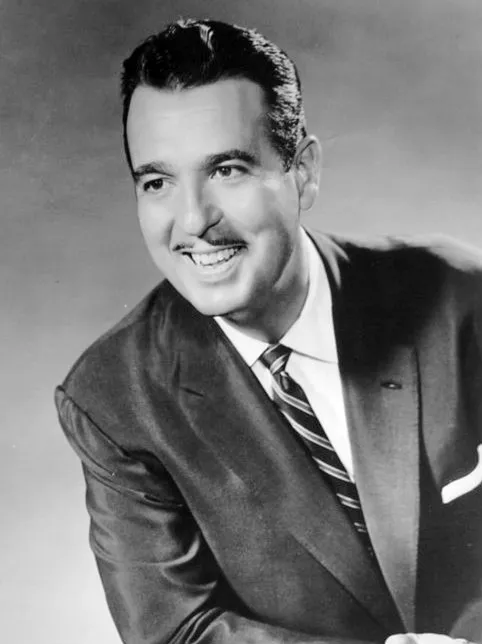
Photo by NBC Television , licensed under Public domain · Wikimedia Commons
Rank #380
Tennessee Ernie Ford
From Wikipedia
Ernest Jennings Ford, known professionally as Tennessee Ernie Ford, was an American singer and television host who enjoyed success in the country and western, pop, and gospel musical genres. Noted for his rich bass-baritone voice and down-home humor, he is remembered for his hit recordings of "The Shotgun Boogie" and "Sixteen Tons".
Discography & Previews
Browse through and click an album to open and play 30-second previews streamed from Apple Music.

This Lusty Land!
1955 · 12 tracks
- 1 John Henry ↗ 2:58
- 2 Trouble In Mind ↗ 2:20
- 3 Dark As A Dungeon ↗ 2:51
- 4 False Hearted Girl ↗ 2:24
- 5 Chicken Road ↗ 2:42
- 6 Who Will Shoe Your Pretty Little Foot ↗ 3:11
- 7 The Rovin' Gambler ↗ 2:18
- 8 In The Pines ↗ 2:52
- 9 I Gave My Love A Cherry ↗ 3:36
- 10 Nine Pound Hammer ↗ 2:07
- 11 Gaily The Troubadour ↗ 2:02
- 12 The Last Letter ↗ 4:01

Hymns
1956 · 12 tracks
- 1 Who At My Door Is Standing ↗ 3:13
- 2 Rock Of Ages ↗ 2:48
- 3 Softly And Tenderly ↗ 3:09
- 4 Sweet Hour Of Prayer ↗ 2:55
- 5 My Task ↗ 2:16
- 6 Let The Lower Lights Be Burning ↗ 2:02
- 7 The Ninety And Nine ↗ 3:05
- 8 The Old Rugged Cross ↗ 2:55
- 9 When They Ring The Golden Bells ↗ 3:47
- 10 In The Garden ↗ 2:49
- 11 Ivory Palaces ↗ 3:30
- 12 Others ↗ 2:50

Ol’ Rockin’ Ern
1957 · 12 tracks
- 1 Milk 'Em In the Mornin' Blues ↗ 2:23
- 2 Catfish Boogie ↗ 2:15
- 3 Anticipation Blues ↗ 2:10
- 4 Country Junction ↗ 2:12
- 5 Shot-Gun Boogie ↗ 2:13
- 6 She's My Baby ↗ 2:14
- 7 Blackberry Boogie ↗ 1:53
- 8 Kiss Me Big ↗ 2:14
- 9 Ain't Nobody's Business But My Own ↗ 1:57
- 10 Smokey Mountain Boogie ↗ 2:19
- 11 I Ain't a-Gonna Let It Happen No More ↗ 2:28
- 12 The Lord's Lariat ↗ 2:35

The Star Carol
1958 · 14 tracks
- 1 Joy to the World ↗ 1:47
- 2 O Little Town of Bethlehem ↗ 1:52
- 3 O Holy Night ↗ 1:53
- 4 The Star Carol ↗ 2:26
- 5 Hark! The Herald Angels Sing ↗ 1:28
- 6 Some Children See Him ↗ 3:54
- 7 God Rest Ye Merry Gentlemen ↗ 2:11
- 8 O Hearken Ye ↗ 2:24
- 9 Adeste Fideles ↗ 2:32
- 10 The First Noel ↗ 3:02
- 11 Sleep, My Little Lord Jesus ↗ 3:08
- 12 We Three Kings ↗ 2:16
- 13 It Came Upon a Midnight Clear ↗ 3:06
- 14 Silent Night ↗ 2:39

Gather ’Round
1959 · 12 tracks
- 1 Brown's Ferry Blues ↗ 2:12
- 2 Black Is the Color of My True Loves Hair ↗ 3:10
- 3 Old Blue ↗ 2:41
- 4 Freight Train Blues ↗ 2:52
- 5 The Night Herding Song ↗ 2:45
- 6 Darby's Ram ↗ 1:48
- 7 Pretty Little Pink ↗ 2:15
- 8 Barbara Allen ↗ 2:38
- 9 Look Down ↗ 3:00
- 10 My Grandfather's Clock ↗ 3:18
- 11 Twenty-One Years ↗ 3:14
- 12 Left My Gal In the Mountains ↗ 2:41

Ernie Looks at Love
1961 · 12 tracks
- 1 Molly Darling ↗ 2:31
- 2 Cold, Cold Heart ↗ 3:30
- 3 Bouquet Of Roses ↗ 2:23
- 4 I Forgot More Than You'll Ever Know ↗ 2:38
- 5 I Can't Help It (If I'm Still In Love With You) ↗ 2:31
- 6 Don't Rob Another Man's Castle ↗ 2:32
- 7 I Love You So Much It Hurts ↗ 3:12
- 8 Jealous Heart ↗ 3:37
- 9 I Gotta Have My Baby Back ↗ 3:46
- 10 Take Me In Your Arms And Hold Me ↗ 2:54
- 11 I Really Don't Want To Know ↗ 2:43
- 12 Half As Much ↗ 2:13

Country Hits…Feelin’ Blue
1964 · 12 tracks
- 1 Try Me One More Time ↗ 2:39
- 2 No Letter Today ↗ 2:31
- 3 Born To Lose ↗ 3:13
- 4 Don't Rob Another Man's Castle ↗ 2:54
- 5 There'll Be No Teardrops Tonight ↗ 2:45
- 6 I Don't Hurt Anymore ↗ 2:48
- 7 Worried Mind ↗ 2:33
- 8 No One Will Ever Know ↗ 2:57
- 9 Funny How Time Slips Away ↗ 3:11
- 10 Sweet Dreams ↗ 2:51
- 11 Tears On My Pillow ↗ 2:47
- 12 May You Never Be Alone ↗ 2:41

Great Gospel Songs
1964 · 12 tracks
- 1 Just Over In Gloryland (feat. The Jordanaires) ↗ 2:18
- 2 Hide Me, Rock Of Ages (feat. The Jordanaires) ↗ 2:56
- 3 I'll Have A New Life ↗ 2:07
- 4 He Know What I Need (feat. The Jordanaires) ↗ 2:28
- 5 A Beautiful Life (feat. The Jordanaires) ↗ 2:27
- 6 Daniel Prayed (feat. The Jordanaires) ↗ 1:46
- 7 I Can Tell You The Time ↗ 3:22
- 8 Just A Little Talk With Jesus (feat. The Jordanaires) ↗ 2:57
- 9 Peace Like A River (feat. The Jordanaires) ↗ 2:35
- 10 We'll Soon Be Done With Troubles And Trials ↗ 2:37
- 11 On The Jericho Road ↗ 2:34
- 12 Give The World A Smile ↗ 2:00

Aloha From Tennessee Ernie Ford
1967 · 11 tracks

Ernie Sings & Glen Picks
1975 · 10 tracks
- 1 Trouble In Mind ↗ 3:05
- 2 (I'd Be) A Legend In My Time ↗ 2:35
- 3 Here Comes My Baby Back Again ↗ 2:55
- 4 There Goes My Everything ↗ 2:58
- 5 She Called Me Baby ↗ 3:04
- 6 I Gotta Have My Baby Back ↗ 3:42
- 7 Nobody Wins ↗ 2:53
- 8 Loving Her Was Easier ↗ 3:04
- 9 I Really Don't Want to Know ↗ 2:52
- 10 For the Good Times ↗ 3:42

Swing Wide Your Golden Gate
1978 · 10 tracks
- 1 Swing Wide Your Golden Gate ↗ 2:28
- 2 How Big Is God ↗ 3:17
- 3 Just a Little While ↗ 2:58
- 4 Mansion over the Hilltop ↗ 3:02
- 5 I Like the Old Time Way ↗ 2:09
- 6 What Would You Give in Exchange? ↗ 2:40
- 7 Bring Back the Springtime ↗ 2:57
- 8 The Unclouded Day ↗ 2:56
- 9 Room at the Cross ↗ 2:29
- 10 One Day at a Time ↗ 2:52

Ramblin’ Down Country Roads With Tennessee Ernie Ford
1979 · 12 tracks
- 1 Sixteen Tons (1979 Version) ↗ 2:30
- 2 Dark As A Dungeon (1979 Version) ↗ 2:49
- 3 Nine Pound Hammer (1979 Version) ↗ 2:15
- 4 Streamlined Cannonball (1979 Version) ↗ 2:54
- 5 Who's Gonna Shoe Your Pretty Little Feet (1979 Version) ↗ 2:33
- 7 This Land Is Your Land (1979 Version) ↗ 2:12
- 8 Tennessee Waltz (1979 Version) ↗ 2:40
- 9 The Roving Gambler (1979 Version) ↗ 2:38
- 10 Black Is The Color Of My True Love's Hair (1979 Version) ↗ 3:19
- 11 Daddy Frank (The Guitar Man) [1979 Version] ↗ 3:03
- 12 Green Green Grass Of Home (1979 Version) ↗ 3:50
- 13 Take Me Home, Country Roads (1979 Version) ↗ 2:30

Tell Me the Old, Old Story
1980 · 10 tracks
- 1 Tell Me the Old, Old Story ↗ 2:47
- 2 Send the Light ↗ 2:54
- 3 When We All Get to Heaven ↗ 2:39
- 4 Let Others See Jesus in You ↗ 2:56
- 5 Stand up for Jesus ↗ 2:51
- 6 Only Believe ↗ 2:56
- 7 Yield Not to Temptation ↗ 3:00
- 8 Are You Washed in the Blood ↗ 2:29
- 9 Standing on the Promises ↗ 2:47
- 10 Revive Us Again ↗ 2:00

Back Where I Belong
1982 · 10 tracks
- 1 This Old Heart is (Gonna Rise Again) ↗ 3:03
- 2 A Legend in His Mind ↗ 3:10
- 3 Tell Me You Remember, Betty Jean ↗ 3:12
- 4 Get a Little Dirt on Your Hands ↗ 3:08
- 5 Born to Lose ↗ 3:19
- 6 Raised by the Railroad Line ↗ 3:44
- 7 Piece of the Rock ↗ 2:28
- 8 Homegrown Man (Made in America) ↗ 2:46
- 9 (It's over) Nobody Wins ↗ 2:27
- 10 Old Fashioned Love ↗ 2:26

6000 Sunset Boulevard
2009 · 23 tracks
- 1 Full Time Job ↗ 2:39
- 2 It's My Lazy Day ↗ 2:03
- 3 I'm Gonna Sit Right Down (And Write Myself a Letter) ↗ 1:35
- 4 Eerybody's Got a Girl but Me ↗ 2:45
- 5 Sweet Mama, Tree Top Tall ↗ 1:48
- 6 Medley_ in a Little Red Barn_back Home Again in Indiana ↗ 2:00
- 7 Lover ↗ 2:17
- 8 She's Funny That Way ↗ 3:03
- 9 I Found a Million Dollar Baby (In a Five and Ten Cent Store) ↗ 1:57
- 10 Paper Doll ↗ 1:26
- 11 I'm Sitting on Top of the World ↗ 1:34
- 12 Sophisticated Swing ↗ 1:23
- 13 Up a Lazy River ↗ 1:50
- 14 Nobody ↗ 2:01
- 15 Hot Toddy ↗ 1:12
- 16 Steam Heat ↗ 2:49
- 17 Try a Little Tenderness ↗ 2:27
- 18 Blue Skys ↗ 2:15
- 19 Little Red Wagon ↗ 1:47
- 20 Georgia on My Mind ↗ 1:55
- 21 I Can't Get Started ↗ 2:50
- 22 There'll Be Some Changes Made ↗ 1:59
- 23 Side by Side ↗ 2:27
Country
— · 12 tracks
- 1 Try Me One More Time ↗ 2:39
- 2 No Letter Today ↗ 2:31
- 3 Born To Lose ↗ 3:13
- 4 Don't Rob Another Man's Castle ↗ 2:54
- 5 There'll Be No Teardrops Tonight ↗ 2:45
- 6 I Don't Hurt Anymore ↗ 2:48
- 7 Worried Mind ↗ 2:33
- 8 No One Will Ever Know ↗ 2:57
- 9 Funny How Time Slips Away ↗ 3:11
- 10 Sweet Dreams ↗ 2:51
- 11 Tears On My Pillow ↗ 2:47
- 12 May You Never Be Alone ↗ 2:41
-
 This Lusty Land!Tennessee Ernie Ford195512 tracks
 -
 HymnsTennessee Ernie Ford195612 tracks
 -
 Ol’ Rockin’ ErnTennessee Ernie Ford195712 tracks
 -
 The Star CarolTennessee Ernie Ford195814 tracks
 -
 Gather ’RoundTennessee Ernie Ford195912 tracks
 -
 Ernie Looks at LoveTennessee Ernie Ford196112 tracks
 -
 Country Hits…Feelin’ BlueTennessee Ernie Ford196412 tracks
 -
 Great Gospel SongsTennessee Ernie Ford196412 tracks
 -
 Aloha From Tennessee Ernie FordTennessee Ernie Ford196711 tracks
 -
 Ernie Sings & Glen PicksTennessee Ernie Ford197510 tracks
 -
 Swing Wide Your Golden GateTennessee Ernie Ford197810 tracks
 -
 Ramblin’ Down Country Roads With Tennessee Ernie FordTennessee Ernie Ford197912 tracks
 -
 Tell Me the Old, Old StoryTennessee Ernie Ford198010 tracks
 -
 Back Where I BelongTennessee Ernie Ford198210 tracks
 -
 6000 Sunset BoulevardTennessee Ernie Ford200923 tracks
 - CountryTennessee Ernie Ford—12 tracks
Deep Dive
Overview
Tennessee Ernie Ford stands as one of mid-twentieth-century America’s most durable and genre-spanning recording artists. Born Ernest Jennings Ford in 1919, he forged a career that moved fluidly between rockabilly energy, country tradition, pop accessibility, and devotional hymn singing—a range that reflected both his artistic ambition and the fluidity of postwar American musical taste. His rich bass-baritone voice, paired with a gift for down-home humor and storytelling, became his signature across radio, records, and television. Though often remembered for novelty hits and gospel work, Ford was fundamentally an artist who understood how to reach different audiences without abandoning his core identity.
Formation Story
Tennessee Ernie Ford’s path to music began in the American South, where he absorbed the region’s vernacular traditions—country ballads, work songs, and sacred music. He came of age during the rise of country radio and the early stirrings of electric amplification in rural and working-class music. By the early 1950s, as rock and roll was beginning to take shape from country, blues, and pop hybrids, Ford positioned himself as a vocalist who could navigate all these territories. His initial recordings on Capitol Records, beginning with the 1952 album Capitol Presents… Tennessee Ernie, established him as a voice capable of handling both novelty and substance. The immediate postwar era saw an appetite for exactly this kind of versatility: artists who could appeal to country radio, Top 40 stations, and television audiences all at once.
Breakthrough Moment
Ford’s commercial breakthrough came in the mid-1950s with recordings that capitalized on the rockabilly moment without demanding he abandon his country roots. “The Shotgun Boogie” became one of his signature recordings, showcasing his ability to deliver rhythm-driven novelty material with charm and technical confidence. The 1955 album This Lusty Land! represented Ford in his earthier, more energetic mode, capturing the spirit of working-class American music that rockabilly drew upon. However, his truly massive hit came with “Sixteen Tons,” a song that transcended its novelty framework to become a cultural touchstone. The recording became inescapable, reaching audiences far beyond country radio and establishing Ford as a genuine pop crossover act. This dual identity—capable of both rockabilly energy and broader commercial appeal—defined his subsequent career.
Peak Era
The period from 1955 through the early 1960s represented Ford’s most visible and commercially successful window. His 1957 album Ol’ Rockin’ Ern made explicit his connection to the rockabilly surge, even as he began simultaneously releasing gospel and hymn albums that catered to a different but equally substantial audience. What distinguished Ford from many of his contemporaries was his refusal to choose between these modes. Rather than abandon country and gospel after achieving pop success, he deepened his commitment to hymn and spiritual recordings throughout the late 1950s and 1960s, releasing multiple collections per year—Hymns (1956), The Star Carol (1958), Nearer the Cross (1958), Spirituals (1958), and dozens more. This prolific sacred output was not a retreat but a strategy: Ford recognized that postwar America contained vast audiences for both honky-tonk energy and devotional music, and he possessed the vocal instrument and interpretive range to serve both markets.
Musical Style
Ford’s voice was his instrument and his calling card. His bass-baritone had a natural warmth and depth that could deliver a novelty boogie with swagger or render a hymn with genuine reverence. In his rockabilly and novelty work, the voice sat atop rhythmic accompaniment that borrowed the electric guitar-driven energy of early rock and roll while maintaining country phrasing and lyrical storytelling. In his gospel work, that same voice became a vehicle for spiritual sincerity, rarely oversinging yet commanding full attention through tonal richness. His phrasing was rooted in country tradition—he rarely approached a lyric without a sense of character and narrative—yet he proved flexible enough to adapt to pop idioms and sacred conventions. The production of his records generally favored clarity and restraint, allowing the voice to dominate while accompaniment provided texture rather than distraction. This balance made his recordings accessible to radio and domestic listening alike.
Major Albums
Ol’ Rockin’ Ern (1957)
A straightforward document of Ford in his rockabilly and novelty stride, this album captures the spirit of mid-1950s country-derived rock material with the swagger and comic timing that made “The Shotgun Boogie” and related recordings memorable.
Hymns (1956)
Among Ford’s earliest purely devotional collections, establishing that his sacred music work was not secondary to his novelty recordings but a central commitment, performed with the same professionalism and vocal confidence he brought to pop crossovers.
This Lusty Land! (1955)
A broad-ranging collection that showcased Ford’s interpretive range across country, novelty, and pop material, demonstrating his ability to move fluidly between registers and audiences without seeming opportunistic.
Spirituals (1958)
Part of Ford’s intensive output of gospel and spiritual material in the late 1950s, reflecting the postwar resurgence of interest in traditional American sacred music and his position as one of few mainstream acts capable of serving that market authentically.
Sixteen Tons – Hit Parade: Platinum Collection (2007)
A retrospective compilation that, while assembled decades after Ford’s death, captures the enduring commercial and cultural resonance of his novelty and crossover material, underscoring which recordings remained culturally durable.
Signature Songs
- “Sixteen Tons” — The massive crossover hit that transcended novelty status to become a standard, reaching audiences across age, geography, and musical preference.
- “The Shotgun Boogie” — An early signature recording that established Ford’s credentials in the rockabilly-inflected novelty space with rhythm, character, and accessibility.
- “Give Me My Flowers While I’m Still Living” — A testament to Ford’s ability to perform sacred and traditional material with conviction and emotional directness.
- “Mule Train” — A novelty recording that showcased his comic timing and willingness to inhabit vocal characters within the constraints of a short pop song.
Influence on Rock
Tennessee Ernie Ford’s influence on rock music proper was less direct than his influence on the broader landscape of American popular music and the trajectory of country music itself. He represented a model of genre fluidity at a moment when musical boundaries were shifting rapidly. Unlike artists who staked identity on a single genre, Ford demonstrated that a performer of sufficient vocal and interpretive talent could move between rockabilly, novelty pop, country, and gospel without losing coherence or audience trust. This permission structure—to be multiple things at once—became increasingly normal across rock music. His example suggested that commercial success in a song did not obligate abandonment of other material. Furthermore, his willingness to record sacred music as a primary rather than secondary activity challenged the emerging rock and roll industry’s implicit secularism, insisting that spiritual and devotional music remained commercially and artistically viable in the postwar pop world.
Legacy
Tennessee Ernie Ford’s posthumous presence rests primarily on his novelty and crossover recordings, particularly “Sixteen Tons,” which has experienced periodic revival through television, film, and streaming platforms. The volume of his recorded output—spanning four decades and encompassing hundreds of performances across multiple genres—ensures that his voice remains part of the American recorded legacy. However, the critical and cultural memory of Ford has tended to flatten his career into a curiosity: the bass-voiced novelty singer and gospel enthusiast. This oversimplifies his actual achievement, which was sustained competence across genres and an unusual ability to navigate commercial and artistic demands without compromising either. His vast discography of sacred music, much of it recorded with genuine care and musicianship, remains largely unexamined by rock and popular music historians, in part because gospel and hymn recording has traditionally occupied a lower status in critical hierarchies than novelty and rock material. Yet Ford’s recordings across all modes demonstrate a professional consistency and vocal confidence that transcends genre boundaries.
Fun Facts
- Ford’s recording career extended from 1952 until his death in 1991, encompassing nearly forty years of consistent studio output and making him one of the most prolific recording artists of the postwar era.
- His 1961 releases included separate collections devoted to Civil War songs from both the North and the South, Tennessee Ernie Ford Sings Civil War Songs of the North and Tennessee Ernie Ford Sings Civil War Songs of the South, reflecting his interest in American musical and historical traditions.
- Throughout the 1960s and 1970s, Ford released multiple gospel and inspirational albums per year, often numbering three to four annual releases, demonstrating the sustained commercial viability of sacred music recording.
- His 1971 collaboration with Buck Owens, the album Music Hall, paired him with one of country music’s modernists, suggesting continued respect from contemporaries working in country’s progressive wing.