
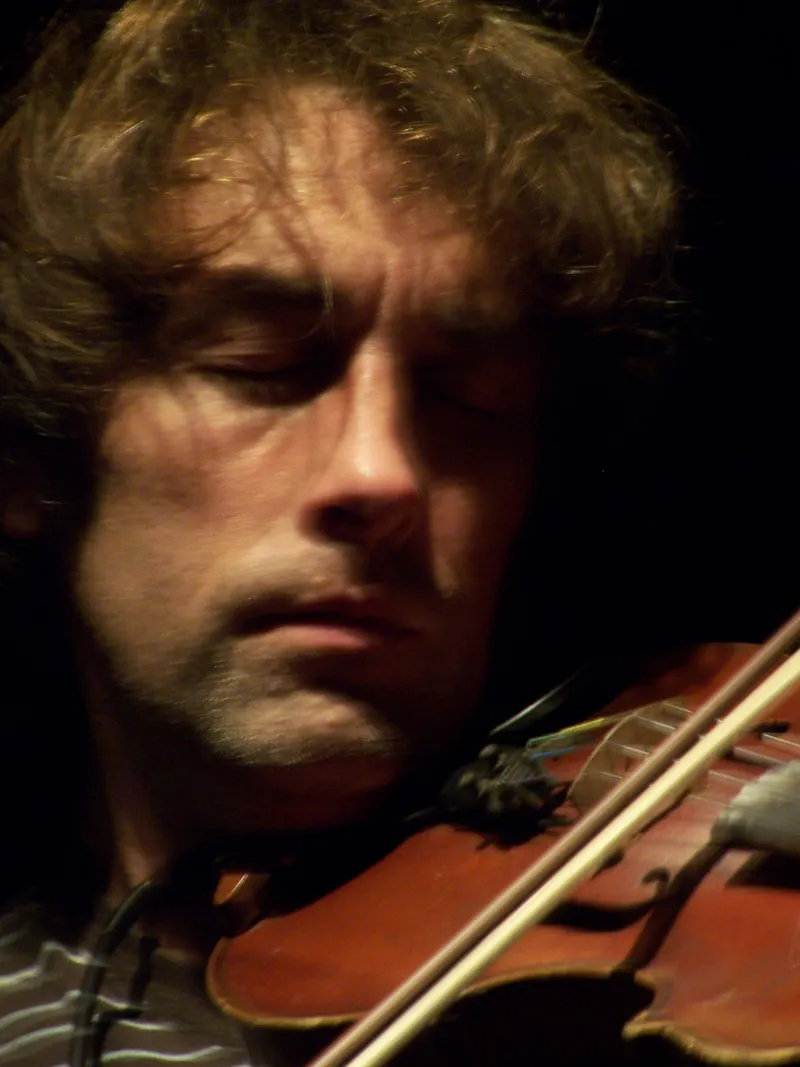
Photo by Paul from Görlitz, Germany , licensed under CC BY-SA 2.0 · Wikimedia Commons
Rank #196
Yann Tiersen
From Wikipedia
Yann Pierre Tiersen is a French musician and composer from Brittany. His musical career is split between studio recordings, music collaborations, and film soundtracks songwriting. His music incorporates a large variety of classical and contemporary instruments, primarily the electric guitar, the piano, synthesisers, and the violin, but he also includes instruments such as the melodica, xylophone, toy piano, harpsichord, piano accordion, and even a typewriter.
Discography & Previews
Browse through and click an album to open and play 30-second previews streamed from Apple Music.


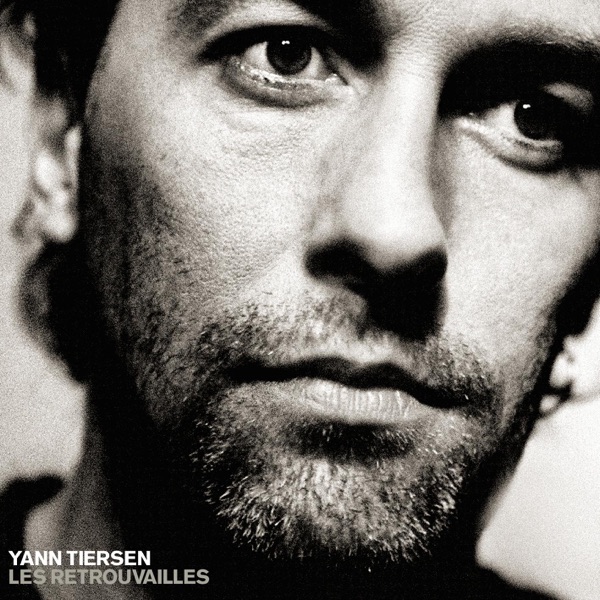
Les Retrouvailles
2005 · 16 tracks
- 1 Western ↗ 2:24
- 2 Kala ↗ 4:09
- 3 Loin des villes ↗ 3:20
- 4 La veillée ↗ 3:12
- 5 Plus d'hiver ↗ 2:24
- 6 A ceux qui sont malades par mer calme ↗ 3:30
- 7 A secret place ↗ 3:26
- 8 Le matin ↗ 1:59
- 9 Les enfants ↗ 2:01
- 10 Le jour de l'ouverture ↗ 3:38
- 11 La boulange ↗ 2:47
- 12 La plage ↗ 1:58
- 13 Mary ↗ 3:38
- 14 7:PM ↗ 2:41
- 15 Les retrouvailles ↗ 1:30
- 16 La jetée ↗ 1:03

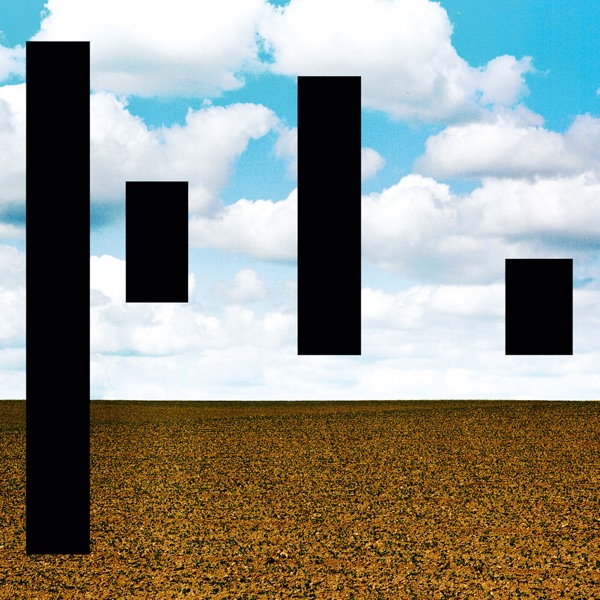

EUSA
2016 · 18 tracks
- 1 Hent I ↗ 2:56
- 2 Pern ↗ 4:27
- 3 Hent II ↗ 1:15
- 4 Porz Goret ↗ 4:56
- 5 Lok Gweltz ↗ 3:50
- 6 Hent III ↗ 0:54
- 7 Penn ar Roc'h ↗ 3:04
- 8 Hent IV ↗ 3:22
- 9 Kereon ↗ 2:45
- 10 Hent V ↗ 1:08
- 11 Yuzin ↗ 3:05
- 12 Roc'h ar Vugale ↗ 6:15
- 13 Hent VI ↗ 0:43
- 14 Penn ar Lann ↗ 3:58
- 15 Hent VII ↗ 1:44
- 16 Enez Nein ↗ 5:05
- 17 Kadoran ↗ 1:18
- 18 Hent VIII ↗ 6:30


Portrait
2019 · 25 tracks
- 1 Introductory Movement (feat. Stephen O'Malley) [Portrait Version] ↗ 7:15
- 2 The Long Road (Portrait Version) ↗ 2:19
- 3 Monochrome (feat. Gruff Rhys) [Portrait Version] ↗ 3:55
- 4 Chapter 19 (Portrait Version) ↗ 4:26
- 5 Rue des cascades (Portrait Version) ↗ 6:22
- 6 The Old Man Still Wants It (Portrait Version) ↗ 1:48
- 7 Gwennilied (feat. Emilie Tiersen) [Portrait Version] ↗ 4:33
- 8 Prad (feat. Stephen O'Malley) [Portrait Version] ↗ 4:12
- 9 Diouz an Noz (feat. Emilie Tiersen & Ólavur Jákupsson) [Portrait Version] ↗ 3:42
- 10 Porz Goret (Portrait Version) ↗ 4:18
- 11 La dispute (Portrait Version) ↗ 3:41
- 12 Pell (feat. Emilie Tiersen) [Portrait Version] ↗ 4:00
- 13 Erc'h (feat. Ólavur Jákupsson) [Portrait Version] ↗ 7:40
- 14 The Wire (Sur Le Fil) [Portrait Version] ↗ 3:29
- 15 The Waltz of the Monsters (Portrait Version) ↗ 2:08
- 16 Closer (feat. Blonde Redhead) [Portrait Version] ↗ 3:55
- 17 Naval (Portrait Version) ↗ 4:24
- 18 The Jetty (Portrait Version) ↗ 1:03
- 19 Koad (feat. Ólavur Jákupsson) [Portrait Version] ↗ 5:09
- 20 Prayer No. 2 (Portrait Version) ↗ 3:01
- 21 Grønjørd (feat. Ólavur Jákupsson) [Portrait Version] ↗ 2:47
- 22 Kala (feat. Ólavur Jákupsson) [Portrait Version] ↗ 2:49
- 23 Comptine d'un autre été (l'après-midi) [Portrait Version] ↗ 2:18
- 24 Tempelhof (Pt. 2) [Portrait Version] ↗ 0:59
- 25 Thinking Like a Mountain (feat. John Grant & Stephen O'Malley) [Portrait Version] ↗ 6:26


11 5 18 2 5 18
2022 · 9 tracks
- 1 11 5 18 2 5 18 ↗ 11:39
- 2 11 5 18. 1 12. 12 15 3 8 ↗ 6:23
- 3 1 18. 13 1 14 5 18. 11 15 26 8 ↗ 4:23
- 4 16 1 12 5 19 20 9 14 5 ↗ 4:57
- 5 3 8 1 16 20 5 18. 14 9 14 5 20 5 5 14 ↗ 6:11
- 6 11 5 18 12 1 14 14 ↗ 4:06
- 7 11 5 18. 25 5 7 21 ↗ 3:48
- 8 16 15 21 12 12. 2 15 10 5 18 ↗ 4:34
- 9 13 1 18 25 (6 5 1 20. 17 21 9 14 17 21 9 19) ↗ 4:05
-
 L’AbsenteYann Tiersen200112 tracks
 -
 Yann Tiersen & Shannon WrightYann Tiersen200410 tracks
 -
 Les RetrouvaillesYann Tiersen200516 tracks
 -
 Dust LaneYann Tiersen20108 tracks
 -
 SkylineYann Tiersen20119 tracks
 -
 EUSAYann Tiersen201618 tracks
 -
 ALLYann Tiersen201911 tracks
 -
 PortraitYann Tiersen201925 tracks
 -
 KerberYann Tiersen20217 tracks
 -
 11 5 18 2 5 18Yann Tiersen20229 tracks
 - Kerber (Solo Piano)Yann Tiersen20227 tracks
Deep Dive
Overview
Yann Tiersen is a French musician and composer from Brest, Brittany, whose career spans studio recordings, film soundtracks, and collaborative projects. Emerging in the mid-1990s, Tiersen established himself as a distinctive voice in contemporary instrumental music, drawing on minimalist traditions and neoclassicism while incorporating rock instrumentation. His approach blends acoustic and electronic textures across a kaleidoscopic array of instruments—electric guitar, piano, synthesizers, violin, melodica, xylophone, toy piano, harpsichord, piano accordion, and even typewriter—creating a densely layered, genre-defying sound that resists easy categorization.
Formation Story
Born in 1970 in Brest, Brittany, Tiersen came of age in a region with its own distinct cultural identity. The port city of Brest, situated on France’s northwestern coast, provided a backdrop both isolated and culturally rich, fostering an artistic sensibility outside the gravitational pull of Paris’s dominant music scene. Tiersen’s early musical education drew from both classical training and contemporary experimentation, setting him on a path that would eventually lead him to blur boundaries between composition, rock musicianship, and soundtrack work. His entry into professional music came with the release of his debut album in 1995, marking the beginning of a prolific career rooted in Brittany but gradually extending across Europe and beyond.
Breakthrough Moment
Tiersen’s early albums—La Valse des monstres (1995), Rue des cascades (1996), and Le Phare (1998)—established his reputation as a composer unafraid to layer disparate instrumental voices into cohesive pieces. These releases, each expanding his sonic palette and compositional ambition, built a dedicated following in experimental and contemporary classical circles. The late 1990s and early 2000s saw Tiersen expanding his reach through film soundtrack work and international collaborations, culminating in projects like the 2004 collaboration Yann Tiersen & Shannon Wright, which brought his intricate arrangements to a wider audience. His willingness to work across genres and formats—from solo piano to orchestrated ensemble pieces—positioned him as an increasingly vital figure in European art rock and contemporary composition.
Peak Era
The 2000s and 2010s represented Tiersen’s most prolific and creatively expansive period. Albums such as L’Absente (2001), Les Retrouvailles (2005), Dust Lane (2010), and Skyline (2011) showcased his maturation as a composer and arranger, each project exploring different instrumental combinations and emotional territories. During this period, Tiersen balanced studio work with film composition, leveraging his distinctive sound across multiple creative outlets. His mastery of miniature forms—pieces that could be intimate or grand, spare or densely orchestrated—allowed him to craft albums of consistent quality and imaginative variety. The release of ∞ (2014) signaled continued evolution, while Pour Amélie: Piano Music (2015) demonstrated his facility with solo piano, a format that would recur throughout his later work.
Musical Style
Tiersen’s sound is fundamentally heteroclite, resisting singular genre definition. His foundation rests on minimalist principles—the repetition and gradual transformation of small musical cells—combined with neoclassical harmonic language and melodic sensibility. Yet across this classical architecture, he deploys rock and contemporary instruments with equal authority: electric guitar, synthesizers, and percussion textures that pull the music toward indie rock and experimental pop territories. The violin and piano often serve as melodic anchors, while unconventional instruments such as toy piano, xylophone, and typewriter add textural surprise and whimsical character. His arrangements are typically layered but never cluttered; each instrument occupies a distinct space in the mix, creating clarity within complexity. Vocally, Tiersen is primarily instrumental, though his collaborative work—particularly with Shannon Wright—has explored sung passages. The result is a body of work that feels equally at home in concert halls and art-house cinemas, rooted equally in European contemporary composition and English-language indie rock traditions.
Major Albums
La Valse des monstres (1995)
Tiersen’s debut album established the core vocabulary of his sound: intricate instrumental arrangements layering piano, strings, and electronics into miniature compositions that hint at both classical form and avant-garde experiment.
Le Phare (1998)
Building on his early foundation, Le Phare (The Lighthouse) deepens Tiersen’s exploration of atmospheric arrangement and melodic restraint, with instrumental pieces that evoke specific emotional or visual landscapes.
L’Absente (2001)
This album consolidated Tiersen’s reputation for sophisticated, genre-blending composition, expanding his use of rock and electronic textures while maintaining the clarity and emotional directness of his earlier work.
Dust Lane (2010)
A landmark album that captured Tiersen’s mature style: meticulous arrangements of traditional and unconventional instruments, balancing minimalist purity with emotional richness across a suite of carefully crafted pieces.
Pour Amélie: Piano Music (2015)
Tiersen’s exploration of solo piano work, demonstrating his ability to generate emotional and harmonic complexity through a single instrument, while reaffirming his connection to contemporary classical traditions.
Kerber (2021)
A sustained artistic statement released in both full ensemble and solo piano versions, Kerber showcased Tiersen’s continued engagement with his core aesthetic: layered instrumental arrangements combining classical sensibility with contemporary sonic ambition.
Signature Songs
- Amélie — The internationally recognized piano theme, a signature of Tiersen’s melodic gift and his mastery of film composition, widely known through its use in cinema and media.
- On the Roof of the World — A piece exemplifying Tiersen’s ability to build emotional resonance through minimal melodic material and layered arrangement.
- Summer ‘78 — Demonstrates his gift for evoking specific emotional or temporal spaces through instrumental miniature, combining rock and classical sensibilities.
- Dust Lane — The title piece from his 2010 album, illustrating his mature compositional style and mastery of texture and form.
Influence on Rock
Tiersen’s career represents an important bridge between European classical modernism and English-language indie rock and experimental music. His prolific output across film soundtracks and studio albums has influenced contemporary composers and musicians working at the intersection of classical training and rock instrumentation. Artists exploring minimalism, art rock, and instrumental soundtrack composition have drawn from his example of technical sophistication coupled with emotional directness. His willingness to treat unconventional and toy instruments with serious artistic intent has expanded the palette available to rock and contemporary classical musicians. Tiersen’s work demonstrates that instrumental music grounded in both classical tradition and popular music sensibility can achieve mainstream recognition without sacrificing artistic integrity.
Legacy
Yann Tiersen’s legacy rests on his consistent output across three decades and his refusal to settle into a single artistic category. From his 1995 debut through releases into the 2020s—including Island (2023) and Rathlin From a Distance | The Liquid Hour (2025)—Tiersen has maintained artistic credibility while exploring new instrumental combinations and emotional territories. His film soundtrack work, particularly his contributions to cinema, has given his music access to global audiences, while his studio albums have built a dedicated following among listeners of experimental, classical, and art-rock music. Tiersen’s career validates an alternative path within contemporary music: one that privileges compositional craft, sonic diversity, and emotional authenticity over commercial calculation or genre purity. His continued activity and creative investment signal an artist who views his work not as a historical artifact but as an ongoing exploration, with new album releases confirming that his artistic project remains unfinished and vital.
Fun Facts
- Tiersen’s use of unconventional instruments such as typewriter and toy piano emerged from a compositional philosophy that treats any sound-producing object as a legitimate orchestral instrument.
- His collaborations with other artists, particularly the full-album partnership with Shannon Wright in 2004, reflect his interest in dialogue and cross-pollination with musicians working in adjacent experimental and indie-rock territories.
- Tiersen’s Brittany origins have remained central to his identity and artistic practice, with the region’s cultural distinctiveness often reflected in his music’s regional flavor despite its international reach.