
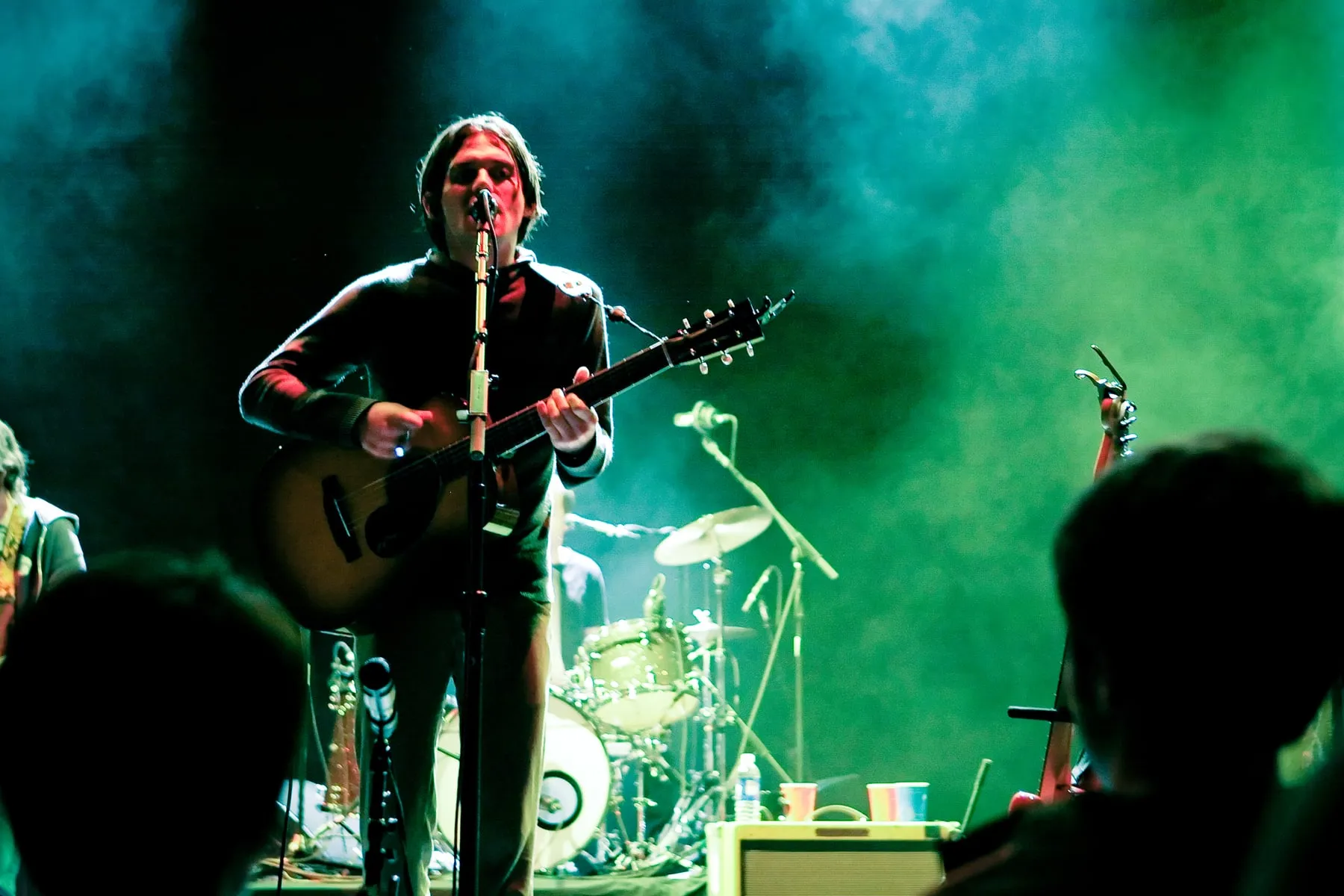
Photo by Davinic , licensed under CC BY-SA 3.0 · Wikimedia Commons
Rank #129
Bright Eyes
From Wikipedia
Bright Eyes is an American indie rock band founded in Omaha, Nebraska by singer-songwriter and guitarist Conor Oberst. It consists of Oberst, multi-instrumentalist and producer Mike Mogis, arranger, composer, trumpet and piano player Nate Walcott, and a rotating line-up of collaborators drawn primarily from Omaha's indie music scene.
Members
- Conor Oberst
- Mike Mogis
- Nate Walcott
Discography & Previews
Browse through and click an album to open and play 30-second previews streamed from Apple Music.

Letting Off the Happiness
1998 · 10 tracks

A Collection of Songs Written and Recorded 1995–1997
1998 · 20 tracks
- 1 The Invisible Gardener ↗ 2:24
- 2 Patient Hope In New Snow ↗ 4:07
- 3 Saturday As Usual ↗ 3:38
- 4 Falling Out of Love At This Volume ↗ 2:17
- 5 Exaltation On a Cool Kitchen Floor ↗ 2:27
- 6 The Awful Sweetness of Escaping Sweat ↗ 4:05
- 7 Puella Quam Amo Est Pulchra ↗ 3:11
- 8 Driving Fast Through a Big City At Night ↗ 2:11
- 9 How Many Lights Do You See? ↗ 3:32
- 10 I Watched You Taking Off ↗ 3:57
- 11 A Celebration Upon Completion ↗ 4:15
- 12 Emily, Sing Something Sweet ↗ 3:01
- 13 All of the Truth ↗ 3:44
- 14 One Straw (Please) ↗ 2:49
- 15 Lila ↗ 2:51
- 16 A Few Minutes On Friday ↗ 4:08
- 17 Supriya ↗ 2:29
- 18 Solid Jackson ↗ 4:31
- 19 Feb. 15th ↗ 4:06
- 20 The 'Feel Good' Revolution ↗ 3:31

Fevers and Mirrors
2000 · 12 tracks
- 1 A Spindle, A Darkness, A Fever, And a Necklace ↗ 6:26
- 2 A Scale, A Mirror, And Those Indifferent Clocks ↗ 2:45
- 3 The Calendar Hung Itself… ↗ 3:56
- 4 Something Vague ↗ 3:33
- 5 The Movement of a Hand ↗ 4:03
- 6 Arienette ↗ 3:45
- 7 When the Curious Girl Realizes She Is Under Glass ↗ 2:40
- 8 Haligh, Haligh, A Lie, Haligh ↗ 4:44
- 9 The Center of the World ↗ 4:43
- 10 Sunrise, Sunset ↗ 4:32
- 11 An Attempt To Tip the Scales ↗ 8:29
- 12 A Song To Pass the Time ↗ 5:30

A Christmas Album
2002 · 11 tracks
- 1 Away in a Manger ↗ 2:48
- 2 Blue Christmas ↗ 2:20
- 3 Oh Little Town of Bethlehem ↗ 2:57
- 4 God Rest Ye Merry Gentlemen ↗ 1:53
- 5 The First Noel ↗ 2:30
- 6 Little Drummer Boy ↗ 2:35
- 7 White Christmas ↗ 1:36
- 8 Silent Night ↗ 3:15
- 9 Silver Bells ↗ 3:55
- 10 Have Yourself a Merry Little Christmas ↗ 4:08
- 11 The Night Before Christmas ↗ 4:07
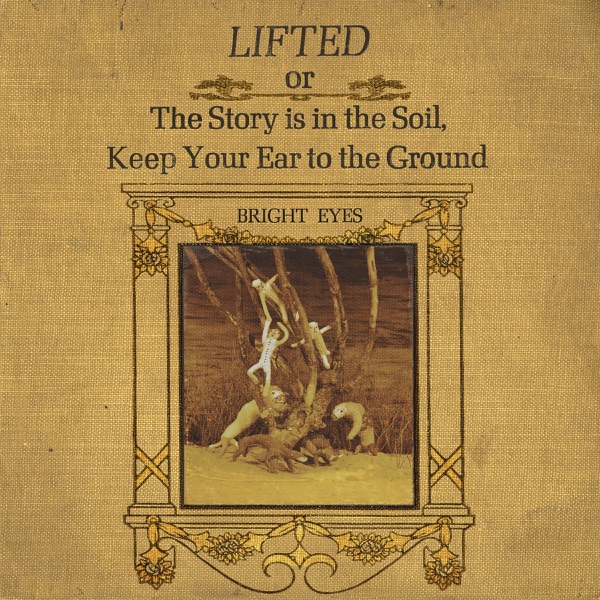
LIFTED or The Story Is in the Soil, Keep Your Ear to the Ground
2002 · 13 tracks
- 1 The Big Picture ↗ 8:42
- 2 Method Acting ↗ 3:42
- 3 False Advertising ↗ 5:52
- 4 You Will. You? Will. You? Will. You? Will. ↗ 3:25
- 5 Lover I Don't Have to Love ↗ 4:00
- 6 Bowl of Oranges ↗ 4:49
- 7 Don't Know When But a Day is Gonna Come ↗ 6:55
- 8 Nothing Gets Crossed Out ↗ 4:35
- 9 Make War ↗ 6:17
- 10 Waste of Paint ↗ 6:30
- 11 From a Balance Beam ↗ 3:40
- 12 Laura Laurent ↗ 4:57
- 13 Let's Not Shit Ourselves (to Love and to Be Loved) ↗ 10:08
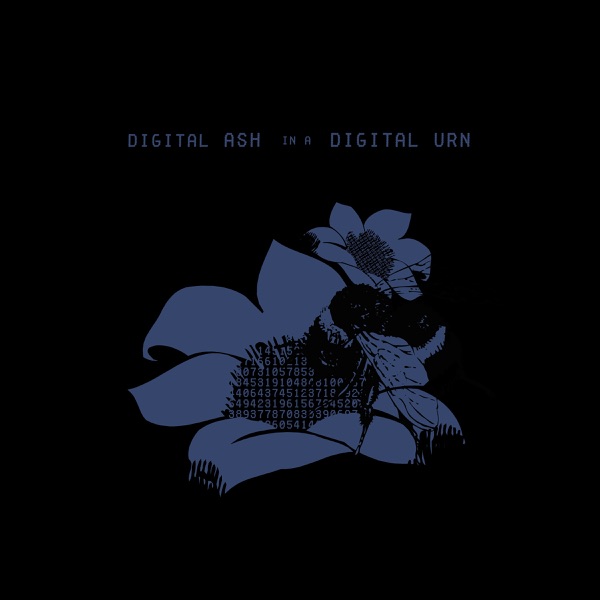
Digital Ash in a Digital Urn
2005 · 12 tracks
- 1 Time Code ↗ 4:28
- 2 Gold Mine Gutted ↗ 3:56
- 3 Arc of Time (Time Code) ↗ 3:54
- 4 Down in a Rabbit Hole ↗ 4:33
- 5 Take It Easy (Love Nothing) ↗ 3:21
- 6 Hit the Switch ↗ 4:47
- 7 I Believe in Symmetry ↗ 5:25
- 8 Devil in the Details ↗ 4:06
- 9 Ship in a Bottle ↗ 3:28
- 10 Light Pollution ↗ 3:17
- 11 Theme to Piñata ↗ 3:19
- 12 Easy/Lucky/Free ↗ 5:24

I’m Wide Awake, It’s Morning
2005 · 10 tracks
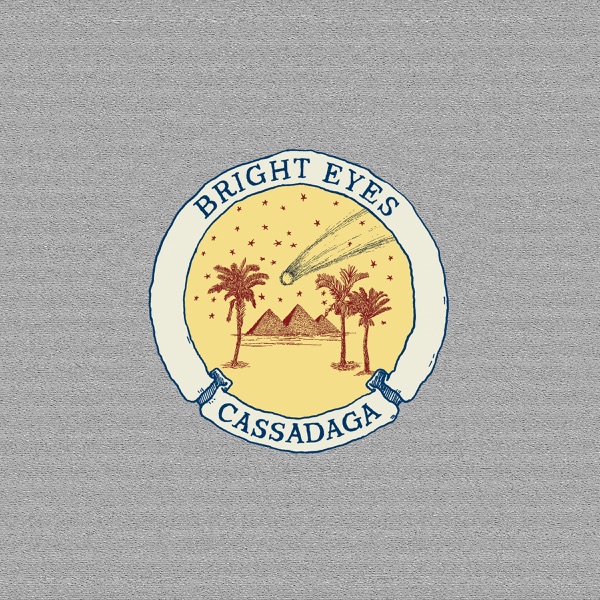
Cassadaga
2007 · 13 tracks
- 1 Clairaudients (Kill or Be Killed) ↗ 6:05
- 2 Four Winds ↗ 4:16
- 3 If the Brakeman Turns My Way ↗ 4:54
- 4 Hot Knives ↗ 4:14
- 5 Make a Plan to Love Me ↗ 4:14
- 6 Soul Singer in a Session Band ↗ 4:14
- 7 Classic Cars ↗ 4:19
- 8 Middleman ↗ 4:50
- 9 Cleanse Song ↗ 3:29
- 10 No One Would Riot for Less ↗ 5:12
- 11 Coat Check Dream Song ↗ 4:10
- 12 I Must Belong Somewhere ↗ 6:19
- 13 Lime Tree ↗ 5:54

The People’s Key
2011 · 10 tracks

Down in the Weeds, Where the World Once Was
2020 · 14 tracks
- 1 Pageturners Rag ↗ 3:58
- 2 Dance and Sing ↗ 4:31
- 3 Just Once in the World ↗ 3:28
- 4 Mariana Trench ↗ 3:42
- 5 One and Done ↗ 4:53
- 6 Pan and Broom ↗ 2:53
- 7 Stairwell Song ↗ 3:40
- 8 Persona Non Grata ↗ 3:32
- 9 Tilt-A-Whirl ↗ 2:20
- 10 Hot Car in the Sun ↗ 2:27
- 11 Forced Convalescence ↗ 4:09
- 12 To Death's Heart (In Three Parts) ↗ 5:26
- 13 Calais to Dover ↗ 4:18
- 14 Comet Song ↗ 5:36

Five Dice, All Threes
2024 · 13 tracks
- 1 Five Dice ↗ 1:40
- 2 Bells and Whistles ↗ 4:07
- 3 El Capitan ↗ 3:55
- 4 Bas Jan Ader ↗ 3:54
- 5 Tiny Suicides ↗ 4:44
- 6 All Threes ↗ 5:24
- 7 Rainbow Overpass ↗ 3:02
- 8 Hate ↗ 4:53
- 9 Real Feel 105° ↗ 3:25
- 10 Spun Out ↗ 3:37
- 11 Trains Still Run on Time ↗ 3:47
- 12 The Time I Have Left ↗ 3:33
- 13 Tin Soldier Boy ↗ 5:00
-
 Letting Off the HappinessBright Eyes199810 tracks
 -
 A Collection of Songs Written and Recorded 1995–1997Bright Eyes199820 tracks
 -
 Fevers and MirrorsBright Eyes200012 tracks
 -
 A Christmas AlbumBright Eyes200211 tracks
 -
 LIFTED or The Story Is in the Soil, Keep Your Ear to the GroundBright Eyes200213 tracks
 -
 Digital Ash in a Digital UrnBright Eyes200512 tracks
 -
 I’m Wide Awake, It’s MorningBright Eyes200510 tracks
 -
 CassadagaBright Eyes200713 tracks
 -
 The People’s KeyBright Eyes201110 tracks
 -
 Down in the Weeds, Where the World Once WasBright Eyes202014 tracks
 -
 Five Dice, All ThreesBright Eyes202413 tracks
Deep Dive
Overview
Bright Eyes is an American indie rock band founded in Omaha, Nebraska in 1995 by singer-songwriter and guitarist Conor Oberst. Over nearly three decades, the project has functioned as both a vehicle for Oberst’s prolific songwriting and a collaborative collective drawing from Omaha’s vibrant indie music ecosystem. Working alongside multi-instrumentalist and producer Mike Mogis and arranger and composer Nate Walcott—supplemented by rotating musicians from the regional scene—Bright Eyes established themselves as a defining voice of 1990s and 2000s indie rock, blending folk sensibilities with electronic experimentation and deeply introspective lyricism.
Formation Story
Conor Oberst founded Bright Eyes in Omaha in 1995, emerging from a Midwestern indie music scene far removed from the coastal industry centers that typically dominated rock discourse. The project began as a solo vehicle for Oberst’s guitar-driven singer-songwriter work but quickly evolved into a collaborative entity. By the late 1990s, Mike Mogis and Nate Walcott had become permanent fixtures, establishing the core trio that would shepherd the band through its most celebrated recordings. Omaha, a city with a strong underground music community but limited major-label infrastructure, became the operational base and creative fountain for Bright Eyes’ aesthetic, fostering a DIY ethos that would define the band’s approach to recording and touring for decades.
Breakthrough Moment
Bright Eyes achieved initial recognition through a pair of 1998 releases: Letting Off the Happiness and A Collection of Songs Written and Recorded 1995–1997. The former showcased Oberst’s gift for emotionally direct songwriting paired with lo-fi production values and folk-inflected arrangements. By Fevers and Mirrors (2000), the band had refined its sound while maintaining an aesthetic resistance to commercial polish, earning critical attention within indie rock circles. The release of LIFTED or The Story Is in the Soil, Keep Your Ear to the Ground (2002) marked a turning point, demonstrating the band’s capacity for lush, orchestral arrangements and sophisticated production while preserving the vulnerability that had attracted early listeners. These albums laid the groundwork for the band’s eventual status as indie rock torchbearers during a period when the genre was gaining broader cultural purchase.
Peak Era
Bright Eyes’ most creatively audacious and commercially successful period arrived with the parallel releases of Digital Ash in a Digital Urn and I’m Wide Awake, It’s Morning in 2005. The former represented a bold pivot toward electronic instrumentation and experimental production, while the latter reaffirmed the band’s folk-rock roots with acoustic guitars and chamber pop arrangements. This simultaneous dual-album strategy showcased the band’s artistic range and willingness to explore contradictory creative impulses within a single calendar year. Cassadaga (2007) continued this exploration, balancing atmospheric production with Oberst’s increasingly sophisticated songwriting. This five-year span from 2002 to 2007 defined Bright Eyes as a major force in indie rock, with the band expanding beyond their regional base to achieve national and international recognition through the indie label network and college radio infrastructure.
Musical Style
Bright Eyes’ sound synthesizes American folk-rock traditions with indie rock production sensibilities and, increasingly, electronic textures. Oberst’s vocal delivery—tender and often plaintive, prone to cracking with emotional intensity—serves as the project’s emotional center, while his guitar work ranges from fingerpicked acoustic passages to strummed folk-pop melodies. Mike Mogis and Nate Walcott have been instrumental in expanding the band’s sonic palette beyond Oberst’s initial singer-songwriter framework, incorporating strings, horns, keyboards, and synthesizers that place their work within broader indie pop traditions. The band’s arrangement philosophy draws from 1960s pop craftsmanship and contemporary electronic production, creating a hybrid aesthetic that resists easy categorization. Thematically, Bright Eyes’ lyrics address alienation, love, mortality, and social disconnection with literary specificity, positioning Oberst’s writing within the confession-based tradition of indie rock rather than narrative folk songwriting.
Major Albums
Letting Off the Happiness (1998)
The band’s full-length debut introduced Oberst’s intimate songwriting and earnest vocal approach, establishing the template for indie folk-rock that would sustain the project through its early years.
LIFTED or The Story Is in the Soil, Keep Your Ear to the Ground (2002)
A watershed moment showcasing orchestral arrangements, sophisticated production, and Oberst’s matured songwriting craft, solidifying Bright Eyes as major voices in contemporary indie rock.
Digital Ash in a Digital Urn (2005)
An experimental pivot toward electronic instrumentation and synth-based production, demonstrating the band’s willingness to venture into territory foreign to their folk-rock origins.
I’m Wide Awake, It’s Morning (2005)
Released simultaneously with Digital Ash, this album returned to acoustic guitars and chamber pop sensibilities while employing sophisticated production, creating a counterpoint to its electronic counterpart.
Cassadaga (2007)
The band balanced atmospheric production with intricate arrangement, representing a synthesis of the competing impulses explored in the 2005 dual-release strategy.
The People’s Key (2011)
A return to electric and electronic-influenced indie rock, continuing the band’s exploration of experimental textures within Oberst’s confessional songwriting framework.
Signature Songs
- “First Day of My Life” — An acoustic ballad of tender vulnerability that became the band’s signature moment, showcasing Oberst’s ability to distill emotional complexity into simple melodic terms.
- “Lua” — A fingerpicked acoustic meditation on longing and displacement, exemplifying the band’s folk-rock foundations and intimate vocal approach.
- “We Are Nowhere and It’s Now” — A synth-driven indie pop song that demonstrates the band’s comfort with electronic production and contemporary production values.
- “Poison Oak” — A melancholic guitar-driven ballad highlighting Oberst’s gift for emotionally direct, character-based songwriting.
Influence on Rock
Bright Eyes proved instrumental in establishing indie rock’s emotional and lyrical credibility during the early 2000s, a period when the genre was transitioning from underground subcultural phenomenon to broader cultural force. The band’s insistence on vulnerability and literary specificity within rock music helped legitimate confessional and introspective approaches to songwriting at a moment when indie rock was exploring diverse sonic territories. Oberst’s prolific output and willingness to experiment across multiple simultaneous albums established a model for artistic ambition within the independent music ecosystem, influencing a generation of singer-songwriters who emerged in indie rock’s subsequent decades. The band’s dual-album strategy and genre-fluid approach anticipated broader shifts toward portfolio careers and multi-project artist models that would become increasingly common in indie rock.
Legacy
Bright Eyes’ catalog has sustained considerable cultural relevance through streaming platforms and continued touring, positioning the band as elder statespeople of the indie rock tradition they helped define. The project’s longevity—spanning nearly three decades from their 1995 foundation through releases including Down in the Weeds, Where the World Once Was (2020) and Five Dice, All Threes (2024)—demonstrates the enduring appeal of Oberst’s songwriting and the band’s adaptive approach to contemporary production and distribution. Omaha itself has been elevated through association with Bright Eyes and the broader Saddle Creek Records ecosystem, establishing the city as a significant node within American indie rock geography. The band’s willingness to experiment across formats and electronic textures while maintaining their essential folk-rock and confessional sensibilities has preserved their relevance across multiple generations of indie rock listeners.
Fun Facts
- Bright Eyes released a Christmas Album in 2002, demonstrating the project’s willingness to explore non-standard formats alongside their main artistic output.
- The band’s 2005 strategy of releasing two simultaneous albums with contrasting production philosophies was unusual for indie rock acts, positioning Digital Ash in a Digital Urn and I’m Wide Awake, It’s Morning as artistic counterweights exploring different dimensions of the same songwriting.
- Bright Eyes emerged from Saddle Creek Records, an independent Omaha-based label that became closely associated with the band’s identity and reflected their commitment to regional music infrastructure over major-label distribution.
- The band has maintained a rotating lineup of collaborators drawn from Omaha’s indie music scene, creating a semi-permanent creative community rather than a traditional fixed ensemble, which allowed for flexible sonic exploration across their catalog.