
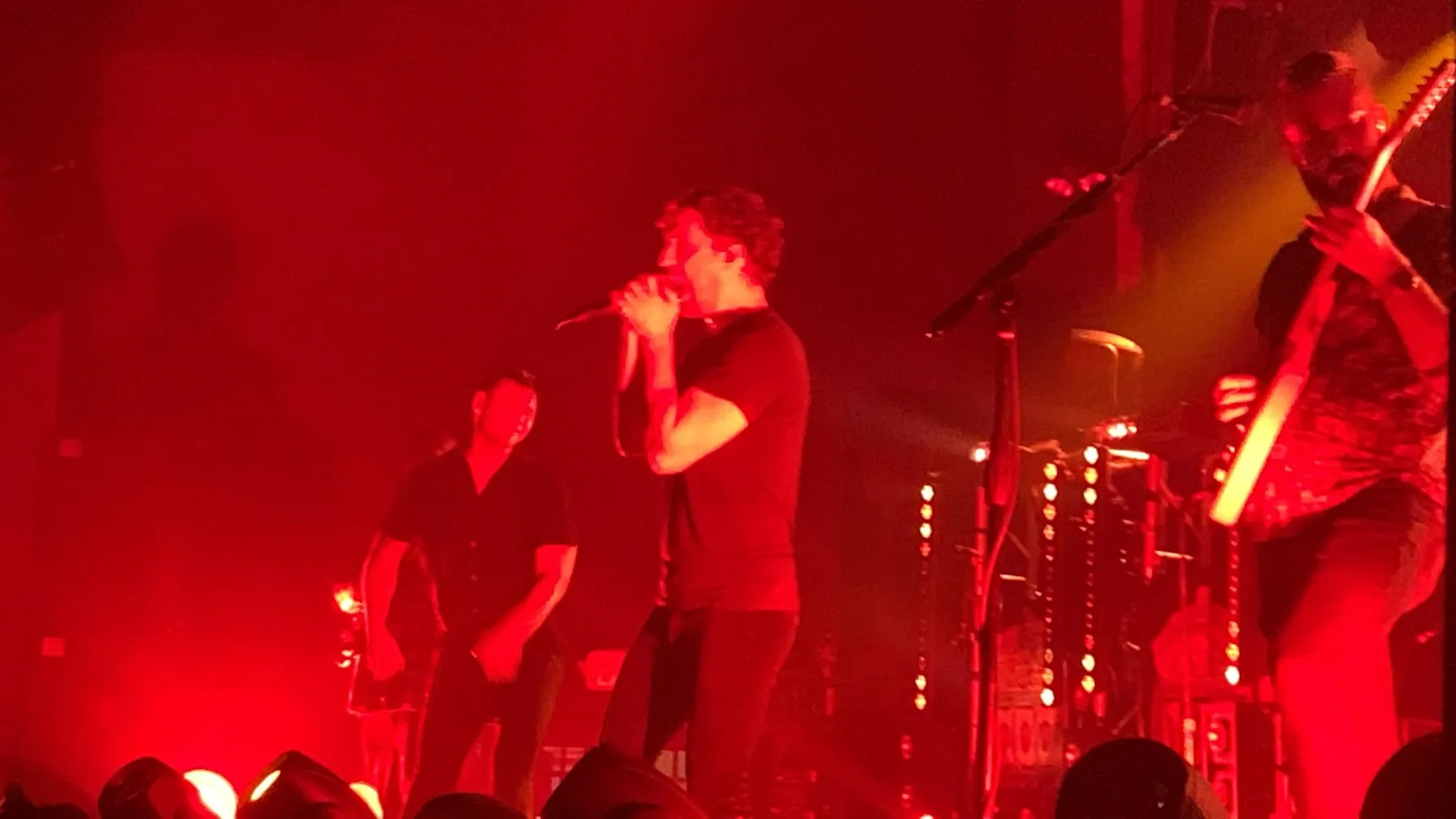
Photo by MrFib , licensed under CC BY-SA 4.0 · Wikimedia Commons
Rank #254
Dance Gavin Dance
From Wikipedia
Dance Gavin Dance is an American rock band from Sacramento, California, formed in 2005. It consists of lead guitarist Will Swan, drummer Matthew Mingus, harsh vocalist Jon Mess, and lead vocalist and rhythm guitarist Andrew Wells. The band formerly included lead vocalists Jonny Craig, Kurt Travis, and Tilian Pearson, and the lineup has changed numerous times since their inception. Swan and Mingus are the only band members who have appeared on every studio album.
Discography & Previews
Browse through and click an album to open and play 30-second previews streamed from Apple Music.

Downtown Battle Mountain
2007 · 11 tracks
- 1 Untitled ↗ 0:48
- 2 And I Told Them I Invented Times New Roman ↗ 4:48
- 3 It's Safe To Say You Dig The Backseat ↗ 5:14
- 4 Strawberry Andre ↗ 3:13
- 5 Lemon Meringue Tie ↗ 3:51
- 6 The Backwards Pumpkin Song ↗ 4:07
- 7 Antlion ↗ 3:19
- 8 Turn Off The Lights, I'm Watching Back To The Future ↗ 3:59
- 9 Open Your Eyes And Look North ↗ 4:30
- 10 Surprise! I'm From Cuba, Everyone Has One Brain ↗ 4:55
- 11 12 Hours 630 Miles ↗ 1:25

Dance Gavin Dance
2008 · 13 tracks
- 1 Alex English ↗ 4:26
- 2 Buffalo! ↗ 2:40
- 3 Me and Zoloft Get Along Just Fine ↗ 3:06
- 4 The Robot With Human Hair, Pt. 3 ↗ 3:46
- 5 Hot Water On Wool ↗ 4:27
- 6 Hot Water On Wool (Reprise) ↗ 1:56
- 7 Uneasy Hearts Weigh the Most ↗ 3:38
- 8 Caviar (feat. Chino Moreno) ↗ 4:16
- 9 Rock Solid ↗ 5:06
- 10 Burning Down the Nicotine Armoire, Pt. 2 ↗ 3:32
- 11 Reprogramming Mental Preprogramming ↗ 3:10
- 12 Skyhook ↗ 2:54
- 13 People You Know ↗ 9:22


Downtown Battle Mountain II
2011 · 11 tracks

Acceptance Speech
2013 · 11 tracks
- 1 Jesus H. Macy ↗ 3:25
- 2 The Robot with Human Hair pt. 4 ↗ 3:33
- 3 Acceptance Speech ↗ 4:26
- 4 Carve ↗ 2:49
- 5 Doom & Gloom ↗ 3:40
- 6 Strawberry Swisher pt. 3 ↗ 3:35
- 7 Honey Revenge ↗ 3:28
- 8 Demo Team ↗ 3:08
- 9 Death of the Robot with Human Hair ↗ 5:07
- 10 The Jiggler ↗ 4:55
- 11 Turn Off the Lights. I'm Watching Back to the Future pt. II ↗ 6:00

Instant Gratification
2015 · 12 tracks

Mothership
2016 · 13 tracks
- 1 Chucky vs. The Giant Tortoise ↗ 3:56
- 2 Young Robot ↗ 3:39
- 3 Frozen One ↗ 2:48
- 4 Flossie Dickey Bounce ↗ 2:54
- 5 Deception ↗ 3:52
- 6 Inspire the Liars ↗ 4:35
- 7 Philosopher King ↗ 3:39
- 8 Here Comes the Winner ↗ 4:47
- 9 Exposed ↗ 3:32
- 10 Betrayed By the Game ↗ 3:10
- 11 Petting Zoo Justice ↗ 3:27
- 12 Chocolate Jackalope ↗ 3:50
- 13 Man of the Year ↗ 5:34

Artificial Selection
2018 · 14 tracks
- 1 Son of Robot ↗ 3:59
- 2 Midnight Crusade ↗ 3:29
- 3 Suspended In This Disaster ↗ 3:19
- 4 Care ↗ 4:26
- 5 Count Bassy ↗ 4:05
- 6 Flash ↗ 3:08
- 7 The Rattler ↗ 3:23
- 8 Shelf Life ↗ 3:09
- 9 Slouch ↗ 3:11
- 10 Story of My Bros ↗ 3:14
- 11 Hair Song ↗ 3:03
- 12 Gospel Burnout ↗ 4:09
- 13 Bloodsucker ↗ 4:20
- 14 Evaporate ↗ 4:58

Afterburner
2020 · 13 tracks
- 1 Prisoner ↗ 3:47
- 2 Lyrics Lie ↗ 3:56
- 3 Calentamiento Global ↗ 3:58
- 4 Three Wishes ↗ 3:28
- 5 One in a Million ↗ 3:41
- 6 Parody Catharsis ↗ 3:41
- 7 Strawberry’s Wake ↗ 3:38
- 8 Born to Fail ↗ 3:28
- 9 Parallels ↗ 3:37
- 10 Night Sway ↗ 2:52
- 11 Say Hi ↗ 3:52
- 12 Nothing Shameful (feat. Andrew Wells) ↗ 4:01
- 13 Into the Sunset (feat. Bilmuri) ↗ 4:30

Jackpot Juicer
2022 · 18 tracks
- 1 Untitled 2 ↗ 0:35
- 2 Cream of the Crop ↗ 3:40
- 3 Synergy (feat. Rob Damiani) ↗ 3:17
- 4 Holy Ghost Spirit ↗ 3:50
- 5 For the Jeers ↗ 4:11
- 6 Ember ↗ 3:46
- 7 Pop Off! ↗ 3:09
- 8 One Man's Cringe ↗ 3:44
- 9 Feels Bad Man ↗ 3:20
- 10 Die Another Day ↗ 3:41
- 11 Two Secret Weapons ↗ 3:30
- 12 Polka Dot Dobbins ↗ 2:46
- 13 Long Nights In Jail ↗ 3:04
- 14 Back On Deck ↗ 3:32
- 15 Current Events ↗ 4:17
- 16 Pray To God For Your Mother ↗ 3:49
- 17 Swallowed By Eternity ↗ 5:05
- 18 Have a Great Life ↗ 3:48

Pantheon
2025 · 13 tracks
- 1 Animal Surgery ↗ 5:10
- 2 Midnight at McGuffy's ↗ 4:11
- 3 The Robot with Human Hair: Rebirth ↗ 5:41
- 4 The Conqueror Worm ↗ 3:37
- 5 Trap Door ↗ 4:22
- 6 Strawberry's Daughters ↗ 3:35
- 7 Space Cow Initiation Ritual (feat. George Clinton) ↗ 3:49
- 8 All the Way Down ↗ 4:26
- 9 A Shoulder to Cry On ↗ 4:42
- 10 The Peak of Superstition ↗ 3:32
- 11 The Stickler ↗ 3:59
- 12 Yikes! ↗ 3:54
- 13 Descend to Chaos ↗ 4:15
-
 Downtown Battle MountainDance Gavin Dance200711 tracks
 -
 Dance Gavin DanceDance Gavin Dance200813 tracks
 -
 HappinessDance Gavin Dance200910 tracks
 -
 Downtown Battle Mountain IIDance Gavin Dance201111 tracks
 -
 Acceptance SpeechDance Gavin Dance201311 tracks
 -
 Instant GratificationDance Gavin Dance201512 tracks
 -
 MothershipDance Gavin Dance201613 tracks
 -
 Artificial SelectionDance Gavin Dance201814 tracks
 -
 AfterburnerDance Gavin Dance202013 tracks
 -
 Jackpot JuicerDance Gavin Dance202218 tracks
 -
 PantheonDance Gavin Dance202513 tracks
Deep Dive
Overview
Dance Gavin Dance is an American post-hardcore band from Sacramento, California, that emerged in the mid-2000s as a distinctive voice in experimental rock. Formed in 2005, the band has built a career on technical complexity, dual-vocal interplay, and genre-blending arrangements that merge post-hardcore’s aggressive urgency with math rock’s rhythmic sophistication and progressive rock’s compositional ambition. Across two decades and eleven studio albums, Dance Gavin Dance has become a cornerstone of modern post-hardcore, known for constant lineup evolution and an uncompromising approach to songwriting that refuses simple categorization.
Formation Story
Dance Gavin Dance coalesced in Sacramento during 2005 around the partnership of guitarist Will Swan and drummer Matthew Mingus, two musicians determined to construct a sound built on intricate instrumental arrangements and layered vocal performances. The early lineup introduced the dual-vocal approach that would become the band’s signature: harsh, often screamed vocals layered against melodic singing, creating a dynamic tension that became central to their identity. The Sacramento origin placed them at a remove from the major post-hardcore hotbeds of the era, yet this geographic periphery contributed to their distinct character—drawing from local influences while synthesizing elements of screamo, emo, experimental rock, and the emerging math rock revival of the 2000s.
Breakthrough Moment
Dance Gavin Dance announced their arrival with their 2007 debut album, Downtown Battle Mountain, which introduced their core sound to a wider audience. The record’s combination of angular guitar work, intricate drumming, and the explosive contrast between harsh and clean vocals established the template for their approach. Released through Rise Records, the album caught the attention of the post-hardcore underground and began building the band’s reputation for technical proficiency and fearless genre-crossing. By the time of their self-titled second album in 2008, Dance Gavin Dance, the band had solidified their presence within the post-hardcore community, demonstrating that their debut was not a one-off but the beginning of a sustained artistic vision.
Peak Era
The period from 2013 to 2018 marked Dance Gavin Dance’s commercial and creative peak. Acceptance Speech (2013) showcased the band’s maturation as songwriters, balancing accessibility with uncompromised instrumental complexity. Instant Gratification (2015) and Mothership (2016) became their most widely heard records, reaching audiences beyond the post-hardcore faithful while maintaining the technical demands that defined their core appeal. Artificial Selection (2018) continued this trajectory, cementing their status as one of the most significant post-hardcore acts of their generation. Throughout this period, Swan and Mingus remained the constants, anchoring the band through multiple vocal-line changes and ensuring continuity across albums that saw the band deepening their exploration of math rock and progressive elements.
Musical Style
Dance Gavin Dance’s sound is characterized by its refusal to settle into a single genre framework. The instrumental backbone consists of Will Swan’s angular, rhythmically complex guitar work interlocked with Matthew Mingus’s equally intricate drumming, creating time-signature shifts and syncopated passages that draw from math rock’s technical vocabulary. Over this foundation sits the band’s defining feature: dual vocals that pit harsh, screamed singing against clean melodic singing, creating immediate textural contrast and emotional range within single songs. The band’s compositional approach emphasizes unexpected instrumental turns, sudden dynamic shifts, and arrangements that reject verse-chorus-verse simplicity in favor of progressive structures. Across their discography, they have gradually incorporated more experimental production techniques and melodic sophistication, pushing from the raw screamo influences of their early work toward a sound that encompasses experimental rock and progressive rock sensibilities without ever abandoning the post-hardcore urgency from which they emerged.
Major Albums
Downtown Battle Mountain (2007)
The debut that introduced Dance Gavin Dance’s technical approach and dual-vocal dynamic, establishing the band’s willingness to build complex arrangements within post-hardcore frameworks.
Happiness (2009)
Their third album, continuing to develop the band’s signature sound and demonstrating consistent songwriting growth in the years following their initial breakthrough.
Acceptance Speech (2013)
A watershed moment that refined the band’s approach into their most focused and accomplished statement, balancing accessibility with uncompromised technical detail.
Mothership (2016)
Their most widely heard record, achieving a peak commercial reach while sustaining the instrumental and compositional complexity that defined their core identity.
Artificial Selection (2018)
A deep exploration of the band’s progressive and experimental impulses, continuing their trajectory toward increasingly ambitious songwriting structures.
Afterburner (2020)
A continuation of their post-2015 commercial and creative momentum, demonstrating sustained creative vision two decades into their career.
Signature Songs
- “Strawberry Swisher Dream” — An early standout from their debut era, exemplifying their angular guitar work and vocal interplay.
- “Spooks” — A track that showcases the band’s ability to build dynamic tension through instrumental contrast.
- “Uneasy Hearts Weigh the Most” — Demonstrating the band’s capacity to balance melody with their characteristic aggressive vocal delivery.
- “Chasing Ghosts” — Reflecting their mid-period evolution toward more accessible but still technically sophisticated songwriting.
- “Bloodsucker” — An example of their willingness to experiment with production and arrangement approaches.
Influence on Rock
Dance Gavin Dance’s influence on post-2000s rock music extends primarily through their role in proving that post-hardcore could accommodate mathematical complexity and progressive song structures without sacrificing emotional directness or accessibility. They demonstrated that dual-vocal systems—harsh and clean, aggressive and melodic—could become a primary compositional tool rather than a stylistic gimmick, influencing numerous bands who followed. By treating math rock and post-hardcore as complementary rather than contradictory, they opened pathways for subsequent bands to move fluidly between technical sophistication and mainstream radio presentation. Their sustained relevance across two decades reinforced the viability of uncompromising instrumental approaches within rock music’s contemporary landscape, at a time when such complexity was increasingly relegated to progressive or metalcore subgenres.
Legacy
Dance Gavin Dance’s legacy rests on their consistency and creative longevity at a time when post-hardcore bands have often fragmented or disbanded. With eleven studio albums across nearly two decades, they have maintained a working lineup built around the constants of Will Swan and Matthew Mingus, providing continuity for a fan base that has grown substantially in the 2010s and 2020s. The band continues to record and tour, with 2022’s Jackpot Juicer and the 2025 release Pantheon demonstrating ongoing creative engagement. Their streaming presence on modern platforms has introduced them to audiences too young to have discovered them during the mid-2000s post-hardcore peak, contributing to a steady trajectory of growth that has made them one of the few acts from their era to achieve sustained relevance without major mainstream radio hits. Within the post-hardcore and math rock communities specifically, they remain influential reference points for technical ambition and genre boundary-crossing.
Fun Facts
- Will Swan and Matthew Mingus are the only band members to appear on every Dance Gavin Dance studio album, making them the project’s true constants across two decades and multiple lineup changes.
- The band’s album Downtown Battle Mountain II (2011) served as a direct sequel title to their 2007 debut, a rare instance of a band explicitly referencing and revisiting their origin point.
- Dance Gavin Dance emerged from Sacramento, California, a city far removed from the major post-hardcore centers of the 2000s, contributing to their distinctive regional identity within the broader genre landscape.
- The band has cycled through several lead vocalists—including Jonny Craig, Kurt Travis, and Tilian Pearson—each bringing distinct vocal character and influencing the band’s sonic evolution across their album cycle.