
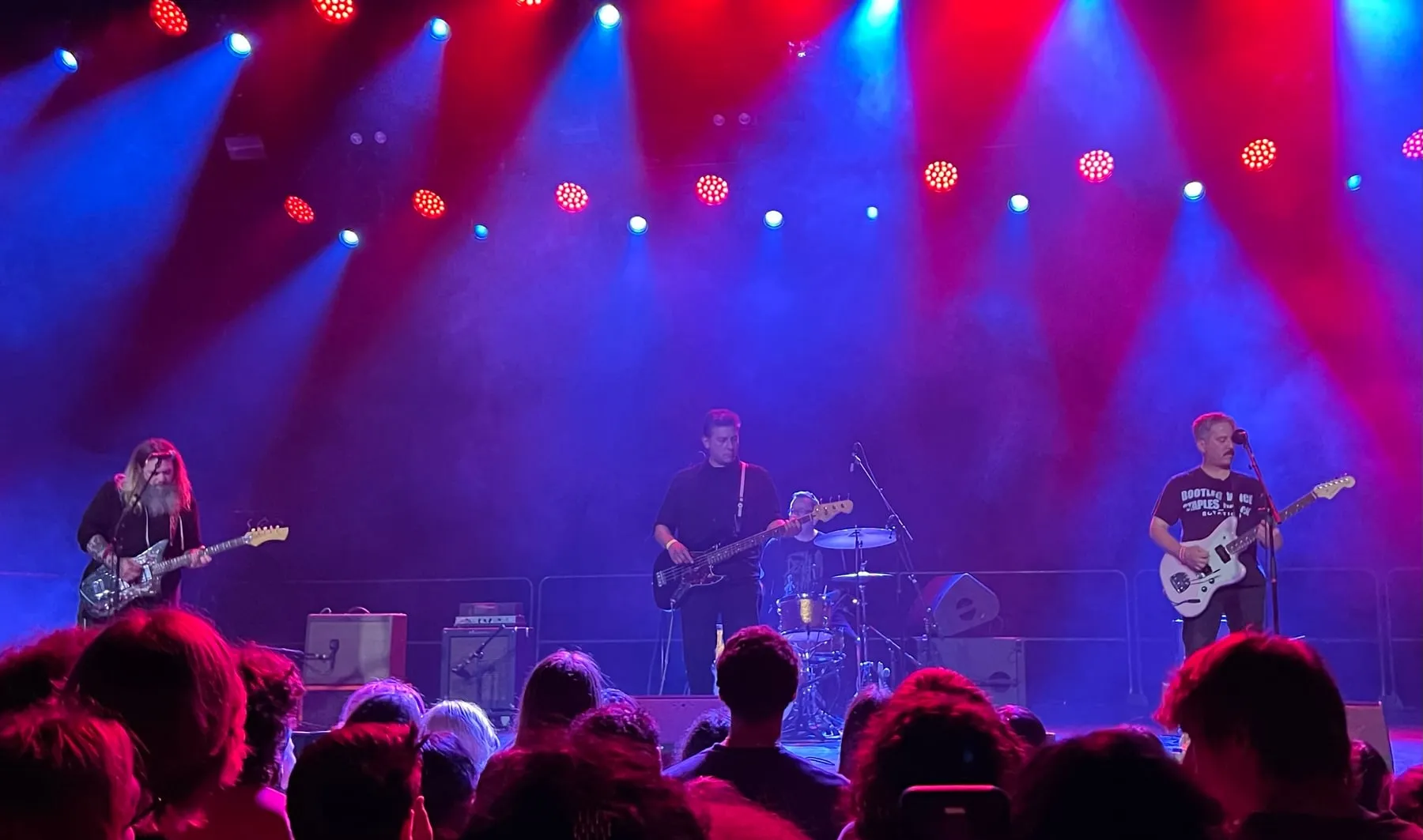
Photo by Will Bonniker , licensed under CC BY-SA 4.0 · Wikimedia Commons
Rank #438
Duster
From Wikipedia
Duster is an American indie rock band, formed in San Jose, California in 1996. For most of its history, the group consisted of multi-instrumentalists Clay Parton and Canaan Dove Amber alongside drummer Jason Albertini before Albertini left the band in 2022.
Discography & Previews
Browse through and click an album to open and play 30-second previews streamed from Apple Music.

Stratosphere
1998 · 17 tracks
- 1 Moon Age ↗ 1:06
- 2 Heading for the Door ↗ 3:08
- 3 Gold Dust ↗ 2:06
- 4 Topical Solution ↗ 5:01
- 5 Docking the Pod ↗ 1:51
- 6 The Landing ↗ 2:43
- 7 Echo, Bravo ↗ 4:32
- 8 Constellations ↗ 3:43
- 9 The Queen of Hearts ↗ 4:19
- 10 Two Way Radio ↗ 0:19
- 11 Inside Out ↗ 2:21
- 12 Stratosphere ↗ 6:58
- 13 Reed to Hillsborough ↗ 4:01
- 14 Shadows of Planes ↗ 1:50
- 15 Earth Moon Transit ↗ 4:23
- 16 The Twins / Romantica ↗ 3:43
- 17 Sideria ↗ 1:48

Contemporary Movement
2000 · 12 tracks


In Dreams
2024 · 13 tracks
-
 StratosphereDuster199817 tracks
 -
 Contemporary MovementDuster200012 tracks
 -
 DusterDuster201912 tracks
 -
 TogetherDuster202213 tracks
 -
 In DreamsDuster202413 tracks
Deep Dive
Overview
Duster is an American indie rock band formed in San Jose, California in 1996. Operating primarily as a duo of multi-instrumentalists Clay Parton and Canaan Dove Amber, supported by drummer Jason Albertini for much of their career, the group emerged from the West Coast indie underground during the post-grunge era. Their sound straddles slowcore, lo-fi, and space rock—textural, deliberately paced compositions that prize atmosphere and restraint over conventional rock dynamics. Though they initially dissolved into relative obscurity, Duster’s catalog has experienced significant reassessment in the streaming era, positioning them as formative figures in the genealogy of contemporary lo-fi and ambient-adjacent indie rock.
Formation Story
Duster coalesced in San Jose during 1996, a moment when American indie rock was fracturing into dozens of microgenres and regional scenes. The band’s core creative partnership developed between Clay Parton and Canaan Dove Amber, both capable across multiple instruments and uninterested in conventional rock roles. Drummer Jason Albertini completed the classic lineup, establishing Duster as a three-piece committed to exploratory, minimalist composition. San Jose’s geographic position—between the Bay Area’s experimental music heritage and proximity to Los Angeles—placed the band outside the New York and Seattle media centers that dominated rock coverage in the 1990s, a circumstance that would shape their trajectory as cult rather than mainstream figures.
Breakthrough Moment
Duster’s debut album Stratosphere, released in 1998, announced their aesthetic fully formed: extended instrumental passages, hushed vocal delivery, and production deliberately stripped of commercial polish. The same year saw the release of Hier Kommt Der Schwartze Mond, establishing a prolific initial period. These early records established Duster’s core audience among collectors of experimental indie and lo-fi music but did not generate mainstream recognition. Their work circulated primarily through indie retail channels and mail-order networks, building a dedicated if small fanbase that appreciated their refusal to accommodate radio expectations. By the early 2000s, with releases including Experimental Dust, Contemporary Movement, and Rarities, the band had crystallized their sound but remained marginal in the broader rock conversation, a positioning that would ultimately prove advantageous for their later reassessment.
Peak Era
Duster’s initial run from 1998 to 2001 represented their most sustained period of creative output, yielding five studio and compilation releases that established the band’s definitive sonic identity. This era preceded their extended dormancy but also contained the seeds of their later cult status: music that resisted easy categorization or commercialization, built on the premise that indie rock could be as contemplative and abstracted as classical minimalism. The production values were intentionally modest, foregrounding compositional intricacy and tonal detail over polished engineering. By 2001, however, the band had withdrawn from active recording, a hiatus that would stretch nearly two decades before their self-titled 2019 return.
Musical Style
Duster’s sound emerges from the intersection of slowcore’s emotional restraint, lo-fi’s embrace of tape hiss and documentary authenticity, and space rock’s drift toward ambient texture. Multi-track guitar layers, often tuned low and played with restraint, create harmonic density without aggression. Canaan Dove Amber’s vocals are characteristically distant and double-tracked, treated as an additional textural element rather than a narrative focal point. The rhythm section—Albertini’s drumming in particular—favors subtlety and negative space; drums enter not to drive momentum but to anchor extended instrumental passages. The band’s instrumentation ranges across conventional rock elements (guitars, bass, drums) supplemented by keyboards and production techniques that blur the line between rock and electronic music. Sonically, their work suggests influence from post-punk’s structural innovations and the ambient production sensibilities emerging in parallel indie scenes, resulting in music that plays equally well in solitude or as background texture.
Major Albums
Stratosphere (1998)
Duster’s debut established the template for their entire aesthetic: extended instrumental passages, hushed vocals, and deliberate pacing that challenged punk-derived rock conventions. The album’s approach to production and composition defined the band’s identity from inception.
Experimental Dust (2000)
This release deepened and refined the instrumental explorations of Stratosphere, with compositions that moved further toward ambient and space rock territory while maintaining indie rock instrumentation.
Duster (2019)
Returning after eighteen years away, this self-titled record demonstrated the core partnership of Parton and Amber remaining artistically vital. The album affirmed that the band’s aesthetic, initially marginal in the late 1990s, had gained broader cultural resonance through streaming and lo-fi revival movements.
Together (2022)
Released the same year Jason Albertini departed the band, Together marked Duster’s continued activity in a reduced format, featuring the primary duo of Parton and Amber.
In Dreams (2024)
The band’s most recent release extended their contemporary-era momentum, maintaining their commitment to slow-tempo, texture-focused composition.
Signature Songs
- “Stratosphere” — The album’s extended title track exemplifies the band’s approach to instrumental development and textural layering.
- “Echo, Bravo” — A composition that showcases the interplay between Amber’s restrained vocals and the band’s harmonic architecture.
- “Beside a Raven” — Representative of Duster’s ability to sustain emotional resonance across deliberately paced, extended arrangements.
Influence on Rock
Duster’s significance lies not in commercial dominance but in their demonstration that indie rock could embrace slowness, abstraction, and emotional subtlety without abandoning rock instrumentation or song-oriented structure. Their work anticipated and influenced the broader reassessment of lo-fi and slowcore aesthetics in the 2010s, when streaming platforms and internet communities revived interest in 1990s underground movements. The band’s refusal to accommodate conventional rock dynamics—their rejection of verses, choruses, and climactic builds in favor of floating, ambient-adjacent compositions—provided a template for subsequent generations of indie artists exploring the boundary between rock and ambient music. Contemporary artists working in lo-fi production, shoegaze revival, and slowcore revival movements trace partial lineage to Duster’s early experiments, even if direct citation remains infrequent.
Legacy
Duster’s trajectory—cult status followed by extended dormancy and subsequent revival—reflects broader patterns in digital-era music consumption. Their 1998–2001 catalog, long relegated to specialist collections and trading networks, experienced renewed attention through streaming platforms and lo-fi YouTube communities, introducing their work to audiences born after their initial activity period. The 2019 reunion announced not a departure from their core aesthetic but a continuation of it, validating the artistic choices made in 1996 by demonstrating their resilience across changing musical and cultural contexts. Ongoing streaming presence and the continued release of new material—including 2022’s Together and 2024’s In Dreams—confirm Duster as an active entity rather than a historical artifact. Their story illustrates how indie rock acts operating outside mainstream commercial structures can accumulate influence and cultural significance through patient audience building and aesthetic consistency.
Fun Facts
- Duster formed in San Jose, California, placing them geographically outside the dominant New York and Seattle indie rock centers of the 1990s, contributing to their limited initial recognition.
- The band released five studio and compilation albums between 1998 and 2001 before an eighteen-year hiatus, returning in 2019 with their self-titled Duster.
- Jason Albertini, the band’s original drummer, remained with the group from their 1996 formation until his departure in 2022, anchoring their sound across more than two decades.