
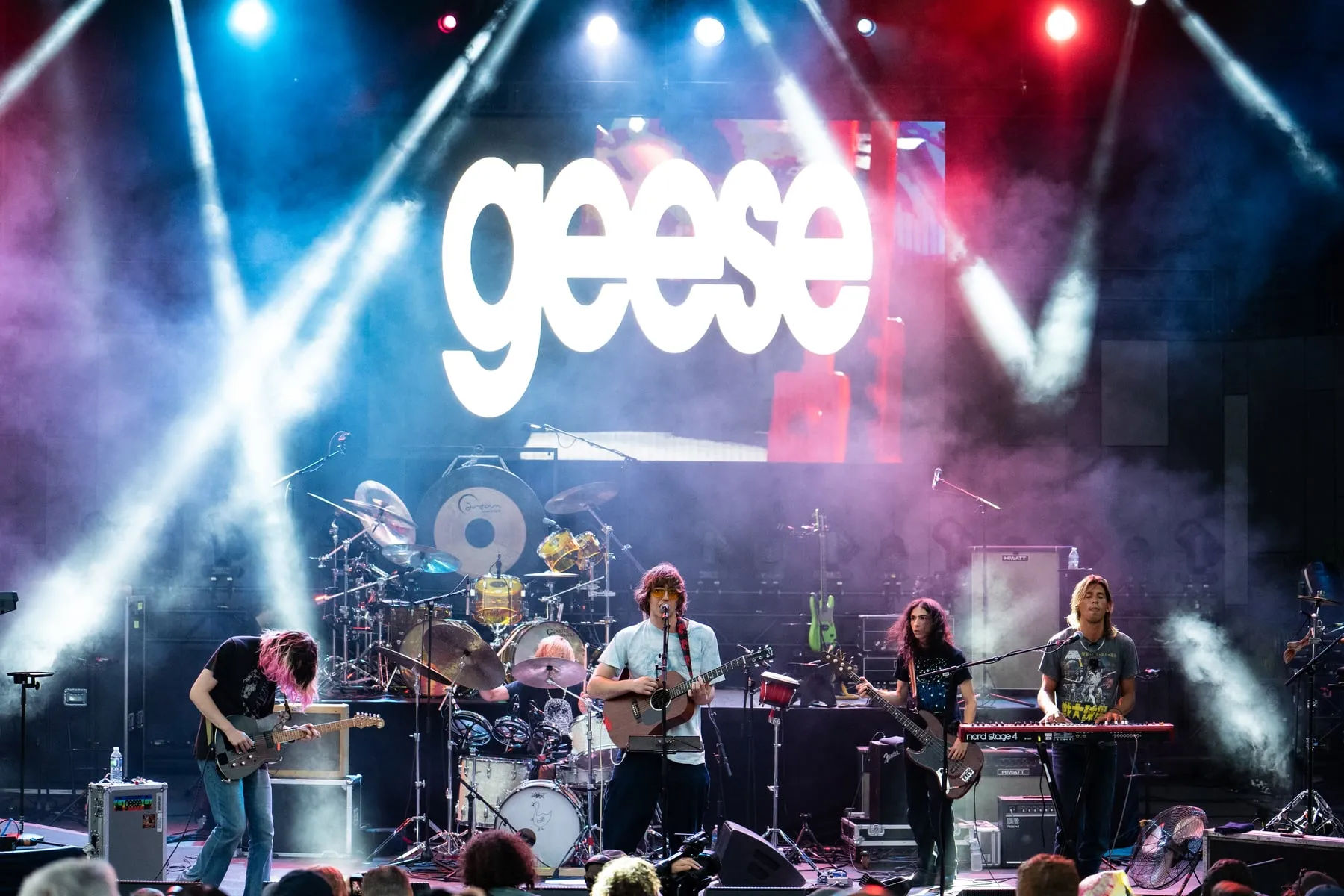
Photo by Lygonstreet , licensed under CC BY-SA 4.0 · Wikimedia Commons
Rank #331
Geese
From Wikipedia
Geese is an American rock band formed in 2016 in Brooklyn, New York. The band currently consists of Cameron Winter, Emily Green (guitar), Dominic DiGesu (bass) and Max Bassin (drums). During live performances, the band is joined by keyboardist Sam Revaz.
Members
- Cameron Winter (2016–present)
- Dominic DiGesu (2016–present)
- Emily Green (2016–present)
- Max Bassin (2016–present)
Discography & Previews
Browse through and click an album to open and play 30-second previews streamed from Apple Music.


-
 ProjectorGeese20219 tracks
 -
 3D CountryGeese202311 tracks
 -
 Getting KilledGeese202511 tracks
Deep Dive
Overview
Geese is an American rock band that emerged from Brooklyn in 2016, representing the post-punk and art rock revival of the 2010s. The band channels angular guitar work, intricate rhythmic structures, and atmospheric production into a sound that bridges post-punk minimalism with art rock complexity. Since their formation nearly a decade ago, Geese have become part of a broader contemporary movement of bands drawing from the formal rigor and emotional restraint of late-1970s and early-1980s post-punk while incorporating production techniques and compositional ambitions tied to art rock traditions.
Formation Story
Geese came together in Brooklyn, New York in 2016, coalescing around the songwriting and vocal presence of Cameron Winter alongside guitarist Emily Green, bassist Dominic DiGesu, and drummer Max Bassin. All four members have remained constant throughout the band’s existence, establishing a stable creative nucleus from inception. The Brooklyn setting placed them within a thriving independent rock scene, one oriented toward post-punk reinterpretation and art-rock experimentation. The city’s history as a crucible for experimental music—from no wave through indie rock—provided both a cultural context and a receptive audience for their approach.
Breakthrough Moment
Geese’s full-length debut, A Beautiful Memory, arrived in 2018 and introduced their architectural approach to post-punk songwriting. The album demonstrated a band uninterested in punk’s speed or energy in favor of tension, precision, and textural development. Two years of relative quiet followed before the group’s second album, Projector, landed in 2021, marking a moment of growing recognition within indie and post-punk circles. The three-year gap between debut and sophomore release allowed the band to refine their approach and build momentum within the streaming era and independent music networks, gradually expanding their audience beyond Brooklyn’s immediate scene.
Peak Era
The period from 2021 onwards represents Geese’s most productive and artistically expansive stretch. Projector in 2021 demonstrated deepened arrangements and production sophistication, while 3D Country in 2023 continued to expand the band’s sonic palette. By the early 2020s, Geese had solidified their position within the contemporary post-punk landscape, competing for attention among a generation of bands similarly oriented toward late-1970s formal rigor. Their live performances, augmented by keyboardist Sam Revaz, added harmonic and textural layers that deepened the recorded material, making the quartet’s studio work translate into more complex soundscapes onstage.
Musical Style
Geese’s sound balances the restraint and angular geometry of post-punk with the compositional ambition and textural layering of art rock. Emily Green’s guitar work emphasizes dissonance, repetition, and precise dynamics rather than melodic display, often functioning as a rhythmic and tonal element alongside Dominic DiGesu’s melodic bass lines. Max Bassin’s drumming favors unusual time signatures and syncopation over straightforward power, creating rhythmic spaces that allow other elements to breathe. Cameron Winter’s vocals occupy a middle register, often treated with subtle effects and integration into the overall mix rather than foregrounded as a traditional rock frontman presence. Production choices favor clarity and separation of elements—individual instruments are legible within dense arrangements—rather than cohesion into a unified wash of sound. The band’s post-punk lineage traces to art-school influenced groups from the late 1970s, while their contemporary positioning aligns with 2010s bands who engaged post-punk not as nostalgia but as a formal language for modern anxieties and compositional curiosity.
Major Albums
A Beautiful Memory (2018)
Geese’s debut established their architectural approach to post-punk, introducing the band’s signature blend of angular guitar work, intricate rhythms, and restrained vocal production. The album announced a band more interested in compositional precision and tonal color than straightforward song craft.
Projector (2021)
The second full-length deepened the band’s sonic ambitions with more sophisticated arrangements and production techniques. Projector demonstrated the band’s growing technical facility and willingness to expand their post-punk foundation into more expansive song structures.
3D Country (2023)
Geese’s third album continued their exploration of textural layering and formal experimentation, solidifying the band’s position within contemporary post-punk and art rock circles. The album title and its accompanying aesthetic suggested continued evolution beyond their earlier work.
Signature Songs
- “Lemon Pound” (from A Beautiful Memory, 2018) — An early statement of the band’s precision and attention to harmonic and rhythmic detail within a relatively compact song form.
- “Sheepshead” (from A Beautiful Memory, 2018) — A track exemplifying Geese’s ability to build tension through repetition and carefully managed instrumental interaction without relying on conventional dynamics or melody.
- “Belts” (from Projector, 2021) — A highlight of the band’s second album showcasing expanded arrangements and deeper production sophistication.
Influence on Rock
Geese represent one facet of a broader post-punk revival that gained momentum throughout the 2010s and into the 2020s. Bands of their generation approached post-punk not as a historical pastiche but as a usable formal language—the genre’s emphasis on precision, restraint, and compositional clarity offered an alternative to both mainstream rock’s spectacle and indie rock’s melodicism. While Geese operate in relative obscurity compared to larger contemporary acts, they contribute to a lineage of post-punk interpretation that includes formally ambitious, art-school influenced approaches to rock music. Their integration of art-rock elements—unusual song structures, harmonic complexity, textural sophistication—into post-punk’s angular minimalism influences how younger bands conceptualize the relationship between constraint and ambition.
Legacy
As an active band with an ongoing recording and touring practice, Geese’s legacy remains in formation. Their three albums and continued work through the early 2020s established them as part of a cohort of post-punk-oriented acts contributing to rock music’s continued formal and conceptual evolution. The stability of their lineup since 2016 and their consistent release schedule suggest a band committed to long-term artistic development rather than rapid commercial scaling. Within indie and alternative rock ecosystems—streaming platforms, independent record labels, touring circuits—Geese occupy a secure if modest position, with their work finding audiences among listeners attuned to post-punk and art-rock traditions.
Fun Facts
- Sam Revaz’s presence as a live keyboardist adds harmonic and textural dimensions to Geese’s recorded material during performances, creating a distinction between the studio and live versions of their songs.
- The band has maintained an entirely consistent lineup since their formation in 2016, rare among contemporary rock bands in an era of frequent membership changes.
- Geese’s official website (geeseband.com) serves as their primary digital presence, reflecting an independent approach to band promotion and fan engagement.