
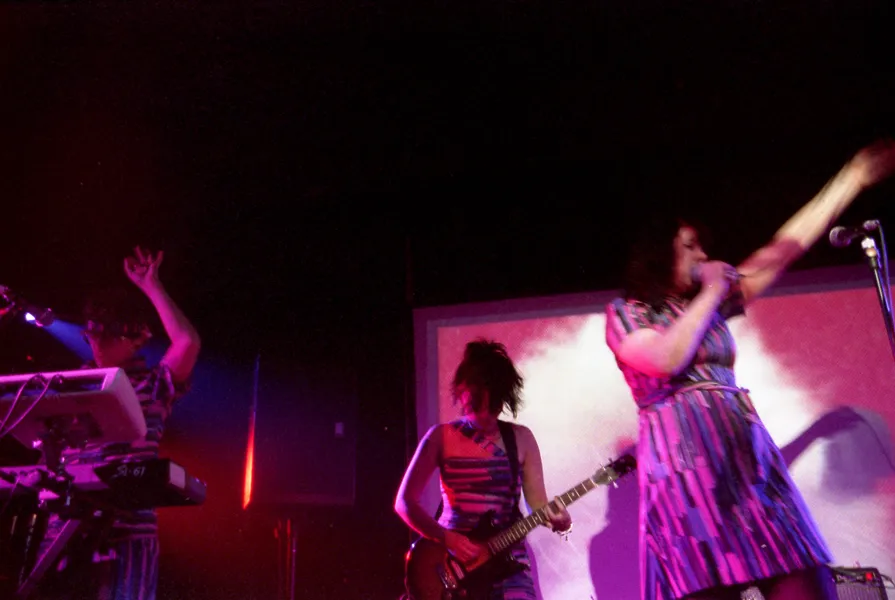
Photo by Dirk , licensed under CC BY 2.0 · Wikimedia Commons
Rank #205
Le Tigre
From Wikipedia
Le Tigre is an American art punk and riot grrrl band formed by Kathleen Hanna, Johanna Fateman and Sadie Benning in 1998 in New York City. Benning left in 2000 and was replaced by JD Samson. They mixed punk's directness and politics with playful samples, eclectic pop, and lo-fi electronics. Like with many bands in and from the riot grrrl movement, many of the lyrics addressed feminist themes and ideas. The group also added multimedia and performance art elements to their live shows, which often featured support from like-minded acts such as the Need.
Members
- JD Samson (2001–present)
- Johanna Fateman
- Kathleen Hanna
- Sadie Benning (?–2001)
Discography & Previews
Browse through and click an album to open and play 30-second previews streamed from Apple Music.

Le Tigre
1999 · 12 tracks
- 1 Deceptacon ↗ 3:05
- 2 Hot Topic ↗ 3:45
- 3 What's Yr Take On Cassavetes? ↗ 2:23
- 4 The The Empty ↗ 2:04
- 5 Phanta ↗ 3:15
- 6 Eau D' Bedroom Dancing ↗ 2:56
- 7 Let's Run ↗ 2:35
- 8 My My Metrocard ↗ 2:54
- 9 Friendship Station ↗ 3:08
- 10 Slideshow At Free University ↗ 2:48
- 11 Dude Yr So Crazy!! ↗ 3:27
- 12 Les and Ray ↗ 2:06

Feminist Sweepstakes
2001 · 13 tracks

This Island
2004 · 13 tracks
-
 Le TigreLe Tigre199912 tracks
 -
 Feminist SweepstakesLe Tigre200113 tracks
 -
 This IslandLe Tigre200413 tracks
Deep Dive
Overview
Le Tigre emerged in 1998 New York City as an art punk and riot grrrl band that married punk’s directness and political edge with playful samples, eclectic pop sensibilities, and lo-fi electronics. Built on the creative foundation of Kathleen Hanna, Johanna Fateman, and Sadie Benning, the group became known for their fearless engagement with feminist themes and their willingness to layer multimedia and performance art elements into live shows that transcended the traditional rock concert format. Their integration of electronic textures with punk ideology created a template for art-rock bands seeking to blend experimental production with activist messaging.
Formation Story
Le Tigre came together in New York City in 1998, emerging from a creative milieu that valued artistic experimentation and political engagement. The trio of Kathleen Hanna, Johanna Fateman, and Sadie Benning crystallized a shared vision combining punk’s uncompromising ethos with the broader riot grrrl movement’s commitment to feminist critique and accessibility. The band’s formation arrived at a moment when electronic music and punk rock were beginning to find common ground in underground and art spaces; Le Tigre positioned themselves at that intersection, rejecting the separation between “authentic” rock and digital production. Their music and live presentation drew inspiration from like-minded acts such as the Need, establishing themselves within a community of performers committed to integrating political content, multimedia elements, and genre-blending experimentation.
Breakthrough Moment
Le Tigre’s self-titled debut album, released in 1999, introduced their distinctive sound and aesthetic to a broader audience within the underground and art-rock communities. The album demonstrated the band’s capacity to embed feminist politics directly into the song’s fabric while maintaining an undeniable sense of playfulness and sonic innovation. Rather than presenting politics and entertainment as opposing forces, the record showed how lo-fi electronics, sampled fragments, and direct vocal delivery could coexist to create something both intellectually engaging and viscerally engaging. The album’s reception established Le Tigre not as a novelty but as serious artists operating within multiple genres and contexts simultaneously.
Peak Era
Le Tigre reached their creative and commercial zenith between 1999 and 2004, a period spanning their first three studio albums. Following the 1999 debut, the group released Feminist Sweepstakes in 2001, marking a point when JD Samson had replaced founding member Sadie Benning in the lineup. The 2001 album solidified the band’s reputation for addressing feminist themes while continuing to evolve their sonic approach. Their third album, This Island, arrived in 2004 and represented the culmination of their early creative period. Throughout this five-year arc, Le Tigre maintained a rigorous touring schedule and developed a reputation for live performances that incorporated multimedia elements and support from a network of aligned artists, reinforcing their status as torchbearers for a politicized, art-conscious approach to electronic rock.
Musical Style
Le Tigre’s music synthesized punk rock’s political urgency and directness with electronic production techniques and lo-fi aesthetics that rejected the ultra-polished sound dominating mainstream electronic music of the 1990s. Their songs typically featured programmed drums or samples, synthesizers and other electronic instrumentation, layered vocal parts often treated with effects, and prominent use of sampled material—both musical and spoken—that functioned as compositional elements rather than mere decoration. The production style deliberately maintained a rough-edged, DIY character even as the songwriting grew more sophisticated. Lyrically, they confronted feminist ideas and issues head-on, treating these subjects with the same clarity and commitment that punk rock had historically directed toward social criticism. Vocally, Kathleen Hanna’s delivery ranged from spoken word to sung melody, often deployed to maximize emotional and political impact rather than technical virtuosity. The band’s live shows extended their sonic palette by incorporating video, performance art, and collaborative presentations that positioned the music within a broader multimedia context.
Major Albums
Le Tigre (1999)
The self-titled debut introduced the band’s signature blend of electronic production, punk ethos, and feminist politics, establishing their sound and philosophical foundation with lo-fi electronics and sampled textures woven throughout.
Feminist Sweepstakes (2001)
The second album deepened the band’s engagement with feminist themes while refining their electronic production, marking a point of artistic consolidation with the new lineup featuring JD Samson.
This Island (2004)
The third studio album represented the evolution of their sound and songwriting, demonstrating the band’s continued commitment to art-punk innovation and political messaging through refined yet still accessible electronic production.
Signature Songs
- “Deceptacon” — A statement of purpose that combines playful electronics with Hanna’s distinctive vocal delivery and addresses themes of honesty and straightforwardness in relationships and art.
- “Viz” — Showcases the band’s ability to layer multiple vocal parts and electronic textures while maintaining punk rock’s directness and energy.
- “The Empty” — Demonstrates their skill at building tension through repetition and electronic variation, grounding abstract feminist critique in concrete musical expression.
- “Aftermath” — Features the band’s signature interplay between programmed rhythm and organic vocal delivery, exploring political and personal themes with characteristic wit.
Influence on Rock
Le Tigre proved influential in establishing that electronic music and punk politics were not incompatible but rather natural partners in creating art that challenged conventional boundaries. Their example opened space for subsequent art-punk and electronic-influenced bands to engage openly with political content, particularly feminist critique, without irony or apology. The band demonstrated that lo-fi aesthetics and DIY approaches to electronic production could coexist with serious artistic intent and technical sophistication. Their integration of multimedia elements and performance art into rock music presentations influenced how bands across multiple genres approached the live experience, encouraging a generation of artists to think beyond traditional guitar-bass-drums configurations. Within the riot grrrl lineage, Le Tigre extended the movement’s reach into electronic and experimental territories, showing that the ethos of the movement could evolve and adapt without losing its political core.
Legacy
Le Tigre’s career spanning from 1998 to the present has established them as a durable force in art-rock and electronic music, maintaining their commitment to multimedia performance and feminist politics across decades of cultural shifts. The band’s willingness to sustain their practice while refusing to compromise their artistic vision or political message has positioned them as elder stateholders within the wider community of politically engaged art-rock. Their influence extends across indie rock, art-punk, and electronic music communities, with their albums serving as touchstones for artists seeking models of how to integrate experimental production, feminist critique, and rock music’s communicative directness. The band’s longevity and consistent output across three decades demonstrate the viability of a practice rooted in artistic experimentation and political commitment, inspiring subsequent generations of musicians to pursue similar integrations of art, politics, and popular music forms.
Fun Facts
- Le Tigre’s live shows frequently featured support from the Need and other like-minded acts, cultivating a deliberate community of aligned artists rather than positioning themselves as isolated performers.
- The band released their music through Mr. Lady Records, an independent label committed to supporting feminist and queer artists in electronic and experimental music.
- Founding member Sadie Benning, who left the band in 2000 (initially listed as departing in 2001), came to the project with a background in video art and multimedia performance, contributing to the band’s signature integration of visual elements into their presentations.
- Kathleen Hanna’s distinctive vocal approach—shifting between spoken word, half-sung delivery, and full melody—became one of the band’s most recognizable sonic signatures across their three studio albums.