
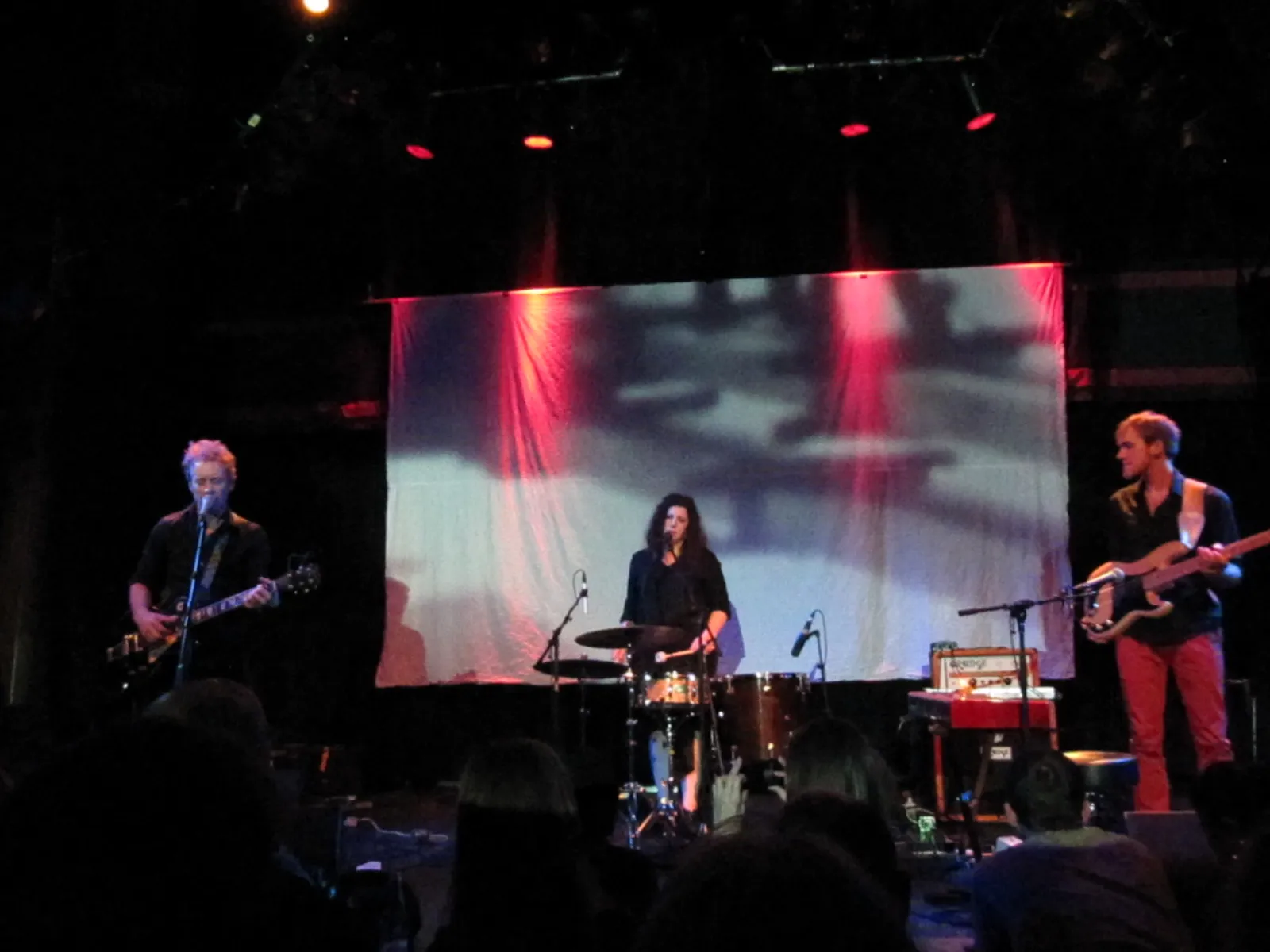
Photo by Dirk Haun , licensed under CC BY 2.0 · Wikimedia Commons
Rank #156
Low
From Wikipedia
Low was an American indie rock band from Duluth, Minnesota, formed in 1993 by the husband and wife duo of Alan Sparhawk and Mimi Parker.
Members
- Alan Sparhawk (1993–present)
- Mimi Parker (1993–2022)
- Zak Sally (1994–2005)
Discography & Previews
Browse through and click an album to open and play 30-second previews streamed from Apple Music.

Things We Lost in the Fire
2001 · 13 tracks

Trust
2002 · 13 tracks
- 1 (That's How You Sing) Amazing Grace ↗ 7:14
- 2 Canada ↗ 3:45
- 3 Candy Girl ↗ 4:38
- 4 Time Is the Diamond ↗ 5:30
- 5 Tonight ↗ 4:05
- 6 The Lamb ↗ 7:13
- 7 In the Drugs ↗ 4:25
- 8 Last Snowstorm of the Year ↗ 2:16
- 9 John Prine ↗ 7:55
- 10 Little Argument With Myself ↗ 3:05
- 11 La la Song ↗ 3:25
- 12 Point of Disgust ↗ 3:26
- 13 Shots & Ladders ↗ 7:52

The Great Destroyer
2004 · 13 tracks
- 1 Monkey ↗ 4:20
- 2 California ↗ 3:23
- 3 Everybody's Song ↗ 3:56
- 4 Silver Rider ↗ 5:04
- 5 Just Stand Back ↗ 3:04
- 6 On the Edge Of ↗ 3:50
- 7 Cue the Strings ↗ 3:30
- 8 Step ↗ 3:18
- 9 When I Go Deaf ↗ 4:42
- 10 Broadway (So Many People) ↗ 7:14
- 11 Pissing ↗ 5:09
- 12 Death of a Salesman ↗ 2:28
- 13 Walk into the Sea ↗ 2:56

Drums and Guns
2007 · 15 tracks
- 1 Pretty People ↗ 3:01
- 2 Belarus ↗ 3:18
- 3 Breaker ↗ 2:53
- 4 Dragonfly ↗ 3:45
- 5 Sandinista ↗ 2:23
- 6 Always Fade ↗ 3:58
- 7 Dust On the Window ↗ 4:12
- 8 Hatchet ↗ 2:19
- 9 Your Poison ↗ 1:14
- 10 Take Your Time ↗ 4:18
- 11 In Silence ↗ 2:47
- 12 Murderer ↗ 3:43
- 13 Violent Past ↗ 3:38
- 14 Hatchet (Optimimi Version) ↗ 3:13
- 15 Breaker (Dub Plate) ↗ 3:55


-
 I Could Live in HopeLow199411 tracks
 -
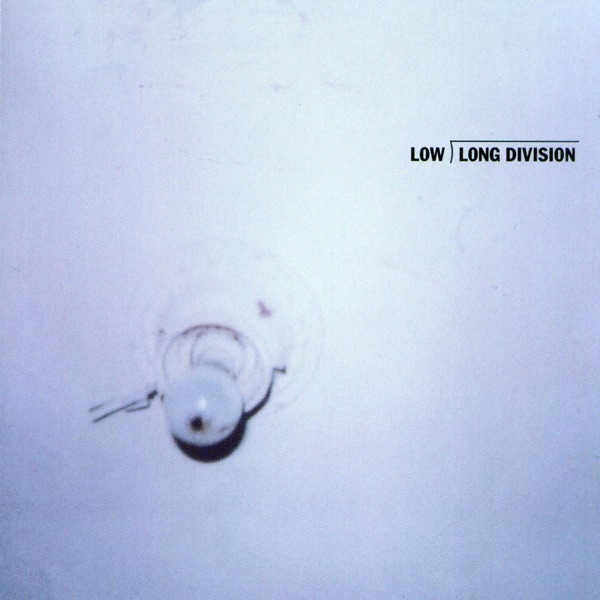
 Long DivisionLow199512 tracks
 -
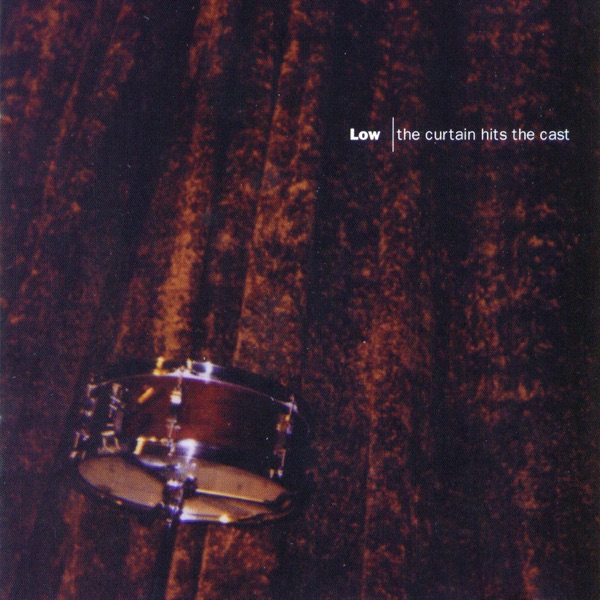
 The Curtain Hits the CastLow199612 tracks
 -
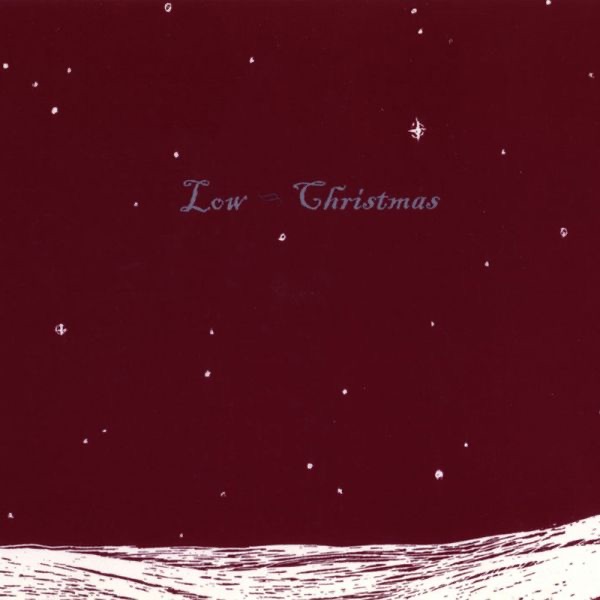
 ChristmasLow19998 tracks
 -
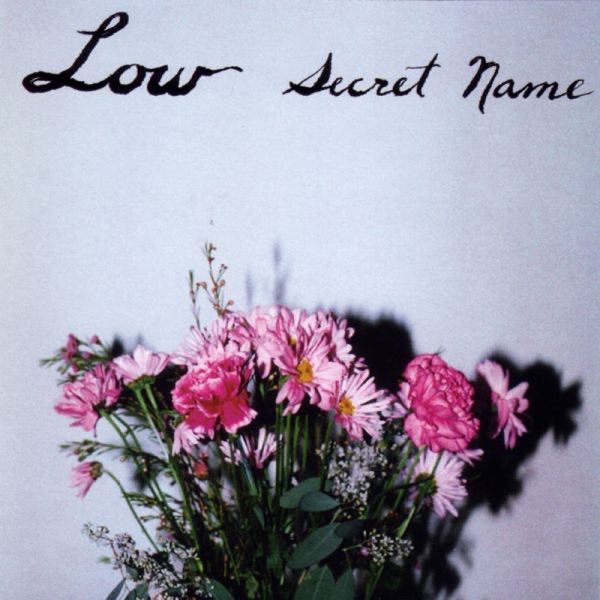
 Secret NameLow199912 tracks
 -
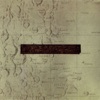 Things We Lost in the FireLow200113 tracks
 -
 TrustLow200213 tracks
 -
 The Great DestroyerLow200413 tracks
 -
 Drums and GunsLow200715 tracks
 -
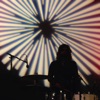 C’monLow201110 tracks
 -
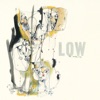 The Invisible WayLow201311 tracks
 -
 Ones and SixesLow201512 tracks
 -
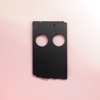 Double NegativeLow201811 tracks
 -
 HEY WHATLow202110 tracks
Deep Dive
Overview
Low was an American indie rock band from Duluth, Minnesota, formed in 1993 by the husband-and-wife duo of Alan Sparhawk and Mimi Parker. Over nearly three decades, the band became one of the defining acts of slowcore—a subgenre characterized by hushed vocals, minimal arrangements, and emotional restraint—while gradually expanding into experimental territories that challenged indie rock conventions. Active from 1993 until 2022, Low occupied a singular position in American alternative rock: neither mainstream nor purely underground, they maintained artistic independence on Sub Pop while building a devoted international following through disciplined experimentation and an unwavering commitment to their original vision.
Formation Story
Low emerged from Duluth, Minnesota in 1993 when Alan Sparhawk and Mimi Parker, married to each other, began composing and performing together. The couple’s decision to form a band in a small Midwestern city far from the major music industry centers meant they developed their sound in relative isolation, influenced by the broader indie rock landscape but unconstrained by geographic proximity to the genre’s epicenters. Zak Sally joined as bassist in 1994, completing the core trio that would define the band’s early and middle periods. The formation of Low coincided with a broader moment in American indie rock when lo-fi aesthetics and emotional vulnerability were becoming legitimate artistic statements rather than technical limitations, positioning the band at the vanguard of this shift.
Breakthrough Moment
Low’s debut album, I Could Live in Hope, arrived in 1994 on Sub Pop, the label that had shepherded Nirvana and other Seattle acts to prominence but was increasingly defined by its roster’s stylistic diversity. The album’s combination of sparse instrumentation, whispering vocals, and deeply introspective songwriting marked an immediate departure from grunge and heavier alternative rock sounds. With Long Division in 1995 and The Curtain Hits the Cast in 1996, Low solidified their approach and began attracting critical attention for their refinement of slowcore aesthetics. By the time Secret Name appeared in 1999—their first album following a three-year gap that included the holiday-themed Christmas release—the band had developed a recognizable sonic identity that distinguished them within the indie rock underground and established them as key figures in slowcore’s canon.
Peak Era
Low’s most sustained period of critical and artistic achievement spanned from 1999 through the early 2010s. Secret Name (1999), Things We Lost in the Fire (2001), and Trust (2002) represented the band at their most confident, balancing meditative beauty with subtle harmonic complexity. The Great Destroyer (2004) marked a significant evolution, introducing heavier production textures and a more assertive instrumental presence while maintaining their core aesthetic. Drums and Guns (2007) continued this trajectory, demonstrating that Low could expand their sound without abandoning the restraint and emotional precision that defined them. The release of C’mon in 2011 showed a band willing to embrace more direct melodic hooks and slightly more expansive arrangements, while The Invisible Way (2013) and Ones and Sixes (2015) proved their staying power and continued creative ambition well into their third decade of existence.
Musical Style
Low’s signature sound combined sparse arrangements, often built around fingerpicked acoustic guitar and minimalist percussion, with a vocal approach rooted in quietness and precision rather than power. Alan Sparhawk and Mimi Parker’s voices, frequently doubling in harmony, created an intimate vocal texture that seemed to address the listener from within a private emotional space. Zak Sally’s bass work, present during his 1994–2005 tenure, provided subtle harmonic support without overwhelming the delicate balance of arrangement. The band’s instrumentation typically included acoustic guitar, minimal drums, and bass, avoiding the electric guitar-driven sonics of much alternative rock in favor of an approach closer to indie folk in its restraint. As Low evolved through the 2000s, particularly on albums like The Great Destroyer and Drums and Guns, they gradually incorporated additional textures—more pronounced percussion, occasional electric guitar, subtle production effects—without abandoning their core commitment to emotional clarity and compositional understatement. By Double Negative (2018), the band had embraced noisy, heavily processed production that stood in sharp sonic contrast to their early work while maintaining their commitment to meaningful restraint and emotional precision. Their final album, HEY WHAT (2021), continued experimenting with texture and production while maintaining the band’s fundamental identity.
Major Albums
I Could Live in Hope (1994)
Low’s debut introduced the slowcore template they would refine and deconstruct across three decades: intimate, sparse arrangements supporting quietly sung explorations of emotional vulnerability and domestic life. The album established their Sub Pop foundation and signaled a new direction for the label.
Secret Name (1999)
After a three-year gap, Low returned with an album that balanced their foundational sparseness with increased harmonic sophistication and subtle arrangement details. Secret Name represented the band at their most refined within their classic approach.
Things We Lost in the Fire (2001)
Combining the intimacy of their early work with expanded production possibilities, this album stands as a bridge between Low’s quietest period and their later experiments. It contains some of their most fully realized compositions.
The Great Destroyer (2004)
A turning point that introduced heavier production, more pronounced drums, and slightly more assertive instrumentation while maintaining emotional core, demonstrating Low’s willingness to evolve without abandoning their identity.
Double Negative (2018)
Low’s most experimental work embraced noise, digital processing, and heavily layered production while retaining the band’s commitment to emotional meaning. The album proved the band remained creatively vital in their third decade.
Signature Songs
- “Lullaby” — A foundational slowcore statement exemplifying the band’s use of quietness and harmonic doubling to create emotional intensity.
- “Winter” — Demonstrates Low’s ability to build emotional weight through minimal instrumentation and precise vocal delivery.
- “Last Snowstorm of the Year” — A characteristic example of the band’s domestic imagery and understated melodic grace.
- “Monkey” — Shows the band’s slightly more direct approach in their later period while maintaining core aesthetic principles.
- “Violence” — From their experimental phase, demonstrates their willingness to incorporate heavier production while retaining emotional clarity.
Influence on Rock
Low occupied a crucial position in defining and expanding slowcore beyond a temporary indie rock novelty into a sustainable artistic approach. Their consistent output across three decades demonstrated that restraint, quietness, and emotional vulnerability could sustain long-term artistic careers without compromising integrity or requiring the commercial concessions demanded of more mainstream acts. The band’s influence extended throughout indie rock and into broader alternative music, affecting artists working in minimal or emotionally direct modes. Their evolution from sparse acoustic arrangements to more experimental production frameworks showed that slowcore could accommodate technological sophistication and sonic complexity without abandoning its fundamental commitments. As alternative rock fragmented into numerous microgenres and stylistic directions throughout the 2000s and 2010s, Low’s continued relevance demonstrated the enduring power of their foundational aesthetic.
Legacy
Low dissolved in 2022 after nearly three decades of continuous activity, leaving behind a catalog that spans from the lo-fi aesthetic experiments of early 1990s indie rock through the noise-influenced experiments of the 2010s. The band’s consistency and refusal to chase commercial trends established them as elder statespeople of American indie rock, respected by both critics and fellow musicians for their artistic integrity. Their position on Sub Pop—a major independent label with distribution and cultural reach—ensured their work remained accessible to listeners beyond purely underground circles, making them one of slowcore’s few acts to achieve both critical credibility and sustained listener engagement. The band’s final album HEY WHAT in 2021 confirmed their creative vitality until the very end, containing no suggestion that a longstanding band was winding down operations. Low’s influence on contemporary indie rock and alternative music remains significant, with their approach to emotional directness and restraint continuing to resonate with musicians and listeners seeking alternatives to both commercialism and irony in rock music.
Fun Facts
- Low’s husband-and-wife core partnership meant that the band’s creative process was inseparable from their domestic life, a reality reflected in their frequent use of domestic imagery and intimate emotional content throughout their discography.
- The band released a Christmas album in 1999, Christmas, a stylistically cohesive work that extended slowcore’s emotional reserve into holiday material rather than attempting novelty or entertainment.
- Low maintained their official website at chairkickers.com throughout their active period, preserving direct fan connection through the internet during the band’s entire existence.
- The band’s bass player Zak Sally left in 2005 after more than a decade with the group, leaving Low as a duo for their final seventeen years of activity.