
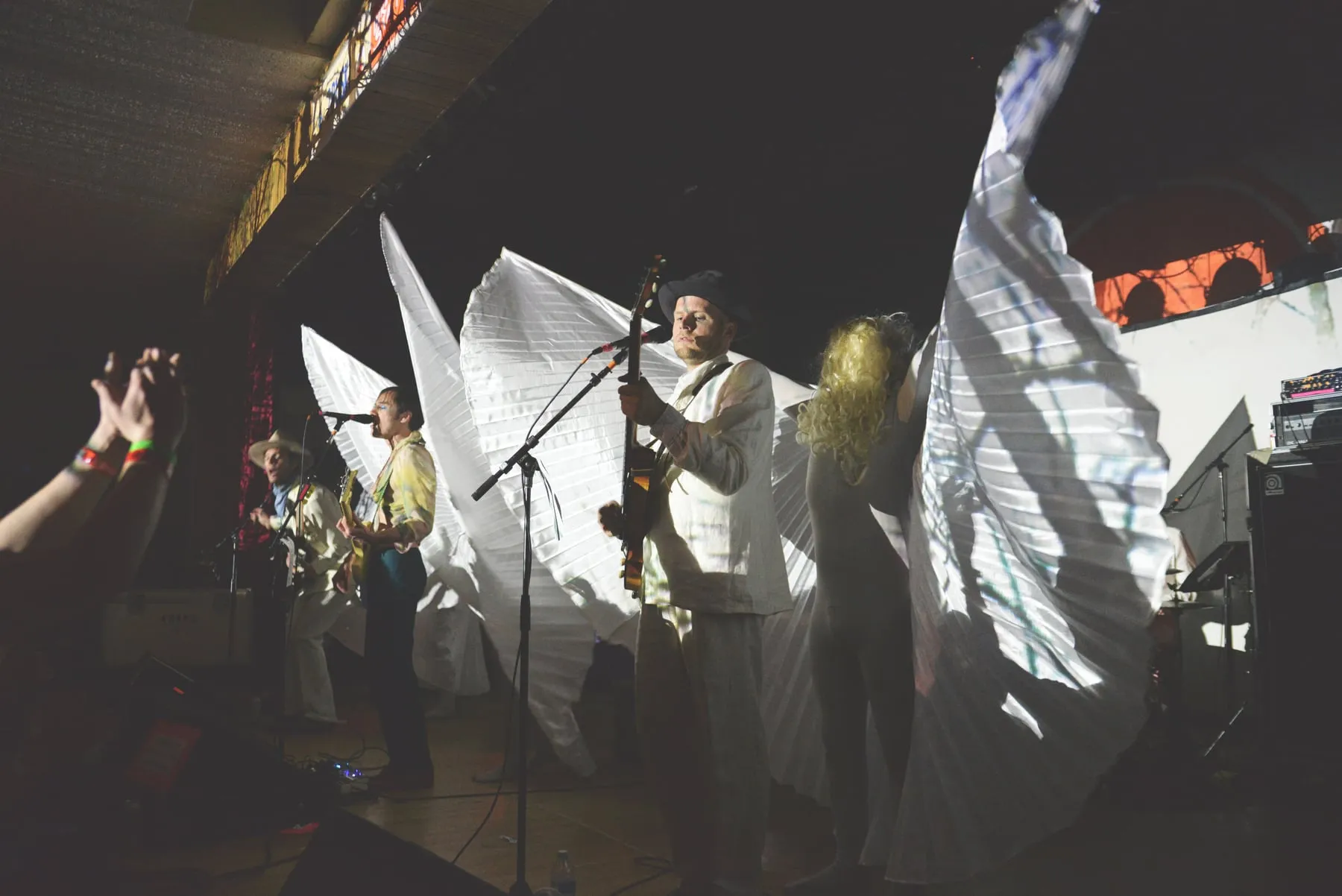
Photo by Treefort Music Fest , licensed under CC BY 2.0 · Wikimedia Commons
Rank #457
of Montreal
Athens, Georgia indie-pop band of Kevin Barnes' theatrical psychedelic glam.
From Wikipedia
of Montreal is an American indie pop band from Athens, Georgia. It was founded by frontperson Kevin Barnes in 1996, named after a failed romance between Barnes and a woman "of Montreal". The band is identified as part of the Elephant 6 collective.
Members
- Kevin Barnes
Discography & Previews
Browse through and click an album to open and play 30-second previews streamed from Apple Music.

Cherry Peel
1997 · 14 tracks
- 1 Everything Disappears When You Come Around ↗ 2:34
- 2 Baby ↗ 2:31
- 3 I Can't Stop Your Memory ↗ 3:26
- 4 When You're Loved Like You Are ↗ 2:34
- 5 Don't Ask Me to Explain ↗ 2:46
- 6 In Dreams I Dance With You ↗ 2:05
- 7 Sleeping in the Beetle Bug ↗ 2:18
- 8 Tim I Wish You Were Born a Girl ↗ 1:47
- 9 Montreal ↗ 2:31
- 10 This Feeling (Dereks Theme) ↗ 2:42
- 11 I Was Watching Your Eyes ↗ 1:52
- 12 Springtime is the Season ↗ 2:14
- 13 At Night Trees Aren't Sleeping ↗ 1:49
- 14 You've Got a Gift ↗ 4:50

The Bedside Drama: A Petite Tragedy
1998 · 16 tracks
- 1 One of a Very Few of a Kind ↗ 1:38
- 2 Happy Yellow Bumble Bee ↗ 2:18
- 3 Little Viola Hidden in the Orchestra ↗ 3:37
- 4 The Couple's First Kiss ↗ 1:29
- 5 Sing You a Love You Song ↗ 2:37
- 6 Honeymoon in San Francisco ↗ 2:35
- 7 The Couple in Bed Together Under a Warm Blanket Wrapped up in Each Others Arms Asleep ↗ 1:24
- 8 Cutie Pie ↗ 2:20
- 9 Panda Bear ↗ 4:48
- 10 Sadness Creeping up and Scaring Away the Couple's Happiness ↗ 1:30
- 11 Please Tell Me So ↗ 2:20
- 12 My Darling, I've Forgotten ↗ 2:11
- 13 If You Feel You Must Go, Don't Go! ↗ 2:08
- 14 Just Recently Lost Something of Importance ↗ 2:25
- 15 The Hollow Room ↗ 1:47
- 16 It's Easy to Sleep When You're Dead ↗ 4:30

The Gay Parade
1999 · 16 tracks
- 1 Old Familiar Way ↗ 2:26
- 2 Fun Loving Nun ↗ 2:18
- 3 Tulip Baroo ↗ 2:10
- 4 Jacques Lamure ↗ 2:31
- 5 The March of the Gay Parade ↗ 2:55
- 6 Neat Little Domestic Life ↗ 2:45
- 7 A Collection of Poems About Water ↗ 3:57
- 8 Y the Quale and Vaguely Bird Noisily Enjoying Their Forbidden Tryst/I'd Be a Yellow Feathered Loon ↗ 2:41
- 9 The Autobiographical Grandpa ↗ 2:19
- 10 The Miniature Philosopher ↗ 1:54
- 11 My Friend Will Be Me ↗ 3:54
- 12 My Favorite Boxer ↗ 3:02
- 13 Advice From a Divorced Gentleman to His Bachelor Friend Considering Marriage ↗ 2:08
- 14 A Man's Life Flashing Before His Eyes While He and His Wife Drive Off a Cliff into the Ocean ↗ 3:04
- 15 Nickee Coco and the Invisible Tree ↗ 5:21
- 16 The Gay Parade Outro ↗ 0:48

Coquelicot Asleep in the Poppies: A Variety of Whimsical Verse
2001 · 22 tracks
- 1 Good Morning Mr. Edminton ↗ 2:45
- 2 Peacock Parasols ↗ 2:54
- 3 Look at the Bell ↗ 1:44
- 4 An Introduction for Isabell ↗ 3:29
- 5 Let's Do Everything for the First Time Forever ↗ 2:38
- 6 Coquelicot's Tea Party ↗ 0:43
- 7 Rose Robert ↗ 2:27
- 8 It's a Very Starry Night ↗ 3:48
- 9 Mimi Merlot ↗ 2:57
- 10 Butterscotching Mr. Lynn ↗ 1:38
- 11 Coquelicot, Claude and Lecithin Dance Aboard the Ocean Liner ↗ 1:04
- 12 Go Call You Mine ↗ 1:29
- 13 The Events Leading up to the Collapse of Detective Dullight ↗ 2:41
- 14 Penelope ↗ 2:53
- 15 A Dreamy Day of Dreaming of You ↗ 2:02
- 16 Hello from Inside a Shell ↗ 3:37
- 17 Lecithin's Tale of a Dna Experiment That Went Horribly Awry ↗ 3:14
- 18 Its Just So ↗ 2:37
- 19 The Frozen Island ↗ 3:58
- 20 Upon Settling on the Frozen Island, Lecithin Presents Claude and Coquelicot with His Animal Creations for Them to Approve or Reject ↗ 1:07
- 21 Let's Go for a Walk ↗ 2:12
- 22 The Hopeless Opus or the Great Battle of the Unfriendly Ridiculous ↗ 17:56

If He Is Protecting Our Nation, Then Who Will Protect Big Oil, Our Children?
2002 · 13 tracks
- 1 My, What a Strange Day with a Swede ↗ 4:11
- 2 An Ill - Treated Hiccup ↗ 2:23
- 3 Cast in the Haze (Been There Four Days) ↗ 2:46
- 4 Mimi Merlot (Beatnik Version) ↗ 0:31
- 5 Girl from Nyc (Named Julia) ↗ 2:15
- 6 Inside a Room Full of Treasures a Black Pygmy Horse's Head Pops up Like a Periscope ↗ 2:28
- 7 Charlie & Freddy ↗ 1:31
- 8 There Is Nothing Wrong with Hating Rock Critics ↗ 4:41
- 9 Maple Licorice ↗ 0:58
- 10 Barely Asian at the Beefcake Horizon ↗ 1:13
- 11 Spooky Spider Chandelier ↗ 1:30
- 12 Friends of Mine ↗ 2:20
- 13 Christmas Isn't Safe for Animals ↗ 3:42

Aldhils Arboretum
2002 · 14 tracks
- 1 Doing Nothing ↗ 3:23
- 2 Old People in the Cemetery ↗ 3:21
- 3 Isn't It Nice? ↗ 2:56
- 4 Jennifer Louise ↗ 2:01
- 5 The Blank Husband Epidemic ↗ 2:40
- 6 Pancakes for One ↗ 2:41
- 7 We Are Destroying the Song ↗ 2:48
- 8 An Ode to the Nocturnal Muse ↗ 3:43
- 9 Predictably Sulking Sara ↗ 2:28
- 10 Natalie and Effie in the Park ↗ 2:12
- 11 A Question for Emily Foreman ↗ 2:42
- 12 Kissing in the Grass ↗ 3:39
- 13 Kid Without Claws ↗ 3:56
- 14 Death Dance of Omipapas and Sons for You ↗ 2:24

Satanic Panic in the Attic
2004 · 14 tracks
- 1 Disconnect the Dots ↗ 4:26
- 2 Lysergic Bliss ↗ 4:04
- 3 Will You Come and Fetch Me ↗ 1:59
- 4 My British Tour Diary ↗ 2:19
- 5 Rapture Rapes the Muses ↗ 3:03
- 6 Eros' Entropic Tundra ↗ 3:13
- 7 City Bird ↗ 2:21
- 8 Erroneous Escape into Erik Eckles ↗ 2:48
- 9 Chrissy Kiss the Corpse ↗ 2:40
- 10 Your Magic Is Working ↗ 3:43
- 11 Climb the Ladder ↗ 3:26
- 12 How Lester Lost His Wife ↗ 2:31
- 13 Spike the Senses ↗ 3:11
- 14 Vegan in Furs ↗ 3:54


Hissing Fauna, Are You the Destroyer?
2007 · 12 tracks
- 1 Suffer for Fashion ↗ 2:58
- 2 Sink the Seine ↗ 1:04
- 3 Cato as a Pun ↗ 3:03
- 4 Heimdalsgate Like a Promethean Curse ↗ 3:19
- 5 Gronlandic Edit ↗ 3:25
- 6 A Sentence of Sorts in Kongsvinger ↗ 4:56
- 7 The Past Is a Grotesque Animal ↗ 11:53
- 8 Bunny Ain't No Kind of Rider ↗ 3:51
- 9 Faberge Falls for Shuggie ↗ 4:31
- 10 Labyrinthian Pomp ↗ 3:21
- 11 She's a Rejecter ↗ 4:03
- 12 We Were Born the Mutants Again with Leafling ↗ 4:58

Skeletal Lamping
2008 · 15 tracks
- 1 Nonpareil of Favor ↗ 5:49
- 2 Wicked Wisdom ↗ 5:00
- 3 For Our Elegant Caste ↗ 2:35
- 4 Touched Something's Hollow ↗ 1:26
- 5 An Eluardian Instance ↗ 4:35
- 6 Gallery Piece ↗ 3:48
- 7 Women's Studies Victims ↗ 2:59
- 8 St. Exquistie's Confessions ↗ 4:35
- 9 Triphallus, to Punctuate! ↗ 3:23
- 10 And I've Seen a Bloody Shadow ↗ 2:24
- 11 Plastis Wafer ↗ 7:12
- 12 Death Is Not a Parallel Move ↗ 3:02
- 13 Beware Our Nubile Miscreants ↗ 4:52
- 14 Mingusings ↗ 3:01
- 15 Id Engager ↗ 3:25

False Priest
2010 · 15 tracks
- 1 I Feel Ya' Strutter ↗ 3:41
- 2 Our Riotous Defects (feat. Janelle Monáe) ↗ 5:15
- 3 Coquet Coquette ↗ 3:44
- 4 Godly Intersex ↗ 3:31
- 5 Enemy Gene (feat. Janelle Monáe) ↗ 3:38
- 6 Hydra Fancies ↗ 3:26
- 7 Like a Tourist ↗ 4:03
- 8 Sex Karma (feat. Solange) ↗ 4:02
- 9 Girl Named Hello ↗ 4:14
- 10 Famine Affair ↗ 3:49
- 11 Casualty of You ↗ 3:00
- 12 Around the Way ↗ 4:34
- 13 You Do Mutilate? ↗ 6:53
- 14 Our Riotous Defects (Alternate Version [Bonus Track]) ↗ 5:13
- 15 Tonight (Bonus Track) ↗ 3:06

Paralytic Stalks
2012 · 9 tracks

Lousy With Sylvianbriar
2013 · 11 tracks
- 1 Fugitive Air ↗ 4:13
- 2 Obsidian Currents ↗ 3:55
- 3 Belle Glade Missionaries ↗ 5:55
- 4 Sirens of Your Toxic Spirit ↗ 4:06
- 5 Colossus ↗ 3:37
- 6 Triumph of Disintegration ↗ 4:12
- 7 Amphibian Days ↗ 5:05
- 8 She Ain't Speakin' Now ↗ 3:41
- 9 Hegira Émigré ↗ 4:03
- 10 Raindrop in My Skull ↗ 2:48
- 11 Imbecile Rages ↗ 4:01

Aureate Gloom
2015 · 10 tracks

Innocence Reaches
2016 · 12 tracks
- 1 Let's Relate ↗ 3:53
- 2 It's Different for Girls ↗ 3:59
- 3 Gratuitous Abysses ↗ 4:12
- 4 My Fair Lady ↗ 4:25
- 5 Les Chants De Maldoror ↗ 6:04
- 6 A Sport and a Pastime ↗ 4:33
- 7 Ambassador Bridge ↗ 3:38
- 8 Def Pacts ↗ 5:03
- 9 Chaos Arpeggiating ↗ 5:55
- 10 Nursing Slopes ↗ 4:17
- 11 Trashed Exes ↗ 4:16
- 12 Chap Pilot ↗ 6:17

White Is Relic / Irrealis Mood
2018 · 6 tracks
- 1 Soft Music / Juno Portraits of the Jovian Sky ↗ 5:36
- 2 Paranoiac Intervals / Body Dysmorphia ↗ 7:15
- 3 Writing the Circles / Orgone Tropics ↗ 6:15
- 4 Plateau Phase / No Careerism No Corruption ↗ 5:19
- 5 Sophie Calle Private Game / Every Person Is a P***y, Every P***y Is a Star! ↗ 8:09
- 6 If You Talk to Symbol / Hostility Voyeur ↗ 8:33

UR FUN
2020 · 10 tracks
- 1 Peace to All Freaks ↗ 4:45
- 2 Polyaneurism ↗ 3:31
- 3 Get God’s Attention by Being an Atheist ↗ 3:51
- 4 Gypsy That Remains (feat. Locate S,1) ↗ 4:18
- 5 You’ve Had Me Everywhere ↗ 4:46
- 6 Carmillas of Love ↗ 4:00
- 7 Don’t Let Me Die in America ↗ 3:36
- 8 St. Sebastian ↗ 4:06
- 9 Deliberate Self - Harm Ha Ha ↗ 4:20
- 10 20th Century Schizofriendic Revengoid - Man ↗ 3:23

I Feel Safe With You, Trash
2021 · 20 tracks
- 1 Carton Aesthesis (O Portão) ↗ 2:00
- 2 And We Can Survive Anything If We Fake It ↗ 2:55
- 3 Aries Equals Good Trash ↗ 4:20
- 4 Queer as Love ↗ 2:40
- 5 Now That's What I Call Freewave ↗ 2:43
- 6 Japanese Word for Witch ↗ 3:06
- 7 This Is Exposed ↗ 2:58
- 8 True Beauty Forever ↗ 3:48
- 9 Fuckheads Is the Auto - Correction ↗ 4:24
- 10 Drowner's Teãrs ↗ 2:50
- 11 I Feel Safe with You, Trash ↗ 3:21
- 12 Fingerless Gloves ↗ 3:02
- 13 Notes of Violate Spectates a Flatter of Male ↗ 3:26
- 14 Equatorial Hemorrhage Is a Dead Link ↗ 3:36
- 15 Yamagata Forest Flutes ↗ 1:50
- 16 Extract the Masculine Germ from Remote Memory ↗ 3:26
- 17 Thram Rammaged à Man - Mod ↗ 2:49
- 18 Kcrraanggaanngg!! ↗ 4:03
- 19 Karlheinz Chop up Children ↗ 3:50
- 20 So Chill Then (O Portão) ↗ 5:03


Lady on the Cusp
2024 · 10 tracks

aethermead
2026 · 13 tracks
- 1 Already Dreaming ↗ 3:08
- 2 Wanting on Air ↗ 3:03
- 3 Listen to Music and Cry ↗ 2:51
- 4 My Zhe Zhe ↗ 2:24
- 5 Take the Form ↗ 3:06
- 6 When ↗ 2:33
- 7 Hack It Up ↗ 3:23
- 8 Lacan in the Family ↗ 2:54
- 9 Having a Moment ↗ 3:32
- 10 From the Font of You ↗ 4:50
- 11 To Nothing’s Reward ↗ 2:32
- 12 Now We Cringe at the Thought ↗ 3:25
- 13 Dismissal Mosaics ↗ 3:44
-
 Cherry Peelof Montreal199714 tracks
 -
 The Bedside Drama: A Petite Tragedyof Montreal199816 tracks
 -
 The Gay Paradeof Montreal199916 tracks
 -
 Coquelicot Asleep in the Poppies: A Variety of Whimsical Verseof Montreal200122 tracks
 -
 If He Is Protecting Our Nation, Then Who Will Protect Big Oil, Our Children?of Montreal200213 tracks
 -
 Aldhils Arboretumof Montreal200214 tracks
 -
 Satanic Panic in the Atticof Montreal200414 tracks
 -
 The Sunlandic Twinsof Montreal20054 tracks
 -
 Hissing Fauna, Are You the Destroyer?of Montreal200712 tracks
 -
 Skeletal Lampingof Montreal200815 tracks
 -
 False Priestof Montreal201015 tracks
 -
 Paralytic Stalksof Montreal20129 tracks
 -
 Lousy With Sylvianbriarof Montreal201311 tracks
 -
 Aureate Gloomof Montreal201510 tracks
 -
 Innocence Reachesof Montreal201612 tracks
 -
 White Is Relic / Irrealis Moodof Montreal20186 tracks
 -
 UR FUNof Montreal202010 tracks
 -
 I Feel Safe With You, Trashof Montreal202120 tracks
 -
 Freewave Lucifer f<ck f^ck f>ckof Montreal20227 tracks
 -
 Lady on the Cuspof Montreal202410 tracks
 -
 aethermeadof Montreal202613 tracks
Deep Dive
Overview
of Montreal is an American indie pop band from Athens, Georgia, founded by frontperson Kevin Barnes in 1996 and formally established in 1997. The band emerged as a central figure in the broader Athens indie scene and became identified as part of the Elephant 6 collective, a loose association of psychedelia-minded bands sharing artistic vision and aesthetic values across the late 1990s and 2000s. Named after a failed romance between Barnes and a woman “of Montreal,” the project evolved from bedroom pop into a vehicle for theatrical, genre-fluid experimentation that would define much of independent rock’s first two decades.
Formation Story
Kevin Barnes launched of Montreal in 1996 in Athens, Georgia, a city with an established underground music tradition. The project began as a solo endeavor, with Barnes handling most instrumentation and songwriting duties. The name itself carries romantic detritus—a reference to a relationship that never materialized—lending the project an introspective melancholy that would color its early output. By embedding himself in the Athens and broader Elephant 6 network, Barnes positioned of Montreal within a community of like-minded artists pursuing ornate, maximalist indie pop rather than the then-dominant alternative rock orthodoxy.
Breakthrough Moment
of Montreal released its debut, Cherry Peel, in 1997, establishing the project’s willingness to combine lo-fi production with melodic intricacy. Subsequent early releases—The Bedside Drama: A Petite Tragedy (1998) and The Gay Parade (1999)—deepened this reputation for narrative-driven, densely arranged indie pop. However, the project’s transition from cult curiosity to wider recognition crystallized with Satanic Panic in the Attic (2004). This album marked a sonic expansion, demonstrating Barnes’ evolving production sophistication and willingness to layer psychedelic textures over pop structures, attracting audiences beyond the Elephant 6 faithful.
Peak Era
of Montreal reached its creative and commercial zenith between 2005 and 2010. The Sunlandic Twins (2005) showcased an increasingly assured production palette, while Hissing Fauna, Are You the Destroyer? (2007) became the band’s most lauded work, blending synth-driven psychedelia with personal vulnerability. The period culminated with Skeletal Lamping (2008) and False Priest (2010), both of which found Barnes at his most theatrical and prolific, crafting elaborate arrangements that spanned glam rock, soul, electronic pop, and prog influences. These releases solidified of Montreal’s position as one of the defining bands of twenty-first-century indie experimentalism.
Musical Style
of Montreal’s sound defies easy categorization, though indie pop and psychedelic rock form its foundation. Early recordings featured lo-fi guitar arrangements, falsetto vocals, and wistful melodies; over time, Barnes incorporated synthesizers, drum machines, orchestral instrumentation, and layered vocal production. The band’s approach draws from a lineage spanning 1960s psychedelia, glam rock’s theatrical impulse, and post-punk’s structural ambition, yet filtered through indie rock’s DIY ethos and melodic sensibilities. Barnes’ production became increasingly elaborate, building tracks through accumulation of disparate sonic elements—horn sections, string arrangements, pitched vocals, unconventional percussion—creating dense, almost baroque pop that remained rooted in accessible melody. The vocal performance ranges from breathy whispers to soaring belts, often within a single song, emphasizing emotional extremes and theatrical delivery over conventional power or control.
Major Albums
Satanic Panic in the Attic (2004)
A transitional work that marked Barnes’ turn toward fuller production and psychedelic texture, establishing the sonic direction that would define the band’s subsequent decade.
The Sunlandic Twins (2005)
Demonstrated sustained growth in arrangement sophistication and emotional nuance, showcasing Barnes’ increasing ambition in layering electronic and organic instrumentation.
Hissing Fauna, Are You the Destroyer? (2007)
The band’s most acclaimed release, blending synth-driven psychedelia with intimate songwriting, becoming a landmark of contemporary indie pop.
Skeletal Lamping (2008)
An exploratory, dense work featuring glam-rock flourishes and baroque pop ambition, exemplifying Barnes’ theatrical maximalism at its peak.
False Priest (2010)
Capitalized on the momentum of its predecessors with expansive arrangements and polished production, representing the culmination of the 2000s creative run.
Signature Songs
- Heimdalsgate Like a Promethean Cursing — A synth-driven epic from Hissing Fauna that showcases layered vocals and baroque pop architecture.
- Gronlandic Edit — A psychedelic, effects-laden track featuring rhythmic complexity and experimental production.
- Daughter of Evil — A glam-tinged song exemplifying Barnes’ theatrical vocal delivery and ornate arrangement style.
- False Priest — Title track from the 2010 album, demonstrating the band’s pop sensibility amid complex production.
- Suffer for Fashion — A standout balancing accessibility with psychedelic texture and introspective lyrics.
Influence on Rock
of Montreal helped establish a template for twenty-first-century indie pop that prioritized theatrical presentation, production sophistication, and genre-blending over the guitar-band orthodoxy that dominated rock radio. The band’s success within the Elephant 6 ecosystem demonstrated that maximalist, ornate pop could sustain listener interest and critical acclaim without conforming to mainstream rock expectations. Barnes’ approach to synthesizer integration and vocal layering influenced subsequent generations of bedroom pop and experimental indie artists who embraced digital production tools and psychedelic sensibility. The band proved influential in normalizing gender-ambiguous presentation and fluid sonic identity within indie rock spaces, paving ground for subsequent art-rock and electronic pop experimentation.
Legacy
of Montreal has remained prolific into the 2020s, releasing Aureate Gloom (2015), Innocence Reaches (2016), UR FUN (2020), I Feel Safe With You, Trash (2021), and Lady on the Cusp (2024), among others. The band’s sustained output across three decades demonstrates both artistic durability and commitment to constant evolution rather than nostalgia-driven retrospection. Though mainstream recognition has remained modest relative to their influence, of Montreal achieved canonical status within indie rock discourse, with Hissing Fauna, Are You the Destroyer? frequently cited among the essential works of 2000s alternative music. The project endures as a touchstone for artists seeking to combine accessibility with uncompromising experimentation, and for audiences resistant to rock music’s conservative tendencies. Kevin Barnes’ relentless creativity and refusal to settle into a fixed identity have made of Montreal a model of artistic independence within the indie ecosystem.
Fun Facts
- The band’s elaborate album titles—often surrealist, absurdist, or grammatically unconventional—have become as anticipated as the music itself, reflecting Barnes’ commitment to treating the project as total artistic statement.
- of Montreal has maintained affiliation with Polyvinyl Records throughout its existence, an unusually stable relationship for an artist of the band’s profile.
- The Elephant 6 collective, with which of Montreal became identified, operated largely without formal contracts or hierarchical organization, embodying indie rock’s cooperative ideals.