
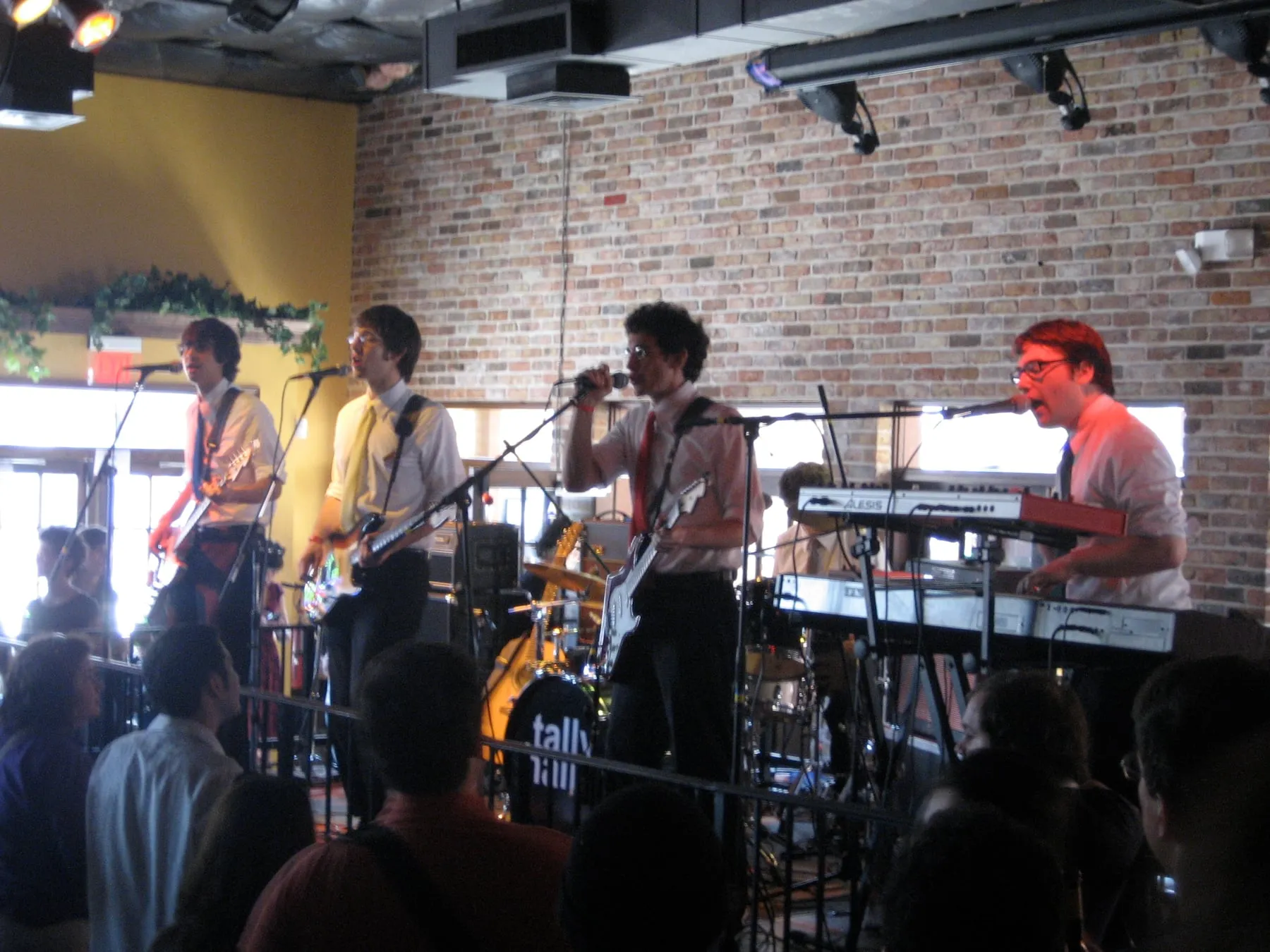
Photo by Daniel Morrison , licensed under CC BY 2.0 · Wikimedia Commons
Rank #451
Tally Hall
From Wikipedia
Tally Hall is an American rock band formed in Ann Arbor, Michigan, in December 2002, and publicly active until the conclusion of their Good & Evil tour in 2011. The band's current line-up consists of guitarists Joe Hawley and Rob Cantor, bassist Zubin Sedghi, keyboardist Andrew Horowitz and drummer Ross Federman. The band is known for its eclectic musical style, extensive use of vocal harmonies, and matching outfits featuring white button up shirts, colored neckties, and after 2008, black vests. The members originally described their musical style as "wonky rock", later redefining their sound as "fabloo", to not let any particular genres define their music after critics began defining the characteristics of "wonky rock".
Members
- Andrew Horowitz (2002–present)
- Joe Hawley (2002–present)
- Rob Cantor (2002–present)
- Zubin Sedghi (2002–present)
- Ross Federman (2005–present)
Discography & Previews
Browse through and click an album to open and play 30-second previews streamed from Apple Music.
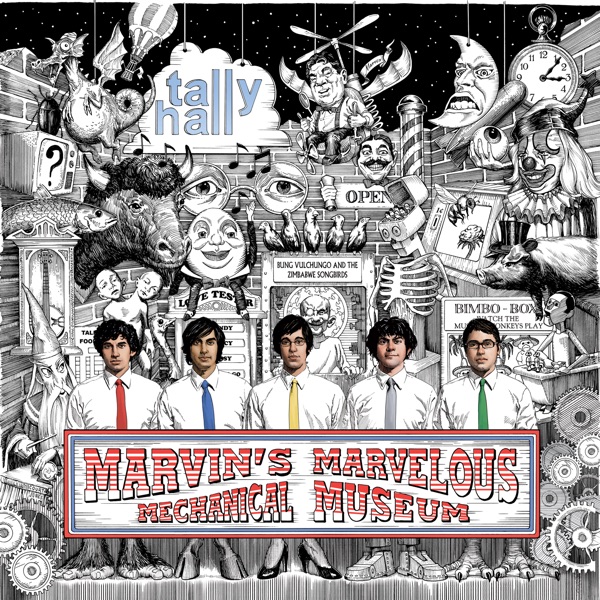
Marvin’s Marvelous Mechanical Museum
2005 · 17 tracks
- 1 Good Day ↗ 3:27
- 2 Greener ↗ 3:43
- 3 Welcome to Tally Hall ↗ 5:11
- 4 Taken for a Ride ↗ 4:44
- 5 The Bidding ↗ 2:41
- 6 Be Born ↗ 3:10
- 7 Banana Man ↗ 4:10
- 8 Just Apathy ↗ 3:12
- 9 Spring and a Storm ↗ 4:48
- 10 Two Wuv ↗ 3:43
- 11 Haiku ↗ 3:03
- 12 The Whole World and You ↗ 1:45
- 13 13 ↗ 0:13
- 14 Ruler of Everything ↗ 3:42
- 15 Hidden In the Sand ↗ 1:53
- 16 Mucka Blucka (Bonus Track) ↗ 1:38
- 17 Dream (Bonus Track) ↗ 1:50

Good & Evil
2011 · 14 tracks
- 1 Never Meant to Know ↗ 3:40
- 2 & ↗ 3:15
- 3 You & Me ↗ 2:52
- 4 Cannibal ↗ 3:28
- 5 Who You Are ↗ 3:41
- 6 Sacred Beast ↗ 2:22
- 7 Hymn for a Scarecrow ↗ 4:50
- 8 A Lady ↗ 1:05
- 9 The Trap ↗ 4:32
- 10 Turn the Lights Off ↗ 2:57
- 11 Misery Fell ↗ 3:35
- 12 Out in the Twilight ↗ 2:52
- 13 You ↗ 2:58
- 14 Fate of the Stars ↗ 6:51
-
 Marvin’s Marvelous Mechanical MuseumTally Hall200517 tracks
 -
 Good & EvilTally Hall201114 tracks
Deep Dive
Overview
Tally Hall is an American rock band that emerged from Ann Arbor, Michigan, in 2002 and established itself as a distinctive presence in power pop and alternative rock through a combination of elaborate vocal arrangements, genre-fluid songwriting, and a carefully cultivated visual identity. The band’s refusal to lock into a single sonic category—moving from self-described “wonky rock” to the self-coined term “fabloo”—reflects a broader commitment to eclecticism that has remained central to their artistic identity across two decades of activity. Operating largely outside mainstream commercial machinery, Tally Hall built a devoted following through the release of two studio albums and extensive touring.
Formation Story
Tally Hall coalesced in Ann Arbor in December 2002, with the core quintet of Joe Hawley (guitar), Rob Cantor (guitar), Andrew Horowitz (keyboards), and Zubin Sedghi (bass) establishing the initial creative core. Drummer Ross Federman joined in 2005, completing the classic lineup that would record both studio albums. The band emerged from the Ann Arbor rock and alternative scene, a city with a lineage of experimental and indie-adjacent acts. From their inception, the members adopted a unified aesthetic: white button-up shirts, colored neckties, and later black vests added in 2008. This coordinated presentation became as central to the Tally Hall identity as the music itself, signaling a theatrical and self-conscious approach to rock performance that extended beyond traditional power pop convention.
Breakthrough Moment
Tally Hall’s breakthrough arrived with the release of their debut album Marvin’s Marvelous Mechanical Museum in 2005. The record introduced listeners to the band’s ornate approach to songwriting—characterized by intricate vocal harmonies, genre-blending arrangements, and a willingness to veer from radio-friendly rock into experimental and whimsical territory. The album’s title itself suggested the band’s irreverent sensibility: a mechanized carnival of musical styles housed under one conceptual roof. Marvin’s Marvelous Mechanical Museum garnered attention within alternative and indie circles and established Tally Hall as a band unafraid to complicate the power pop template with progressive elements, art-rock ambition, and compositional oddness. The record’s reception positioned them for a second album and expanded touring.
Peak Era
Tally Hall’s peak commercial and creative period centered on the years surrounding their second album, Good & Evil, released in 2011. This record represented the band’s most fully realized statement, consolidating the eclectic sensibility of their debut while refining both production and songwriting discipline. The period between their two albums—roughly 2005 to 2011—witnessed extensive touring and the solidification of their cult reputation. The band’s decision to conclude the Good & Evil tour in 2011 marked the end of their publicly active phase, leaving a relatively compact recorded legacy but one marked by consistent artistic coherence. During this era, they had shifted away from the term “wonky rock,” which critics had applied to their early work, toward their own descriptor “fabloo”—a term designed to resist easy categorization and emphasize the band’s deliberate embrace of stylistic plurality.
Musical Style
Tally Hall’s sound is built upon a foundation of power pop’s melodic directness but filtered through a sensibility closer to art rock or progressive alternative music. The band’s instrumental palette is notably full: guitars, keyboards, bass, and drums are supplemented by vocal harmonies that often function as an additional compositional layer, creating density and textural complexity. Joe Hawley and Rob Cantor’s guitar work moves between jangly indie-rock figures and more angular, dissonant passages; Andrew Horowitz’s keyboards contribute everything from traditional rock organ and synthesizer flourishes to unexpected timbral choices that recall experimental music. Zubin Sedghi’s bass lines are melodically active, functioning more as a countermelodic voice than a rhythmic anchor alone. Ross Federman’s drumming tends toward precise, intricate patterns that avoid straightforward rock-song timekeeping. The result is a densely arranged, highly orchestrated approach to rock composition that defies easy genre placement—neither quite pop, nor entirely alternative, nor fully progressive, but a synthesis of all three. The band’s lyrical approach tends toward the oblique, surreal, or humorous, matching the musical unconventionality.
Major Albums
Marvin’s Marvelous Mechanical Museum (2005)
The band’s debut established their core approach: ornate vocal harmonies, genre-fluid arrangements that blend power pop, art rock, and experimental elements, and a conceptual framework that embraced melodic sophistication alongside playfulness and strangeness.
Good & Evil (2011)
Their second and final studio album refined the formula, deepening compositional ambition while maintaining the eclectic energy of the debut, representing the most cohesive statement of their vision.
Signature Songs
- “Brandishing the Evidence” — A showcase for the band’s intricate vocal harmonies and the interplay between angular guitar lines and precise rhythmic arrangement.
- “Be Born” — Demonstrates the band’s ability to blend melodic warmth with compositional complexity and emotional resonance.
- “Good Day” — Highlights their gift for earworm melody delivery without sacrificing harmonic or structural oddness.
- “Dream Sweet in Sea Major” — Exemplifies the band’s art-rock ambitions and their willingness to expand song structure beyond conventional verse-chorus forms.
Influence on Rock
Tally Hall’s influence operates primarily within the realm of alternative rock and indie music, shaping a particular strand of artist-run, genre-resistant rock that prioritizes compositional inventiveness and visual presentation over commercial accessibility. Their insistence on refusing singular genre classification—expressed through the “fabloo” terminology—influenced conversations within the 2000s alternative scene about the exhaustion of rigid genre categories and the value of eclecticism as a compositional and conceptual principle. The band’s elaborate vocal harmonies and ornate arrangements contributed to a broader revitalization of close-harmony singing in rock music, evident in many subsequent indie and alternative acts. Their adoption of a unified aesthetic and visual identity as a core component of artistic presentation also resonated with rock musicians exploring the relationship between sonic and visual language.
Legacy
Tally Hall remains a cult favorite within alternative and power pop circles, their compact two-album discography serving as a reference point for musicians and listeners invested in eclectic, compositionally ambitious rock. Though the band publicly concluded their active phase following the Good & Evil tour in 2011, the durability and continued discovery of their work through streaming platforms and archival enthusiasm—particularly among younger audiences discovering the band decades after release—testifies to the timeless quality of their songwriting and arrangement sensibility. Their refusal to subordinate artistic vision to commercial pressure, and their celebration of weirdness and eclecticism as creative virtues, secured them a lasting place in the alternative rock lineage of the 2000s.
Fun Facts
- Tally Hall’s adoption of matching white button-up shirts, colored neckties, and later black vests was a deliberate theatrical choice that made the band instantly visually distinctive in live performance and promotional imagery, anticipating later trends in self-consciously staged rock presentation.
- The band released their albums through Atlantic Records, a major label, despite their decidedly unconventional and unmarketable sound, reflecting the broader mid-2000s willingness of major labels to sign eclectic alternative acts.
- The term “fabloo,” coined by the band to describe their sound, was an explicit rejection of music-critical categorization and a statement of artistic independence from genre orthodoxy.
- Andrew Horowitz joined the band’s core lineup in 2002 and has been present for the entirety of the band’s existence, making him one of the longest-tenured members across the entire span of the project.