
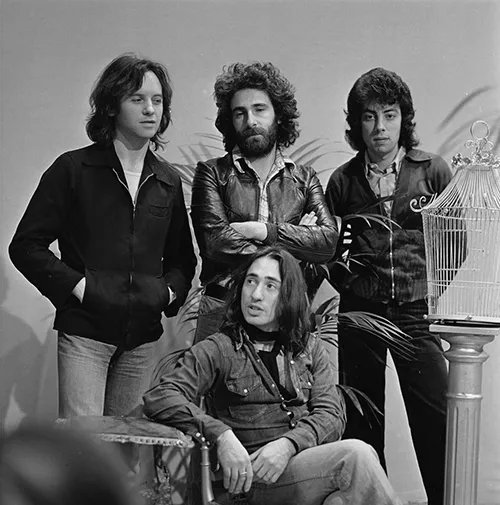
Photo by AVRO , licensed under CC BY-SA 3.0 nl · Wikimedia Commons
Rank #221
10cc
From Wikipedia
10cc are an English rock band formed in 1972 by four musicians who had written and recorded together at their own studio, Strawberry Studios, in Stockport near Manchester since 1968. The group initially consisted of Graham Gouldman, Eric Stewart, Kevin Godley, and Lol Creme. The four members contributed to songwriting, working together in various permutations. Godley and Creme’s songwriting has been said to be inspired by art and cinema. The four members were multi-instrumentalists, singers, writers and producers. Most of the band's records were recorded at their own Strawberry Studios (North) in Stockport and Strawberry Studios (South) in Dorking, with the majority of those engineered by Stewart.
Discography & Previews
Browse through and click an album to open and play 30-second previews streamed from Apple Music.


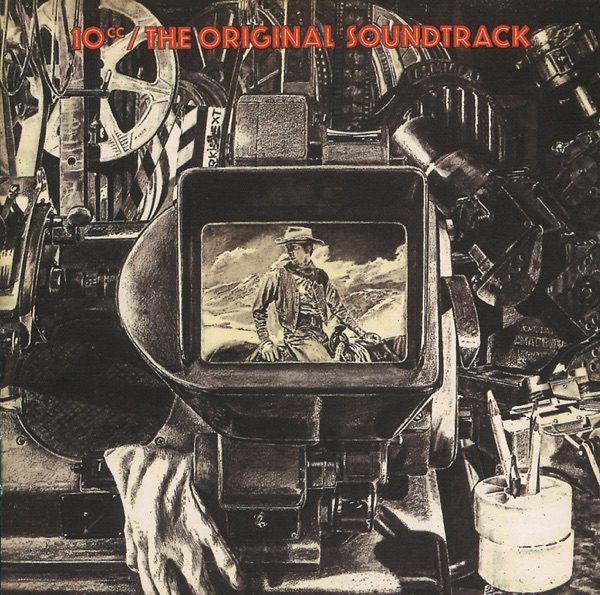
The Original Soundtrack
1975 · 10 tracks
- 1 Une Nuit a Paris, Pt. 1 / The Same Night In Paris, Pt. 2 / Later the Same Night In Paris, Pt. 3 ↗ 8:42
- 2 I'm Not In Love ↗ 6:07
- 3 Blackmail ↗ 4:33
- 4 The Second Sitting for the Last Supper ↗ 4:29
- 5 Brand New Day ↗ 4:12
- 6 Flying Junk ↗ 4:13
- 7 Life Is a Minestrone ↗ 4:44
- 8 The Film of My Love ↗ 5:09
- 9 Channel Swimmer ↗ 2:55
- 10 Good News ↗ 3:57


Deceptive Bends
1977 · 12 tracks
- 1 Good Morning Judge ↗ 2:55
- 2 The Things We Do For Love ↗ 3:28
- 3 Marriage Bureau Rendezvous ↗ 4:03
- 4 People In Love ↗ 3:46
- 5 Modern Man Blues ↗ 5:33
- 6 Honeymoon With B Troop ↗ 2:47
- 7 I Bought a Flat Guitar Tutor ↗ 1:46
- 8 You've Got a Cold ↗ 3:35
- 9 Feel the Benefit (Pts. 1, 2 & 3 ) ↗ 11:29
- 10 Hot To Trot ↗ 4:27
- 11 Don't Squeeze Me Like Toothpaste ↗ 3:37
- 12 I'm So Laid Back, I'm Laid Out ↗ 3:48

Bloody Tourists
1978 · 13 tracks
- 1 Dreadlock Holiday ↗ 4:28
- 2 For You and I ↗ 5:17
- 3 Take These Chains ↗ 2:35
- 4 Shock on the Tube (Don't Want Love) ↗ 3:38
- 5 Last Night ↗ 3:10
- 6 Anonymous Alcoholic ↗ 5:38
- 7 Reds In My Bed ↗ 4:08
- 8 Lifeline ↗ 3:26
- 9 Tokyo ↗ 4:30
- 10 Old Mister Time ↗ 4:27
- 11 From Rochdale to Ocho Rios ↗ 3:41
- 12 Everything You Wanted to Know About!!! ↗ 4:27
- 13 Nothing Can Move Me ↗ 4:04

Look Hear?
1980 · 11 tracks
- 1 One-Two-Five ↗ 5:11
- 2 Welcome To the World ↗ 3:43
- 3 How'm I Ever Going To Say Goodbye ↗ 3:40
- 4 Don't Send We Back ↗ 3:19
- 5 I Took You Home ↗ 5:10
- 6 It Doesn't Matter At All ↗ 4:02
- 7 Dressed To Kill ↗ 3:28
- 8 Lovers Anonymous ↗ 5:07
- 9 I Hate To Eat Along ↗ 2:55
- 10 Strange Lover ↗ 3:41
- 11 L.A. Inflatable ↗ 4:26

Ten Out of 10
1981 · 17 tracks
- 1 Don't Ask ↗ 4:03
- 2 Overdraft In Overdrive ↗ 3:24
- 3 Don't Turn Me Away ↗ 5:04
- 4 Memories ↗ 4:33
- 5 Notell Hotel ↗ 4:58
- 6 Les Nouveaux Riches ↗ 5:14
- 7 Action Man In Motown Suit ↗ 4:48
- 8 Listen With Your Eyes ↗ 3:13
- 9 Lying Here With You ↗ 3:24
- 10 Survivor ↗ 5:49
- 11 The Power of Love ↗ 4:15
- 12 Memories (U.S. Mix) ↗ 4:29
- 13 We've Heard It All Before ↗ 3:37
- 14 Tomorrow's World Today ↗ 3:15
- 15 Run Away ↗ 4:05
- 16 Les Nouveaux Riches (Edit) ↗ 4:38
- 17 You're Coming Home Again ↗ 4:28

Windows in the Jungle
1983 · 15 tracks
- 1 24 Hours (Full Version) ↗ 8:07
- 2 Oomachasaooma (Feel the Love) ↗ 5:11
- 3 Yes I Am ↗ 6:01
- 4 Americana Panorama ↗ 3:44
- 5 City Lights ↗ 3:32
- 6 Food for Thought ↗ 3:33
- 7 Working Girls ↗ 4:25
- 8 Taxi Taxi ↗ 7:39
- 9 24 Hours (Edit) ↗ 4:27
- 10 Dreadlock Holiday (Live From London/1982) ↗ 4:59
- 11 I'm Not In Love (Live From London/1982) ↗ 6:37
- 12 Oomachasaooma (Feel the Love) [Edit] ↗ 3:49
- 13 She Gives Me Pain ↗ 2:16
- 14 Food for Thought (Radio Edit) ↗ 3:24
- 15 The Secret Life of Henry ↗ 6:09

… Meanwhile
1992 · 10 tracks

Mirror Mirror
1995 · 14 tracks
- 1 Yvonne's The One ↗ 4:28
- 2 Code Of Scilence ↗ 5:41
- 3 Blue Bird ↗ 4:06
- 4 Age Of Consent ↗ 5:43
- 5 Take This Woman ↗ 3:53
- 6 The Monkey And The Onion ↗ 3:19
- 7 Everything Is Not Enough ↗ 4:04
- 8 Ready To Go Home ↗ 4:39
- 9 Grow Old With Me ↗ 3:24
- 10 Margo Wants The Mustard ↗ 3:54
- 11 Peace In Our Time ↗ 4:04
- 12 Why Did I Break Your Heart ↗ 5:20
- 13 Now You're Gone ↗ 3:03
- 14 I'm Not In Love ↗ 3:30
-
 10cc10cc197310 tracks
 -
 Sheet Music10cc197410 tracks
 -
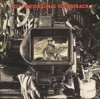 The Original Soundtrack10cc197510 tracks
 -
 How Dare You!10cc197610 tracks
 -
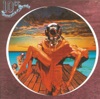 Deceptive Bends10cc197712 tracks
 -
 Bloody Tourists10cc197813 tracks
 -
 Look Hear?10cc198011 tracks
 -
 Ten Out of 1010cc198117 tracks
 -
 Windows in the Jungle10cc198315 tracks
 -
 … Meanwhile10cc199210 tracks
 -
 Mirror Mirror10cc199514 tracks
Deep Dive
Overview
10cc are an English art rock band formed in Stockport in 1972 by four musicians—Graham Gouldman, Eric Stewart, Kevin Godley, and Lol Creme—who had worked together at their own studio since 1968. Operating as multi-instrumentalist singer-songwriters and producers, they became one of the defining acts of 1970s art rock, merging progressive composition with pop sensibility and a distinctly theatrical approach to rock music. Their body of work, recorded primarily at their own Strawberry Studios locations in Stockport and Dorking, established a template for intelligent, studio-crafted rock that prioritized concept and production detail alongside melody.
Formation Story
The four musicians behind 10cc had established themselves as session players and producers at Strawberry Studios in Stockport, near Manchester, beginning in 1968. The studio served as both a workspace and creative laboratory where Gouldman, Stewart, Godley, and Creme developed their collaborative approach to songwriting and arrangement. Rather than forming as a traditional live band first, they consolidated into 10cc in 1972 as a studio-based project, drawing on their years of accumulated experience recording together. The chemistry among the four was rooted in their willingness to contribute across multiple instruments, vocals, and compositional duties, with Godley and Creme’s songwriting particularly influenced by visual art and cinema. Stewart’s engineering and production oversight became central to the band’s sonic identity, with nearly all their records engineered by him across both Strawberry Studios locations.
Breakthrough Moment
The band’s 1973 debut album 10cc introduced their distinctive approach to art rock, but it was Sheet Music in 1974 that established them as significant recording artists. The album showcased their ability to craft intricate pop-rock compositions with orchestral and theatrical elements, gaining them wider recognition beyond their Manchester roots. The album marked the point at which their studio expertise and multi-instrumental capabilities translated into a cohesive artistic statement that resonated with listeners seeking something beyond conventional rock. This period saw them transition from behind-the-scenes session musicians into recognizable frontline artists, with their growing reputation attracting significant attention to their subsequent releases.
Peak Era
The mid-to-late 1970s represented 10cc’s commercial and creative peak. The Original Soundtrack (1975), How Dare You! (1976), Deceptive Bends (1977), and Bloody Tourists (1978) formed a sustained run of albums that refined their art rock formula while maintaining broad appeal. During this period, the band’s reputation grew as serious students of recording craft, with their meticulous approach to production and arrangement earning them respect among musicians and critics alike. These albums demonstrated the full range of their capabilities: intricate instrumental passages, complex vocal harmonies, theatrical narrative elements, and the ability to shift between ambitious compositions and accessible pop hooks within single records. The consistency and ambition of these works positioned them as major figures in art rock during a decade that saw progressive and conceptual approaches to rock music at their commercial height.
Musical Style
10cc worked at the intersection of art rock, progressive pop, and soft rock, creating a sound that prioritized studio sophistication and compositional complexity over live-performance spectacle. As multi-instrumentalists, the four members deployed strings, brass, keyboards, guitars, and unconventional percussion alongside traditional rock instruments, often layering these elements to create dense, textured arrangements. Their songwriting reflected diverse influences, with Godley and Creme’s compositions often incorporating visual and cinematic concepts that pushed beyond conventional three-minute song structures. Eric Stewart’s role as engineer gave the band a significant technical advantage, allowing them to experiment with overdubbing, production effects, and studio techniques that enriched their recordings. Vocally, the band employed multiple lead singers and intricate harmonies, with different members taking prominent roles depending on the song, creating variety across their albums. The overall effect was of a band that viewed the recording studio as a primary instrument, treating each album as a complete artistic work rather than a collection of individual songs.
Major Albums
Sheet Music (1974)
The album that established 10cc as serious recording artists, demonstrating their mastery of intricate pop-rock composition with orchestral sophistication and diverse songwriting styles.
The Original Soundtrack (1975)
A landmark album featuring some of their most complex arrangements and theatrical elements, showcasing the band’s ambition to blend concept-album narratives with immediate melodic appeal.
How Dare You! (1976)
Peaking their creative output, this album features the band’s most confident blend of elaborate instrumentation, sophisticated production, and accessible songwriting across a fully realized album statement.
Deceptive Bends (1977)
Demonstrating sustained consistency during their peak period, this album further refined their art rock formula while maintaining their ability to craft memorable pop hooks within elaborate frameworks.
Signature Songs
- I’m Not in Love — A landmark ballad built on synthesizer, layered vocals, and studio production innovation, becoming one of the band’s most enduring recordings.
- Rubber Bullets — A showcase of the band’s ability to craft clever, hook-laden pop within their art rock context.
- Life Is a Minestrone — Demonstrates their playful approach to complex arrangements and their willingness to incorporate humor and concept into their compositions.
- Clockwork Creep — Exemplifies their theatrical side and intricate instrumental work within a memorable pop structure.
Influence on Rock
10cc’s legacy rests on their demonstration that art rock and sophisticated production could coexist with pop accessibility and commercial success. They proved that a band could maintain artistic credibility while achieving mainstream recognition, influencing subsequent generations of progressive pop and art rock acts. Their approach to the recording studio as a compositional tool, combined with their multi-instrumental fluency and rejection of standard song structures, established a model for intellectually ambitious rock music. The band’s insistence on studio control and their ability to engineer and produce their own work influenced how rock musicians conceived of creative autonomy. They occupied a crucial position in 1970s rock, demonstrating that experimental arrangements, theatrical concepts, and pop hooks were not mutually exclusive.
Legacy
10cc remained active through the 1980s, releasing albums including Windows in the Jungle (1983) and Look Hear? (1980), though their commercial prominence declined from their peak 1970s period. A gap followed before they returned with … Meanwhile (1992) and Mirror Mirror (1995), indicating an enduring commitment to creating new material. The band’s catalog from the 1970s continued to gain retrospective appreciation, with their technical innovations and songwriting complexity earning them recognition as significant figures in art rock’s history. Their own Strawberry Studios remains part of their legacy as a site where innovative rock music was created and engineered. The band’s official digital presence and continued occasional touring activity signal their ongoing status within rock culture, with their 1970s output remaining influential to musicians and listeners who value studio craft and compositional ambition.
Fun Facts
- The band’s name, 10cc, derived from the amount of semen in an average human ejaculation according to a scientific study the band members encountered, a detail that reflected their willingness to subvert rock music convention with provocative wordplay.
- Strawberry Studios, the band’s own facility, became a significant Manchester-area recording hub where multiple bands and artists recorded during the 1970s, giving 10cc complete control over their recording process while supporting the broader regional music scene.
- The four members’ multi-instrumental abilities meant that songwriting credits often involved complex arrangements where each member contributed substantially, creating a genuinely collaborative creative process rare among rock bands of the era.
- Eric Stewart’s engineering work on 10cc’s records was so integral to the band’s sound that he effectively functioned as a fifth creative member, shaping the studio production that defined their musical identity.