
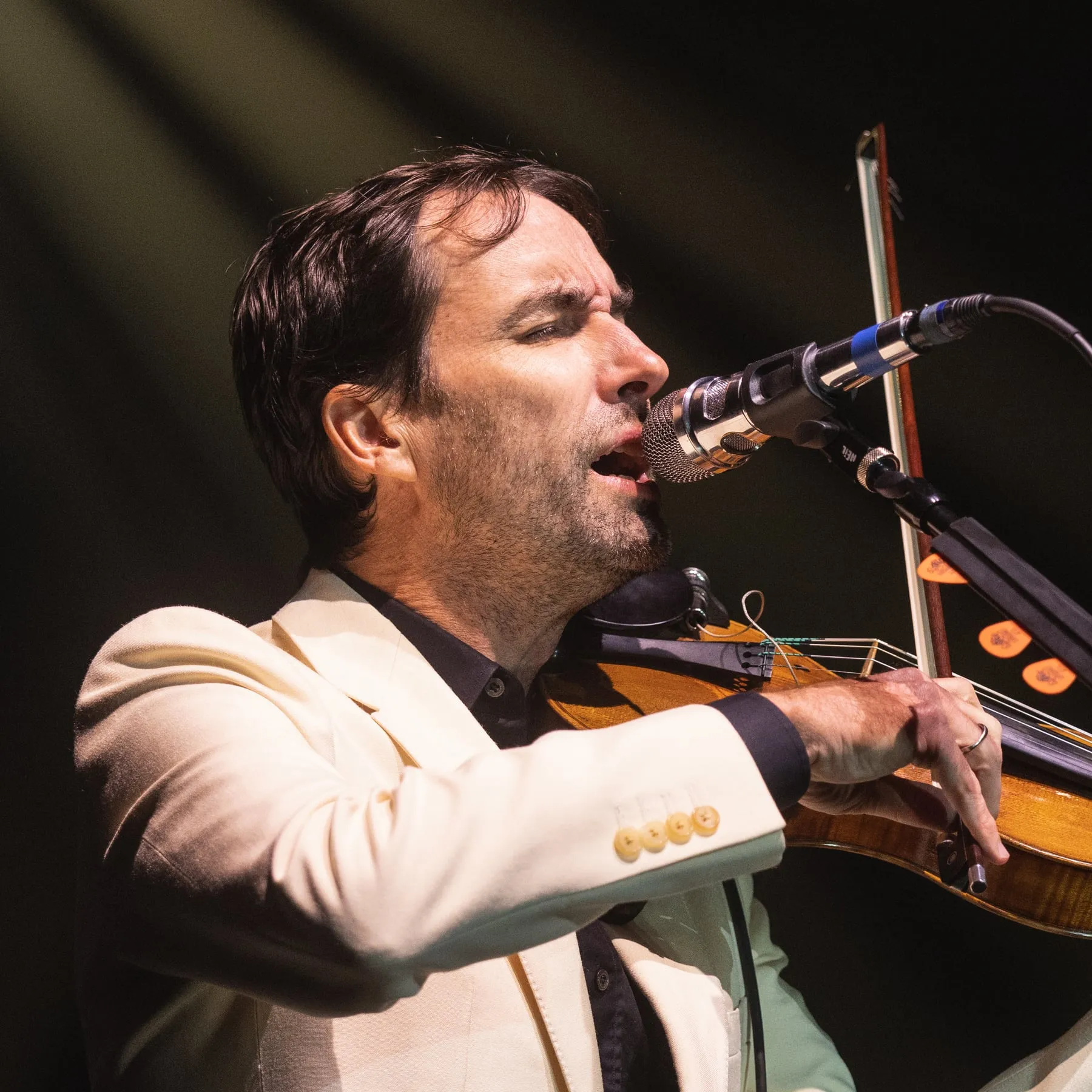
Photo by Andy Witchger , licensed under CC BY 2.0 · Wikimedia Commons
Rank #208
Andrew Bird
From Wikipedia
Andrew Wegman Bird is an American singer, songwriter, and musician. Since 1996, he has released 16 studio albums, as well as several live albums and EPs, spanning various genres including swing music, indie rock, and folk music. He is primarily known for his unique style of violin playing, accompanied by loop and effect pedals, whistling, and vocals. In the 1990s, he sang and played violin in several jazz ensembles, including Squirrel Nut Zippers and Kevin O'Donnell's Quality Six. He went on to start his own swing ensemble, Andrew Bird's Bowl of Fire, which released three albums between 1998 and 2001. Weather Systems (2003) was his first solo album after Bowl of Fire disbandment, and it marked a departure from jazz music into indie music. Bird's 2019 album My Finest Work Yet was nominated for "Best Folk Album" at the 2020 Grammy Awards. Beyond his own record releases, he has collaborated with various artists, including The Handsome Family, Dosh, Fiona Apple, Madison Cunningham and Nora O'Connor.
Discography & Previews
Browse through and click an album to open and play 30-second previews streamed from Apple Music.
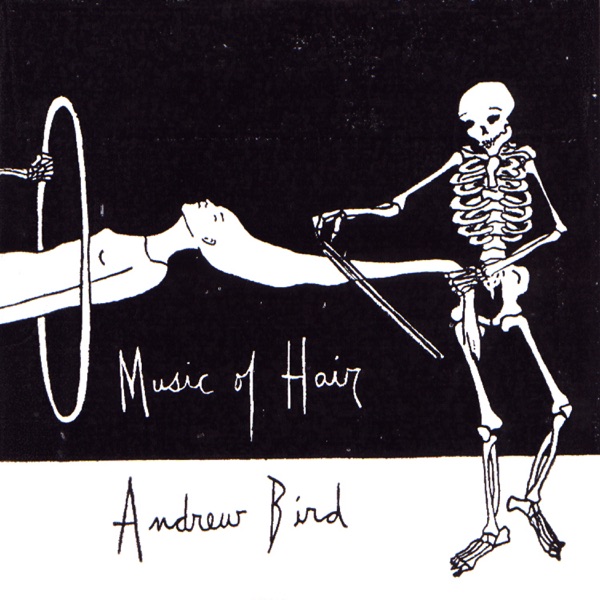
Music of Hair
1997 · 12 tracks
- 1 Nuthinduan Waltz ↗ 5:01
- 2 Ambivalence Waltz ↗ 2:30
- 3 Oh So Insistent ↗ 3:55
- 4 Rhodeoah ↗ 4:44
- 5 Two Sisters ↗ 4:20
- 6 St. Francis Reel ↗ 3:10
- 7 Ratitat/Peter's Wolf/Oblivious Reel ↗ 5:19
- 8 The Greenhorn/Exile of Erin/Glasgow Reel ↗ 4:17
- 9 Pathetique ↗ 4:10
- 10 Song of Foot ↗ 2:57
- 11 Minor Beatrice ↗ 10:01
- 12 Oh So Sad ↗ 5:49


The Mysterious Production of Eggs
2005 · 14 tracks
- 1 /=/ ↗ 1:06
- 2 Sovay ↗ 4:41
- 3 A Nervous Tic Motion of the Head to the Left ↗ 5:00
- 4 Fake Palindromes ↗ 2:53
- 5 Measuring Cups ↗ 2:52
- 6 Banking on a Myth ↗ 4:28
- 7 Masterfade ↗ 4:11
- 8 Opposite Day ↗ 4:32
- 9 Skin Is, My ↗ 3:37
- 10 The Naming of Things ↗ 4:58
- 11 MX Missiles ↗ 4:22
- 12 /=/=/ ↗ 1:09
- 13 Tables and Chairs ↗ 4:44
- 14 The Happy Birthday Song ↗ 5:03


Noble Beast
2009 · 14 tracks
- 1 Oh No ↗ 4:21
- 2 Masterswarm ↗ 6:36
- 3 Fitz and the Dizzyspells ↗ 3:37
- 4 Effigy ↗ 5:06
- 5 Tenuousness ↗ 3:51
- 6 Nomenclature ↗ 2:54
- 7 ouo ↗ 0:20
- 8 Not a Robot, But a Ghost ↗ 5:37
- 9 Unfolding Fans ↗ 0:58
- 10 Anonanimal ↗ 4:47
- 11 Natural Disaster ↗ 4:19
- 12 The Privateers ↗ 3:24
- 13 Souverian ↗ 7:18
- 14 On Ho ↗ 1:08
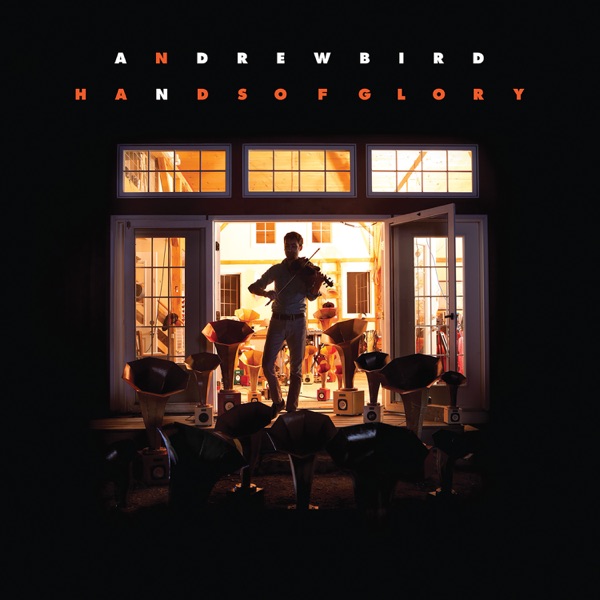

Break It Yourself
2012 · 14 tracks
- 1 Desperation Breeds … ↗ 5:29
- 2 Polynation ↗ 0:45
- 3 Danse Caribe ↗ 5:19
- 4 Give It Away ↗ 4:28
- 5 Eyeoneye ↗ 4:03
- 6 Lazy Projector ↗ 4:59
- 7 Near Death Experience Experience ↗ 4:29
- 8 Behind the Barn ↗ 1:02
- 9 Lusitania ↗ 4:04
- 10 Orpheo Looks Back ↗ 4:54
- 11 Sifters ↗ 4:11
- 12 Fatal Shore ↗ 5:02
- 13 Hole in the Ocean Floor ↗ 8:16
- 14 Belles ↗ 2:53

Things Are Really Great Here, Sort of…
2014 · 10 tracks


Are You Serious
2016 · 11 tracks

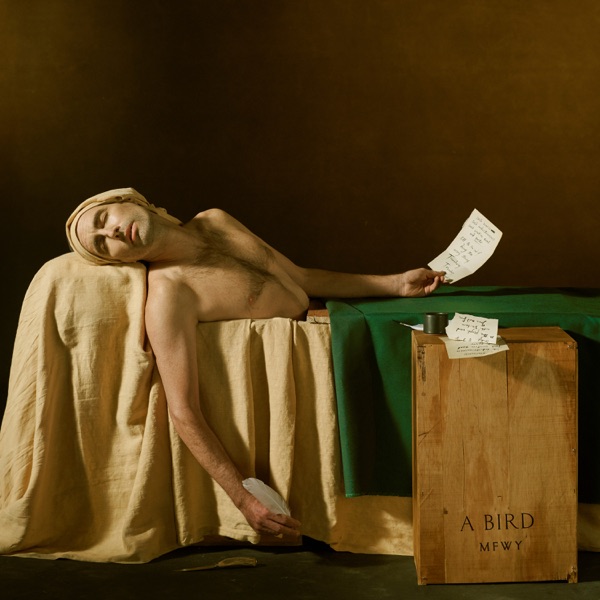

HARK!
2020 · 13 tracks

These 13
2021 · 13 tracks
- 1 Poor Lost Souls ↗ 4:16
- 2 Sweet Oblivion ↗ 3:13
- 3 Encircle My Love ↗ 3:42
- 4 Beat Still My Heart ↗ 3:57
- 5 Red Velvet Rope ↗ 3:14
- 6 High John ↗ 3:51
- 7 Stonewall (1863) ↗ 4:11
- 8 Bright Sunny South ↗ 1:05
- 9 Bell Witch ↗ 3:11
- 10 Dig up the Hatchet ↗ 2:34
- 11 Jack O' Diamonds ↗ 2:44
- 12 Burn the Honky Tonk ↗ 2:22
- 13 Three White Horses and a Golden Chain ↗ 6:33



Sunday Morning Put-On
2024 · 10 tracks
- 1 I Didn’t Know What Time It Was ↗ 3:08
- 2 Caravan ↗ 4:32
- 3 I Fall in Love Too Easily ↗ 3:59
- 4 You’d Be So Nice to Come Home To ↗ 2:47
- 5 My Ideal ↗ 4:26
- 6 Django ↗ 3:27
- 7 I Cover the Waterfront ↗ 4:52
- 8 Softly, as in a Morning Sunrise ↗ 4:12
- 9 I’ve Grown Accustomed to Her Face ↗ 1:49
- 10 Ballon de peut-être ↗ 9:16
-
 Music of HairAndrew Bird199712 tracks
 -
 Weather SystemsAndrew Bird20029 tracks
 -
 The Mysterious Production of EggsAndrew Bird200514 tracks
 -
 Armchair ApocryphaAndrew Bird200712 tracks
 -
 Useless CreaturesAndrew Bird20099 tracks
 -
 Noble BeastAndrew Bird200914 tracks
 -
 Hands of GloryAndrew Bird20128 tracks
 -
 Break It YourselfAndrew Bird201214 tracks
 -
 Things Are Really Great Here, Sort of…Andrew Bird201410 tracks
 -
 Echolocations: CanyonAndrew Bird20157 tracks
 -
 Are You SeriousAndrew Bird201611 tracks
 -
 Echolocations: RiverAndrew Bird20178 tracks
 -
 My Finest Work YetAndrew Bird201910 tracks
 -
 HARK!Andrew Bird202013 tracks
 -
 These 13Andrew Bird202113 tracks
 -
 Inside ProblemsAndrew Bird202211 tracks
 -
 Outside ProblemsAndrew Bird20239 tracks
 -
 Cunningham BirdAndrew Bird202410 tracks
 -
 Sunday Morning Put-OnAndrew Bird202410 tracks
Deep Dive
Overview
Andrew Bird is an American singer, songwriter, and multi-instrumentalist whose career bridges jazz ensemble work, avant-garde swing, and indie rock experimentation. Born in 1973, Bird has built a distinctive artistic identity centered on his virtuosic violin playing, processed through loop and effect pedals, coupled with intricate vocal arrangements and instrumental composition. Since 1996, he has released 16 studio albums across nearly three decades, establishing himself as a singular voice in contemporary indie and alternative music—neither fully jazz nor wholly rock, but a restless synthesist who has repeatedly reinvented his sonic palette while maintaining a consistent commitment to rhythmic complexity and textural innovation.
Formation Story
Bird emerged into professional musicianship during the 1990s in the American jazz ensemble tradition, working as a violinist and vocalist in several ensembles including Squirrel Nut Zippers and Kevin O’Donnell’s Quality Six. These early years grounded him in swing idioms and ensemble discipline. Rather than remain in that circuit, Bird founded his own group, Andrew Bird’s Bowl of Fire, around the turn of the millennium. The ensemble released three albums between 1998 and 2001, establishing Bird as a bandleader capable of orchestrating complex arrangements and sustaining a vision across multiple recordings. This period was formative but not final; by the early 2000s, Bird recognized the need to move beyond the jazz-ensemble model toward a more solitary and experimental path.
Breakthrough Moment
Bird’s transition to a sustained solo career crystallized with Weather Systems (2003), his first record released independently of Bowl of Fire. The album marked a decisive departure from the swing and jazz idioms that had defined his 1990s work, pivoting instead toward indie rock and art-pop sensibilities. Weather Systems introduced audiences to Bird’s mature approach: violin as a primary melodic instrument rather than an accompanying voice, processed through effects and loops to create layered, textural soundscapes. The album’s commercial and critical reception—modest but respectful—signaled that Bird had found his primary artistic territory. He would spend the next two decades deepening and varying this approach across multiple labels and recording contexts.
Peak Era
Bird’s most creatively prolific and widely recognized period occurred between 2005 and 2012. The Mysterious Production of Eggs (2005) and Armchair Apocrypha (2007) consolidated his reputation as an innovative indie-rock composer, while Noble Beast (2009) and Break It Yourself (2012) demonstrated his willingness to experiment with production, arrangement, and genre boundaries. During this span, Bird released records at a steady cadence, each one exploring different sonic territories—from the intricate, chamber-like textures of his early Bloodshot Records albums to more expansive, orchestral arrangements as his career progressed. His technical facility on violin, his ear for unconventional song structures, and his ability to integrate folk, jazz, and rock idioms without falling into pastiche made him a singular figure in indie rock’s broader ecosystem.
Musical Style
Bird’s sound is defined by the marriage of classical violin training with modern electronic processing. His primary instrument, the violin, functions as a lead voice rather than an accompaniment—he bows, plucks, and manipulates the instrument with equal fluency, often processing the signal through loop pedals and effects units to build dense, multi-tracked arrangements in real time or in the studio. His vocal approach is precise and often reserved, employing whistling and wordless syllables alongside sung melody, creating a palimpsest of human sounds. Lyrically, he tends toward introspection and semantic density, avoiding straightforward narrative in favor of impressionistic imagery and rhythmic wordplay. The harmonic language draws from jazz—unexpected chord substitutions, modal inflections, suspended resolutions—but applies them within indie rock’s typical song durations and production contexts. Instrumentation varies considerably across his catalog: early recordings emphasize acoustic instrumentation and ensemble textures, while later albums incorporate electronic production, synthesizers, and more layered studio techniques.
Major Albums
The Mysterious Production of Eggs (2005)
A watershed moment in Bird’s indie-rock development, this album established the sonic template he would refine across the next decade: intricate violin arrangements, looped textures, and sparse but meticulous production emphasizing detail and spatial clarity.
Armchair Apocrypha (2007)
Featuring some of Bird’s most direct melodic songwriting, this record balanced his avant-garde instrumental tendencies with more accessible compositional structures, demonstrating that complexity and emotional immediacy need not be opposing forces.
Noble Beast (2009)
A more expansive, orchestral statement that pushed Bird’s arrangements toward larger sonic canvases while maintaining his commitment to rhythmic sophistication and tonal exploration.
Break It Yourself (2012)
Among Bird’s most accomplished works, this album showcased a mature artist in full command of his stylistic vocabulary, blending intricate instrumentation with confident, expressive songwriting.
My Finest Work Yet (2019)
Released toward the end of Bird’s fourth decade of life, this album earned a Grammy nomination for Best Folk Album at the 2020 Grammy Awards, attesting to its artistic reach and the folk-music lineages that had always underpinned his work beneath the indie-rock and jazz surfaces.
Signature Songs
- “Imitosis” — A defining statement of Bird’s looped-violin approach, the song constructs complex rhythmic and textural layers from a deceptively simple melodic idea.
- “Fiery Crash” — Demonstrates Bird’s ability to merge jazz-influenced harmonic language with indie-rock sensibility and rhythmic precision.
- “The Supine” — Showcases the intimate, chamber-like production and restrained vocal delivery that characterized much of his mid-career work.
- “Heretics” — Exemplifies Bird’s gift for pairing complex instrumental arrangements with precise, image-rich lyrics.
Influence on Rock
Bird’s career represents a significant lineage of late-20th and early-21st-century indie rock that refuses the binary between “experimental” and “accessible.” His integration of classical-instrumental training, jazz-ensemble discipline, and contemporary electronic processing influenced a generation of indie artists and singer-songwriters who came of age in the 2000s and 2010s. He demonstrated that violin could be a primary rock instrument without irony, kitsch, or self-consciousness—a perspective that subtly shifted the palette available to indie and alternative musicians. His collaborations with artists spanning multiple genres—from Fiona Apple to The Handsome Family, from Madison Cunningham to Nora O’Connor—positioned him as a musical peer and creative catalyst across multiple communities, influencing how contemporary musicians think about genre boundaries and cross-genre collaboration.
Legacy
Across more than 25 years of sustained recording and performance, Bird has established himself as a singular and uncompromising voice in contemporary rock. His 16 studio albums, numerous live recordings, and collaborative projects constitute a body of work notable for its consistency of vision and technical sophistication. The 2019 Grammy nomination for My Finest Work Yet in the Best Folk Album category underscored his music’s reach across multiple listener communities and genre frameworks. Bird’s streaming presence and ongoing recording activity—including albums released as recently as 2024—confirm his position as an active, evolving artist rather than a figure confined to a particular era or moment. His influence extends not only through direct emulation but through the implicit permission his career grants to musicians seeking to integrate disparate traditions and technical approaches into a coherent personal voice.
Fun Facts
- Bird’s technical mastery extends beyond violin to multiple stringed and wind instruments, which he deploys across his recordings and live performances.
- His collaborations have included projects with producer Dosh and folk-music luminaries The Handsome Family, demonstrating his range across different aesthetic communities.
- The dual release of Echolocations: Canyon (2015) and Echolocations: River (2017) reflected Bird’s interest in concept-album structures and thematic artistic statements.
- In 2024, Bird released Cunningham Bird, a collaborative project with Madison Cunningham, signaling his ongoing commitment to partnership and ensemble work despite his reputation as a solo artist.