
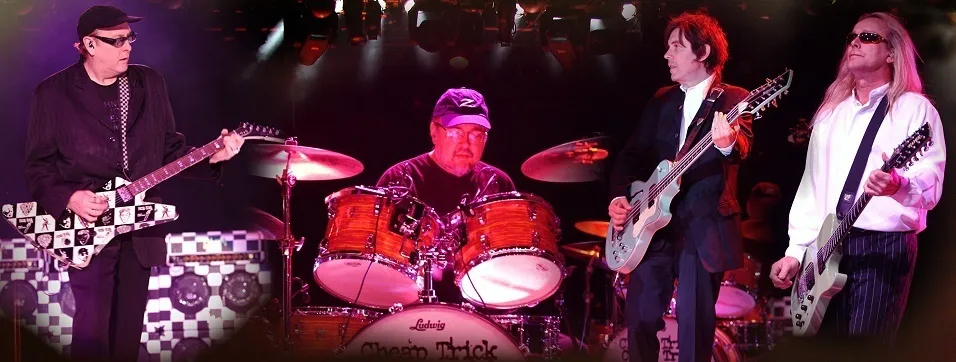
Photo by Dwight McCann , licensed under CC BY-SA 2.5 · Wikimedia Commons
Rank #192
Cheap Trick
From Wikipedia
Cheap Trick is an American rock band formed in Rockford, Illinois, in 1973. The band's work bridged elements of 1960s guitar pop, 1970s hard rock, and the emerging punk rock sound, and helped set the template for subsequent power pop artists.
Members
- Bun E. Carlos
- Rick Nielsen
- Robin Zander
- Tom Petersson
Discography & Previews
Browse through and click an album to open and play 30-second previews streamed from Apple Music.

Cheap Trick
1977 · 10 tracks
- 1 ELO Kiddies (Single Version) ↗ 3:41
- 2 Daddy Should Have Stayed in High School ↗ 4:45
- 3 Taxman, Mr. Thief ↗ 4:16
- 4 Cry, Cry ↗ 4:23
- 5 Oh, Candy ↗ 3:07
- 6 Hot Love ↗ 2:31
- 7 Speak Now or Forever Hold Your Peace ↗ 4:35
- 8 He's a Whore ↗ 2:43
- 9 Mandocello ↗ 4:47
- 10 The Ballad of TV Violence (I'm Not the Only Boy) ↗ 5:15


All Shook Up
1980 · 10 tracks
- 1 Stop This Game ↗ 3:57
- 2 Just Got Back ↗ 2:05
- 3 Baby Loves to Rock ↗ 3:17
- 4 Can't Stop It But I'm Gonna Try ↗ 3:31
- 5 World's Greatest Lover ↗ 4:52
- 6 High Priest of Rhythmic Noise ↗ 4:13
- 7 Love Comes a-Tumblin' Down ↗ 3:09
- 8 I Love You Honey but I Hate Your Friends ↗ 3:50
- 9 Go for the Throat (Use Your Own Imagination) ↗ 3:05
- 10 Who D'King ↗ 2:16

One on One
1982 · 11 tracks

Next Position Please
1983 · 16 tracks
- 1 I Can't Take It ↗ 3:29
- 2 Borderline ↗ 3:36
- 3 I Don't Love Her Anymore ↗ 3:53
- 4 Next Position Please ↗ 2:56
- 5 Younger Girls ↗ 3:17
- 6 Don't Make Our Love a Crime ↗ 3:45
- 7 3-D ↗ 3:39
- 8 You Talk Too Much ↗ 1:57
- 9 Y.O.Y.O.Y. ↗ 4:56
- 10 Won't Take No For an Answer ↗ 3:14
- 11 Heaven's Falling ↗ 3:48
- 12 Invaders of the Heart ↗ 4:01
- 13 Twisted Heart ↗ 4:17
- 14 Don't Hit Me With Love ↗ 3:25
- 15 You Say Jump ↗ 3:08
- 16 Dancing the Night Away ↗ 4:57


The Doctor
1986 · 10 tracks


Busted
1990 · 11 tracks
- 1 Back 'n Blue ↗ 4:42
- 2 I Can't Understand It ↗ 3:30
- 3 Wherever Would I Be ↗ 4:06
- 4 If You Need Me ↗ 4:46
- 5 Can't Stop Falling Into Love ↗ 3:50
- 6 Busted ↗ 4:06
- 7 Walk Away (feat. Chrissie Hynde) ↗ 3:43
- 8 You Drive, I'll Steer ↗ 4:34
- 9 When You Need Someone ↗ 5:18
- 10 Had to Make You Mine ↗ 3:16
- 11 Rock 'n' Roll Tonight ↗ 4:57

Woke Up With a Monster
1994 · 11 tracks

Rockford
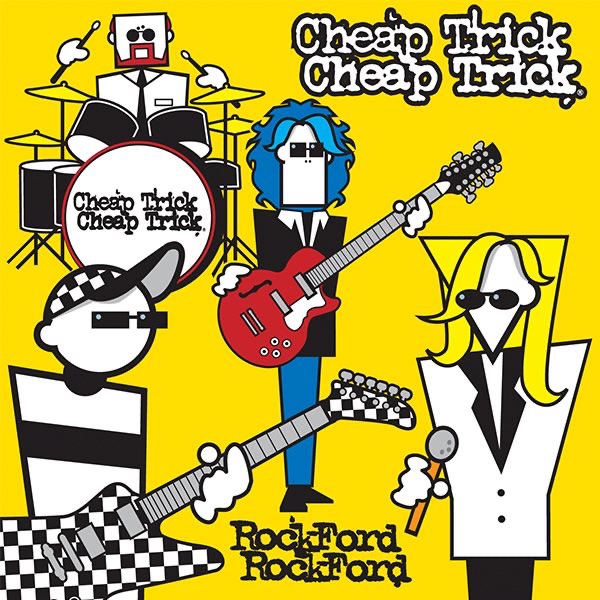
2006 · 12 tracks
- 1 Welcome to the World ↗ 2:07
- 2 Perfect Stranger ↗ 3:42
- 3 If It Takes a Lifetime ↗ 4:22
- 4 Come On Come On Come On ↗ 3:04
- 5 O Claire ↗ 3:43
- 6 This Time You Got It ↗ 4:02
- 7 Give It Away ↗ 2:49
- 8 One More Day ↗ 3:50
- 9 Every Night and Every Day ↗ 3:13
- 10 Dream the Night Away ↗ 3:14
- 11 All Those Years ↗ 3:36
- 12 Decaf ↗ 3:38
The Latest
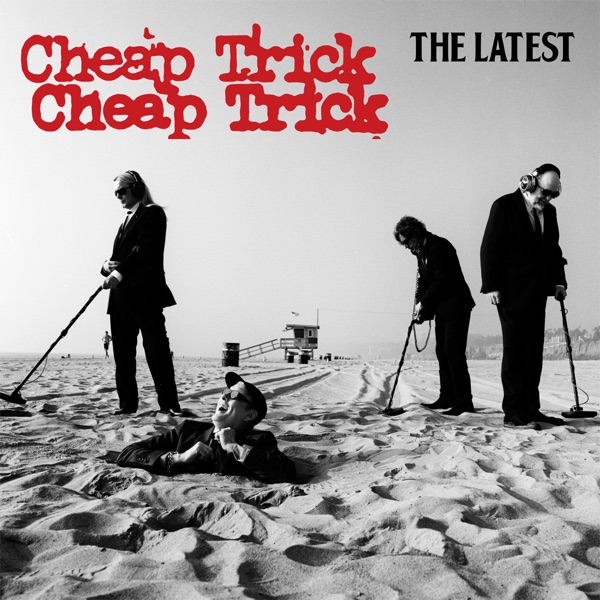
2009 · 13 tracks
- 1 Sleep Forever ↗ 1:37
- 2 When the Lights Are Out ↗ 3:26
- 3 Miss Tomorrow ↗ 4:11
- 4 Sick Man of Europe ↗ 2:08
- 5 These Days ↗ 2:44
- 6 Miracle ↗ 3:47
- 7 Everyday You Make Me Crazy ↗ 1:17
- 8 California Girl ↗ 2:47
- 9 Everybody Knows ↗ 4:16
- 10 Alive ↗ 3:36
- 11 Times of Our Lives ↗ 3:59
- 12 Closer, the Ballad of Burt and Linda ↗ 3:00
- 13 Smile ↗ 4:12

Bang, Zoom, Crazy… Hello
2016 · 11 tracks


Christmas Christmas
2017 · 12 tracks
- 1 Merry Christmas Darlings ↗ 3:45
- 2 I Wish It Could Be Christmas Every Day ↗ 3:35
- 3 I Wish It Was Christmas Today ↗ 3:14
- 4 Merry Xmas Everybody ↗ 3:17
- 5 Please Come Home for Christmas ↗ 3:29
- 6 Remember Christmas ↗ 3:01
- 7 Run Rudolph Run ↗ 3:59
- 8 Father Christmas ↗ 3:55
- 9 Silent Night ↗ 3:56
- 10 Merry Christmas (I Don't Want to Fight Tonight) ↗ 2:07
- 11 Our Father of Life ↗ 3:17
- 12 Christmas Christmas ↗ 2:16

In Another World
2021 · 13 tracks
- 1 The Summer Looks Good On You ↗ 3:57
- 2 Quit Waking Me Up ↗ 3:43
- 3 Another World ↗ 4:02
- 4 Boys & Girls & Rock N Roll ↗ 3:54
- 5 The Party ↗ 2:54
- 6 Final Days ↗ 4:39
- 7 So It Goes ↗ 3:04
- 8 Light Up the Fire ↗ 2:54
- 9 Passing Through ↗ 3:20
- 10 Here's Looking At You ↗ 3:20
- 11 Another World (Reprise) ↗ 3:24
- 12 I'll See You Again ↗ 2:50
- 13 Gimme Some Truth ↗ 3:27

All Washed Up
2025 · 11 tracks
-
 Cheap TrickCheap Trick197710 tracks
 -
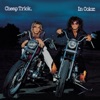 In ColorCheap Trick197710 tracks
 -
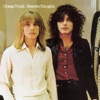 Heaven TonightCheap Trick197811 tracks
 -
 Dream PoliceCheap Trick19799 tracks
 -
 All Shook UpCheap Trick198010 tracks
 -
 One on OneCheap Trick198211 tracks
 -
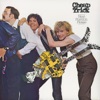 Next Position PleaseCheap Trick198316 tracks
 -
 Standing on the EdgeCheap Trick198510 tracks
 -
 The DoctorCheap Trick198610 tracks
 -
 Lap of LuxuryCheap Trick198810 tracks
 -
 BustedCheap Trick199011 tracks
 -
 Woke Up With a MonsterCheap Trick199411 tracks
 -
 Cheap TrickCheap Trick199711 tracks
 -
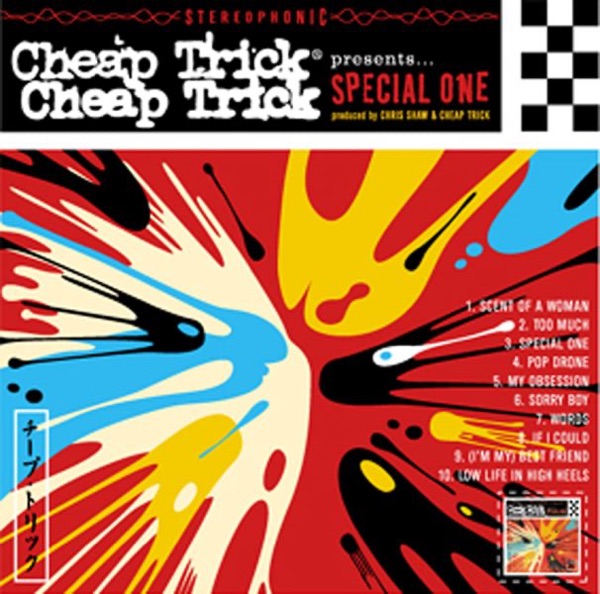
 Special OneCheap Trick200311 tracks
 -
 RockfordCheap Trick200612 tracks
 -
 The LatestCheap Trick200913 tracks
 -
 Bang, Zoom, Crazy… HelloCheap Trick201611 tracks
 -
 We’re All Alright!Cheap Trick201710 tracks
 -
 Christmas ChristmasCheap Trick201712 tracks
 -
 In Another WorldCheap Trick202113 tracks
 -
 All Washed UpCheap Trick202511 tracks
Deep Dive
Overview
Cheap Trick is an American rock band formed in Rockford, Illinois, that emerged from the heartland in the mid-1970s to become one of the defining acts of power pop. Drawing from 1960s guitar pop, 1970s hard rock, and the raw energy of punk rock, the band fashioned a sound that was simultaneously melodic and hard-edged, helping to establish the template that would define power pop for subsequent generations. Their combination of hook-laden songwriting, explosive live performance, and technical musicianship positioned them as crucial bridge figures between classic rock and the punk-influenced alternative rock that would gain prominence in the 1980s.
Formation Story
Cheap Trick coalesced in Rockford in 1974, bringing together four musicians who would remain the core lineup throughout the band’s history: guitarist and principal songwriter Rick Nielsen, vocalist Robin Zander, bassist Tom Petersson, and drummer Bun E. Carlos. Rockford, a mid-sized industrial city in northern Illinois, was an unlikely birthplace for a rock act that would achieve international prominence, yet the band’s Midwestern origins would remain central to their identity. The four members shared a vision that fused the melodic sophistication of 1960s British Invasion pop with the amplified power of hard rock and the defiant spirit of emerging punk rock, a combination that initially puzzled radio programmers and industry gatekeepers but would eventually establish Cheap Trick as torchbearers for a new strain of rock music.
Breakthrough Moment
Cheap Trick’s rise accelerated with two albums released in 1977: their self-titled debut Cheap Trick and the follow-up In Color. These early records introduced listeners to the band’s formula of infectious melodies wrapped in hard-hitting arrangements, but the band’s true watershed moment came with their live recording From Tokyo to You in 1978. Recorded in Japan, where they had developed an enthusiastic fanbase, the live album captured the electrifying intensity of the band’s performances and proved that their meticulously crafted pop-rock songs could detonate on stage. The success of this live release demonstrated that Cheap Trick had transcended their regional base and built a dedicated national and international audience.
Peak Era
The years spanning 1978 to 1980 represented Cheap Trick’s most commercially successful and creatively vital period. The studio album Heaven Tonight (1978) solidified their commercial breakthrough with a mixture of power-pop gems and hard rock stompers. Dream Police (1979) deepened their catalog with some of their most celebrated material, while All Shook Up (1980) maintained the momentum, confirming that the band had achieved genuine mainstream success. During this span, Cheap Trick dominated rock radio and concert venues, their live shows becoming legendary for the chemistry between Nielsen’s precision guitar work, Zander’s soaring vocal delivery, Petersson’s melodic bass lines, and Carlos’s propulsive drumming. The band’s ability to sound both accessible and technically accomplished made them anomalies in an era increasingly divided between art-rock complexity and punk minimalism.
Musical Style
Cheap Trick’s sound synthesized three distinct traditions with uncommon skill. The foundation was melodic rock songwriting rooted in 1960s pop sensibility—particularly the influence of the Beatles and post-British Invasion bands—emphasized through Zander’s clean, stratospheric vocal delivery and Nielsen’s gift for crafting hooks that lodged instantly in listeners’ heads. Layered over this pop foundation was the sonic aggression of hard rock: thick guitar tones, prominent bass lines, and pounding drums that gave their records heft and their live shows visceral impact. The emerging punk rock of the mid-to-late 1970s contributed an attitude of directness and energy; Cheap Trick’s songs rarely indulged in lengthy passages or self-indulgent instrumental showcases, instead favoring tight, energetic arrangements that built to explosive climaxes. This three-part fusion was distinctive because it was neither diluted compromise nor confused eclecticism; the band had genuinely internalized influences from three musical worlds and forged something unified from them. As their career progressed through albums like One on One (1982) and beyond, they continued to refine this core sound while occasionally experimenting with new wave and pop production techniques, yet the essential formula—crafted melody meeting hard-rock momentum—remained their touchstone.
Major Albums
In Color (1977)
The 1977 follow-up to their debut, In Color deepened their power-pop foundation with sharper production and more assured songwriting, establishing the melodic-meets-powerful formula that would define their career.
Heaven Tonight (1978)
Heaven Tonight marked their commercial breakthrough, showcasing their ability to craft radio-friendly rock songs without sacrificing instrumental energy or complexity.
Dream Police (1979)
Released in 1979, Dream Police became their definitive statement of the era, packed with some of their most enduring compositions and representing the band at their creative peak.
Lap of Luxury (1988)
A 1988 studio album that demonstrated the band’s continued relevance and ability to adapt to contemporary production while maintaining their core identity.
Rockford (2006)
The 2006 album Rockford, named after their hometown, represented a return to form and renewed creative vigor after years of touring and recording.
Signature Songs
- “Dream Police” — The title track from their 1979 album, a hard-rock anthem that became one of their most recognizable compositions.
- “Surrender” — A staple of their catalog that exemplified their gift for wedding hook-laden melodies to hard-rock aggression.
- “I Want You to Want Me” — A power-pop classic that showcased their pop sensibility and became a rock radio standard.
- “Saturday Night” — A high-energy showcase for their live prowess and their ability to build infectious momentum.
- “Goodnight Now” — A ballad that demonstrated the band’s range and Zander’s vocal capabilities.
Influence on Rock
Cheap Trick occupied a crucial position in rock music history as bridge builders. Their success validated the possibility of combining pop melody with rock power—a synthesis that had been attempted before but rarely achieved so successfully. The band proved that power pop was not a marginal or novelty subgenre but a legitimate and commercially viable form of rock music. Their influence rippled through subsequent generations of rock and alternative musicians who took as a given that crafted pop songwriting and hard-rock instrumentation could coexist. Bands emerging in the 1980s and 1990s, particularly power-pop revivalists and alternative-rock acts seeking melodic substance, owed a debt to Cheap Trick’s demonstration that these elements could be unified into a coherent artistic vision. Their technical proficiency and compositional sophistication also positioned them as influences on more complex rock forms that emerged in later decades.
Legacy
Cheap Trick maintained active status as performers and recording artists well into the 2010s and 2020s, releasing albums including We’re All Alright! (2017), In Another World (2021), and All Washed Up (2025), demonstrating remarkable longevity and continued creative engagement. Their early studio albums and live recordings remain foundational texts in power-pop history and are consistently cited by critics and musicians as essential listening. The band’s hometown of Rockford became indelibly associated with them, serving as both a source of identity and a reminder that major artistic achievements could emerge from regions outside the traditional music-industry centers of Los Angeles, New York, and Nashville. The enduring availability of their catalog across streaming platforms and the continued reverence accorded to their 1970s and 1980s work ensures that new generations of rock listeners encounter Cheap Trick as a cornerstone band of the power-pop tradition.
Fun Facts
- Cheap Trick became particularly successful in Japan during the late 1970s, where they developed a devoted fanbase before achieving equivalent commercial success in the United States, leading to the landmark live recording From Tokyo to You.
- The band’s name was inspired by the idea of offering rock music at bargain-basement prices, reflecting their commitment to accessible, unpretentious entertainment.
- Rick Nielsen’s distinctive mullet hairstyle and energetic stage presence became visual signatures of the band during their peak era, contributing to their identity as rock performers who understood spectacle alongside musicianship.
- The lineup of Nielsen, Zander, Petersson, and Carlos proved remarkably stable throughout the band’s decades-long career, with all four members remaining active in the group from formation through the 2020s.