
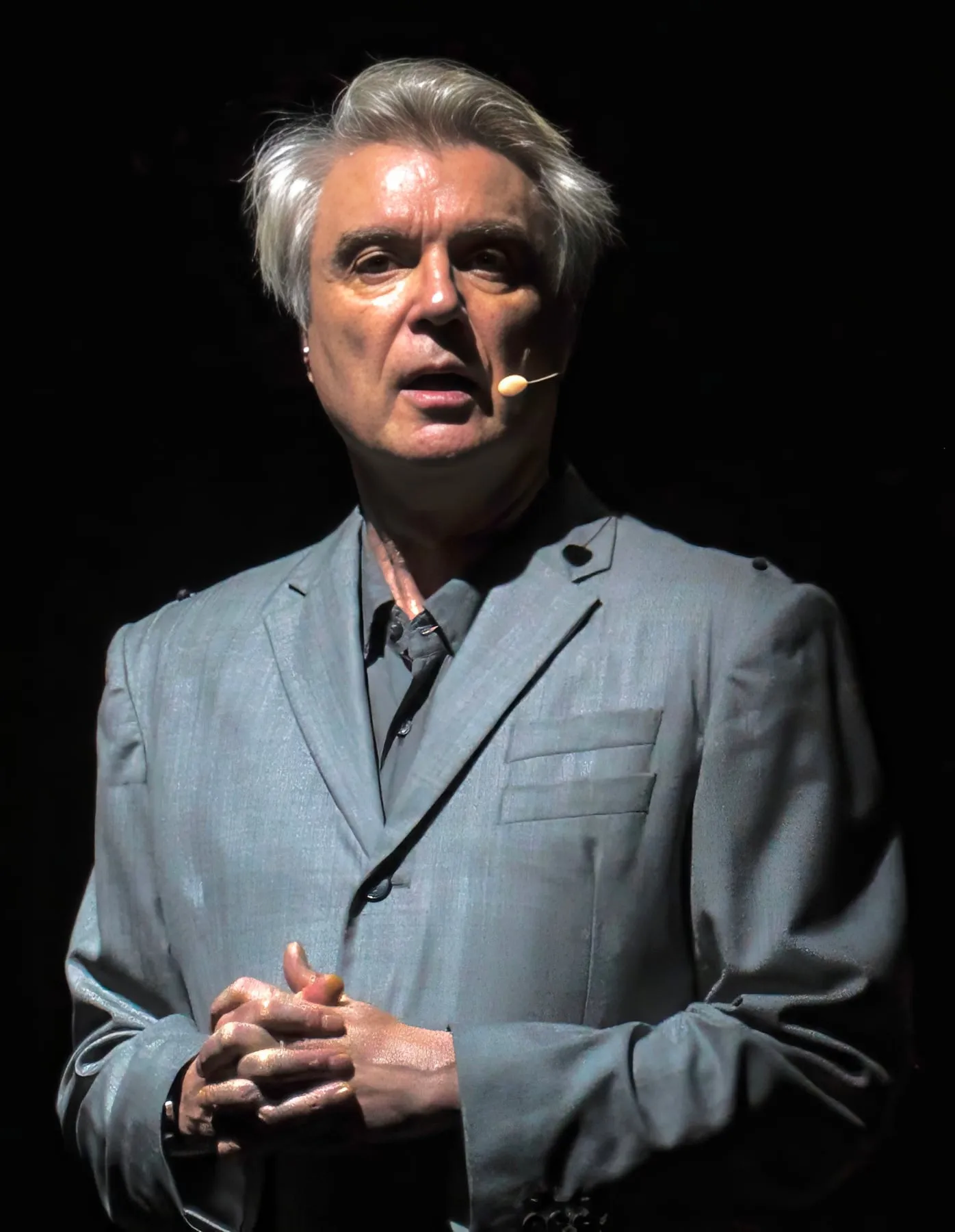
Photo by Raph_PH , licensed under CC BY 2.0 · Wikimedia Commons
Rank #210
David Byrne
From Wikipedia
David Byrne is an American musician, writer, visual artist, and filmmaker. He was a founding member and the principal songwriter, lead vocalist, and guitarist of the rock band Talking Heads.
Discography & Previews
Browse through and click an album to open and play 30-second previews streamed from Apple Music.
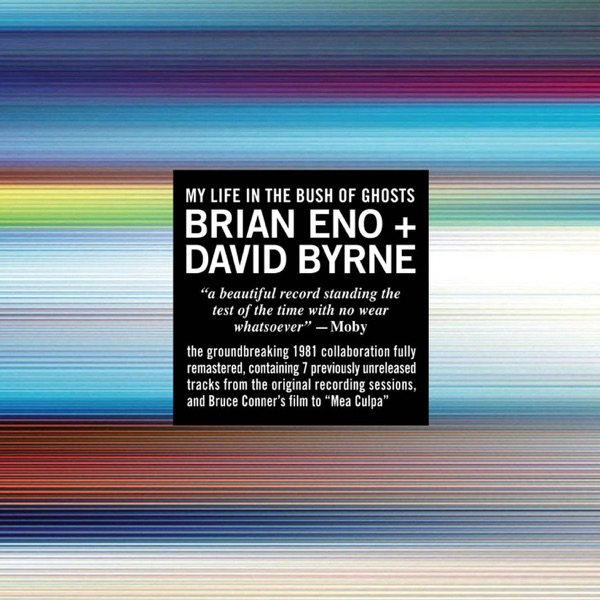
My Life in the Bush of Ghosts
1980 · 18 tracks
- 1 America Is Waiting ↗ 3:38
- 2 Mea Culpa ↗ 4:58
- 3 Regiment ↗ 4:11
- 4 Help Me Somebody ↗ 4:19
- 5 The Jezebel Spirit ↗ 4:54
- 6 Very, Very Hungry ↗ 3:20
- 7 Moonlight In Glory ↗ 4:29
- 8 The Carrier ↗ 4:20
- 9 A Secret Life ↗ 2:31
- 10 Come With Us ↗ 2:43
- 11 Mountain of Needles ↗ 2:35
- 12 Pitch to Voltage ↗ 2:39
- 13 Two Against Three ↗ 1:55
- 14 Vocal Outtakes ↗ 0:36
- 15 New Feet ↗ 2:26
- 16 Defiant ↗ 3:42
- 17 Number 8 Mix ↗ 3:30
- 18 Solo Guitar With Tin Foil ↗ 2:56
My Life in the Bush of Ghosts
1981 · 18 tracks
- 1 America Is Waiting ↗ 3:38
- 2 Mea Culpa ↗ 4:58
- 3 Regiment ↗ 4:11
- 4 Help Me Somebody ↗ 4:19
- 5 The Jezebel Spirit ↗ 4:54
- 6 Very, Very Hungry ↗ 3:20
- 7 Moonlight In Glory ↗ 4:29
- 8 The Carrier ↗ 4:20
- 9 A Secret Life ↗ 2:31
- 10 Come With Us ↗ 2:43
- 11 Mountain of Needles ↗ 2:35
- 12 Pitch to Voltage ↗ 2:39
- 13 Two Against Three ↗ 1:55
- 14 Vocal Outtakes ↗ 0:36
- 15 New Feet ↗ 2:26
- 16 Defiant ↗ 3:42
- 17 Number 8 Mix ↗ 3:30
- 18 Solo Guitar With Tin Foil ↗ 2:56
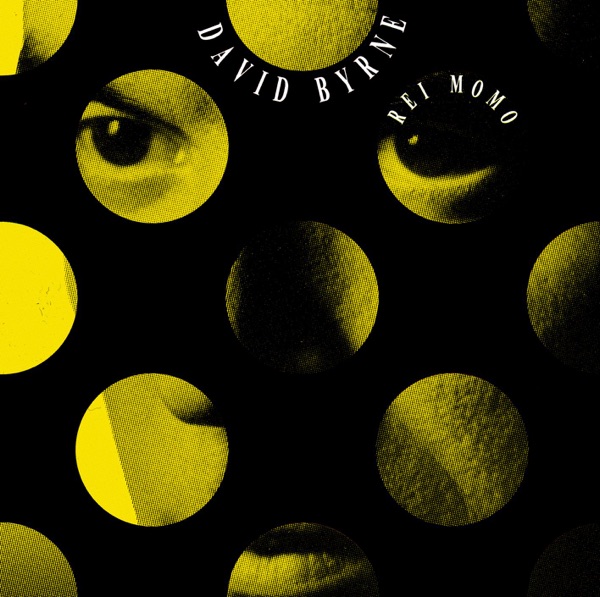
Rei Momo
1989 · 15 tracks
- 1 Independence Day ↗ 5:44
- 2 Make Believe Mambo ↗ 5:23
- 3 The Call of the Wild ↗ 4:53
- 4 Dirty Old Town ↗ 4:13
- 5 The Rose Tattoo ↗ 3:51
- 6 Loco de Amor ↗ 3:46
- 7 The Dream Police ↗ 3:00
- 8 Don't Want to Be Part of Your World ↗ 4:58
- 9 Marching Through the Wilderness ↗ 4:30
- 10 Good and Evil ↗ 4:35
- 11 Lie to Me ↗ 3:37
- 12 Office Cowboy ↗ 3:40
- 13 Woman vs. Man ↗ 4:05
- 14 Carnival Eyes ↗ 4:04
- 15 I Know Sometimes a Man Is Wrong ↗ 3:14


Uh‐oh
1992 · 12 tracks
- 1 Now I'm Your Mom ↗ 4:43
- 2 Girls On My Mind ↗ 3:52
- 3 Something Ain' Right ↗ 3:37
- 4 She's Mad ↗ 5:20
- 5 Hanging Upside Down ↗ 4:32
- 6 A Walk In the Dark ↗ 4:23
- 7 Twistin' In the Wind ↗ 4:15
- 8 The Cowboy Mambo (Hey Lookit Me Now) ↗ 3:37
- 9 Monkey Man ↗ 4:08
- 10 A Million Miles Away ↗ 4:23
- 11 Tiny Town ↗ 5:04
- 12 Somebody ↗ 4:59


Feelings
1997 · 13 tracks
- 1 Fuzzy Freaky ↗ 4:59
- 2 Miss America ↗ 4:20
- 3 A Soft Seduction ↗ 3:01
- 4 Dance On Vaseline ↗ 5:08
- 5 The Gates of Paradise ↗ 3:31
- 6 Amnesia ↗ 3:26
- 7 You Don't Know Me ↗ 2:30
- 8 Daddy Go Down ↗ 4:07
- 9 Finite=Alright ↗ 2:24
- 10 Wicked Little Doll ↗ 2:55
- 11 Burnt By the Sun ↗ 4:21
- 12 The Civil Wars ↗ 3:40
- 13 They Are In Love ↗ 4:08
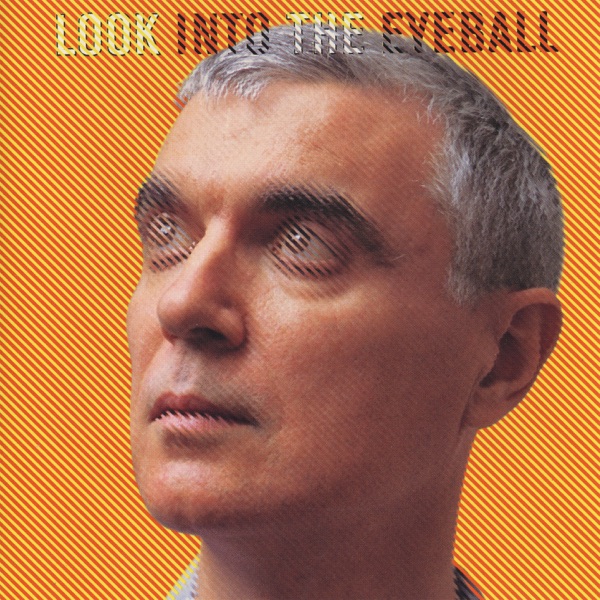
Look Into the Eyeball
2001 · 12 tracks
- 1 U.B. Jesus ↗ 3:50
- 2 The Revolution ↗ 2:15
- 3 The Great Intoxication ↗ 2:37
- 4 Like Humans Do ↗ 3:32
- 5 Broken Things ↗ 4:30
- 6 The Accident ↗ 2:35
- 7 Desconocido Soy (feat. Café Tacvba & NRU) ↗ 2:40
- 8 Neighborhood ↗ 4:32
- 9 Smile ↗ 3:34
- 10 The Moment of Conception ↗ 2:57
- 11 Walk on Water ↗ 3:26
- 12 Everyone's in Love with You ↗ 2:29

Lead Us Not Into Temptation
2003 · 15 tracks
- 1 Body in a River ↗ 2:53
- 2 Mnemonic Discordance ↗ 2:43
- 3 Seaside Smokes ↗ 3:08
- 4 Canal Life ↗ 2:28
- 5 Locks & Barges ↗ 2:01
- 6 Haitian Fight Song ↗ 2:50
- 7 Sex on the Docks ↗ 4:26
- 8 Inexorable ↗ 2:20
- 9 Warm Sheets ↗ 3:02
- 10 Dirty Hair ↗ 4:49
- 11 Bastard ↗ 2:58
- 12 The Lodger ↗ 4:16
- 13 Ineluctable ↗ 4:20
- 14 Speechless ↗ 4:05
- 15 The Great Western Road ↗ 4:45

Grown Backwards
2004 · 15 tracks
- 1 Glass, Concrete and Stone ↗ 4:14
- 2 The Man Who Loved Beer ↗ 2:41
- 3 Au Fond du Temple Saint ↗ 4:50
- 4 Empire ↗ 4:13
- 5 Tiny Apocalypse ↗ 4:03
- 6 She Only Sleeps ↗ 2:59
- 7 Dialog Box ↗ 3:32
- 8 The Other Side of This Life ↗ 4:01
- 9 Why ↗ 2:56
- 10 Pirates ↗ 3:53
- 11 Civilization ↗ 3:17
- 12 Astronaut ↗ 2:56
- 13 Glad ↗ 1:58
- 14 Un Di Felice, Eterea ↗ 2:52
- 15 Lazy ↗ 9:37

Everything That Happens Will Happen Today
2008 · 11 tracks

Here Lies Love
2010 · 22 tracks
- 1 Here Lies Love (feat. Florence Welch) ↗ 5:51
- 1 Dancing Together (feat. Sharon Jones) ↗ 3:53
- 2 Every Drop of Rain ↗ 5:34
- 2 Men Will Do Anything (feat. Alice Russell) ↗ 4:06
- 3 You'll Be Taken Care of (feat. Tori Amos) ↗ 3:20
- 3 The Whole Man (feat. Kate Pierson) ↗ 4:15
- 4 The Rose of Tacloban (feat. Martha Wainwright) ↗ 2:33
- 4 Never So Big (feat. Sia) ↗ 4:00
- 5 How Are You? (feat. Nellie McKay) ↗ 2:43
- 5 Please Don't (feat. Santigold) ↗ 3:59
- 6 A Perfect Hand (feat. Steve Earle) ↗ 4:58
- 6 American Troglodyte ↗ 4:07
- 7 Eleven Days (feat. Cyndi Lauper) ↗ 2:44
- 7 Solano Avenue (feat. Nicole Atkins) ↗ 3:56
- 8 When She Passed By (feat. Allison Moorer) ↗ 3:50
- 8 Order 1081 (feat. Natalie Merchant) ↗ 5:47
- 9 Walk Like a Woman (feat. Charmaine Clamor) ↗ 3:59
- 9 Seven Years (feat. Shara Nova) ↗ 5:40
- 10 Don't You Agree? ↗ 3:20
- 10 Why Don't You Love Me? (feat. Tori Amos) ↗ 3:58
- 11 Pretty Face (feat. Camille) ↗ 3:23
- 12 Ladies In Blue (feat. Theresa Andersson) ↗ 4:21
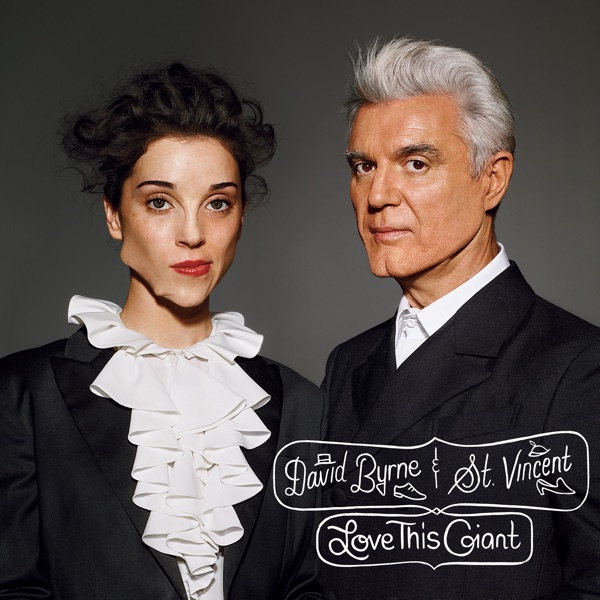
Love This Giant
2012 · 12 tracks

American Utopia
2018 · 10 tracks

Who Is the Sky?
2025 · 13 tracks
- 1 Everybody Laughs ↗ 3:48
- 2 When We Are Singing ↗ 3:24
- 3 My Apartment Is My Friend ↗ 3:03
- 4 A Door Called No ↗ 2:35
- 5 What Is The Reason For It? (feat. Hayley Williams) ↗ 3:11
- 6 I Met The Buddha at a Downtown Party ↗ 3:14
- 7 Don't Be Like That ↗ 3:01
- 8 The Avant Garde ↗ 3:42
- 9 Moisturizing Thing ↗ 2:42
- 10 I'm an Outsider ↗ 3:32
- 11 She Explains Things To Me ↗ 2:19
- 12 The Truth ↗ 3:02
- 13 DefCon ↗ 1:16
-
 My Life in the Bush of GhostsDavid Byrne198018 tracks
 - My Life in the Bush of GhostsDavid Byrne198118 tracks
-
 Rei MomoDavid Byrne198915 tracks
 -
 The ForestDavid Byrne199110 tracks
 -
 Uh‐ohDavid Byrne199212 tracks
 -
 David ByrneDavid Byrne199412 tracks
 -
 FeelingsDavid Byrne199713 tracks
 -
 Look Into the EyeballDavid Byrne200112 tracks
 -
 Lead Us Not Into TemptationDavid Byrne200315 tracks
 -
 Grown BackwardsDavid Byrne200415 tracks
 -
 Everything That Happens Will Happen TodayDavid Byrne200811 tracks
 -
 Here Lies LoveDavid Byrne201022 tracks
 -
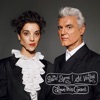 Love This GiantDavid Byrne201212 tracks
 -
 American UtopiaDavid Byrne201810 tracks
 -
 Who Is the Sky?David Byrne202513 tracks
Deep Dive
Overview
David Byrne stands as one of rock’s most restlessly intellectual voices. Born in 1952, he emerged as the founding member, principal songwriter, lead vocalist, and guitarist of Talking Heads, the New Wave institution that dominated the late 1970s and 1980s. Yet his solo career—spanning from 1980 to the present—reveals an artist equally committed to boundary dissolution: collaborations across continents, genre-defying production, visual art, film direction, and written essays that position music within broader cultural and social frameworks. His work both within and outside Talking Heads altered what rock music could be.
Formation Story
Byrne was born in Scotland in 1952 but grew up primarily in the Baltimore and Philadelphia area, absorbing the diverse sonic landscapes of the American East Coast. By the mid-1970s, he had gravitated toward New York’s Lower Manhattan, where the CBGB scene was incubating punk and its immediate offshoots. Talking Heads crystallized from this ferment: Byrne alongside bassist Tina Weymouth and drummer Chris Frantz formed the core, later expanded by guitarist Jerry Harrison. The band’s sensibility—angular, rhythmically sophisticated, art-school minded—separated them from punk’s three-chord orthodoxy even as they shared its energy and anti-establishment ethos. They became the thinking person’s rock band, marrying post-punk intensity with funk-influenced grooves and lyrics concerned with anxiety, observation, and the machinery of everyday life.
Breakthrough Moment
Talking Heads’ breakthrough arrived with their second album, More Songs About Buildings and Food (1978), but their international commercial dominance crystallized with Remain in Light (1980), a landmark collaboration with producer Brian Eno that fused New Wave structures with Afrobeat influences and studio experimentation. That same year, Byrne released his first solo work, My Life in the Bush of Ghosts, again with Eno, an instrumental-heavy exploration featuring layered vocal samples and world music textures. The album signaled that Byrne’s interests extended far beyond the rock-band format. While Talking Heads continued to record and tour—achieving their greatest mainstream success with Speaking in Tongues (1983) and its attendant David Byrne-directed film Stop Making Sense (1984)—Byrne’s solo catalog began to establish him as an artist unwilling to repeat formulas.
Peak Era
The period from the mid-1980s through the early 1990s marked Byrne’s most creatively prolific stretch across both his solo work and Talking Heads. Music for The Knee Plays (1985) and Rei Momo (1989) saw him deepening his engagement with non-Western music, Latin rhythms, and studio production as an instrument itself. Uh-oh (1992) continued this eclectic approach, while David Byrne (1994) showcased a more refined, pop-leaning sensibility. Simultaneously, Talking Heads remained active, though the band’s internal dynamics and diverging interests would eventually lead to their initial dissolution in the early 1990s. Byrne’s willingness to pursue multiple creative directions—soundtrack work, production, songwriting partnerships—during this window established the template for his entire subsequent career: the artist as perpetual explorer rather than brand custodian.
Musical Style
Byrne’s vocal delivery—precise, slightly detached, prone to rapid-fire observation—anchors his music even as his instrumental palettes shift dramatically. His guitar playing, though sometimes understated, carries an angular precision inherited from art-rock and post-punk traditions. What unifies his solo output is a deep curiosity about rhythm, particularly the intersection of Western pop structures with African, Caribbean, Brazilian, and Indian musical traditions. Unlike rock musicians who merely sample or tourists who dabble, Byrne’s engagement appears structural: he absorbs polyrhythmic complexity, call-and-response vocal patterns, and non-Western harmonic sensibilities into his songwriting and production choices. His lyrics maintain a characteristic blend of social observation, vulnerability, and intellectual distance. Partnered repeatedly with Brian Eno in the 1980s and working with producers like Flood and others across subsequent decades, Byrne has become increasingly comfortable with studio experimentation—layering, looping, and textural density—that can obscure traditional song structures while foregrounding atmosphere and groove.
Major Albums
My Life in the Bush of Ghosts (1980–1981)
Byrne’s first solo statement, crafted with producer Brian Eno, introduced his vision of art-pop as a laboratory for global sounds, vocal samples, and avant-garde production—establishing a template he would revisit throughout his solo career.
Rei Momo (1989)
A full-band collaboration reflecting Byrne’s deepening interest in Latin and African rhythms, Rei Momo merged English-language songwriting with Brazilian percussion and Caribbean influences.
David Byrne (1994)
A more streamlined and pop-accessible solo album that balanced his experimental impulses with stronger melodies and clearer vocal prominence, representing a consolidation of his mid-period style.
Look Into the Eyeball (2001)
A return to exploratory production and conceptual ambition, this album married electronic textures with world-music influences and featured collaborations that expanded Byrne’s sonic palette further.
American Utopia (2018)
Released after a lengthy hiatus from solo recording, American Utopia merged his longstanding interest in rhythm and global influences with contemporary production, reasserting Byrne’s relevance and earning widespread critical reappraisal.
Signature Songs
- “Once in a Lifetime” — Perhaps Talking Heads’ most iconic song, its minimalist groove and Byrne’s neurotic vocal mantra became a touchstone for new wave itself.
- “Burning Down the House” — A co-write with Talking Heads that exemplified the band’s knack for turning anxiety into infectious energy.
- “Road to Nowhere” — A later Talking Heads anthem capturing existential drift with an irresistible rhythmic pulse.
- “Dreamworld” — From My Life in the Bush of Ghosts, an early solo track showcasing Byrne’s production experiments and atmospheric ambitions.
Influence on Rock
Byrne’s impact extends well beyond his songwriting and vocal presence. He demonstrated that a rock musician could remain intellectually ambitious while pursuing commercial success, that New Wave could engage world music without appropriation, and that the rock-band format was just one tool in a larger artistic toolkit. His intellectual rigor—evident in his visual direction, his film work, and his written essays on culture and technology—elevated rock musicians’ aspirations beyond the conventional boundaries of albums and tours. He influenced generations of alternative and indie rock artists who similarly rejected genre purity and embraced conceptual ambition. Producers and musicians across alternative, post-punk revival, and electronic music have traced lineage through his work with Eno and his later genre-fluid collaborations.
Legacy
Talking Heads’ reunion performances in the 2000s and subsequent dissolution again proved that Byrne’s primary commitment remained artistic exploration over nostalgia cycles. His solo discography, spanning from 1980 to 2025, documents an artist in constant motion: never satisfied with repetition, always pursuing new collaborators, production techniques, and cultural influences. American Utopia (2018) and its accompanying book and stage production demonstrated that Byrne remained capable of major artistic statements even as streaming and social media reshaped music consumption. His solo work has maintained consistent critical respect and moderate commercial visibility, particularly among listeners interested in experimental pop and world-music fusion. Talking Heads’ induction into the Rock and Roll Hall of Fame in 2002 acknowledged their foundational importance to new wave and post-punk. Byrne’s ongoing creative output—including Who Is the Sky? (2025)—confirms him as one of rock’s few elder statesmen still producing original work rather than managing legacy.
Fun Facts
- Byrne directed the concert film Stop Making Sense (1984), often considered one of the finest live-music documentaries ever made, capturing Talking Heads at their peak with innovative staging and visual composition.
- In addition to music, Byrne has worked as a filmmaker and visual artist, with his interests spanning architecture, urban planning, and technology—preoccupations that inform his music and written work.
- His label Luaka Bop, founded in the 1990s, served as a vehicle for releasing world-music discoveries and collaborative projects, reflecting his commitment to cultural exchange beyond his own recordings.
- Byrne has authored several books examining music, culture, and society, positioning himself as a cultural critic and intellectual, not merely a musician.