
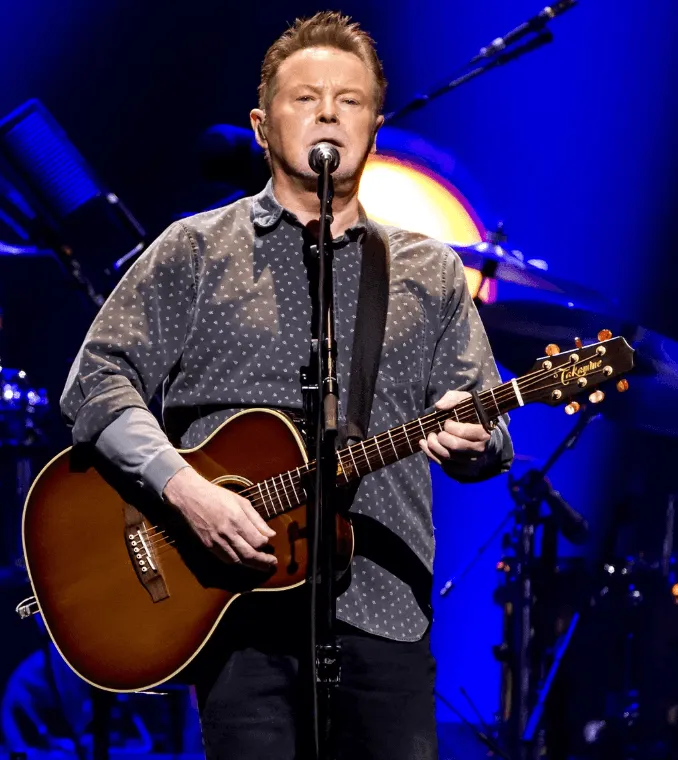
Photo by Derek Russell , licensed under CC BY-SA 2.0 · Wikimedia Commons
Rank #267
Don Henley
From Wikipedia
Donald Hugh Henley is an American singer, songwriter and musician. Henley is a founding member of the Eagles, serving as a songwriter, drummer, and vocalist for the band. He sang lead vocals on Eagles songs such as "Witchy Woman", "Desperado", "Best of My Love", "One of These Nights", "Hotel California", "Life in the Fast Lane", and "The Long Run". The Eagles disbanded in 1980, but reunited in 1994.
Discography & Previews
Browse through and click an album to open and play 30-second previews streamed from Apple Music.

I Can’t Stand Still
1982 · 11 tracks
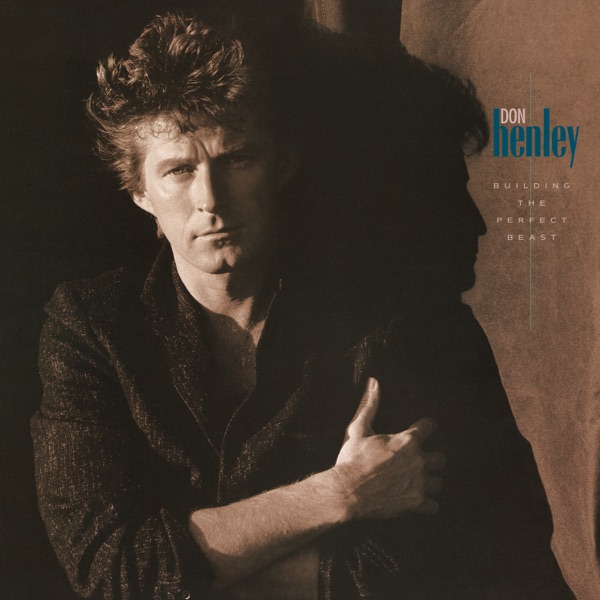
Building the Perfect Beast
1984 · 11 tracks
- 1 The Boys Of Summer (Remastered 2024) ↗ 4:50
- 2 You Can't Make Love (Remastered 2024) ↗ 3:33
- 3 Man With A Mission (Remastered 2024) ↗ 2:45
- 4 You're Not Drinking Enough (Remastered 2024) ↗ 4:40
- 5 Not Enough Love In The World (Remastered 2024) ↗ 3:56
- 6 Building The Perfect Beast (Remastered 2024) ↗ 5:01
- 7 All She Wants To Do Is Dance (Remastered 2024) ↗ 4:30
- 8 A Month Of Sundays (Remastered 2024) ↗ 4:30
- 9 Sunset Grill (Remastered 2024) ↗ 6:19
- 10 Drivin' With Your Eyes Closed (Remastered 2024) ↗ 3:37
- 11 Land Of The Living (Remastered 2024) ↗ 3:24

The End of the Innocence
1989 · 10 tracks
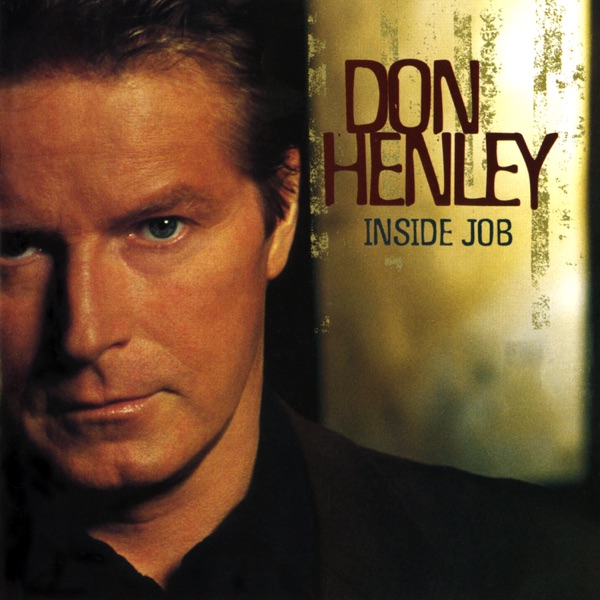
Inside Job
2000 · 13 tracks
- 1 Nobody Else in the World but You ↗ 4:51
- 2 Taking You Home ↗ 5:32
- 3 For My Wedding ↗ 3:37
- 4 Everything Is Different Now ↗ 5:13
- 5 Workin' It ↗ 5:38
- 6 Goodbye to a River ↗ 5:50
- 7 Inside Job ↗ 4:50
- 8 They're Not Here, They're Not Coming ↗ 6:00
- 9 Damn It, Rose ↗ 7:13
- 10 Miss Ghost ↗ 6:42
- 11 The Genie ↗ 5:45
- 12 Annabel ↗ 3:42
- 13 My Thanksgiving ↗ 5:10

Cass County
2015 · 12 tracks
- 1 Bramble Rose ↗ 4:30
- 2 The Cost of Living ↗ 3:40
- 3 Take a Picture of This ↗ 4:07
- 4 Waiting Tables ↗ 4:48
- 5 No, Thank You ↗ 3:45
- 6 Praying for Rain ↗ 5:01
- 7 Words Can Break Your Heart ↗ 3:40
- 8 That Old Flame ↗ 4:26
- 9 When I Stop Dreaming ↗ 3:06
- 10 A Younger Man ↗ 4:21
- 11 Train in the Distance ↗ 4:47
- 12 Where I Am Now ↗ 2:35
-
 I Can’t Stand StillDon Henley198211 tracks
 -
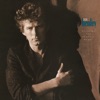 Building the Perfect BeastDon Henley198411 tracks
 -
 The End of the InnocenceDon Henley198910 tracks
 -
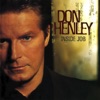 Inside JobDon Henley200013 tracks
 -
 Cass CountyDon Henley201512 tracks
Deep Dive
Overview
Don Henley stands as one of the defining voices of classic rock, first as a founding member and primary creative force within the Eagles, then as a solo artist who maintained commercial and critical relevance across multiple decades. Born in 1947, Henley emerged from the 1970s California rock scene as a skilled multi-instrumentalist and songwriter whose work shaped the sound of country-rock and arena rock during their commercial peak. His career arc—from drummer and vocalist in one of rock’s best-selling bands to independent recording artist—demonstrates the durability of his songwriting craft and his ability to evolve beyond a single project.
Formation Story
Don Henley was born in 1947 and came of age during the rise of rock and country-influenced American music in the 1960s. He gravitated toward the Los Angeles music scene of the early 1970s, where country-rock fusion was emerging as a dominant force. In 1971, Henley co-founded the Eagles alongside Glenn Frey, Bernie Leadon, and Randy Meisner. The band synthesized country instrumentation and songwriting sensibilities with rock energy and pop accessibility, drawing on the California country-rock tradition established by artists like the Flying Burrito Brothers and Gram Parsons. Henley served as drummer, vocalist, and songwriter from the group’s inception, roles that positioned him as a central architectural voice within the band’s sound and output.
Breakthrough Moment
The Eagles’ 1976 album Hotel California became a landmark moment not only for Henley but for the entire genre. The title track, on which Henley sang lead vocal, became one of rock music’s defining songs—a dark, introspective meditation wrapped in pristine production and layered guitar work. The album itself achieved enormous commercial success and cultural penetration, cementing the Eagles as rock’s preeminent act of the mid-1970s. Henley’s vocal delivery and his prominent songwriting contributions to tracks like “Life in the Fast Lane” established him as the creative equal of his bandmates and a major voice in American rock. By the time of Hotel California, Henley had already sung lead on multiple Eagles hits including “Witchy Woman,” “Desperado,” “Best of My Love,” and “One of These Nights,” making him the band’s primary vocalist and public face.
Peak Era
The Eagles’ commercial and creative zenith spanned the mid-to-late 1970s, from their 1975 self-titled debut through the 1979 album The Long Run. During this five-year window, the band dominated rock radio, sold millions of albums, and defined the sound of American rock for a generation. Henley’s role expanded across this period; he moved from sharing vocal duties to anchoring much of the band’s output, while his songwriting became increasingly sophisticated and introspective. The Eagles disbanded in 1980, a dissolution that reflected both internal creative tensions and the shifting cultural landscape of rock music. Henley emerged from the breakup with considerable leverage as both a known quantity and a proven hitmaker, positioning him for a solo career that would begin almost immediately.
Musical Style
Henley’s musical identity, both within the Eagles and as a solo artist, drew from country-rock roots while incorporating pop sensibility and increasingly introspective lyrical content. His voice—warm, expressive, and capable of both gentleness and urgency—became the Eagles’ primary vehicle for emotional communication. As a songwriter, Henley favored character-driven narratives and observations of American life, often with a melancholic or skeptical edge. Within the Eagles, he wrote or co-wrote many of the band’s most enduring songs, including the aforementioned “Hotel California,” which exemplified his gift for wrapping dark subject matter in appealing melodic and harmonic frameworks. His solo work maintained these threads while incorporating influences from 1980s production aesthetics and contemporary rock trends, though the core elements—narrative songwriting, sophisticated arrangements, and pop-accessible melody—remained constant throughout his career.
Major Albums
I Can’t Stand Still (1982)
Henley’s solo debut announced his intent to succeed as a solo act with a blend of rock sophistication and radio-friendly production, establishing the template for his independent recording career.
Building the Perfect Beast (1984)
His second solo album deepened both his commercial and creative ambitions, demonstrating that his success was not dependent on the Eagles framework.
The End of the Innocence (1989)
Released nine years into his solo career, this album represented a creative peak for Henley, combining his narrative gifts with contemporary production and musicianship.
Cass County (2015)
Decades into his solo career, this album saw Henley returning to country-music roots with collaborations and a more stripped-down approach than his 1980s work.
Signature Songs
- “Hotel California” (1976) — The Eagles’ masterpiece and one of rock’s greatest achievements, featuring Henley on lead vocal and co-writing credits.
- “Life in the Fast Lane” (1976) — A hard-rocking Eagles staple that showcased Henley’s ability to deliver both vocally and lyrically within high-energy arrangements.
- “Desperado” (1973) — An Eagles classic demonstrating Henley’s emotional range and the band’s country-rock sophistication.
- “The Long Run” (1979) — The title track from the Eagles’ final album before their initial breakup, with Henley’s lead vocal anchoring its ambitious arrangement.
- “Best of My Love” (1974) — An early Eagles hit that established Henley’s vocal prominence and the band’s pop-rock accessibility.
Influence on Rock
Don Henley’s influence on rock music operates on multiple levels. As a member of the Eagles, he helped define the sound and commercial model of arena rock and country-rock fusion in the 1970s, a template that influenced countless bands in subsequent decades. The Eagles’ success demonstrated that rock music could achieve both critical respect and massive commercial returns; their albums and songs became touchstones of FM radio programming and popular culture. As a solo artist, Henley proved that membership in a supergroup did not preclude sustained individual success—a lesson that validated the mid-1980s trend of superstars launching solo careers while maintaining band affiliations. His songwriting approach, emphasizing narrative and emotional specificity over generic rock posturing, influenced songwriters who valued craft and storytelling in the rock idiom.
Legacy
Don Henley’s legacy rests primarily on his work with the Eagles, whose reunion in 1994 demonstrated the enduring power of their catalog and the demand for their live performances. The Eagles’ albums remain among the best-selling rock records of all time, and songs like “Hotel California” have achieved canonical status in rock music. Henley’s solo career, while less commercially dominant than his Eagles work, established him as a credible independent artist and proved his worth as a standalone figure rather than merely a member of a larger ensemble. His willingness to reunite the Eagles after fourteen years of separation demonstrated flexibility and an understanding of legacy; subsequent Eagles tours have become among rock music’s most profitable live endeavors. Henley has remained active as a recording and touring artist well into the 2010s, maintaining his catalog through streaming platforms and continuing to perform both solo material and Eagles songs to audiences that span multiple generations.
Fun Facts
- Henley served as drummer for the Eagles before moving increasingly toward vocal and songwriting roles, a transition that reflected his evolving creative ambitions within the band.
- The Eagles’ 1980 breakup remained one of rock’s most famous band dissolutions until their surprise reunion tour in 1994, which redefined the possibilities of reunion tours in rock music economics.
- Henley has recorded for Asylum Records throughout his career, maintaining a stable label relationship across his Eagles and solo work.
- His 2015 album Cass County marked a deliberate return to country-music influences after decades of rock-focused solo work, suggesting a late-career revisiting of the genre foundations that shaped his earliest work.