
Photo by Metro-Goldwyn-Mayer, Inc. Reproduction Number: LC-USZ6-2067 Location: NYWTS -- BIOG , licensed under Public domain · Wikimedia Commons
Rank #13
Elvis Presley
From Wikipedia
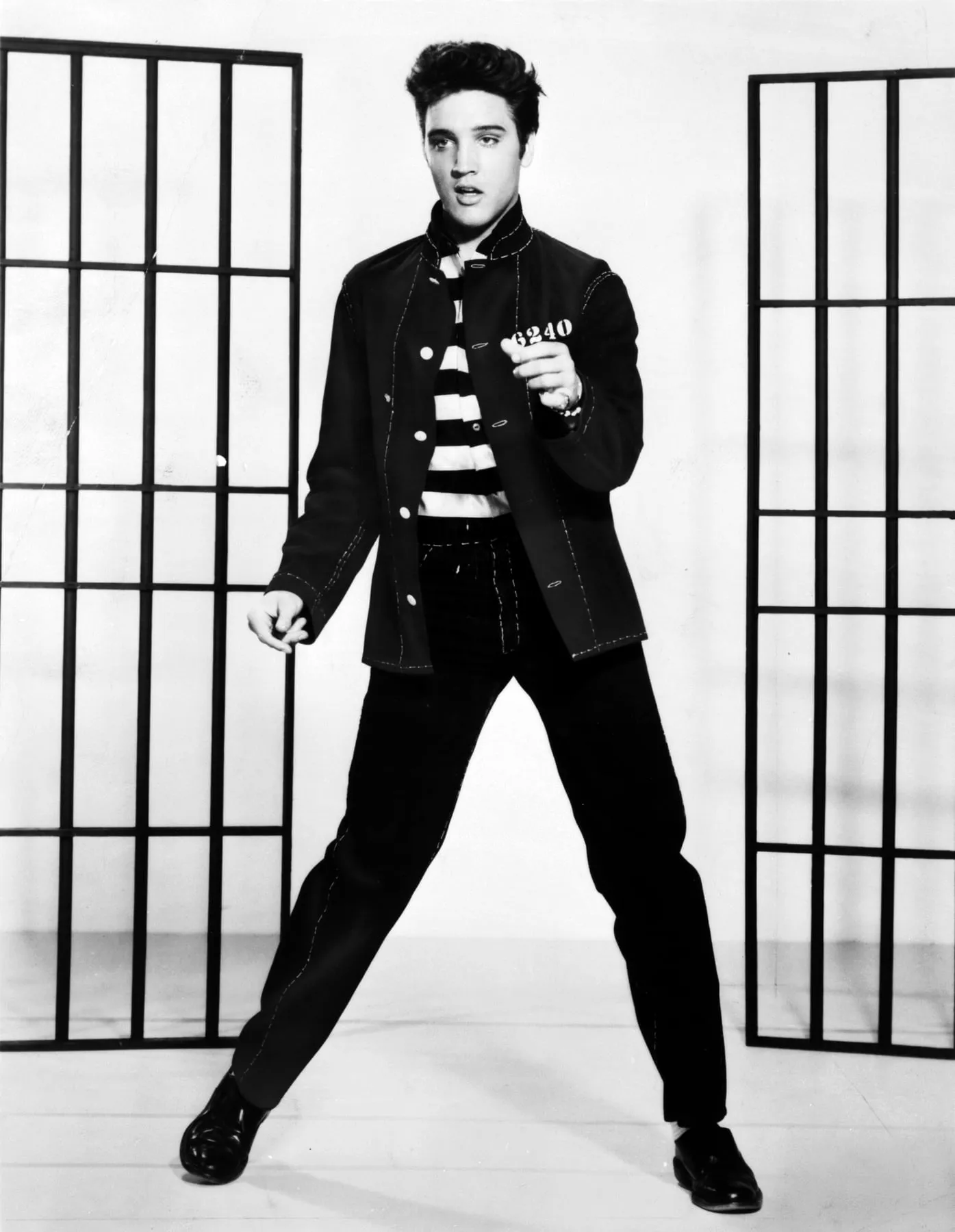
Elvis Aaron Presley was an American singer and actor. Referred to as the "King of Rock and Roll", he is widely regarded as one of the most culturally significant figures of the 20th century. Presley's energetic and sexually provocative performance style, combined with a mix of influences across color lines during a transformative era in race relations, brought both great success and initial controversy.
Discography & Previews
Browse through and click an album to open and play 30-second previews streamed from Apple Music.

Elvis Presley
1956 · 12 tracks
- 1 Blue Suede Shoes ↗ 2:02
- 2 I'm Counting On You ↗ 2:26
- 3 I Got a Woman ↗ 2:27
- 4 One-Sided Love Affair ↗ 2:12
- 5 I Love You Because ↗ 2:43
- 6 Just Because ↗ 2:34
- 7 Tutti Frutti ↗ 2:00
- 8 Trying to Get to You ↗ 2:33
- 9 I'm Gonna Sit Right Down and Cry (Over You) ↗ 2:06
- 10 I'll Never Let You Go (Little Darlin') ↗ 2:26
- 11 Blue Moon ↗ 2:45
- 12 Money Honey ↗ 2:35

Elvis
1956 · 12 tracks
- 1 Rip It Up ↗ 1:55
- 2 Love Me ↗ 2:47
- 3 When My Blue Moon Turns to Gold Again ↗ 2:24
- 4 Long Tall Sally ↗ 1:55
- 5 First In Line ↗ 3:25
- 6 Paralyzed ↗ 2:27
- 7 So Glad You're Mine ↗ 2:23
- 8 Old Shep ↗ 4:12
- 9 Ready Teddy ↗ 1:58
- 10 Anyplace Is Paradise ↗ 2:28
- 11 How's the World Treating You ↗ 2:27
- 12 How Do You Think I Feel ↗ 2:10
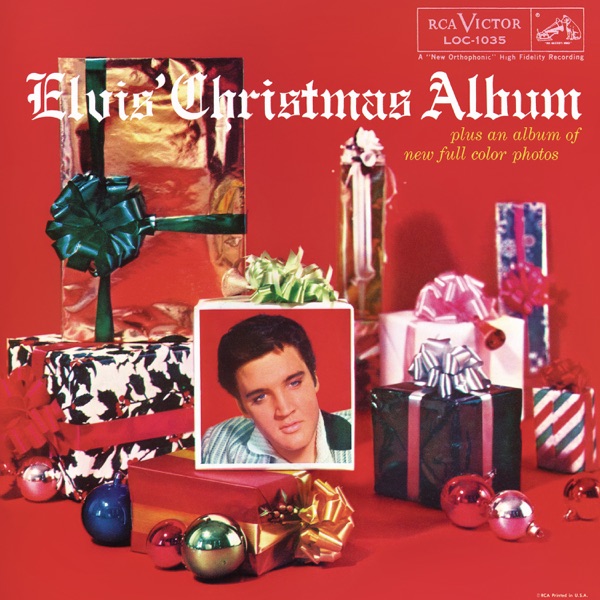
Elvis’ Christmas Album
1957 · 12 tracks
- 1 Santa Claus Is Back In Town ↗ 2:26
- 2 White Christmas ↗ 2:26
- 3 Here Comes Santa Claus (Right Down Santa Claus Lane) ↗ 1:58
- 4 I'll Be Home for Christmas ↗ 1:56
- 5 Blue Christmas ↗ 2:10
- 6 Santa Bring My Baby Back (To Me) ↗ 1:55
- 7 O Little Town of Bethlehem ↗ 2:39
- 8 Silent Night ↗ 2:27
- 9 (There'll Be) Peace In the Valley (For Me) ↗ 3:24
- 10 I Believe ↗ 2:07
- 11 Take My Hand, Precious Lord ↗ 3:20
- 12 It Is No Secret (What God Can Do) ↗ 3:54

Elvis Is Back!
1960 · 12 tracks
- 1 Make Me Know It ↗ 2:02
- 2 Fever ↗ 3:35
- 3 The Girl of My Best Friend ↗ 2:26
- 4 I Will Be Home Again ↗ 2:37
- 5 Dirty, Dirty Feeling ↗ 1:37
- 6 Thrill of Your Love ↗ 3:03
- 7 Soldier Boy ↗ 3:07
- 8 Such a Night ↗ 3:02
- 9 It Feels So Right ↗ 2:12
- 10 The Girl Next Door Went a'Walking ↗ 2:16
- 11 Like a Baby ↗ 2:42
- 12 Reconsider Baby ↗ 3:39
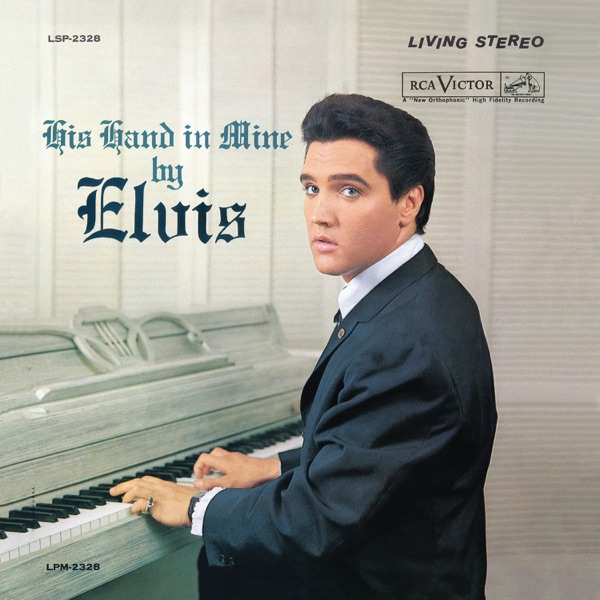
His Hand in Mine
1960 · 12 tracks
- 1 His Hand In Mine ↗ 3:18
- 2 I'm Gonna Walk Dem Golden Stairs ↗ 1:53
- 3 In My Father's House ↗ 2:06
- 4 Milky White Way ↗ 2:16
- 5 Known Only to Him ↗ 2:09
- 6 I Believe In the Man In the Sky ↗ 2:13
- 7 Joshua Fit the Battle ↗ 2:40
- 8 He Knows Just What I Need ↗ 2:13
- 9 Swing Down Sweet Chariot ↗ 2:34
- 10 Mansion Over the Hilltop ↗ 2:58
- 11 If We Never Meet Again ↗ 2:00
- 12 Working On the Building ↗ 1:52

Something for Everybody
1961 · 12 tracks

Pot Luck
1962 · 12 tracks
- 1 Kiss Me Quick ↗ 2:49
- 2 Just for Old Time Sake ↗ 2:11
- 3 Gonna Get Back Home Somehow ↗ 2:32
- 4 (Such An) Easy Question ↗ 2:23
- 5 Steppin' Out of Line ↗ 1:56
- 6 I'm Yours ↗ 2:23
- 7 Something Blue ↗ 3:01
- 8 Suspicion ↗ 2:37
- 9 I Feel That I've Known You Forever ↗ 1:43
- 10 Night Rider ↗ 2:12
- 11 Fountain of Love ↗ 2:19
- 12 That's Someone You Never Forget ↗ 2:48

Elvis for Everyone!
1965 · 12 tracks
- 1 Your Cheatin' Heart ↗ 2:28
- 2 Summer Kisses, Winter Tears ↗ 2:22
- 3 Finders Keepers, Losers Weepers ↗ 1:54
- 4 In My Way ↗ 1:26
- 5 Tomorrow Night ↗ 2:56
- 6 Memphis, Tennessee ↗ 2:13
- 7 For the Millionth and the Last Time ↗ 2:10
- 8 Forget Me Never ↗ 1:39
- 9 Sound Advice ↗ 1:49
- 10 Santa Lucia (From "Viva Las Vegas") ↗ 1:14
- 11 I Met Her Today ↗ 2:44
- 12 When It Rains, It Really Pours ↗ 1:50
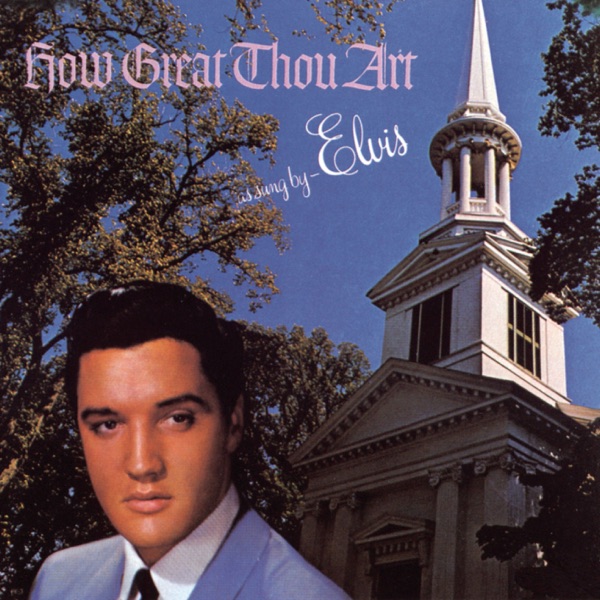
How Great Thou Art
1967 · 12 tracks
- 1 How Great Thou Art ↗ 3:03
- 2 In the Garden ↗ 3:12
- 3 Somebody Bigger Than You and I ↗ 2:28
- 4 Farther Along ↗ 4:07
- 5 Stand By Me ↗ 2:29
- 6 Without Him ↗ 2:30
- 7 So High ↗ 1:58
- 9 By and By ↗ 1:53
- 10 If the Lord Wasn't Walking By My Side ↗ 1:39
- 11 Run On ↗ 2:24
- 12 Where No One Stands Alone ↗ 2:45
- 13 Crying In the Chapel ↗ 2:27

From Elvis in Memphis
1969 · 16 tracks
- 1 Wearin' That Loved On Look ↗ 2:48
- 2 Only the Strong Survive ↗ 2:45
- 3 I'll Hold You In My Heart (Till I Can Hold You In My Arms) ↗ 4:35
- 4 Long Black Limousine ↗ 3:45
- 5 It Keeps Right On A-Hurtin' ↗ 2:40
- 6 I'm Movin' On ↗ 2:56
- 7 Power of My Love ↗ 2:41
- 8 Gentle On My Mind ↗ 3:26
- 9 After Loving You ↗ 3:08
- 10 True Love Travels On a Gravel Road ↗ 2:42
- 11 Any Day Now ↗ 3:04
- 12 In the Ghetto ↗ 2:48
- 13 Suspicious Minds ↗ 4:23
- 14 Don't Cry Daddy ↗ 2:49
- 15 Kentucky Rain ↗ 3:17
- 16 Mama Liked the Roses ↗ 2:39
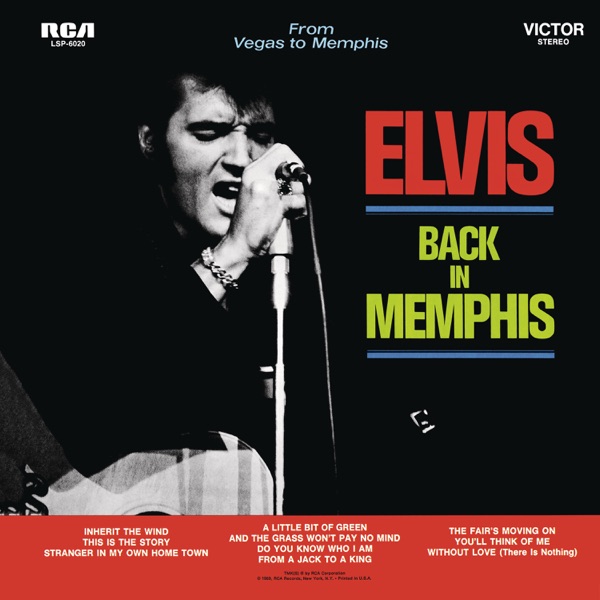
Back in Memphis
1969 · 10 tracks
- 1 Inherit the Wind ↗ 3:00
- 2 This Is the Story ↗ 2:32
- 3 Stranger In My Own Home Town ↗ 4:28
- 4 A Little Bit of Green ↗ 3:26
- 5 And the Grass Won't Pay No Mind ↗ 3:13
- 6 Do You Know Who I Am ↗ 2:52
- 7 From a Jack to a King ↗ 2:28
- 8 The Fair's Moving On ↗ 3:13
- 9 You'll Think of Me ↗ 4:04
- 10 Without Love (There Is Nothing) ↗ 2:53

That’s the Way It Is
1970 · 14 tracks
- 1 I Just Can't Help Believin' (Live) ↗ 4:40
- 2 Twenty Days and Twenty Nights ↗ 3:17
- 3 How the Web Was Woven ↗ 3:25
- 4 Patch It Up ↗ 4:01
- 5 Mary In the Morning ↗ 4:11
- 6 You Don't Have to Say You Love Me ↗ 2:31
- 7 You've Lost That Lovin' Feelin' (Live) ↗ 4:24
- 8 I've Lost You (Live) ↗ 3:41
- 9 Just Pretend ↗ 4:06
- 10 Stranger In the Crowd ↗ 3:48
- 11 The Next Step Is Love ↗ 3:33
- 12 Bridge Over Troubled Water ↗ 4:37
- 13 I've Lost You (Single Version) ↗ 3:33
- 14 Patch It Up (Single Version) ↗ 3:10

Elvis Sings the Wonderful World of Christmas
1971 · 12 tracks
- 1 O Come, All Ye Faithful ↗ 2:51
- 2 The First Noel ↗ 2:14
- 3 On a Snowy Christmas Night ↗ 2:52
- 4 Winter Wonderland ↗ 2:21
- 5 The Wonderful World of Christmas ↗ 2:00
- 6 It Won't Seem Like Christmas (Without You) ↗ 2:44
- 7 I'll Be Home On Christmas Day ↗ 3:51
- 8 If I Get Home On Christmas Day ↗ 2:55
- 9 Holly Leaves and Christmas Trees ↗ 2:16
- 10 Merry Christmas Baby ↗ 5:47
- 11 Silver Bells ↗ 2:30
- 12 If Every Day Was Like Christmas ↗ 2:53

Love Letters From Elvis
1971 · 14 tracks
- 1 Love Letters ↗ 2:55
- 2 When I'm Over You ↗ 2:30
- 3 If I Were You ↗ 3:03
- 4 Got My Mojo Working / Keep Your Hands Off of It ↗ 4:39
- 5 Heart of Rome ↗ 2:59
- 6 Only Believe ↗ 2:52
- 7 This Is Our Dance ↗ 3:17
- 8 Cindy, Cindy ↗ 2:35
- 9 I'll Never Know ↗ 2:28
- 10 It Ain't No Big Thing (But It's Growing) ↗ 2:50
- 11 Life ↗ 3:13
- 12 The Sound of Your Cry ↗ 3:18
- 13 Where Did They Go, Lord ↗ 2:30
- 14 Rags to Riches ↗ 1:56

Elvis Now
1972 · 13 tracks
- 1 Help Me Make It Through the Night ↗ 2:51
- 2 Miracle of the Rosary ↗ 1:54
- 3 Hey Jude ↗ 4:36
- 4 Put Your Hand In the Hand ↗ 3:19
- 5 Until It's Time for You to Go ↗ 4:02
- 6 We Can Make the Morning ↗ 3:58
- 7 Early Mornin' Rain (with The Nashville Edition) ↗ 3:00
- 8 Sylvia ↗ 3:20
- 9 Fools Rush In (Where Angels Fear to Tread) ↗ 2:46
- 10 I Was Born About Ten Thousand Years Ago ↗ 3:19
- 11 I'm Leavin' ↗ 3:52
- 12 It's Only Love ↗ 2:40
- 13 The First Time Ever I Saw Your Face ↗ 3:43

He Touched Me
1972 · 12 tracks
- 1 He Touched Me ↗ 2:40
- 2 I've Got Confidence ↗ 2:23
- 3 Amazing Grace ↗ 3:36
- 4 Seeing Is Believing ↗ 2:55
- 5 He Is My Everything ↗ 2:42
- 6 Bosom of Abraham ↗ 1:38
- 7 An Evening Prayer ↗ 1:57
- 8 Lead Me, Guide Me ↗ 2:43
- 9 There Is No God But God ↗ 2:21
- 10 A Thing Called Love ↗ 2:27
- 11 I, John ↗ 2:18
- 12 Reach Out to Jesus ↗ 3:15

Elvis
1973 · 16 tracks
- 1 Fool ↗ 2:45
- 2 Where Do I Go from Here ↗ 2:42
- 3 Love Me, Love the Life I Lead ↗ 3:05
- 4 It's Still Here ↗ 2:06
- 5 It's Impossible ↗ 2:53
- 6 (That's What You Get) For Lovin' Me ↗ 2:11
- 7 Padre ↗ 2:30
- 8 I'll Take You Home Again, Kathleen ↗ 2:28
- 9 I Will Be True ↗ 2:32
- 10 Don't Think Twice, It's All Right ↗ 2:45
- 11 Separate Ways ↗ 2:37
- 12 For the Good Times ↗ 3:09
- 13 Burning Love ↗ 2:52
- 14 Always On My Mind ↗ 3:39
- 15 It's a Matter of Time ↗ 3:04
- 16 An American Trilogy (Live) ↗ 4:28

Good Times
1974 · 10 tracks
- 1 Take Good Care of Her ↗ 2:54
- 2 Loving Arms ↗ 2:52
- 3 I Got a Feelin' In My Body ↗ 3:36
- 4 If That Isn't Love ↗ 3:32
- 5 She Wears My Ring ↗ 3:24
- 6 I've Got a Thing About You Baby ↗ 2:23
- 7 My Boy ↗ 3:22
- 8 Spanish Eyes ↗ 2:25
- 9 Talk About the Good Times ↗ 2:27
- 10 Good Time Charlie's Got the Blues ↗ 3:10

Promised Land
1975 · 10 tracks
- 1 Promised Land ↗ 2:56
- 2 There's a Honky Tonk Angel (Who Will Take Me Back In) ↗ 3:04
- 3 Help Me ↗ 2:32
- 4 Mr. Songman ↗ 2:09
- 5 Love Song of the Year ↗ 3:20
- 6 It's Midnight ↗ 3:25
- 7 Your Love's Been a Long Time Coming ↗ 2:57
- 8 If You Talk In Your Sleep ↗ 2:31
- 9 Thinking About You ↗ 3:05
- 10 You Asked Me To ↗ 2:52

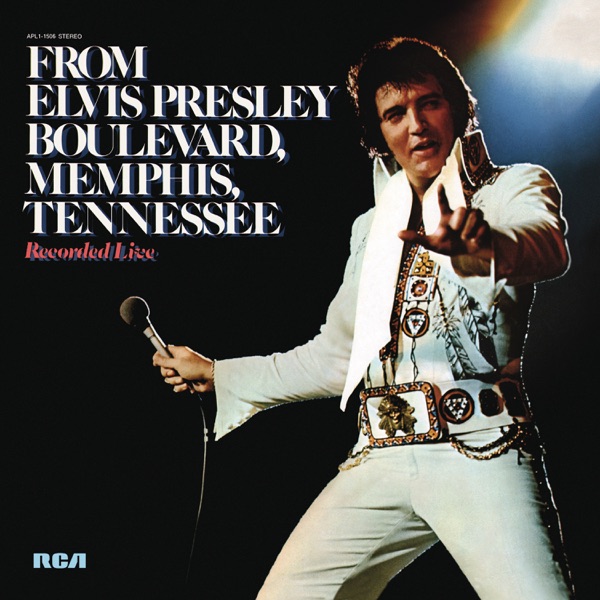
From Elvis Presley Boulevard, Memphis, Tennessee
1976 · 10 tracks
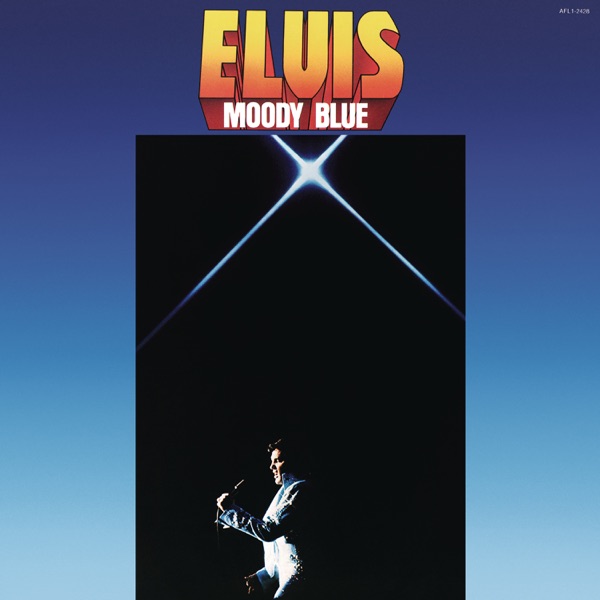
Moody Blue
1977 · 10 tracks
- 1 Unchained Melody (Live at Ann Arbor, MI) ↗ 2:35
- 2 If You Love Me (Let Me Know) [Live] ↗ 3:01
- 3 Little Darlin' (Live) ↗ 1:56
- 4 He'll Have to Go ↗ 4:35
- 5 Let Me Be There ↗ 3:37
- 6 Way Down ↗ 2:41
- 7 Pledging My Love ↗ 2:54
- 8 Moody Blue ↗ 2:52
- 9 She Thinks I Still Care ↗ 3:53
- 10 It's Easy for You ↗ 3:27
-
 Elvis PresleyElvis Presley195612 tracks
 -
 ElvisElvis Presley195612 tracks
 -
 Elvis’ Christmas AlbumElvis Presley195712 tracks
 -
 Elvis Is Back!Elvis Presley196012 tracks
 -
 His Hand in MineElvis Presley196012 tracks
 -
 Something for EverybodyElvis Presley196112 tracks
 -
 Pot LuckElvis Presley196212 tracks
 -
 Elvis for Everyone!Elvis Presley196512 tracks
 -
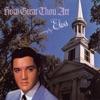 How Great Thou ArtElvis Presley196712 tracks
 -
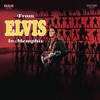 From Elvis in MemphisElvis Presley196916 tracks
 -
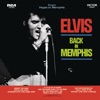 Back in MemphisElvis Presley196910 tracks
 -
 That’s the Way It IsElvis Presley197014 tracks
 -
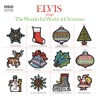 Elvis Sings the Wonderful World of ChristmasElvis Presley197112 tracks
 -
 Love Letters From ElvisElvis Presley197114 tracks
 -
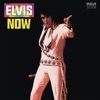 Elvis NowElvis Presley197213 tracks
 -
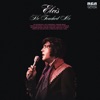 He Touched MeElvis Presley197212 tracks
 -
 ElvisElvis Presley197316 tracks
 -
 Good TimesElvis Presley197410 tracks
 -
 Promised LandElvis Presley197510 tracks
 -
 TodayElvis Presley197510 tracks
 -
 From Elvis Presley Boulevard, Memphis, TennesseeElvis Presley197610 tracks
 -
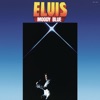 Moody BlueElvis Presley197710 tracks
Deep Dive
Overview
Elvis Aaron Presley stands as one of the most culturally significant figures of the twentieth century. His emergence as a performer in the mid-1950s fundamentally altered the landscape of popular music and youth culture in the United States, introducing a broader mainstream audience to the energy and sexuality of rock and roll, rockabilly, and rhythm-and-blues-inflected pop. Born in 1935, Presley became the first major crossover star of the rock era, a position he held until his death in 1977. His catalog spans two decades of studio recordings and ranges across pop rock, rockabilly, gospel, country, and blues—a breadth that underscores his role not as a genre purist but as a cultural synthesist.
Formation Story
Elvis Aaron Presley was born in Tupelo, Mississippi, in 1935, in a region where country, blues, and gospel traditions overlapped in radio broadcasts and live performance. His early years in the American South exposed him to the full spectrum of vernacular music that would shape his artistic identity. Though he did not learn music formally in a structured way, the sounds of country radio, Black gospel churches, and rhythm-and-blues records penetrated his consciousness during childhood. When his family relocated to Memphis, Tennessee, in the early 1950s, Presley found himself in a city at the crossroads of American musical innovation—a place where country, gospel, and Black popular music existed in close proximity. This geographic and cultural positioning proved decisive. Memphis’s music scene, centered around Beale Street and the emerging Sun Records studio, provided the exact environment in which a young performer with Presley’s openness to multiple traditions could thrive.
Breakthrough Moment
Presley’s entry into professional recording began at Sun Records in 1953, but his breakthrough came in 1956 with the near-simultaneous release of two self-titled albums—Elvis Presley and Elvis—coupled with a series of singles that crossed over from country radio to pop and R&B charts. His energetic stage presence and sexually provocative movements, combined with his ability to deliver country, rockabilly, and rhythm-and-blues material with equal conviction, created both unprecedented success and moral panic among conservative adults. The performance style and physical charisma he brought to television appearances and live shows became as famous as the records themselves. This controversy and appeal together made him a figure of intense interest across racial and generational lines at a moment when American popular culture was beginning to reckon with integration and youth rebellion. By 1956, at age twenty-one, Presley had become a national phenomenon, his records reaching audiences far beyond the regional circuits of country and R&B music.
Peak Era
The period from 1956 through the early 1960s represented Presley’s most creatively vital and commercially dominant years. Albums such as Elvis Is Back! (1960) and His Hand in Mine (1960) demonstrated his versatility—moving fluidly between secular pop-rock material and gospel, a genre to which he maintained deep spiritual attachment throughout his life. The soundtrack albums for his film appearances further expanded his reach into Hollywood and the adult entertainment market. Even as his recording output remained prolific, his influence on the broader shape of rock and roll solidified. Young musicians across multiple genres—from British Invasion acts to American rock and country performers—cited his work as foundational. By the mid-1960s, Presley had established himself not merely as a successful recording artist but as a historical force that had permanently altered what rock music could be and whom it could reach.
Musical Style
Presley’s sound fused country twang, blues phrasing, and gospel inflection into a pop-rock idiom that was neither wholly country nor wholly rhythm-and-blues, yet drew authentically from both traditions. His vocal approach—mannered, expressive, capable of both tender nuance and raw power—became instantly recognizable. Early recordings featured lean, guitar-driven arrangements with minimal instrumentation, allowing his voice and the interplay between lead and rhythm guitars to take prominence. His later studio work, particularly from the late 1960s onward, incorporated fuller production, orchestral arrangements, and a more expansive approach to songwriting and material selection. What remained consistent was his ability to inhabit multiple vocal registers and emotional registers within a single performance, singing ballads with restraint and uptempo numbers with barely contained energy. This stylistic fluidity—his refusal to be contained by a single genre or mood—was both a commercial strength and the foundation of his long-term cultural impact. He could deliver a country weeper, a gospel standard, a blues-inflected rocker, and a pop ballad often within the span of a single album.
Major Albums
Elvis Presley (1956)
His debut album established the template for his career: a mixture of uptempo rockers and ballads showcasing his range and the Sun Records sound that had first captured his talent.
Elvis Is Back! (1960)
Recorded after his return from military service, this album reasserted his dominance with a blend of pop sophistication and the raw energy that had made him famous.
From Elvis in Memphis (1969)
A landmark late-career statement that demonstrated Presley’s ability to engage with contemporary production and songwriting while maintaining his essential vocal identity and emotional authenticity.
That’s the Way It Is (1970)
Captured live studio sessions and documented his return to performing after years focused primarily on film work, marking a renewed commitment to live performance and touring.
Raised on Rock / For Ol’ Times Sake (1973)
Reflected his ongoing engagement with rock, country, and soul material, showing an artist still willing to experiment and record diverse styles even in his late career.
Signature Songs
- His early 1956 recordings became instantly iconic, establishing him as the standard-bearer of rock and roll energy and youth rebellion.
- Gospel numbers in his catalog demonstrated the sincerity of his spiritual convictions, particularly present on albums such as His Hand in Mine (1960) and How Great Thou Art (1967).
- His ballad recordings showcased a tender, introspective vocal quality that revealed depth beyond the energetic stage persona.
- Covers of country, blues, and pop standards allowed him to pay homage to his influences while stamping them with his own unmistakable identity.
Influence on Rock
Presley’s impact on rock music and popular culture cannot be overstated. He was the first major figure to convincingly bridge the racial and stylistic divides that had separated country, blues, and pop music in the early 1950s. His success proved that mass audiences—particularly young audiences—would embrace music and performers that drew from African-American musical traditions, a realization that opened pathways for countless artists who followed. The British Invasion acts of the 1960s, from The Beatles onward, cited Presley as a foundational influence; his example showed that rock and roll could sustain a decades-long career, evolve artistically, and command the highest levels of commercial success and cultural attention. Beyond music, his performance style—the physical expressiveness, the breaking of social taboos around sexuality and decorum on stage—became a template for rock performers who came after, one that emphasized spectacle, danger, and transgression as legitimate components of live performance. His willingness to record across multiple genres—gospel, country, blues, pop—established a model of artistic catholicity that opposed the idea of a rock performer as a single-genre specialist.
Legacy
Elvis Presley died on August 16, 1977, at age forty-two, leaving behind a catalog of studio albums spanning more than two decades and an influence that has only deepened with time. His recordings remain in continuous circulation, available across all major streaming platforms and in multiple reissue formats. The cultural phenomenon surrounding Presley—including his image, his Memphis home, and the broader mythology of his life—has become a permanent fixture of American popular culture. Subsequent generations of listeners have discovered his work through both historical study and popular culture references, ensuring that his role as the foundational figure of rock and roll remains secure. Documentaries, books, and academic study have further established his place as a subject of serious cultural and historical inquiry. The 1993 Gold Collection releases and 2008 Christmas With Elvis Presley compilation are among numerous posthumous projects that have kept his catalog in active conversation with contemporary audiences. For a figure who emerged in the 1950s, to remain a cultural reference point and an artist whose recordings are regularly discovered by new listeners speaks to the durability of his artistry and the historical moment he inhabited and fundamentally altered.
Fun Facts
- Presley recorded gospel music throughout his career, viewing it as spiritually important alongside his secular work, with albums such as His Hand in Mine and How Great Thou Art demonstrating his commitment to the genre.
- His military service from 1958 to 1960 was a pivotal moment in his career, as he served as a regular soldier rather than seeking entertainment assignments, an decision that enhanced his public standing and cultural legitimacy.
- Presley’s film career ran parallel to his recording career for much of the 1960s, with multiple soundtrack albums capturing material he performed for Hollywood productions.
- His return to live touring and recording in 1969 marked a renaissance in his career, proving that even after nearly a decade away from active touring, he retained his drawing power and creative relevance.