
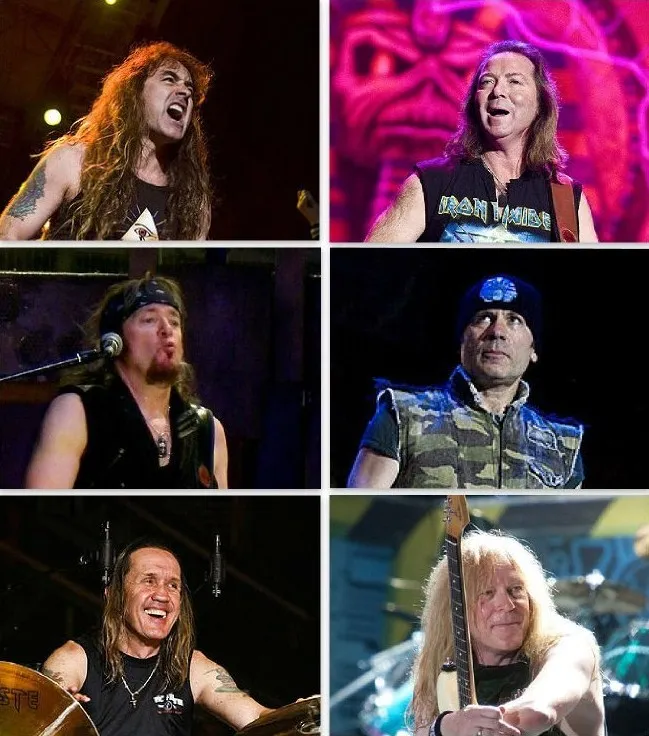
Photo by File:Steve Harris 521.jpg : adels File:Davemurray.jpg : adels File:Adrian Smith Iron Maiden Newcastle.jpg : Mike Lawrence File:Iron Maiden en Costa Rica Bruce.jpg : adels File:Nicko McBrain 2.jpg : adels File:Janick Gers @ Bluesfest July 6 2010.jpg : Scott Penner , licensed under CC BY-SA 2.0 · Wikimedia Commons
Rank #103
Iron Maiden
From Wikipedia
Iron Maiden are an English heavy metal band formed in Leyton, East London, in 1975 by bassist and primary songwriter Steve Harris. Although fluid in the early years of the band, the line-up for most of the band's history has consisted of Harris, lead vocalist Bruce Dickinson, drummer Nicko McBrain, and guitarists Dave Murray, Adrian Smith and Janick Gers. As pioneers of the new wave of British heavy metal movement, Iron Maiden released a series of UK and US Platinum and Gold albums, including 1980's debut album, 1981's Killers, and 1982's The Number of the Beast – its first album with Dickinson, who in 1981 replaced Paul Di'Anno as lead singer. The addition of Dickinson was a turning point in their career, establishing them as one of heavy metal's most important bands. The Number of the Beast is among the most popular heavy metal albums of all time, having sold almost 20 million copies worldwide.
Members
- Dave Sullivan · guitar (1975–1976)
- Paul Mario Day · voice (1975–1976)
- Ron Matthews · drum kit (1975–1976)
- Steve Harris · bass guitar (1975–present)
- Terry Rance · guitar (1975–1976)
- Dennis Wilcock · voice (1976–1978)
- Bob Sawyer · guitar (1977–1977)
- Doug Sampson · drum kit (1977–1979)
- Terry Wapram · guitar (1977–1978)
- Thunderstick · drum kit (1977–1977)
- Tony Moore · electronic keyboard (1977–1977)
- Dave Murray · guitar (1978–present)
- Paul Cairns · guitar (1978–1979)
- Paul Di'Anno · voice (1978–1981)
- Clive Burr · drum kit (1979–1982)
- Dennis Stratton · guitar (1979–1980)
- Tony Parsons · guitar (1979–1979)
- Adrian Smith · guitar (1980–1990)
- Nicko McBrain · drum kit (1982–present)
- Janick Gers · guitar (1990–present)
- Blaze Bayley · voice (1994–1999)
- Bruce Dickinson · voice (1999–present)
Discography & Previews
Browse through and click an album to open and play 30-second previews streamed from Apple Music.

Iron Maiden
1980 · 8 tracks
- 1 Prowler (2015 Remaster) ↗ 3:55
- 2 Remember Tomorrow (2015 Remaster) ↗ 5:29
- 3 Running Free (2015 Remaster) ↗ 3:18
- 4 Phantom of the Opera (2015 Remaster) ↗ 7:21
- 5 Transylvania (2015 Remaster) ↗ 4:05
- 6 Strange World (2015 Remaster) ↗ 5:47
- 7 Charlotte the Harlot (2015 Remaster) ↗ 4:13
- 8 Iron Maiden (2015 Remaster) ↗ 3:34

Killers
1981 · 10 tracks
- 1 The Ides of March (2015 Remaster) ↗ 1:45
- 2 Wrathchild (2015 Remaster) ↗ 2:55
- 3 Murders in the Rue Morgue (2015 Remaster) ↗ 4:19
- 4 Another Life (2015 Remaster) ↗ 3:24
- 5 Genghis Khan (2015 Remaster) ↗ 3:08
- 6 Innocent Exile (2015 Remaster) ↗ 3:53
- 7 Killers (2015 Remaster) ↗ 5:02
- 8 Prodigal Son (2015 Remaster) ↗ 6:13
- 9 Purgatory (2015 Remaster) ↗ 3:21
- 10 Drifter (2015 Remaster) ↗ 4:49

The Number of the Beast
1982 · 8 tracks
- 1 Invaders (2015 Remaster) ↗ 3:23
- 2 Children of the Damned (2015 Remaster) ↗ 4:35
- 3 The Prisoner (2015 Remaster) ↗ 6:03
- 4 22 Acacia Avenue (2015 Remaster) ↗ 6:37
- 5 The Number of the Beast (2015 Remaster) ↗ 4:51
- 6 Run to the Hills (2015 Remaster) ↗ 3:53
- 7 Gangland (2015 Remaster) ↗ 3:49
- 8 Hallowed Be Thy Name (1982 Remaster) ↗ 7:11
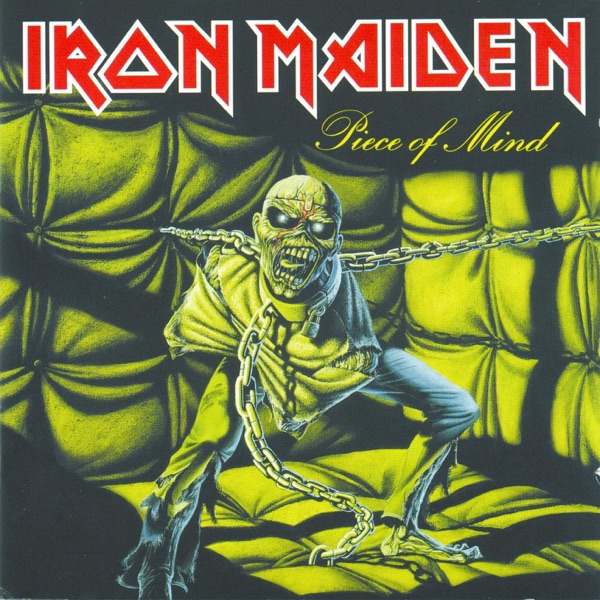
Piece of Mind
1983 · 9 tracks
- 1 Where Eagles Dare (2015 Remaster) ↗ 6:13
- 2 Revelations (2015 Remaster) ↗ 6:50
- 3 Flight of Icarus (2015 Remaster) ↗ 3:51
- 4 Die With Your Boots On (2015 Remaster) ↗ 5:27
- 5 The Trooper (2015 Remaster) ↗ 4:13
- 6 Still Life (2015 Remaster) ↗ 4:57
- 7 Quest for Fire (2015 Remaster) ↗ 3:43
- 8 Sun and Steel (2015 Remaster) ↗ 3:28
- 9 To Tame a Land (2015 Remaster) ↗ 7:29
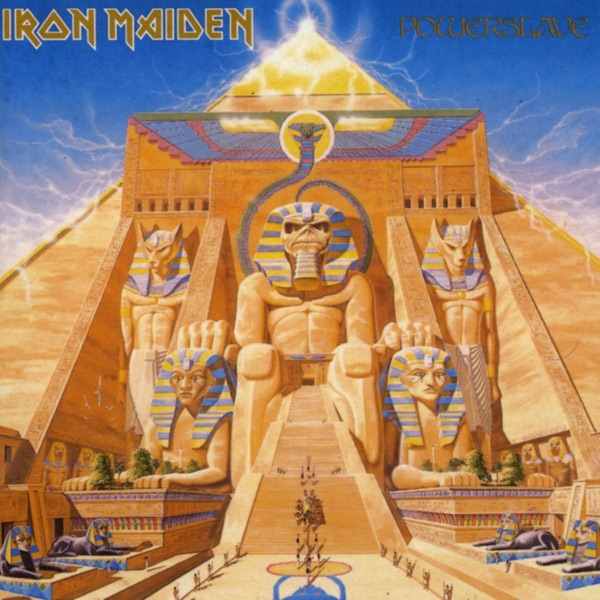
Powerslave
1984 · 8 tracks
- 1 Aces High (2015 Remaster) ↗ 4:32
- 2 2 Minutes to Midnight (2015 Remaster) ↗ 6:04
- 3 Losfer Words (Big 'Orra) [2015 Remaster] ↗ 4:15
- 4 Flash of the Blade (2015 Remaster) ↗ 4:06
- 5 The Duellists (2015 Remaster) ↗ 6:08
- 6 Back in the Village (2015 Remaster) ↗ 5:03
- 7 Powerslave (2015 Remaster) ↗ 7:12
- 8 Rime of the Ancient Mariner (2015 Remaster) ↗ 13:39

Somewhere in Time
1986 · 8 tracks
- 1 Caught Somewhere in Time (2015 Remaster) ↗ 7:27
- 2 Wasted Years (2015 Remaster) ↗ 5:10
- 3 Sea of Madness (2015 Remaster) ↗ 5:44
- 4 Heaven Can Wait (2015 Remaster) ↗ 7:24
- 5 The Loneliness of the Long Distance Runner (2015 Remaster) ↗ 6:33
- 6 Stranger in a Strange Land (2015 Remaster) ↗ 5:47
- 7 Deja Vu (2015 Remaster) ↗ 4:59
- 8 Alexander the Great (356-323 B.C) [2015 Remaster] ↗ 8:37

Seventh Son of a Seventh Son
1988 · 8 tracks
- 1 Moonchild (2015 Remaster) ↗ 5:41
- 2 Infinite Dreams (2015 Remaster) ↗ 6:09
- 3 Can I Play With Madness (2015 Remaster) ↗ 3:31
- 4 The Evil That Men Do (2015 Remaster) ↗ 4:34
- 5 Seventh Son of a Seventh Son (2015 Remaster) ↗ 9:54
- 6 The Prophecy (2015 Remaster) ↗ 5:06
- 7 The Clairvoyant (2015 Remaster) ↗ 4:27
- 8 Only the Good Die Young (2015 Remaster) ↗ 4:43

No Prayer for the Dying
1990 · 10 tracks
- 1 Tailgunner (2015 Remaster) ↗ 4:14
- 2 Holy Smoke (2015 Remaster) ↗ 3:49
- 3 No Prayer for the Dying ↗ 4:23
- 4 Public Enema Number One ↗ 4:14
- 5 Fates Warning ↗ 4:11
- 6 The Assassin ↗ 4:18
- 7 Run Silent Run Deep ↗ 4:35
- 8 Hooks in You ↗ 4:07
- 9 Bring Your Daughter...To the Slaughter (2015 Remaster) ↗ 4:44
- 10 Mother Russia ↗ 5:32

Fear of the Dark
1992 · 12 tracks
- 1 Be Quick or Be Dead (2015 Remaster) ↗ 3:24
- 2 From Here to Eternity ↗ 3:38
- 3 Afraid to Shoot Strangers (2015 Remaster) ↗ 6:57
- 4 Fear Is the Key ↗ 5:35
- 5 Childhood's End ↗ 4:41
- 6 Wasting Love ↗ 5:51
- 7 The Fugitive ↗ 4:54
- 8 Chains of Misery ↗ 3:37
- 9 The Apparition ↗ 3:55
- 10 Judas Be My Guide ↗ 3:09
- 11 Weekend Warrior ↗ 5:40
- 12 Fear of the Dark ↗ 7:18

The X Factor
1995 · 11 tracks
- 1 Sign of the Cross (2015 Remaster) ↗ 11:17
- 2 Lord of the Flies (2015 Remaster) ↗ 5:04
- 3 Man on the Edge (2015 Remaster) ↗ 4:14
- 4 Fortunes of War (2015 Remaster) ↗ 7:24
- 5 Look for the Truth (2015 Remaster) ↗ 5:10
- 6 The Aftermath (2015 Remaster) ↗ 6:21
- 7 Judgement of Heaven (2015 Remaster) ↗ 5:12
- 8 Blood on the World's Hands (2015 Remaster) ↗ 5:57
- 9 The Edge of Darkness (2015 Remaster) ↗ 6:39
- 10 2 A.M. (2015 Remaster) ↗ 5:38
- 11 The Unbeliever (2015 Remaster) ↗ 8:10

Virtual XI
1998 · 8 tracks
- 1 Futureal (2015 Remaster) ↗ 2:55
- 2 The Angel and the Gambler (2015 Remaster) ↗ 9:53
- 3 Lightning Strikes Twice (2015 Remaster) ↗ 4:50
- 4 The Clansman (2015 Remaster) ↗ 9:00
- 5 When Two Worlds Collide (2015 Remaster) ↗ 6:17
- 6 The Educated Fool (2015 Remaster) ↗ 6:45
- 7 Don't Look to the Eyes of a Stranger (2015 Remaster) ↗ 8:04
- 8 Como Estais Amigos (2015 Remaster) ↗ 5:30

Brave New World
2000 · 10 tracks
- 1 The Wicker Man (2015 Remaster) ↗ 4:35
- 2 Ghost of the Navigator (2015 Remaster) ↗ 6:50
- 3 Brave New World (2015 Remaster) ↗ 6:19
- 4 Blood Brothers (2015 Remaster) ↗ 7:14
- 5 The Mercenary (2015 Remaster) ↗ 4:43
- 6 Dream of Mirrors (2015 Remaster) ↗ 9:21
- 7 The Fallen Angel (2015 Remaster) ↗ 4:01
- 8 The Nomad (2015 Remaster) ↗ 9:06
- 9 Out of the Silent Planet (2015 Remaster) ↗ 6:26
- 10 The Thin Line Between Love and Hate (2015 Remaster) ↗ 8:27


A Matter of Life and Death
2006 · 10 tracks
- 1 Different World (2015 Remaster) ↗ 4:18
- 2 These Colours Don't Run (2015 Remaster) ↗ 6:52
- 3 Brighter Than a Thousand Suns (2015 Remaster) ↗ 8:46
- 4 The Pilgrim (2015 Remaster) ↗ 5:08
- 5 The Longest Day (2015 Remaster) ↗ 7:48
- 6 Out of the Shadows (2015 Remaster) ↗ 5:37
- 7 The Reincarnation of Benjamin Breeg (2015 Remaster) ↗ 7:22
- 8 For the Greater Good of God (2015 Remaster) ↗ 9:25
- 9 Lord of Light (2015 Remaster) ↗ 7:25
- 10 The Legacy (2015 Remaster) ↗ 9:23

The Final Frontier
2010 · 10 tracks
- 1 Satellite 15...The Final Frontier (2015 Remaster) ↗ 8:40
- 2 El Dorado (2015 Remaster) ↗ 6:49
- 3 Mother of Mercy ↗ 5:20
- 4 Coming Home (2015 Remaster) ↗ 5:53
- 5 The Alchemist (2015 Remaster) ↗ 4:29
- 6 Isle of Avalon ↗ 9:06
- 7 Starblind ↗ 7:48
- 8 The Talisman ↗ 9:03
- 9 The Man Who Would Be King ↗ 8:28
- 10 When the Wild Wind Blows (2015 Remaster) ↗ 11:01

The Book of Souls
2015 · 11 tracks
- 1 If Eternity Should Fail ↗ 8:28
- 1 Death or Glory ↗ 5:13
- 2 Speed of Light ↗ 5:02
- 2 Shadows of the Valley ↗ 7:32
- 3 The Great Unknown ↗ 6:38
- 3 Tears of a Clown ↗ 4:59
- 4 The Red and the Black ↗ 13:34
- 4 The Man of Sorrows ↗ 6:28
- 5 When the River Runs Deep ↗ 5:53
- 5 Empire of the Clouds ↗ 18:01
- 6 The Book of Souls ↗ 10:28

-
 Iron MaidenIron Maiden19808 tracks
 -
 KillersIron Maiden198110 tracks
 -
 The Number of the BeastIron Maiden19828 tracks
 -
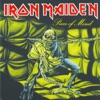 Piece of MindIron Maiden19839 tracks
 -
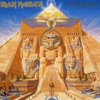 PowerslaveIron Maiden19848 tracks
 -
 Somewhere in TimeIron Maiden19868 tracks
 -
 Seventh Son of a Seventh SonIron Maiden19888 tracks
 -
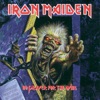 No Prayer for the DyingIron Maiden199010 tracks
 -
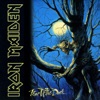 Fear of the DarkIron Maiden199212 tracks
 -
 The X FactorIron Maiden199511 tracks
 -
 Virtual XIIron Maiden19988 tracks
 -
 Brave New WorldIron Maiden200010 tracks
 -
 Dance of DeathIron Maiden200311 tracks
 -
 A Matter of Life and DeathIron Maiden200610 tracks
 -
 The Final FrontierIron Maiden201010 tracks
 -
 The Book of SoulsIron Maiden201511 tracks
 -
 SenjutsuIron Maiden202110 tracks
Deep Dive
Overview
Iron Maiden are an English heavy metal band formed in Leyton, East London, in 1975 by bassist and primary songwriter Steve Harris. Emerging as pioneers of the New Wave of British Heavy Metal (NWOBHM) movement, they built a global commercial and critical foothold through the 1980s and sustained it across decades of touring and recording. The band’s defining moment came in 1982 with The Number of the Beast, a watershed album that established them as one of heavy metal’s most consequential acts and remains among the most popular heavy metal releases of all time.
Formation Story
Steve Harris founded Iron Maiden in 1975, working through a fluid lineup in the band’s earliest years. The initial roster cycled through members including Paul Mario Day on vocals, Dave Sullivan and Terry Rance on guitar, and Ron Matthews on drums, all departing between 1975 and 1976. The band’s early identity solidified gradually: Dennis Wilcock took over vocals from 1976 to 1978, while the guitar chair saw further changes with Paul Cairns (1978–1979) and Dennis Stratton (1979–1980) each contributing tenures. By the end of the 1970s, the lineup had begun to stabilize around Harris’s vision, though the search for the right vocal presence—and the right drummer—continued to shape the band’s chemistry.
Breakthrough Moment
Iron Maiden’s breakthrough arrived with their self-titled debut in 1980, a raw and energetic statement that announced their presence in the growing NWOBHM scene. The follow-up, Killers (1981), deepened their UK and international recognition. The defining pivot came in 1981 when Bruce Dickinson replaced Paul Di’Anno as lead vocalist, a decision that transformed the band’s trajectory. Dickinson’s operatic range, technical precision, and commanding stage presence elevated Iron Maiden from a solid metal act to a world-class one. The band’s first album with Dickinson, The Number of the Beast (1982), became a global landmark: it reached platinum and gold status across multiple territories, sold nearly 20 million copies worldwide, and stands as one of the most iconic heavy metal albums ever released.
Peak Era
The decade from 1982 to 1992 represents Iron Maiden’s peak commercial and creative period. Following The Number of the Beast, the band released Piece of Mind (1983), Powerslave (1984), Somewhere in Time (1986), and Seventh Son of a Seventh Son (1988), each a platinum or gold-selling statement. During this run, Nicko McBrain joined as drummer in 1982, anchoring the rhythm section alongside Harris, while the guitar lineup settled into Dave Murray (1978 onward) and Adrian Smith (1980–1990), creating a twin-guitar architecture that became emblematic of the band’s sound. Fear of the Dark (1992) extended the streak, though the early 1990s marked the beginning of minor commercial and lineup shifts that would characterize the next phase.
Musical Style
Iron Maiden’s sound draws from traditional heavy metal structures—power chords, galloping bass lines, soaring melodies—but refines them through the NWOBHM lens of precision, theatricality, and narrative ambition. Steve Harris’s bass playing is foundational: his galloping, propulsive lines drive nearly every song, creating a sense of forward momentum that distinguishes the band from heavier or slower metal contemporaries. The twin-guitar approach of Murray and Smith (and later Murray and Gers) layers harmony-rich leads and rhythmic textures, often working in counterpoint rather than unison. Bruce Dickinson’s vocals sit at the emotional apex: his soaring range and operatic inflection brought a theatrical grandeur to metal lyrics often drawn from science fiction, history, and literature. The arrangement philosophy emphasizes narrative arc—many Iron Maiden songs build from verses through choruses to extended instrumental passages that showcase the band’s collective technical ability. Lyrically, the band favored conceptual depth over metal cliché, drawing on medieval history, science fiction, and literary sources.
Major Albums
Iron Maiden (1980)
The self-titled debut announced the band’s NWOBHM credentials with raw energy and straightforward heavy metal songcraft, establishing the galloping bass-and-twin-guitar template that would define them.
The Number of the Beast (1982)
The first album with Bruce Dickinson, this landmark release sold millions worldwide and became synonymous with 1980s metal, combining Dickinson’s operatic vocals with Harris’s compositional ambition and the band’s tightening musicianship.
Powerslave (1984)
A high-water mark of 1980s metal songwriting and production, Powerslave balanced accessibility with complexity, introducing the band to stadium audiences while maintaining their technical identity.
Seventh Son of a Seventh Son (1988)
The final album of their initial classic run, this record showcased the band’s ability to sustain quality across conceptual frameworks and multiple album-length narratives.
Brave New World (2000)
Released after Bruce Dickinson’s return to the band in 1999, this album signaled a renewed creative partnership and proved the band’s enduring relevance in the new millennium.
The Book of Souls (2015)
One of the band’s most ambitious albums, demonstrating that decades into their career, Iron Maiden remained capable of substantial compositional and thematic work.
Signature Songs
- Run to the Hills — A metal standard that combines historical narrative with infectious melody and remains a live staple.
- The Number of the Beast — The title track that defines the album and band’s theatrical ambition, built on Dickinson’s operatic delivery and relentless momentum.
- Hallowed Be Thy Name — An extended showcase of compositional sophistication and emotional depth, structured across multiple movements.
- Wasted Years — Among the band’s most commercially successful singles, balancing radio-friendly melody with metal instrumentation.
- Iron Maiden — The self-titled debut track, a concise statement of the band’s galloping aesthetic and sonic identity.
- Powerslave — The title track of their 1984 album, demonstrating the band’s ability to marry stadium-scale production with intricate guitar work.
Influence on Rock
Iron Maiden’s influence on heavy metal and rock extends across the NWOBHM movement and into global metal culture. As pioneers of the New Wave of British Heavy Metal, the band helped codify a sound and approach that revitalized heavy metal in the late 1970s and early 1980s, proving the genre could be both commercially viable and artistically serious. Their success demonstrated that metal lyrics could draw from history, literature, and conceptual frameworks rather than relying on shock or superficial imagery. The twin-guitar approach and the emphasis on technical precision influenced generations of metal bands across thrash, progressive metal, and traditional heavy metal subgenres. Bruce Dickinson’s vocal style—operatic range combined with rhythmic precision—became a touchstone for metal singers navigating the boundary between power and control. The band’s touring ethic and global reach, particularly their commitment to playing new and developing markets, positioned them as ambassadors for metal music itself, expanding the genre’s international footprint.
Legacy
Iron Maiden’s legacy rests on sustained excellence across five decades of recording and touring. The Number of the Beast remains one of the best-selling and most culturally resonant heavy metal albums of all time, a reference point for understanding 1980s rock and metal culture. The band’s commitment to touring—including to markets where metal was underserved—expanded metal’s global reach and established them as one of rock’s most dedicated live acts. The 2000 reunion with Bruce Dickinson after his 1990s absence reinvigorated their creative output; albums like Brave New World (2000), A Matter of Life and Death (2006), The Final Frontier (2010), The Book of Souls (2015), and Senjutsu (2021) demonstrated their ability to remain creatively engaged well into the 21st century. Streaming platforms have ensured their catalog reaches continuous new audiences, while their influence on metal subgenres from thrash to progressive metal remains visible in contemporary bands. Iron Maiden’s status as one of rock’s most enduring and respected acts reflects not innovation for its own sake, but a commitment to musicianship, storytelling, and the theatrical presentation of heavy metal as a complete artistic vision.
Fun Facts
- Steve Harris has been the sole constant member since the band’s 1975 formation, serving as bassist, primary songwriter, and creative center across all lineup changes.
- The band’s 1982 album The Number of the Beast was initially controversial in some territories due to its title and biblical imagery, though the song itself tells the story of a dystopian nightmare rather than advocating for any religious viewpoint.
- Bruce Dickinson’s absence from the band between 1990 and 1998—during which he pursued a solo career—marked a notable chapter; his 1999 return with Blaze Bayley’s departure restored one of metal’s most iconic vocal partnerships.
- The band’s touring schedule has been legendary for both its frequency and geographic reach, with Iron Maiden becoming known for playing venues and countries that larger acts often bypass.