
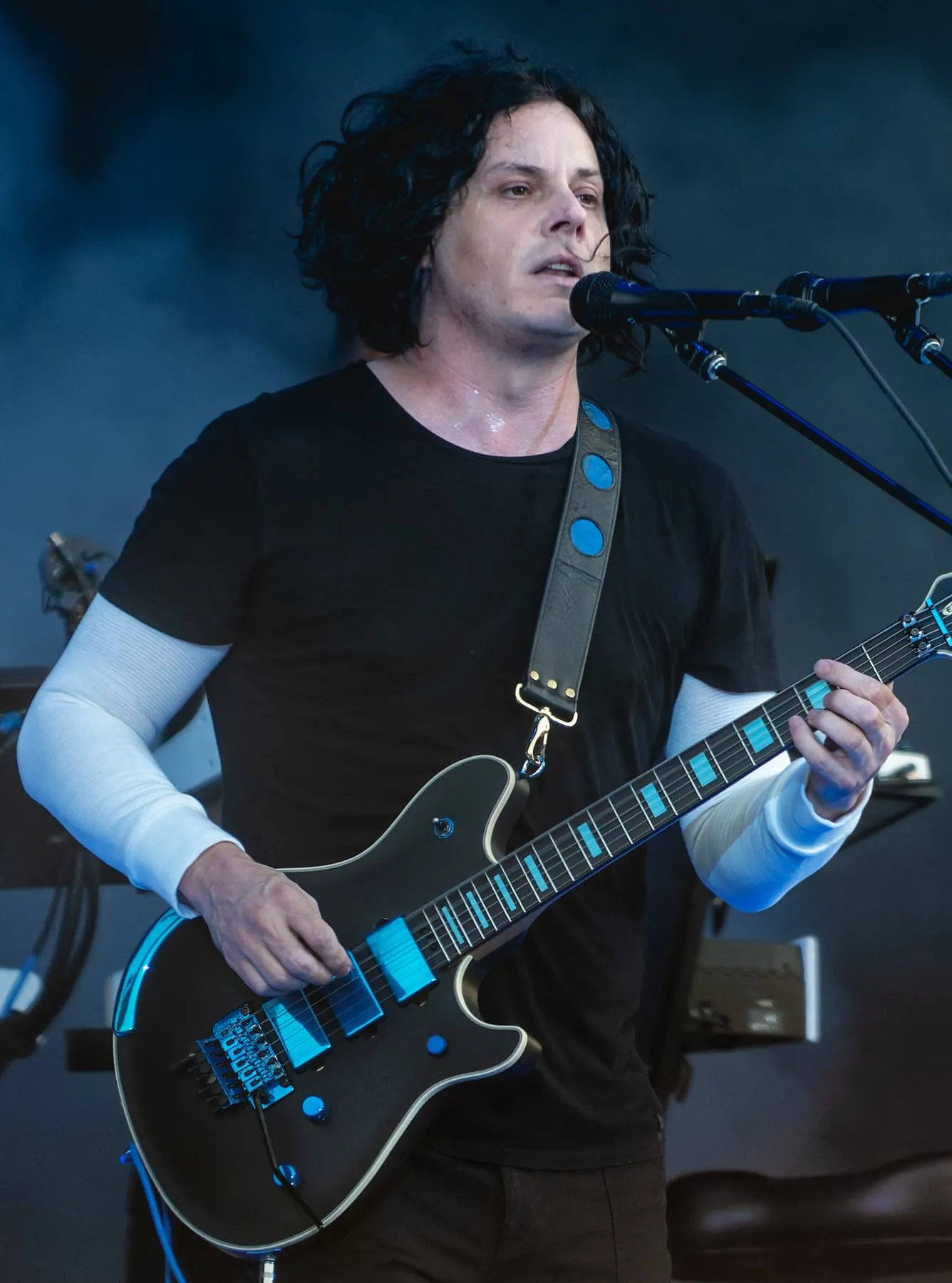
Photo by Raph_PH , licensed under CC BY 2.0 · Wikimedia Commons
Rank #378
Jack White
From Wikipedia
John Anthony White is an American musician and record producer who was the guitarist and lead vocalist of the rock duo the White Stripes. He was a key artist of the 2000s indie and garage rock movements, noted for his distinctive musical techniques, eccentricity, and utilization of analog technology. After the White Stripes split up in 2011, he found success with his solo career and business ventures.
Discography & Previews
Browse through and click an album to open and play 30-second previews streamed from Apple Music.

Blunderbuss
2012 · 13 tracks
- 1 Missing Pieces ↗ 3:27
- 2 Sixteen Saltines ↗ 2:37
- 3 Freedom At 21 ↗ 2:52
- 4 Love Interruption ↗ 2:38
- 5 Blunderbuss ↗ 3:07
- 6 Hypocritical Kiss ↗ 2:50
- 7 Weep Themselves To Sleep ↗ 4:19
- 8 I'm Shakin' ↗ 3:00
- 9 Trash Tongue Talker ↗ 3:20
- 10 Hip (Eponymous) Poor Boy ↗ 3:03
- 11 I Guess I Should Go To Sleep ↗ 2:37
- 12 On And On And On ↗ 3:56
- 13 Take Me With You When You Go ↗ 4:08

Lazaretto
2014 · 11 tracks

Boarding House Reach
2018 · 13 tracks
- 1 Connected By Love ↗ 4:38
- 2 Why Walk a Dog? ↗ 2:29
- 3 Corporation ↗ 5:39
- 4 Abulia and Akrasia ↗ 1:28
- 5 Hypermisophoniac ↗ 3:34
- 6 Ice Station Zebra ↗ 4:00
- 7 Over and Over and Over ↗ 3:36
- 8 Everything You've Ever Learned ↗ 2:13
- 9 Respect Commander ↗ 4:33
- 10 Ezmerelda Steals the Show ↗ 1:43
- 11 Get In the Mind Shaft ↗ 4:13
- 12 What's Done is Done ↗ 2:54
- 13 Humoresque ↗ 3:11

Entering Heaven Alive
2022 · 11 tracks
- 1 A Tip from You to Me ↗ 2:43
- 2 All Along the Way ↗ 3:52
- 3 Help Me Along ↗ 4:46
- 4 Love is Selfish ↗ 2:53
- 5 I’ve Got You Surrounded (With My Love) ↗ 4:24
- 6 Queen of the Bees ↗ 2:31
- 7 A Tree on Fire from Within ↗ 3:00
- 8 If I Die Tomorrow ↗ 3:00
- 9 Please God, Don't Tell Anyone ↗ 4:00
- 10 A Madman from Manhattan ↗ 4:26
- 11 Taking Me Back (Gently) ↗ 4:35

Fear of the Dawn
2022 · 12 tracks
- 1 Taking Me Back ↗ 3:59
- 2 Fear Of The Dawn ↗ 2:03
- 3 The White Raven ↗ 2:44
- 4 Hi-De-Ho (feat. Q-Tip) ↗ 3:57
- 5 Eosophobia ↗ 3:42
- 6 Into the Twilight ↗ 4:41
- 7 Dusk ↗ 0:30
- 8 What's the Trick? ↗ 3:35
- 9 That Was Then, This is Now ↗ 3:11
- 10 Eosophobia (Reprise) ↗ 3:12
- 11 Morning, Noon and Night ↗ 4:45
- 12 Shedding My Velvet ↗ 3:42

No Name
2024 · 13 tracks
- 1 Old Scratch Blues ↗ 3:32
- 2 Bless Yourself ↗ 2:34
- 3 That's How I'm Feeling ↗ 3:12
- 4 It's Rough On Rats (If You're Asking) ↗ 4:11
- 5 Archbishop Harold Holmes ↗ 2:51
- 6 Bombing Out ↗ 2:33
- 7 What's The Rumpus? ↗ 3:24
- 8 Tonight (Was A Long Time Ago) ↗ 4:16
- 9 Underground ↗ 3:47
- 10 Number One With A Bullet ↗ 3:20
- 11 Morning At Midnight ↗ 3:05
- 12 Missionary ↗ 2:33
- 13 Terminal Archenemy Endling ↗ 4:02
-
 BlunderbussJack White201213 tracks
 -
 LazarettoJack White201411 tracks
 -
 Boarding House ReachJack White201813 tracks
 -
 Entering Heaven AliveJack White202211 tracks
 -
 Fear of the DawnJack White202212 tracks
 -
 No NameJack White202413 tracks
Deep Dive
Overview
Jack White is an American musician and record producer who emerged as a defining figure of 2000s garage and indie rock, first as the guitarist and lead vocalist of the White Stripes. After that duo dissolved in 2011, White transitioned into a prolific solo career spanning multiple albums and stylistic explorations while simultaneously building Third Man Records into a respected independent label. His work across both eras is characterized by unconventional recording methods, a devotion to analog technology, and a willingness to cross genre boundaries between rock, blues, and alternative idioms.
Formation Story
John Anthony White was born in 1975 and came of age during the decline of mainstream rock radio and the rise of underground garage and lo-fi recording aesthetics. He emerged from Detroit’s music scene, a city with deep roots in blues, Motown soul, and punk energy. White gravitated toward rock as his primary idiom, drawing on the city’s legacy while remaining skeptical of modern studio polish. His early work in the White Stripes—which ran from the mid-1990s through 2011—established him as an unconventional musician unafraid to embrace limitations and analog recording methods as creative tools rather than constraints.
Breakthrough Moment
White’s mainstream breakthrough came during the White Stripes’ reign as leaders of the 2000s garage rock revival, but his solo career proper began in 2012 with the album Blunderbuss. That record immediately signaled that White’s solo voice would be exploratory and expansive compared to the White Stripes’ minimalist duo format. Blunderbuss demonstrated his range as a songwriter and multi-instrumentalist, featuring collaborations and a fuller sonic palette while retaining his distinctive production philosophy. The album’s success established him as a solo artist with independent momentum separate from his earlier duo identity.
Peak Era
White’s most creatively concentrated solo period spans 2012 to 2014, anchored by Blunderbuss and its follow-up Lazaretto. During these years, he balanced solo recordings with business ventures, most notably the expansion of Third Man Records into a hub for analog recording, vinyl production, and artist development. Lazaretto deepened the sonic experimentation begun on Blunderbuss, reinforcing White’s position as a solo artist capable of sustaining critical and commercial interest without the White Stripes’ brand. This period established the template for his ongoing solo work: eclectic collaborators, high production ambition, and uncompromising devotion to analog methodology.
Musical Style
White’s musicianship is built on technical facility across multiple instruments—guitar, piano, drums, bass—combined with a distinctive vocal delivery that ranges from wailing intensity to intimate restraint. His approach to guitar playing is rooted in blues but filtered through punk energy and avant-garde studio experimentation. He is known for rejecting modern digital recording techniques in favor of analog tape, a choice that influences the warmth and coloration of his records. His songwriting balances pop sensibility with structural unpredictability; songs often feature unexpected key changes, dynamic shifts, or instrumental breaks that defy convention. The blues lineage in his work is explicit and acknowledged, yet refracted through alternative and garage rock idioms that emphasize rawness and emotional directness over technical polish. White’s production aesthetic favors clarity and space—a reaction against over-compressed modern recordings—allowing individual instrumental voices to breathe within arrangements that can range from sparse to densely layered.
Major Albums
Blunderbuss (2012)
White’s solo debut established him as a multifaceted artist capable of handling production, arrangement, and guest collaboration at the highest level. The album’s eclectic instrumentation and thematic range signaled a creative break from the White Stripes’ reductive guitar-and-drums formula.
Lazaretto (2014)
The follow-up deepened White’s exploration of genre and sonic texture while refining the songwriting discipline demonstrated on Blunderbuss. Lazaretto consolidated his solo identity and confirmed that his appeal extended beyond nostalgia or White Stripes legacy.
Boarding House Reach (2018)
This album marked a stylistic pivot toward electronic and synth-based production, a bold shift for an artist known for analog puritanism. Boarding House Reach demonstrated White’s willingness to evolve rather than repeat established formulas.
Fear of the Dawn (2022)
Released the same year as Entering Heaven Alive, Fear of the Dawn showcased White’s return to guitar-driven rock with renewed urgency and conciseness, balancing experimentation with immediate melodic hooks.
Entering Heaven Alive (2022)
The companion album to Fear of the Dawn revealed a more introspective and stripped-back White, with emphasis on songwriting clarity and emotional transparency.
Signature Songs
- “Sixteen Saltines” — A Blunderbuss standout that exemplifies White’s ability to build tension through repetition and rhythmic precision before exploding into cathartic release.
- “Love Interruption” — From Blunderbuss, a rare moment of romantic vulnerability showcasing White’s softer vocal register and his gift for understated melody.
- “Lazaretto” — The title track from his 2014 album, built on kinetic guitar work and lyrically cryptic but emotionally direct songwriting.
- “Connected by Love” — A Fear of the Dawn track that balances White’s blues roots with contemporary production sensibilities.
Influence on Rock
White’s solo work reinforced lessons he taught during the White Stripes era about the power of limitations, analog fidelity, and uncompromising artistic vision in an industry increasingly dominated by digital convenience. His solo albums have influenced younger alternative and indie artists who value sonic authenticity and technical craftsmanship. Through Third Man Records, White has expanded his influence beyond his own recordings to encompass artist development, vinyl reissue culture, and advocacy for analog recording practices. His business and artistic ventures have modeled a path for rock musicians to maintain creative control and economic independence in the streaming era, demonstrating that there remains an audience for carefully produced, intentionally made music released on physical media.
Legacy
Jack White’s solo career has cemented his status as one of rock music’s most distinctive voices and producers. Beginning with Blunderbuss in 2012, he has released five studio albums that collectively demonstrate an artist unwilling to calcify into nostalgia or repeat past successes. His recent albums—Fear of the Dawn, Entering Heaven Alive, and No Name (2024)—confirm that his creative drive remains active and undiminished well into his fifth decade. Beyond his recordings, White’s establishment and stewardship of Third Man Records as an independent label focused on analog recording and artist development has given him lasting influence on the material infrastructure of rock music. His work has ensured that vinyl, tape, and analog recording remain culturally relevant and financially viable in an otherwise digital landscape.
Fun Facts
- White has been notably eccentric in his artistic decisions, including his insistence on recording with analog tape and his rejection of digital music formats for portions of his career.
- Third Man Records, founded by White, operates as both a record label and a recording studio committed to analog technology and vinyl production, serving as headquarters for his various creative projects.
- White’s multi-instrumental prowess means he often plays most or all instruments on his solo recordings, a practice that emphasizes his hands-on approach to production and arrangement.
- His solo career has seen genre-hopping that ranges from the rock focus of Blunderbuss and Lazaretto to the synth-heavy experimentation of Boarding House Reach, demonstrating artistic restlessness and refusal to be confined by established identity.