
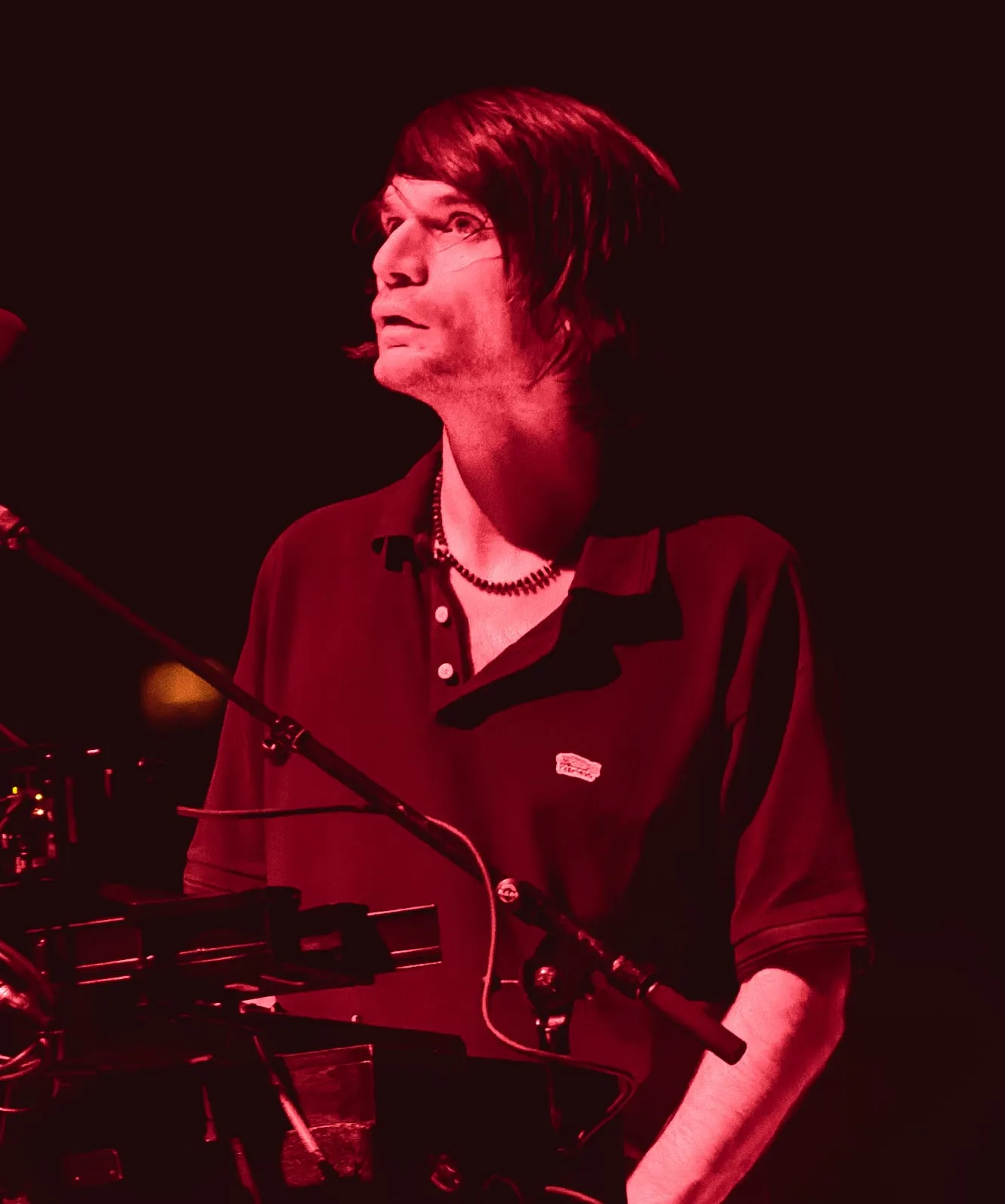
Photo by Raph_PH , licensed under CC BY 4.0 · Wikimedia Commons
Rank #448
Jonny Greenwood
From Wikipedia
Jonathan Richard Guy Greenwood is an English musician who is the lead guitarist of the rock band Radiohead. He has also composed numerous film scores. He has been named one of the greatest guitarists by multiple publications.
Discography & Previews
Browse through and click an album to open and play 30-second previews streamed from Apple Music.


Jarak Qaribak
2023 · 9 tracks
- 1 Djit Nishrab (feat. Ahmed Doma) ↗ 6:25
- 2 Ashufak Shay (feat. Rashid Al Najjar) ↗ 3:22
- 3 Taq ou-Dub (feat. Nour Freteikh) ↗ 3:38
- 4 Leylet Hub (feat. Mohssine Salaheddine) ↗ 4:42
- 5 Ya Mughir al-Ghazala (feat. Karrar Alsaadi) ↗ 3:55
- 6 Ahibak (feat. Safae Essafi) ↗ 4:57
- 7 Ya 'Anid Ya Yaba (feat. Lynn A.) ↗ 3:39
- 8 Lhla Yzid Ikthar ↗ 4:44
- 9 Jan al-Galb Salik (feat. Noamane Chaari & Zaineb Elouati) ↗ 4:23

-
 JununJonny Greenwood201513 tracks
 -
 Jarak QaribakJonny Greenwood20239 tracks
 -
 RanjhaJonny Greenwood202611 tracks
Deep Dive
Overview
Jonny Greenwood is an English musician born in 1971 who emerged as the lead guitarist of Radiohead, one of rock’s most consequential bands. Beyond his role in that ensemble, Greenwood has established himself as a prolific and acclaimed film composer, earning recognition as one of the greatest guitarists of his generation. His work spans electronica, art rock, alternative rock, and intelligent dance music—genres that reflect both his studio experiments with Radiohead and his solo compositions that range from orchestral film scores to experimental instrumental pieces.
Formation Story
Greenwood was born in 1971 in Oxford, England, a city that would become central to his musical identity. He came of age during the post-punk and new wave era, absorbing influences from the electronic experimentation and art-rock sensibilities that defined the late 1970s and early 1980s. His entry into rock music came through his work with Radiohead, where he joined as the band’s lead guitarist and became instrumental in shaping their sound from their early 1990s alternative-rock period through their genre-defying albums of the 1990s and 2000s. Greenwood’s approach to the guitar—unconventional, effects-heavy, and constantly evolving—became a defining element of Radiohead’s identity and his own artistic trajectory.
Breakthrough Moment
While Greenwood’s major breakthrough came as part of Radiohead’s ascent in the 1990s, his recognition as a solo voice and composer emerged gradually through his work on film scores beginning in the 2010s. His first solo album, From Here On Out, appeared in 2011, marking the beginning of his documented solo discography. However, it was his parallel work in film composition that solidified his reputation as a serious composer beyond his guitarist role, earning him accolades and broadening his artistic scope into orchestral and experimental territory distinct from Radiohead’s output.
Peak Era
Greenwood’s most prolific solo period spans the 2010s and 2020s, during which he balanced his ongoing involvement with Radiohead alongside an expanding film-score portfolio. Between 2011 and 2023, he released five studio albums—From Here On Out (2011), St. Carolyn by the Sea / Suite From “There Will Be Blood” (2014), Junun (2015), Volume 2: Industry Water (2019), and Jarak Qaribak (2023)—each exploring different facets of instrumental composition and electronic experimentation. This era established him as a significant figure in contemporary classical and experimental music, with his scores and solo work reaching audiences far beyond rock’s traditional boundaries. A sixth album, Ranjha, is forthcoming in 2026.
Musical Style
Greenwood’s guitar work is characterized by its refusal of conventional rock idioms. Rather than relying on power chords or straightforward lead-guitar heroics, he employs effects processing, unconventional tunings, and compositional techniques derived from contemporary classical music and electronic production. His playing encompasses shimmering arpeggios, textural drones, subtle noise elements, and orchestrated arrangements that blur the line between guitar-based rock and art music. In his solo work, particularly his film scores, Greenwood expands into orchestral composition, synthesizers, and field recordings, creating soundscapes that are atmospheric and intricate. His production sensibilities span electronica and intelligent dance music alongside more sparse, acoustic approaches, reflecting an artist uninterested in genre constraints. The instrumentation in his solo albums ranges from orchestral strings and woodwinds to digital synthesis and processed vocals, all in service of layered, immersive compositions.
Major Albums
From Here On Out (2011)
Greenwood’s debut solo album established his voice as a composer independent of Radiohead, featuring instrumental pieces that showcase his guitar work alongside orchestral and electronic textures.
St. Carolyn by the Sea / Suite From “There Will Be Blood” (2014)
This album pairs new compositions with material drawn from Greenwood’s acclaimed film score for Paul Thomas Anderson’s There Will Be Blood, exemplifying his crossover between cinema and concert music.
Junun (2015)
A collaborative instrumental album that demonstrates Greenwood’s openness to cross-cultural musical exchange and his ability to work within structured ensemble settings outside the rock tradition.
Volume 2: Industry Water (2019)
Released as the second volume in an apparent series, this album continues Greenwood’s exploration of electronic and acoustic textures, reflecting his mature compositional voice.
Jarak Qaribak (2023)
Greenwood’s most recent album showcases the evolution of his sound and compositional approach across nearly fifteen years of solo work, consolidating his position as a serious art-music composer.
Signature Songs
- “Analyse” — A Radiohead track featuring Greenwood’s characteristic use of effects and restraint, exemplifying his guitar philosophy in a band context.
- “There Will Be Blood” (film theme) — An orchestral composition demonstrating his mastery of dramatic scoring and instrumental arrangement.
- “Everything in Its Right Place” (Radiohead) — Features Greenwood’s innovative guitar textures layered beneath electronic production, marking his role in Radiohead’s experimental turn.
- “Pyramid Song” (Radiohead) — Showcases his sensitivity to dynamics and his use of guitar as a coloring instrument rather than a lead voice.
Influence on Rock
Greenwood’s significance lies in his dismantling of the boundary between rock guitar and contemporary composition. Through Radiohead, he demonstrated that the electric guitar could be an instrument of subtle sophistication, capable of exploring texture and atmosphere rather than speed or power. His approach influenced younger guitarists and producers across alternative rock, art rock, and electronic music who sought to transcend rock’s conventional language. His parallel career in film scoring elevated the profile of guitar-based composition in cinema and demonstrated that rock musicians could achieve credibility in classical and art-music contexts. By treating the guitar as one voice among many in orchestral and electronic arrangements, Greenwood helped expand what rock music could encompass.
Legacy
Jonny Greenwood remains an active and respected figure in both rock and contemporary music. His discography continues to grow, with Ranjha scheduled for 2026, suggesting an ongoing commitment to artistic exploration. He is recognized as one of rock’s greatest guitarists, a distinction earned not through technical flash but through innovation, taste, and a willingness to challenge genre expectations. His film scores have gained significant cultural reach, bringing contemporary composition to mainstream audiences. Greenwood’s career trajectory—deepening his creative output across rock and classical contexts simultaneously—has positioned him as a model for how rock musicians can expand into other serious artistic disciplines without abandoning their core identity. His work remains influential in progressive rock, art rock, and electronic music communities.
Fun Facts
- Greenwood’s film-score work has become increasingly prominent alongside his Radiohead involvement, reflecting a deliberate diversification of his creative output.
- His 2014 album incorporates material from Paul Thomas Anderson’s film There Will Be Blood, demonstrating his early success in cinema composition.
- The titles and release patterns of his solo albums—including Volume 2: Industry Water—suggest a conceptual or thematic architecture that rewards deeper listening.
- Greenwood’s solo work frequently incorporates non-Western musical influences and collaborations, expanding beyond Western rock and classical traditions.