
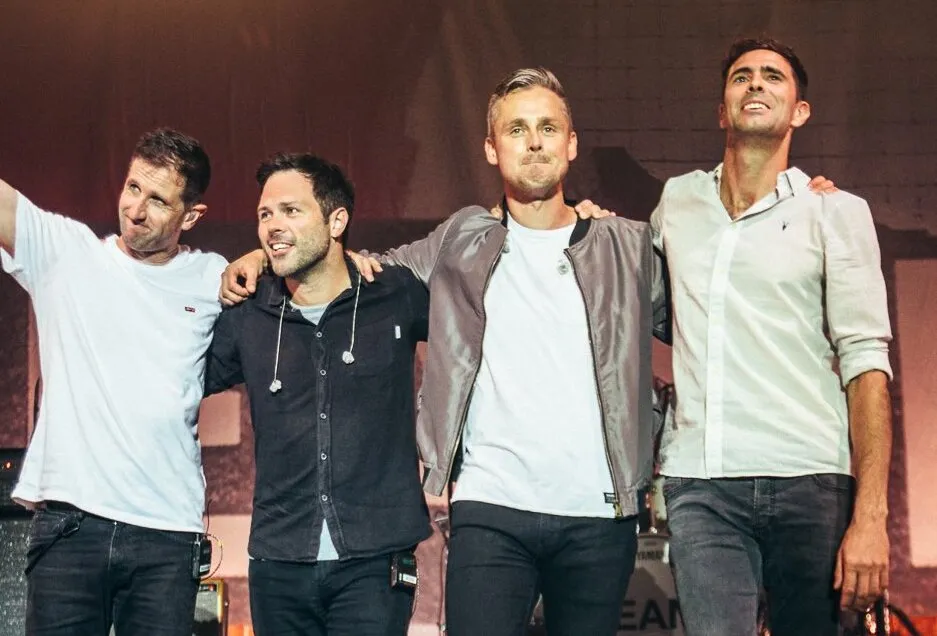
Photo by CalumMew28 , licensed under CC BY-SA 4.0 · Wikimedia Commons
Rank #388
Keane
From Wikipedia
Keane are an English alternative rock band from Battle, East Sussex, formed in 1995. The band comprises Tom Chaplin, Tim Rice-Oxley, Richard Hughes and Jesse Quin. Their original line-up included founder and guitarist Dominic Scott, who left in 2001.
Members
- Dominic Scott (1995–2001)
- Jesse Quin (1995–present)
- Richard Hughes (1995–present)
- Tim Rice-Oxley (1995–present)
- Tom Chaplin (1995–present)
Discography & Previews
Browse through and click an album to open and play 30-second previews streamed from Apple Music.

Hopes and Fears
2004 · 11 tracks

Under the Iron Sea
2006 · 13 tracks
- 1 Atlantic ↗ 4:14
- 2 Is It Any Wonder? ↗ 3:06
- 3 Nothing In My Way ↗ 4:00
- 4 Leaving So Soon? ↗ 4:00
- 5 A Bad Dream ↗ 5:04
- 6 Hamburg Song ↗ 4:37
- 7 Put It Behind You ↗ 3:37
- 8 The Iron Sea ↗ 2:57
- 9 Crystal Ball ↗ 3:54
- 10 Try Again ↗ 4:28
- 11 Broken Toy ↗ 6:07
- 12 The Frog Prince ↗ 4:23
- 13 Let It Slide ↗ 4:10
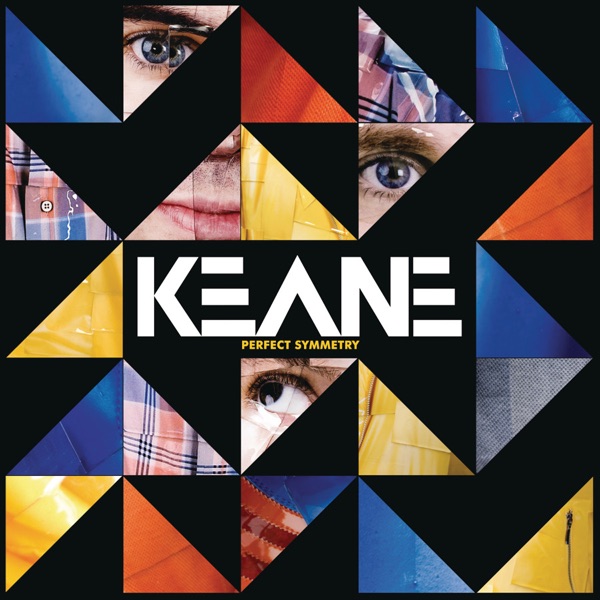
Perfect Symmetry
2008 · 13 tracks
- 1 Spiralling ↗ 4:19
- 2 The Lovers Are Losing ↗ 5:04
- 3 Better Than This ↗ 4:04
- 4 You Haven't Told Me Anything ↗ 3:47
- 5 Perfect Symmetry ↗ 5:12
- 6 You Don't See Me ↗ 4:03
- 7 Again & Again ↗ 3:50
- 8 Playing Along ↗ 5:35
- 9 Pretend That You're Alone ↗ 3:47
- 10 Black Burning Heart ↗ 5:23
- 11 Love Is the End ↗ 5:38
- 12 Time to Go ↗ 3:49
- 13 My Shadow ↗ 4:50

Strangeland
2012 · 12 tracks

-
 Hopes and FearsKeane200411 tracks
 -
 Under the Iron SeaKeane200613 tracks
 -
 Perfect SymmetryKeane200813 tracks
 -
 StrangelandKeane201212 tracks
 -
 Cause and EffectKeane201911 tracks
Deep Dive
Overview
Keane are an English alternative rock band from Battle, East Sussex, who emerged in the mid-1990s as practitioners of piano-driven alternative rock. Formed in 1995, the band comprises vocalist Tom Chaplin, keyboardist and songwriter Tim Rice-Oxley, drummer Richard Hughes, and bassist Jesse Quin. The group’s sound married post-Britpop sensibilities with a keyboard-centric aesthetic that set them apart from the guitar-dominated landscape of their era. Their debut album would eventually arrive a decade after formation, but when it did, it established them as a significant voice in contemporary rock.
Formation Story
Keane came together in Battle, a small market town in East Sussex, with the core trio of Chaplin, Rice-Oxley, and Hughes anchoring the project from its inception in 1995. Dominic Scott, a guitarist, was present at the band’s formation and remained a member until his departure in 2001, after which the group solidified into its now-familiar four-piece configuration with the addition of bassist Jesse Quin. Emerging from the post-Britpop environment of 1990s England, they developed their sound during a period when British rock was fragmenting into multiple subgenres, yet they carved a distinctive identity centered on Rice-Oxley’s keyboard arrangements and Chaplin’s vocal delivery.
Breakthrough Moment
Keane’s major breakthrough arrived in 2004 with the release of Hopes and Fears, their debut studio album, which found immediate commercial and critical resonance. The album’s arrival marked the culmination of nearly a decade of development and established the band as a notable force in contemporary alternative rock. The record introduced listeners to the group’s crystalline production, emotional restraint, and emphasis on melody and arrangement—qualities that would define their approach to songwriting and recording. Hopes and Fears became the foundation upon which the band’s subsequent career would be built, providing them with a strong foothold in the international rock marketplace.
Peak Era
The period spanning 2004 through 2008 represented Keane’s most prolific and commercially successful years. Following the success of Hopes and Fears, they released Under the Iron Sea in 2006 and Perfect Symmetry in 2008, establishing a consistent trajectory of studio output and touring. During this stretch, the band refined their aesthetic while maintaining the core identity that had made their debut resonant. These three albums in succession demonstrated their capacity to sustain momentum and evolve their sound, navigating the transition from emerging act to established alternative rock presence on both sides of the Atlantic. The consistency of their output during this window cemented their status as reliable architects of contemporary rock music.
Musical Style
Keane’s sound is fundamentally built around the interplay between Tim Rice-Oxley’s keyboard arrangements and Tom Chaplin’s expressive, often soaring vocal lines. The band operates in the piano rock and alternative rock idioms, drawing from post-Britpop influences while foregrounding electronic and acoustic textures rather than guitar-driven dynamics. Their production typically favors clarity and space, allowing individual instrumental elements to register with precision. Richard Hughes’s drumming provides melodic and rhythmic sophistication, while Jesse Quin’s bass work anchors the arrangements with harmonic sensibility. The songwriting tends toward introspective subject matter delivered with considerable emotional directness, a quality that distinguishes them from both the irony-laden rock of their immediate predecessors and the heavier alternative rock movements contemporaneous with their rise.
Major Albums
Hopes and Fears (2004)
Keane’s debut album announced their arrival as a fully formed artistic statement, introducing their signature blend of keyboard-centric production, reflective lyricism, and carefully constructed arrangements that would define their broader career trajectory.
Under the Iron Sea (2006)
The follow-up deepened the band’s exploration of their core sound while demonstrating their ability to sustain commercial momentum and artistic credibility in the competitive landscape of mid-2000s alternative rock.
Perfect Symmetry (2008)
This third album continued Keane’s consistent output during their most prolific period, further refining their approach to songwriting and production while maintaining the melodic sensibility and emotional restraint that characterized their work.
Strangeland (2012)
After a four-year gap, Keane returned with an album that showed the band’s continued commitment to their established aesthetic while navigating the shifting landscape of rock music in the streaming era.
Cause and Effect (2019)
The band’s most recent studio album demonstrates their ongoing relevance and willingness to record new material, maintaining an active presence in the contemporary rock marketplace more than two decades after their formation.
Signature Songs
- A track-driven entity whose compositions often featured on alternative rock playlists throughout the 2000s and beyond.
- Their body of work emphasizes melodic construction and emotional accessibility across multiple album cycles.
- The band’s catalog reflects consistent exploration of keyboard-based arrangements as the primary textural driver.
- Songs typically showcase Tom Chaplin’s vocal approach as a central compositional element rather than mere ornamentation.
Influence on Rock
Keane’s emergence in the 2000s occurred during a period of significant genre stratification in rock music, and their success demonstrated an ongoing appetite for keyboard-driven alternative rock in a landscape increasingly dominated by guitar-centric heavy music and electronic production. Their approach influenced the perception of piano rock as a viable mainstream alternative rock idiom, proving that bands could achieve substantial commercial success while centering keyboards rather than guitars. The band’s consistent touring and recording schedule across multiple decades has kept them visible in contemporary rock discourse, contributing to the continued viability of their particular aesthetic within the broader alternative rock tradition.
Legacy
Keane have maintained a working presence as a rock band for nearly three decades, a longevity that speaks to both the durability of their core audience and their commitment to ongoing creative work. The release of Cause and Effect in 2019 demonstrated their continued capacity to record and release new material, ensuring their place not merely as a artifact of 2000s alternative rock but as an ongoing concern in contemporary rock music. Their albums remain in circulation through digital and physical formats, maintaining accessibility to both longtime listeners and new audiences discovering the band through streaming platforms. The band’s consistency—their formation, stable lineup since 2001, and regular output—has positioned them as a reliable presence in rock music across multiple eras and technological shifts in how music reaches audiences.
Fun Facts
- Keane are from Battle, East Sussex, a location outside London’s immediate orbit, contributing to their identity as a band emerging from England’s regional rock tradition.
- The band’s core three members—Chaplin, Rice-Oxley, and Hughes—have remained together since the band’s 1995 formation, providing remarkable stability across nearly three decades.
- Dominic Scott’s departure in 2001, prior to the band’s major commercial breakthrough, was followed by the arrival of Jesse Quin, creating the lineup that would record their debut and all subsequent albums.
- The gap between the band’s formation in 1995 and their debut album release in 2004 represents nearly a full decade of development, writing, and refinement before their first official studio statement.