
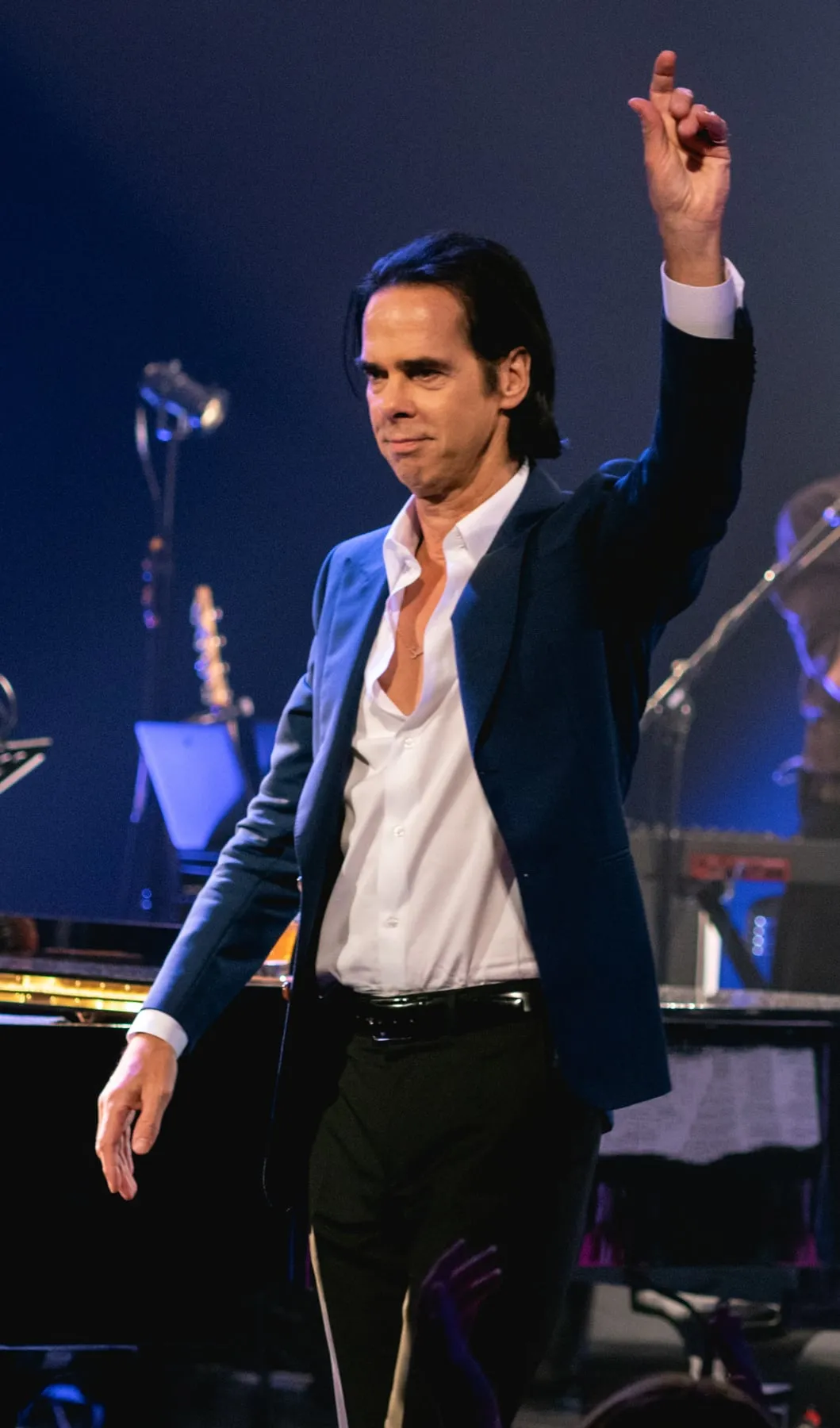
Photo by Raph_PH , licensed under CC BY 2.0 · Wikimedia Commons
Rank #251
Nick Cave
From Wikipedia
Nicholas Edward Cave is an Australian singer, musician and writer. He is the frontman of the rock band Nick Cave and the Bad Seeds. Known for his baritone voice, Cave's music is characterised by emotional intensity, a wide variety of influences and lyrical obsessions with death, religion, love, and violence.
Discography & Previews
Browse through and click an album to open and play 30-second previews streamed from Apple Music.

What a Wonderful World
2002 · 3 tracks

CARNAGE
2021 · 18 tracks
- 1 Spinning Song (Live At The Sydney Opera House) ↗ 5:59
- 1 Hand Of God (Live At The Sydney Opera House) ↗ 6:23
- 2 Bright Horses (Live At The Sydney Opera House) ↗ 4:52
- 2 Shattered Ground (Live At The Sydney Opera House) ↗ 7:09
- 3 Night Raid (Live At The Sydney Opera House) ↗ 4:58
- 3 Galleon Ship (Live At The Sydney Opera House) ↗ 4:53
- 4 Carnage (Live At The Sydney Opera House) ↗ 6:18
- 4 Leviathan (Live At The Sydney Opera House) ↗ 4:45
- 5 White Elephant (Live At The Sydney Opera House) ↗ 5:48
- 5 Balcony Man (Live At The Sydney Opera House) ↗ 5:05
- 6 Ghosteen (Live At The Sydney Opera House) ↗ 12:30
- 6 Hollywood (Live At The Sydney Opera House) ↗ 13:54
- 7 Lavender Fields (Live At The Sydney Opera House) ↗ 4:01
- 7 Ghosteen Speaks (Live At The Sydney Opera House) ↗ 5:41
- 8 Waiting For You (Live At The Sydney Opera House) ↗ 5:33
- 9 I Need You (Live At The Sydney Opera House) ↗ 5:03
- 10 Cosmic Dancer (Live At The Sydney Opera House) ↗ 4:39
- 11 Breathless (Live At The Sydney Opera House) ↗ 3:30

Seven Psalms
2022 · 8 tracks
-
 What a Wonderful WorldNick Cave20023 tracks
 -
 CARNAGENick Cave202118 tracks
 -
 Seven PsalmsNick Cave20228 tracks
Deep Dive
Overview
Nick Cave is an Australian singer, musician, and writer born in 1957 who has shaped rock music across five decades through both band work and solo endeavor. Known primarily as the frontman of Nick Cave and the Bad Seeds, Cave has built a career on emotional intensity, genre-fluidity, and a distinctive baritone that has become inseparable from post-punk and alternative rock. His output blends gothic rock, garage rock, blues, country, and art-rock into a singular vision preoccupied with death, religion, love, and violence—themes that anchor everything from his earliest recordings to his most recent work.
Formation Story
Nick Cave emerged from the Australian post-punk underground of the late 1970s and early 1980s, a period when Melbourne’s music scene was developing its own sharp, uncompromising edge. Before establishing himself as a solo artist and bandleader, Cave cut his teeth in the post-punk milieu, absorbing the aggression and experimentation of the era while developing his lyrical voice and vocal authority. His move toward leadership of a backing ensemble—eventually solidified as Nick Cave and the Bad Seeds—reflected an ambition to construct elaborate, layered arrangements around his songwriting rather than remain bound to a fixed group dynamic. This model allowed Cave to work with varying lineups and collaborators while maintaining artistic control, a strategy that would define his entire career trajectory.
Breakthrough Moment
Cave’s solo career, distinct from his work with the Bad Seeds, began to crystallize in the late 1990s and early 2000s, a period when he pursued recording projects outside the band framework. The 1999 release of The Secret Life of the Love Song marked a significant entry into solo documentation, capturing Cave in a mode less reliant on the full band’s instrumental density. Three years later, What a Wonderful World in 2002 extended this exploration, demonstrating his willingness to revisit his catalog and refine his artistic vision across different formats and contexts. These albums established Cave as an artist capable of sustained creative work beyond the ensemble setting, proving his songwriting and presence could anchor a record on their own terms.
Peak Era
Cave’s most sustained period of creative visibility and influence spans the 1980s through the 2000s, during which the Bad Seeds became one of alternative rock’s most respected and durable acts. This era saw the synthesis of his interests in post-punk austerity, blues feeling, and literary ambition into a mature sound that influenced generations of songwriters across multiple genres. The 2000s in particular saw Cave’s work reach a kind of artistic equilibrium, where his songwriting depth, vocal control, and choice of collaborators all reinforced one another. His solo projects during this time served as parallel outlets for experimentation while the Bad Seeds remained his primary vehicle for touring and major releases.
Musical Style
Cave’s voice—a rich, often grave baritone—has become the primary signature of his work, capable of both gentle delivery and rough, cathartic intensity depending on lyrical and emotional context. His songwriting draws on blues structures and country balladry while maintaining post-punk’s darker aesthetic and art-rock’s formal adventurousness. The instrumentation in his work has ranged from stripped-down acoustic arrangements to orchestral elaboration, reflecting his interests in both traditional song forms and avant-garde sound design. His lyrics prioritize narrative and psychological depth, with recurring imagery drawn from religious iconography, noir fiction, and intimate human conflict. Over time, Cave has proven willing to shift register—from the garage rock rawness of his earliest work to more refined, sometimes orchestral configurations—while maintaining the emotional directness and lyrical obsession that characterizes his best material.
Major Albums
The Secret Life of the Love Song (1999)
A solo project that captured Cave at a reflective moment, documenting his engagement with song form and emotional storytelling outside the full ensemble context.
What a Wonderful World (2002)
Continued Cave’s exploration of solo recording, demonstrating his ability to sustain artistic statement across multiple formats and arrangements.
Shell Shock (Opera) (2016)
A World Premiere Recording from the Royal Opera House at La Monnaie, marking Cave’s venture into operatic collaboration and high-art institutional contexts.
L.I.T.A.N.I.E.S (2020)
One of Cave’s most recent works, continuing his practice of diverse musical exploration and formal experimentation into his sixth decade.
Signature Songs
- “The Mercy Seat” — A meditation on death row and faith, exemplifying Cave’s interest in religious imagery and psychological extremity.
- “Into Your Arms” — A love song built on straightforward emotional vulnerability, showcasing his ability to distill feeling into direct language.
- “Red Right Hand” — A blues-based composition that became widely recognizable and demonstrates his skill at pairing dark lyrical content with accessible melody.
- “Ship Song” — An acoustic piece that reveals Cave’s capacity for tenderness and his grounding in traditional song structures.
Influence on Rock
Cave’s baritone and gothic sensibility have exerted profound influence on alternative rock, post-punk revival, and wider art-rock practice since the 1980s. He demonstrated that post-punk intensity need not exclude emotion or lyricism, and that a single artist’s vision could anchor a band across decades without artistic ossification. His willingness to work across genres—blues, country, orchestral arrangement, operatic form—expanded what rock music could formally contain. Generations of songwriters in alternative, indie, and art-rock contexts have drawn from Cave’s model: the marriage of high formal ambition with direct emotional expression, and the use of repetitive lyrical imagery as a form of psychological exploration rather than commercial hook.
Legacy
Nick Cave has become one of Australian rock’s most significant exports, a figure whose career spans from post-punk’s emergence through the digital era. His music remains consistently available through streaming platforms and continues to reach both longtime listeners and new audiences discovering his catalog. The Bad Seeds have never disbanded, testament to the durability of Cave’s vision and his collaborative relationships. His recent solo works into the 2020s—including L.I.T.A.N.I.E.S and CARNAGE, and Seven Psalms—confirm his continued artistic engagement and evolution. Cave’s influence extends beyond music into literature and visual culture, establishing him as a multidisciplinary artist whose legacy encompasses rock music’s relationship to emotion, darkness, and formal ambition.
Fun Facts
- Cave has worked with Japanese noise artist Merzbow, demonstrating his openness to extreme sonic experimentation across collaborations.
- He has long served as the frontman of Nick Cave and the Bad Seeds while maintaining a parallel solo recording practice, a dual career path unusual in rock music.
- His record label home, Mute Records, has been central to his work, providing a consistent institutional framework for nearly all his releases.
- Cave maintains an official website and active engagement with audiences, unusual for an artist of his stature and age in traditional rock hierarchies.