
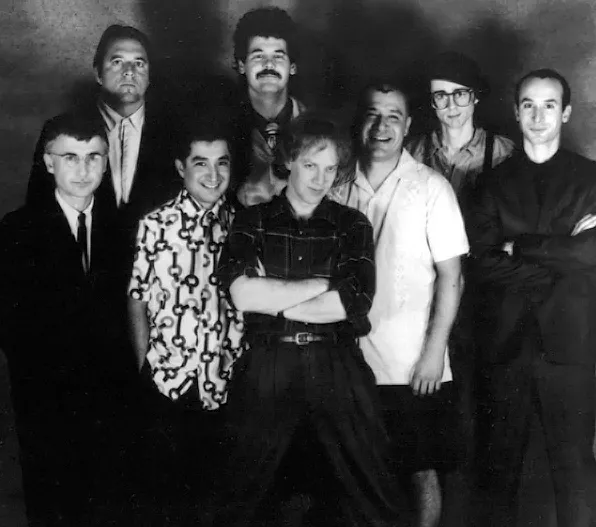
Photo by MCA Records , licensed under Public domain · Wikimedia Commons
Rank #323
Oingo Boingo
From Wikipedia
Oingo Boingo was an American rock band formed by songwriter Danny Elfman in 1979. The band emerged from a surrealist musical theatre troupe, the Mystic Knights of the Oingo Boingo, that Elfman had previously led and written material for.
Members
- Dale Turner (1972–1995)
- Danny Elfman (1972–1995)
- Sam Phipps (1973–1995)
- Steve Bartek (1976–1995)
- Richard Gibbs (1980–1983)
- John Avila (1984–1995)
- Marc Mann (1994–1995)
- Warren Fitzgerald (1994–1995)
Discography & Previews
Browse through and click an album to open and play 30-second previews streamed from Apple Music.


Nothing to Fear
1982 · 10 tracks

Good for Your Soul
1983 · 11 tracks


Dark at the End of the Tunnel
1990 · 11 tracks
-
 Only a LadOingo Boingo198110 tracks
 -
 Nothing to FearOingo Boingo198210 tracks
 -
 Good for Your SoulOingo Boingo198311 tracks
 -
 Dead Man’s PartyOingo Boingo19859 tracks
 -
 BOI-NGOOingo Boingo19879 tracks
 -
 Dark at the End of the TunnelOingo Boingo199011 tracks
 -
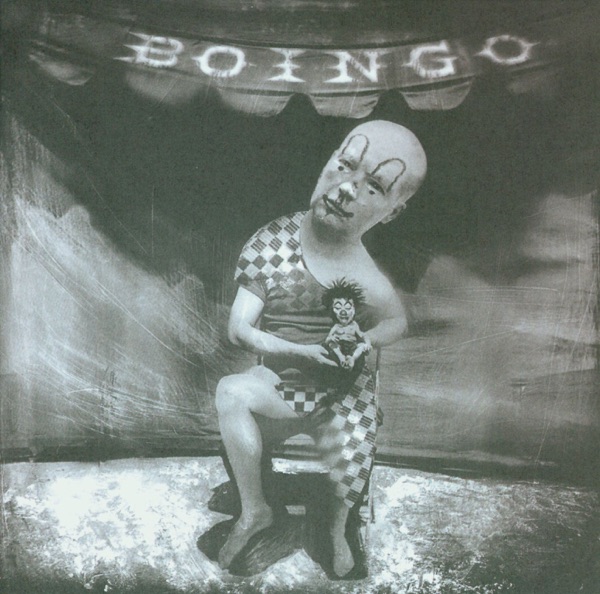
 BoingoOingo Boingo199411 tracks
Deep Dive
Overview
Oingo Boingo was an American rock band that emerged from Los Angeles in the early 1980s, bridging the theatrical energy of surrealist performance art with the angular urgency of post-punk and ska. Led by songwriter and multi-instrumentalist Danny Elfman, the band carved out a distinctive space in the new-wave landscape through a combination of jittery rhythms, horn arrangements, and anxious vocal delivery. Operating primarily from 1979 through 1995, Oingo Boingo became a staple of college radio and alternative venues, their catalog revealing the evolution from jagged post-punk primitivism to increasingly polished new-wave sophistication.
Formation Story
Oingo Boingo did not emerge from a traditional garage or rehearsal-space origin story. The band’s roots trace to the Mystic Knights of the Oingo Boingo, a surrealist musical theatre troupe that Danny Elfman founded and wrote material for beginning in 1972. Los Angeles in the early 1970s provided fertile ground for experimental performance art that blended music with visual spectacle and conceptual abstraction. When Elfman and his core collaborators—including percussionist Dale Turner and keyboardist Sam Phipps, both present since 1972 and 1973 respectively—transitioned from theatrical revue to recording rock music in 1979, they retained the theatrical sensibility and ensemble energy that defined their live performances. The shift coincided with the emergence of post-punk and new-wave radio formats, which proved receptive to the band’s unconventional approach. By 1980, the band had solidified its lineup with guitarist Steve Bartek, who would remain a constant presence throughout the band’s existence, while also beginning to record commercially.
Breakthrough Moment
Oingo Boingo’s first major label visibility came with their debut album Only a Lad in 1981. The record introduced the band’s signature sound—punctuated horns, nervous guitar figures, and Elfman’s distinctive vocal presence—to a growing alternative-music audience. The rapid release of Nothing to Fear the following year and Good for Your Soul in 1983 demonstrated the band’s prolific output during their early years and established them as reliable fixtures on college radio and in the college-concert circuit. These three albums in succession marked their transition from Los Angeles novelty act to a band with national distribution through major labels including MCA Records and I.R.S. Records. By the mid-1980s, Oingo Boingo had cultivated a devoted fan base, particularly among listeners drawn to the theatrical excess and rhythmic complexity that distinguished them from simpler new-wave acts.
Peak Era
Oingo Boingo reached their commercial and creative peak in the mid-to-late 1980s. Dead Man’s Party in 1985 and BOI-NGO in 1987 represented the band at their most confident and sonically expansive. These albums showcased a maturing approach to arrangement and production, with the horn section becoming increasingly integral to the band’s identity rather than merely supplementary. The period from 1985 to 1987 marked a high watermark in terms of radio play, concert attendance, and cultural footprint within alternative rock. The band’s live reputation—built on theatrical presentation, instrumental precision, and Elfman’s restless stage energy—continued to drive their appeal. By the late 1980s, however, the landscape of alternative rock was shifting, with grunge and other movements gradually displacing the post-punk and new-wave bands that had dominated college radio and MTV in the early part of the decade.
Musical Style
Oingo Boingo’s sound was defined by the collision of punk-derived energy with polished new-wave production and theatrical orchestration. Horns—typically saxophones and trumpets—punctuated the mix with sharp, often dissonant figures that contrasted with the driving rhythmic pulse beneath. Danny Elfman’s vocals carried a nervous, sometimes arch quality, capable of both rapid-fire delivery and sudden melodic reaches. The rhythm section, anchored by Dale Turner’s percussion and the various bassists and keyboardists who passed through the band, favored ska-influenced syncopation and post-punk terseness rather than the four-square simplicity of mainstream rock. Song structures often embraced odd time signatures and unexpected dynamic shifts, reflecting the band’s origins in experimental theatre. As the band progressed from their debut through the mid-1980s, the production became more spacious and the arrangements more elaborate, though the essential tension between chaos and control remained central to their identity. The ska and punk genealogy was always present, but filtered through a new-wave lens and delivered with theatrical self-awareness rather than pure street-level rage.
Major Albums
Only a Lad (1981)
Oingo Boingo’s debut, establishing the core instrumental palette—horns, jerky guitar, nervous rhythm—and introducing Danny Elfman as a songwriter capable of balancing melody with deliberate discomfort. The album signaled that a credible alternative act had arrived.
Dead Man’s Party (1985)
A commercial high-water mark in which the band’s arrangements reached new sophistication, with horn lines and keyboard textures fully integrated into the songwriting rather than grafted on. The album solidified their mainstream alternative presence.
BOI-NGO (1987)
The band at their most assured, combining pop accessibility with instrumental complexity and theatrical staging. The album represented the culmination of their mid-1980s creative momentum.
Dark at the End of the Tunnel (1990)
Released as the post-punk revival faded from cultural prominence, this album captured the band attempting to adapt to a changing rock landscape while retaining their core identity.
Boingo (1994)
The band’s final studio album before their 1995 breakup, documenting a unit that had weathered musical trends and internal changes while maintaining their distinctive sensibility.
Signature Songs
- “Dead Man’s Party” — A title-track showcase for the band’s theatrical presentation and Elfman’s vocal range, blending ska rhythm with pop sensibility.
- “No One Lives Forever” — A driving post-punk number exemplifying the band’s ability to compress nervous energy into a radio-length format.
- “Weird Science” — A collaboration with the Aqua Teens that demonstrated the band’s willingness to engage with contemporary culture and comedic sensibility.
- “Shattered Lives” — An early-career showcase for the band’s new-wave credentials and Elfman’s anxious vocal delivery.
- “Perfect Girl” — A mid-period track highlighting the band’s pop instincts without sacrificing rhythmic complexity.
Influence on Rock
Oingo Boingo occupied a specific but significant niche within post-punk and new-wave genealogy. Their theatrical presentation and orchestral ambition influenced subsequent alternative and indie acts who sought to blend art-school sensibility with rock instrumentation. The band’s emphasis on precisely arranged horn sections and complex rhythms informed later ska-punk and horn-based indie rock acts. More broadly, Elfman’s work with the band established his credibility as an arranger and orchestrator, a reputation that would define his subsequent career in film composition. The band demonstrated that post-punk and new-wave approaches could sustain a multi-album career in the mainstream alternative market, even as they occupied the margins of broader radio and MTV rotation. Their persistence through musical trend cycles—from new wave through MTV’s mid-1980s emphasis on synthesizer-driven acts through the grunge ascendancy of the 1990s—illustrated the durability of a distinctive, theatre-derived identity in rock music.
Legacy
Oingo Boingo dissolved in 1995 but maintained an afterlife through archival releases and fan devotion. The 2010 reissues Forbidden Boingo, Volume One and Forbidden Boingo, Volume Two brought previously unreleased material from their catalogue to light, suggesting ongoing interest in their archive. Danny Elfman’s subsequent prominence in film and television composition overshadowed the band’s legacy in popular discourse, yet among alternative-rock historians and fans, Oingo Boingo retained status as an essential example of post-punk refracted through theatrical excess and Los Angeles experimental art. The band’s influence persists in ska-punk and horn-based indie rock, and their catalog remained available through streaming services, ensuring access for new listeners. Though never achieving the stadium-filling popularity of some contemporaries, Oingo Boingo’s distinctive fusion of genres and unapologetic theatrical presentation secured their place as a defining mid-tier alternative band of their era.
Fun Facts
- The band’s origins in the Mystic Knights of the Oingo Boingo theatre troupe meant that early performances blended rock music with visual spectacle, dance, and conceptual art in ways that preceded the theatrical rock movements of later decades.
- Danny Elfman’s transition from Oingo Boingo frontman to film composer occurred while the band was still active, and he would go on to become one of the most prolific and acclaimed composers in contemporary cinema.
- Steve Bartek’s presence in the band from 1976 through 1995 made him the longest-serving member besides Danny Elfman and the core rhythm section, underscoring the band’s internal stability despite shifting musical fashions.
- The band’s emphasis on complex time signatures and orchestral arrangement reflected their theatre-art heritage and distinguished them from simpler punk or new-wave acts of the era.