
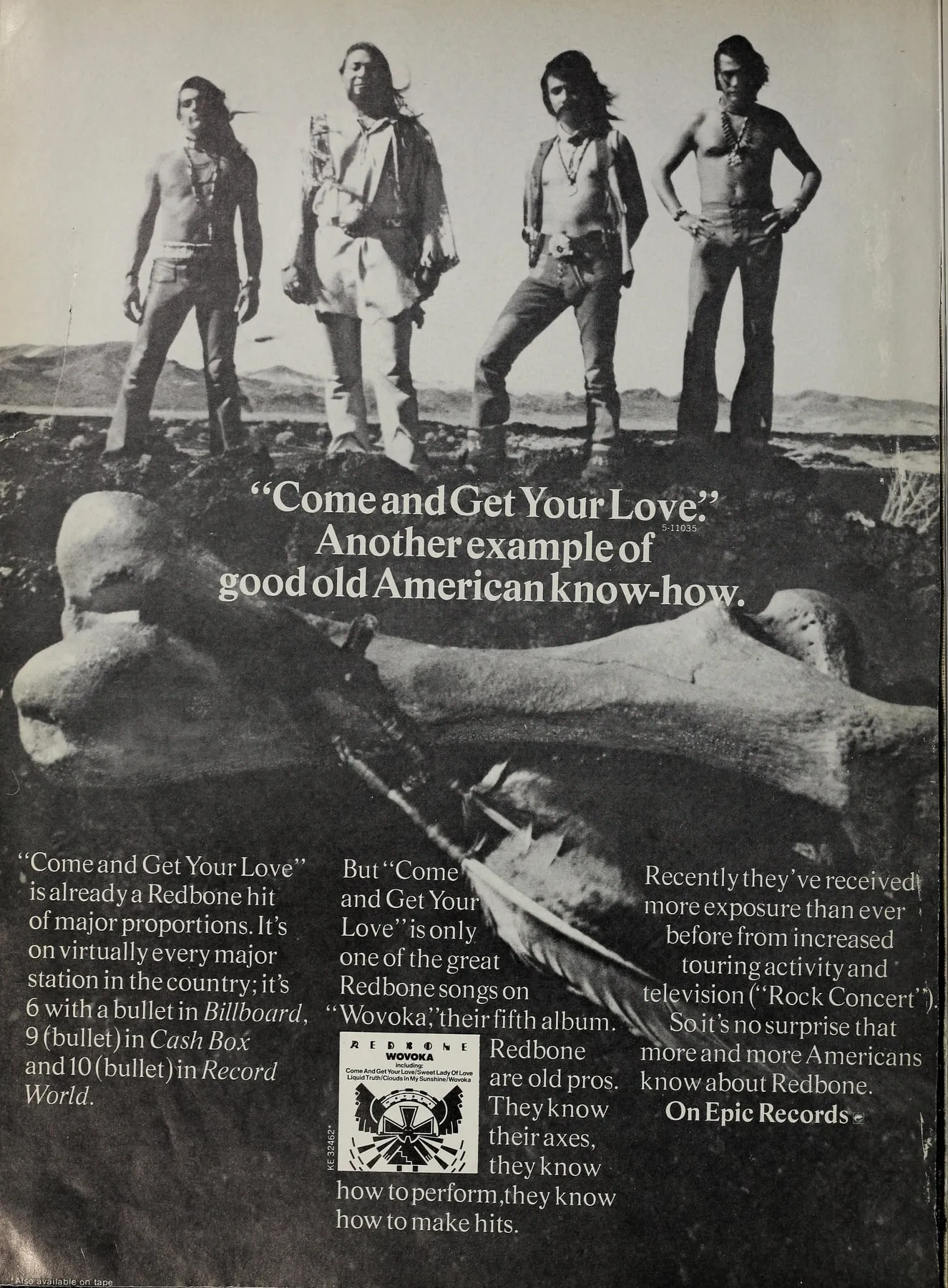
Photo by Epic , licensed under Public domain · Wikimedia Commons
Rank #322
Redbone
From Wikipedia
Redbone is an American rock band that was originally formed in Los Angeles, California, in 1969 by brothers Pat and Lolly Vegas. All members during their commercial peak were of Chicano and Native American heritage, something heavily reflected in their songs, stage regalia, and album art. Catching Fire in the 1970s, the band broke boundaries in the rhealm of rock music and shined a light on social issues while topping the charts.
Discography & Previews
Browse through and click an album to open and play 30-second previews streamed from Apple Music.
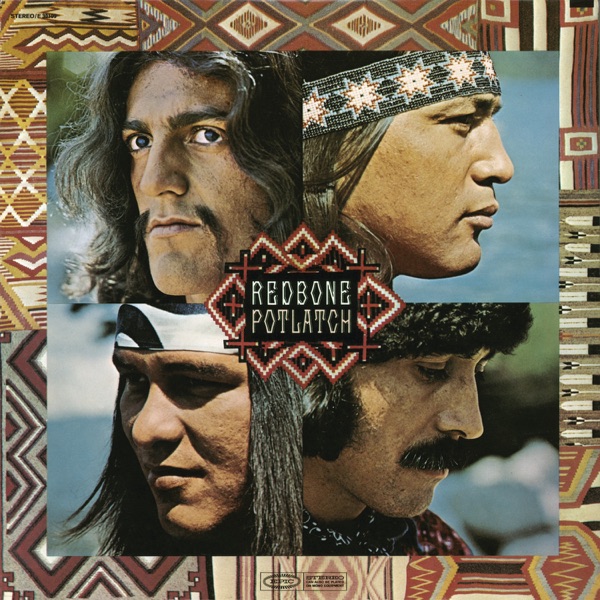
Potlatch
1970 · 12 tracks
- 1 Maggie ↗ 5:08
- 2 Light as a Feather ↗ 1:55
- 3 Who Can Say? ↗ 2:51
- 4 Judgement Day ↗ 2:32
- 5 Without Reservation ↗ 4:12
- 6 Chant: 13th Hour ↗ 5:38
- 7 Alcatraz ↗ 2:34
- 8 Drinkin' and Blo ↗ 2:17
- 9 Bad News Ain't No News At All ↗ 3:10
- 10 New Blue Sermonette ↗ 3:27
- 11 Maggie (Single Edit) ↗ 2:42
- 12 New Blue Sermonette (Single Version) ↗ 3:27

Redbone
1970 · 17 tracks
- 1 Crazy Cajun Cakewalk Band ↗ 3:07
- 2 Prehistoric Rhythm ↗ 3:57
- 3 Niki Hokey ↗ 3:16
- 4 Promise I Won't Let It Show ↗ 3:05
- 5 Minor Seven Heaven ↗ 4:20
- 6 Night Come Down ↗ 3:54
- 7 Tennessee Girl ↗ 2:24
- 8 Rebecca ↗ 3:03
- 9 Jambone ↗ 7:47
- 10 Little Girl ↗ 3:55
- 11 Chance to See ↗ 4:31
- 12 Red and Blue ↗ 2:43
- 13 Suite Mode ↗ 8:21
- 14 (I Can't) Handle It ↗ 5:35
- 15 I'm a Man ↗ 2:55
- 16 Danse Calinda ↗ 2:43
- 17 Things Go Better... ↗ 7:34
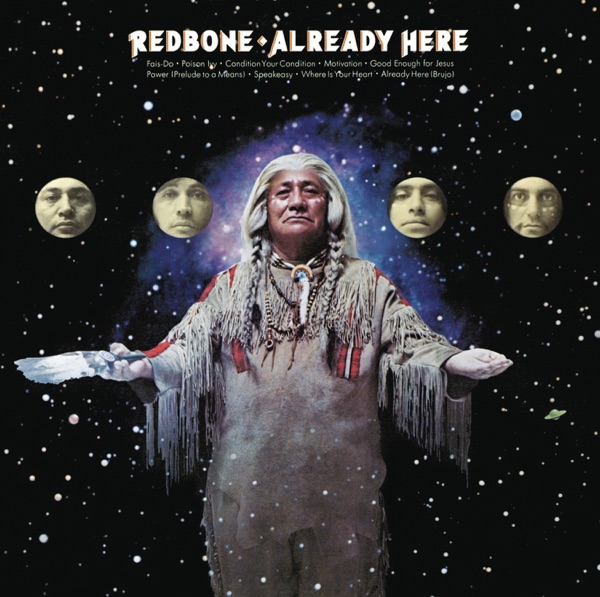
Already Here
1972 · 12 tracks
- 1 Fais-Do ↗ 2:35
- 2 Motivation ↗ 2:22
- 3 Power (Prelude to a Means) ↗ 4:27
- 4 Speakeasy ↗ 3:50
- 5 Condition Your Condition ↗ 2:51
- 6 Where Is Your Heart ↗ 3:06
- 7 Good Enough for Jesus ↗ 2:36
- 8 Poison Ivy ↗ 3:04
- 9 Already Here (Brujo) ↗ 9:18
- 10 We Were All Wounded at Wounded Knee ↗ 3:30
- 11 Speakeasy (Single Version) ↗ 3:42
- 12 Already Here (Brujo) [Single Version] ↗ 3:40


Beaded Dreams Through Turquoise Eyes
1974 · 16 tracks
- 1 One More Time ↗ 3:03
- 2 Suzi Girl ↗ 2:56
- 3 Only You and Rock and Roll ↗ 2:59
- 4 Blood Sweat and Tears ↗ 2:49
- 5 Cookin' with D'Redbone ↗ 3:55
- 6 (Beaded Dreams Through) Turquoise Eyes ↗ 3:20
- 7 Beautiful Illusion ↗ 3:40
- 8 Interstate Highway 101 ↗ 2:53
- 9 I'll Never Stop Loving You ↗ 2:47
- 10 Moon When Four Eclipse ↗ 4:46
- 11 I've Got to Find the Right Woman (Single Version) ↗ 3:13
- 12 Physical Attraction (Single Version) ↗ 2:57
- 13 Keep Me Uptight ↗ 6:06
- 14 To Get the Love I Need ↗ 3:00
- 15 A Little Bitty Ditty ↗ 2:57
- 16 Echoes from Another Planet ↗ 3:39

Soliloquy In Red
1975 · 14 tracks
- 1 Number One ↗ 3:12
- 2 I've Got to Find the Right Woman ↗ 3:14
- 3 Physical Attraction ↗ 2:58
- 4 Tarzan ↗ 4:58
- 5 Gimmie Little Sign ↗ 3:07
- 6 To Get the Love I Need ↗ 2:58
- 7 A Little Bitty Ditty ↗ 2:58
- 8 If You Got TO Make A Fool of Somebody ↗ 2:43
- 9 Echoes from Another Planet ↗ 3:40
- 10 Keep Me Uptight ↗ 6:08
- 11 Prelude To Man ↗ 0:51
- 12 Man ↗ 3:12
- 13 Song ↗ 2:25
- 14 Red Hot ↗ 3:49

-
 PotlatchRedbone197012 tracks
 -
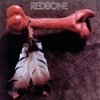 RedboneRedbone197017 tracks
 -
 Already HereRedbone197212 tracks
 -
 WovokaRedbone19738 tracks
 -
 Beaded Dreams Through Turquoise EyesRedbone197416 tracks
 -
 Soliloquy In RedRedbone197514 tracks
 -
 CyclesRedbone19779 tracks
Deep Dive
Overview
Redbone is an American rock band that emerged from Los Angeles in 1969, founded by brothers Pat and Lolly Vegas. The band distinguished itself not merely through its musical output but through its deliberate centering of Chicano and Native American identity in rock music—a stance that was both cultural statement and artistic necessity. During their commercial peak in the 1970s, Redbone married rock instrumentation with lyrical and visual commitments to indigenous and Chicano representation, creating a body of work that operated simultaneously as entertainment and social testimony.
Formation Story
Redbone was formed in Los Angeles in 1969 by brothers Pat Vegas and Lolly Vegas. Both brothers shared Native American and Chicano heritage, a background that would become foundational to the band’s identity and output. The Vegas brothers assembled a lineup in which all members during the group’s commercial peak carried the same multicultural roots, making Redbone one of the few rock bands of the era to foreground indigenous and Latino identity so explicitly. The Los Angeles rock scene of the late 1960s provided the musical vocabulary—hard rock and blues-inflected songwriting—while the brothers’ own cultural positioning gave that vocabulary distinctive lyrical and thematic direction. From their earliest recordings, Redbone made clear that rock music could be a vehicle for indigenous and Chicano voices, not merely an imported Anglo-American form.
Breakthrough Moment
Redbone’s commercial breakthrough arrived in the 1970s, when the band’s fusion of rock energy with culturally specific songwriting began to gain wider radio and chart traction. Their debut, released in 1970 as Potlatch, was immediately followed by their self-titled Redbone that same year, establishing their sonic identity quickly. The band’s willingness to address social and cultural issues in their lyrics—rooted in indigenous and Chicano experience—resonated with audiences seeking rock music that spoke to more than romantic love or existential abstraction. By the early 1970s, Redbone had transitioned from a regional Los Angeles act to a nationally recognized band, their records appearing on charts and their stage presence—which deliberately incorporated Native American regalia and artistic traditions—making them visually and sonically distinctive in the rock landscape.
Peak Era
Redbone’s most commercially and creatively significant period spanned the first half of the 1970s, from roughly 1970 to 1975. During this window, the band released a series of albums including Message From a Drum (1971), Already Here (1972), Wovoka (1973), and Beaded Dreams Through Turquoise Eyes (1974), each of which refined and deepened their signature blend of rock instrumentation and indigenous/Chicano cultural commentary. These albums, issued on Epic Records, demonstrated that rock audiences were receptive to music that centered non-white, non-mainstream-American perspectives. The band’s visual presentation—stage costumes, album artwork, and performance style—reinforced the cultural specificity of their message. Soliloquy In Red (1975) marked the later stage of this peak period, after which the band’s commercial momentum began to wane. Throughout the 1970s, Redbone proved that rock music could be a site of cultural reclamation and indigenous representation without sacrificing commercial viability.
Musical Style
Redbone’s sound drew on rock and blues fundamentals—electric guitar, driving rhythm section, lead vocals pitched between soul and rock idioms—but inflected those elements with songwriting and thematic concerns rooted in Native American and Chicano experience. The band avoided the fantasy-rock or heavy-metal posturing that characterized much of their contemporaries, instead pursuing a lean, groove-oriented rock approach. Lyrically, they addressed social injustice, cultural pride, and indigenous history with a directness unusual in mainstream rock of the era. Their stage regalia and album artwork incorporated Native American visual traditions, extending their cultural statement beyond the purely sonic. The band’s production style remained relatively straightforward and unadorned, allowing the songs’ melodic and rhythmic hooks to carry the weight. By the mid-1970s, their approach had become recognizable: accessible rock songwriting wedded to lyrics and imagery that centered indigenous and Latino voices, a combination that made them culturally significant even as their commercial trajectory began to decline.
Major Albums
Potlatch (1970)
Redbone’s debut established the band’s foundational sound and cultural positioning, announcing their intention to merge rock music with indigenous and Chicano themes from the outset.
Redbone (1970)
The self-titled follow-up, released the same year, consolidated their early identity and helped establish them as a distinctive voice in the rock landscape.
Message From a Drum (1971)
One of their most direct statements of cultural and social purpose, this album deepened the band’s commitment to addressing indigenous experience through rock instrumentation.
Wovoka (1973)
Named after the Paiute prophet, Wovoka represented the band’s most explicit engagement with Native American history and spirituality, demonstrating their scholarly and emotional investment in indigenous narratives.
Beaded Dreams Through Turquoise Eyes (1974)
This album exemplified Redbone’s mature sound, balancing commercial rock accessibility with uncompromising cultural specificity.
Signature Songs
- “Maggie” — A track that showcased the band’s ability to craft melodically engaging rock songs while maintaining their cultural and social focus.
- “Come and Get Your Love” — Among their most recognizable recordings, demonstrating that indigenous-centered rock could achieve broad commercial appeal.
- “The Witch Queen of New Orleans” — Reflected the band’s willingness to draw on diverse cultural and folkloric traditions within their rock framework.
Influence on Rock
Redbone’s presence in rock music during the 1970s opened space for indigenous and Chicano voices in a genre that had historically marginalized such perspectives. Their success—however commercially modest compared to their rock contemporaries—demonstrated that rock audiences would embrace music that centered non-white, non-mainstream narratives. The band’s approach influenced later generations of indigenous and Latin American rock musicians, establishing a lineage of culturally specific rock music that acknowledged indigenous heritage and contemporary indigenous issues. Their visual presentation and album artwork, incorporating Native American aesthetic traditions, also pushed rock culture toward greater indigenous representation. In a decade when rock was often treated as a vehicle for white male experience and fantasy, Redbone insisted that rock belonged equally to indigenous and Chicano artists with their own stories to tell.
Legacy
Redbone remains a landmark act in the history of rock music’s relationship to indigenous and Chicano identity. While their commercial peak was limited to the 1970s, their catalog has endured and found new audiences through streaming platforms and continued interest in rock music history. The band’s insistence that rock could be a vehicle for indigenous cultural expression and social commentary—rather than merely entertainment—established them as culturally and historically significant beyond their chart performance. Their return with the album One World in 2005 demonstrated their continued commitment to their foundational mission. In retrospect, Redbone’s importance lies less in innovations to rock’s formal vocabulary than in their expansion of who could be a rock band and what rock music could be about: a shift in representation and narrative authority that has proven enduring.
Fun Facts
- The band’s name, Redbone, carries multiple meanings rooted in indigenous and Chicano cultural terminology, reflecting their deliberate choice of nomenclature.
- Redbone’s commitment to authentic cultural representation extended to their album artwork, which featured indigenous and Chicano visual traditions rather than generic rock imagery.
- The band performed throughout the 1970s with a stage presentation that incorporated Native American regalia, making them visually distinctive in an era when rock performance was largely standardized around guitar-hero conventions.
- Despite their commercial success in the early 1970s, Redbone remained less documented and discussed in mainstream rock histories than their contemporaries, a disparity that has begun to shift with renewed interest in indigenous and Chicano rock history.