
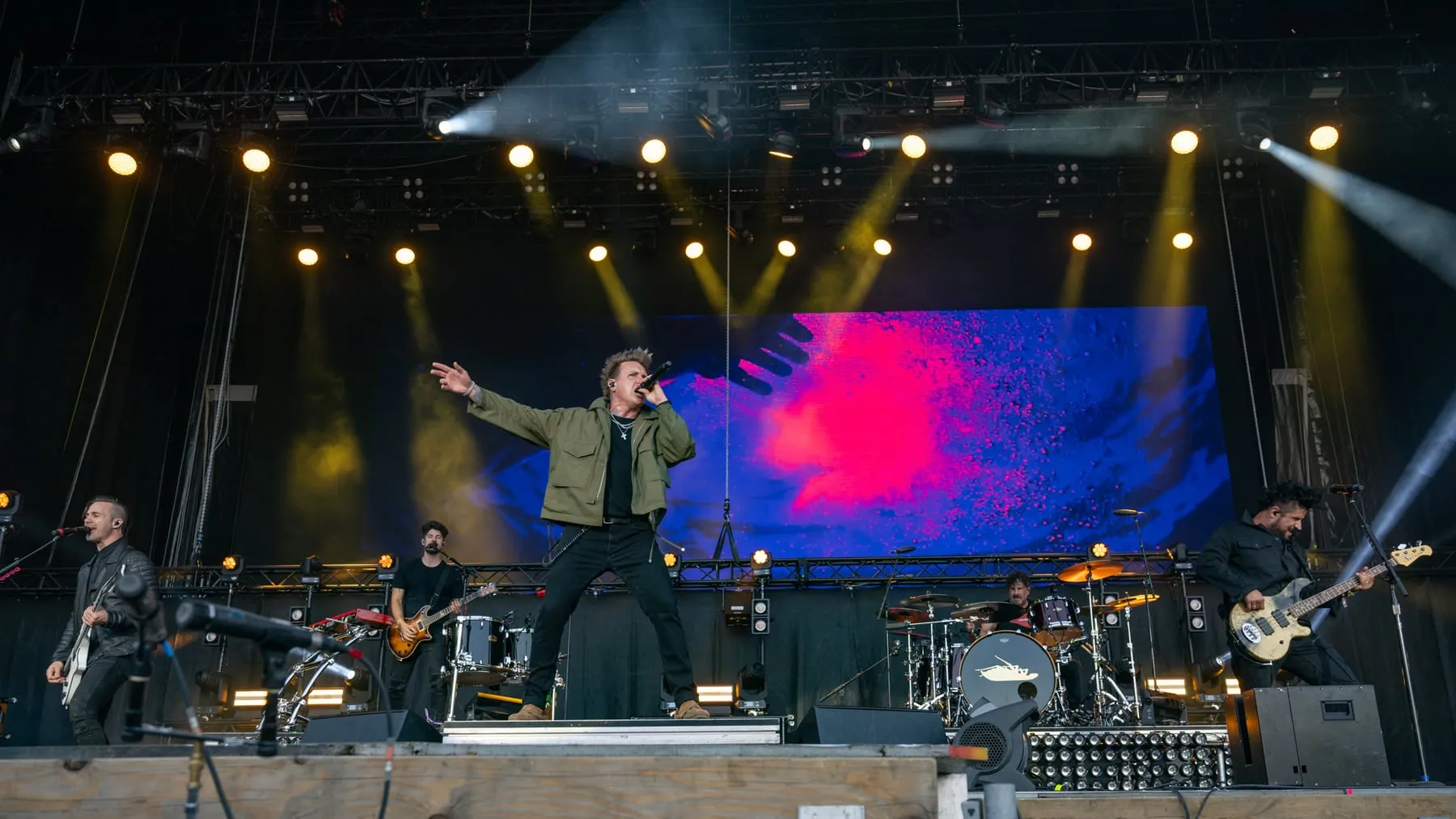
Photo by Stefan Brending ( 2eight ) , licensed under CC BY-SA 4.0 · Wikimedia Commons
Rank #325
Papa Roach
From Wikipedia
Papa Roach is an American rock band from Vacaville, California, formed in 1993. After a few early shifts, the band initially stabilized with the lineup of lead vocalist Jacoby Shaddix, drummer Dave Buckner, guitarist Jerry Horton, and bassist Tobin Esperance. This lineup remained consistent for nearly a decade.
Members
- David Buckner
- Jerry Horton
- Tobin Esperance
- Tony Palermo
- Will James
Discography & Previews
Browse through and click an album to open and play 30-second previews streamed from Apple Music.


Lovehatetragedy
2002 · 13 tracks
- 1 M-80 (Explosive Energy Movement) ↗ 2:26
- 2 Life Is a Bullet ↗ 4:05
- 3 Time and Time Again ↗ 2:58
- 4 Walking Thru Barbed Wire ↗ 3:05
- 5 Decompression Period ↗ 3:59
- 6 Born with Nothing, Die with Everything ↗ 3:50
- 7 She Loves Me Not ↗ 3:30
- 8 Singular Indestructible Droid ↗ 3:49
- 9 Black Clouds ↗ 4:01
- 10 Code of Energy ↗ 4:02
- 11 Lovehatetragedy ↗ 3:12
- 12 Gouge Away ↗ 2:06
- 13 Never Said It ↗ 3:06

Getting Away With Murder
2004 · 12 tracks

The Paramour Sessions
2006 · 13 tracks
- 1 ...To Be Loved ↗ 3:02
- 2 Alive ↗ 3:22
- 3 Crash ↗ 3:22
- 4 The World Around You ↗ 4:35
- 5 Forever ↗ 4:06
- 6 I Devise My Own Demise ↗ 3:36
- 7 Time Is Running Out ↗ 3:23
- 8 What Do You Do? ↗ 4:22
- 9 My Heart Is a Fist ↗ 4:59
- 10 No More Secrets ↗ 3:15
- 11 Reckless ↗ 3:34
- 12 The Fire ↗ 3:29
- 13 Roses On My Grave ↗ 3:14

Metamorphosis
2009 · 12 tracks
- 1 Days of War ↗ 1:25
- 2 Change or Die ↗ 3:19
- 3 Hollywood Whore ↗ 3:54
- 4 I Almost Told You That I Loved You ↗ 3:12
- 5 Lifeline ↗ 4:18
- 6 Had Enough ↗ 4:02
- 7 Live This Down ↗ 3:36
- 8 March Out of the Darkness ↗ 4:22
- 9 Into the Light ↗ 3:28
- 10 Carry Me ↗ 4:26
- 11 Nights of Love ↗ 5:16
- 12 State of Emergency ↗ 5:07

The Connection
2012 · 13 tracks
- 1 Engage ↗ 0:52
- 2 Still Swingin' ↗ 3:23
- 3 Where Did the Angels Go ↗ 3:10
- 4 Silence Is the Enemy ↗ 2:53
- 5 Before I Die ↗ 4:25
- 6 Wish You Never Met Me ↗ 4:06
- 7 Give Me Back My Life ↗ 3:59
- 8 Breathe You In ↗ 3:08
- 9 Leader of the Broken Hearts ↗ 4:13
- 10 Not That Beautiful ↗ 3:18
- 11 Walking Dead ↗ 3:18
- 12 Won't Let Up ↗ 4:00
- 13 As Far as I Remember ↗ 3:43

F.E.A.R.
2015 · 15 tracks
- 1 Face Everything And Rise ↗ 3:11
- 2 Skeletons ↗ 3:55
- 3 Broken As Me ↗ 3:38
- 4 Falling Apart ↗ 3:09
- 5 Love Me Till It Hurts ↗ 3:44
- 6 Never Have To Say Goodbye ↗ 3:47
- 7 Gravity ↗ 4:04
- 8 War Over Me ↗ 3:58
- 9 Devil ↗ 3:28
- 10 Warriors ↗ 2:56
- 11 Hope For The Hopeless ↗ 2:59
- 12 Fear Hate Love ↗ 3:27
- 13 Face Everything and Rise (Live from YouTube Space - NYC) ↗ 3:16
- 14 Leader of the Broken Hearts (Live from YouTube Space - NYC) ↗ 3:53
- 15 Scars (Live from YouTube Space - NYC) ↗ 3:09
F.E.A.R. (commentary)
2015 · 15 tracks
- 1 Face Everything And Rise ↗ 3:11
- 2 Skeletons ↗ 3:55
- 3 Broken As Me ↗ 3:38
- 4 Falling Apart ↗ 3:09
- 5 Love Me Till It Hurts ↗ 3:44
- 6 Never Have To Say Goodbye ↗ 3:47
- 7 Gravity ↗ 4:04
- 8 War Over Me ↗ 3:58
- 9 Devil ↗ 3:28
- 10 Warriors ↗ 2:56
- 11 Hope For The Hopeless ↗ 2:59
- 12 Fear Hate Love ↗ 3:27
- 13 Face Everything and Rise (Live from YouTube Space - NYC) ↗ 3:16
- 14 Leader of the Broken Hearts (Live from YouTube Space - NYC) ↗ 3:53
- 15 Scars (Live from YouTube Space - NYC) ↗ 3:09


Who Do You Trust?
2019 · 15 tracks
- 1 The Ending ↗ 3:30
- 2 Renegade Music ↗ 3:30
- 3 Not the Only One ↗ 3:25
- 4 Who Do You Trust? ↗ 3:16
- 5 Elevate ↗ 3:12
- 6 Come Around ↗ 3:31
- 7 Feel Like Home ↗ 3:11
- 8 Problems ↗ 3:03
- 9 Top of the World ↗ 3:54
- 10 I Suffer Well ↗ 1:21
- 11 Maniac ↗ 3:20
- 12 Better Than Life ↗ 3:21
- 13 Elevate (Dr. Cool & Babe Remix) ↗ 3:48
- 14 Elevate (Aelonia Remix) ↗ 3:48
- 15 Top of the World (Aelonia Remix) ↗ 2:53
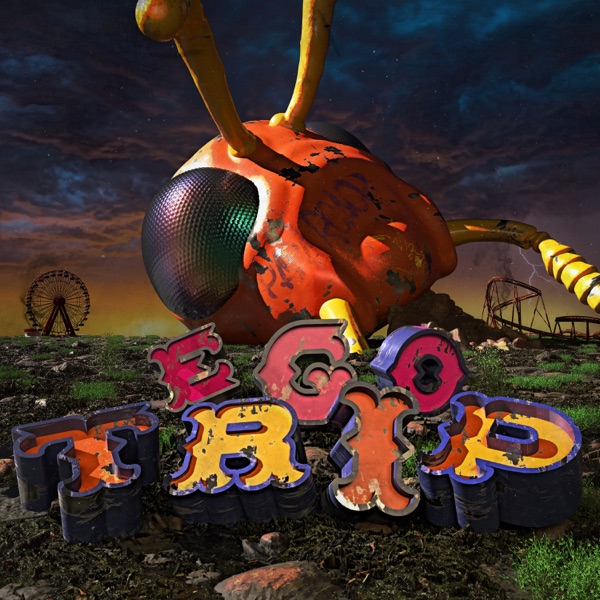
Ego Trip
2022 · 14 tracks
- 1 Kill The Noise ↗ 3:08
- 2 Stand Up ↗ 3:48
- 3 Swerve (feat. FEVER 333 & Sueco) ↗ 2:48
- 4 Bloodline ↗ 2:26
- 5 Liar ↗ 2:58
- 6 Ego Trip ↗ 2:55
- 7 Unglued ↗ 3:00
- 8 Dying To Believe ↗ 3:02
- 9 Killing Time ↗ 3:23
- 10 Leave a Light On ↗ 3:08
- 11 Always Wandering ↗ 2:46
- 12 No Apologies ↗ 3:08
- 13 Cut The Line ↗ 3:30
- 14 I Surrender ↗ 2:54
-
 InfestPapa Roach200011 tracks
 -
 LovehatetragedyPapa Roach200213 tracks
 -
 Getting Away With MurderPapa Roach200412 tracks
 -
 The Paramour SessionsPapa Roach200613 tracks
 -
 MetamorphosisPapa Roach200912 tracks
 -
 The ConnectionPapa Roach201213 tracks
 -
 F.E.A.R.Papa Roach201515 tracks
 - F.E.A.R. (commentary)Papa Roach201515 tracks
-
 Crooked TeethPapa Roach20171 track
 -
 Who Do You Trust?Papa Roach201915 tracks
 -
 Ego TripPapa Roach202214 tracks
Deep Dive
Overview
Papa Roach is an American rock band from Vacaville, California, that emerged from the early 1990s rap rock and nu metal scene. Formed in 1993, the band built a career spanning multiple decades through a fusion of alternative rock, rap-inflected vocals, and heavy instrumentation. Their work has consistently blended rap and metal idioms, establishing them as a fixture in a genre that defined much of the late 1990s and early 2000s rock landscape.
Formation Story
Papa Roach formed in Vacaville, California in 1993, arriving from a region known more for its agricultural output than its music scene. After an initial period of personnel shifts, the band stabilized around lead vocalist Jacoby Shaddix, drummer Dave Buckner, guitarist Jerry Horton, and bassist Tobin Esperance. This core lineup proved foundational, remaining intact for nearly a decade as the band developed its sound and built a regional following. The stability of this four-piece arrangement allowed for the kind of extended creative collaboration that shaped the band’s early studio work and helped establish their identity within the emerging rap rock movement.
Breakthrough Moment
Papa Roach achieved significant mainstream recognition with their major-label debut Infest, released in 2000 on Geffen Records. The album marked a decisive shift in profile, establishing the band as legitimate players in the nu metal and rap rock crossover that had begun to dominate rock radio. Infest became the vehicle for their expanded reach, moving them from a group with regional credibility to one with national and international visibility. The album’s success established Papa Roach as a permanent fixture in the rock and metal landscape of the 2000s.
Peak Era
The period from 2000 through the mid-2000s represented Papa Roach’s most commercially dominant and creatively ambitious phase. Following Infest, the band released Lovehatetragedy in 2002 and Getting Away With Murder in 2004, each demonstrating the band’s ability to refine their approach while maintaining their core sonic identity. The consistency of output during these years—three full-length albums across four years—kept Papa Roach in the touring and album-sales conversation during an era when rock and metal remained substantial commercial forces. The band’s willingness to tour extensively and engage with the growing nu metal festival circuit cemented their position as more than a one-album success story.
Musical Style
Papa Roach’s sound is built on the intersection of rap-inflected vocal delivery and rock instrumentation rooted in heavy, distorted guitars and prominent drums. Jacoby Shaddix’s vocal approach alternates between rapped verses and melodic, often sung choruses, a technique that became central to the late-1990s rap rock aesthetic. Jerry Horton’s guitar work combines downtuned riffs with occasional melodic passages, while Tobin Esperance’s bass provides rhythmic anchor and low-end weight. Dave Buckner’s drumming emphasizes groove and pocket, supporting the band’s hybrid approach rather than pursuing purely technical virtuosity. The band’s instrumentation and production choices reflect the late-1990s and early-2000s nu metal template: heavily processed drums, layered guitars, and a mix that foregrounds both rap and rock elements without fully prioritizing one over the other.
Major Albums
Infest (2000)
Papa Roach’s major-label breakthrough album, Infest introduced the band to a mass audience and established their signature blend of rap and metal as commercially viable. The album became the band’s highest-profile statement during the peak of the nu metal commercial cycle.
Lovehatetragedy (2002)
Released two years after Infest, this album demonstrated Papa Roach’s ability to sustain momentum, deepening their musical palette while remaining faithful to their core sound and appeal.
Getting Away With Murder (2004)
The third full-length studio album continued Papa Roach’s commercial and creative presence, arriving during the still-thriving rap rock moment of the mid-2000s.
The Paramour Sessions (2006)
This album marked a notable shift in approach, suggesting the band’s willingness to explore different production and songwriting contexts as their core fanbase matured.
Metamorphosis (2009)
Released in the post-nu metal commercial peak era, Metamorphosis represented Papa Roach’s attempt to remain relevant as broader rock trends shifted away from the late-1990s aesthetic that had birthed them.
F.E.A.R. (2015)
Album released in the streaming era, demonstrating Papa Roach’s continued commitment to studio recording nearly two decades into their career.
Signature Songs
- Lead track and defining song from Infest, establishing the band’s mainstream identity and remaining their most widely recognized recording.
- Songs from their early major-label period established the band’s rap-rock formula and received significant rock radio and MTV exposure.
- The band’s consistent touring presence ensured multiple tracks from their catalog became familiar to rock and metal audiences throughout the 2000s.
- Later-era releases demonstrate the band’s evolution and their attempt to maintain relevance across changing musical tastes.
Influence on Rock
Papa Roach emerged during and contributed to the commercialization of rap rock and nu metal in the late 1990s and early 2000s. Their sustained presence in the music industry across multiple decades indicates the durability of the hybrid rap-rock model, even as broader commercial and critical trends shifted away from nu metal’s peak moment. The band’s consistent touring schedule and album releases across the 2010s and 2020s suggest that rap rock, despite its decline in mainstream radio, retained enough cultural footprint and fanbase loyalty to sustain bands that had established early popularity within the genre. Papa Roach’s career demonstrates the viability of the alternative-to-metal pipeline for bands willing to embrace both vocal approaches and instrumental styles.
Legacy
Papa Roach’s legacy is primarily as reliable representatives of late-1990s and early-2000s rap rock and nu metal rather than as innovators who fundamentally altered rock music. Their greatest impact lies in their demonstration that the rap-rock crossover could sustain a major international touring career and album-sales presence across multiple decades. The band’s consistent presence since their 1993 formation—active through 2022 and beyond—places them in the category of bands that built careers by maintaining fidelity to their core audience rather than chasing critical reinvention. In the streaming era, their catalog remains accessible and familiar to generations of rock and metal listeners who came of age during the nu metal 2000s.
Fun Facts
- The band’s name, Papa Roach, originated from a family friend and remained unchanged despite early shifts in personnel and musical approach.
- Vacaville, California, the band’s origin city, remains relatively uncommon as a birthplace for internationally significant rock acts, making Papa Roach’s emergence from the region notable for local music history.
- The band’s early album Old Friends From Young Years (1997) predated their major-label signing and represented their independent foundation before Infest brought mainstream recognition.
- Papa Roach’s longevity across three decades reflects both their fanbase loyalty and their pragmatic approach to album releases and touring, remaining active even as broader rock commercial forces declined.