
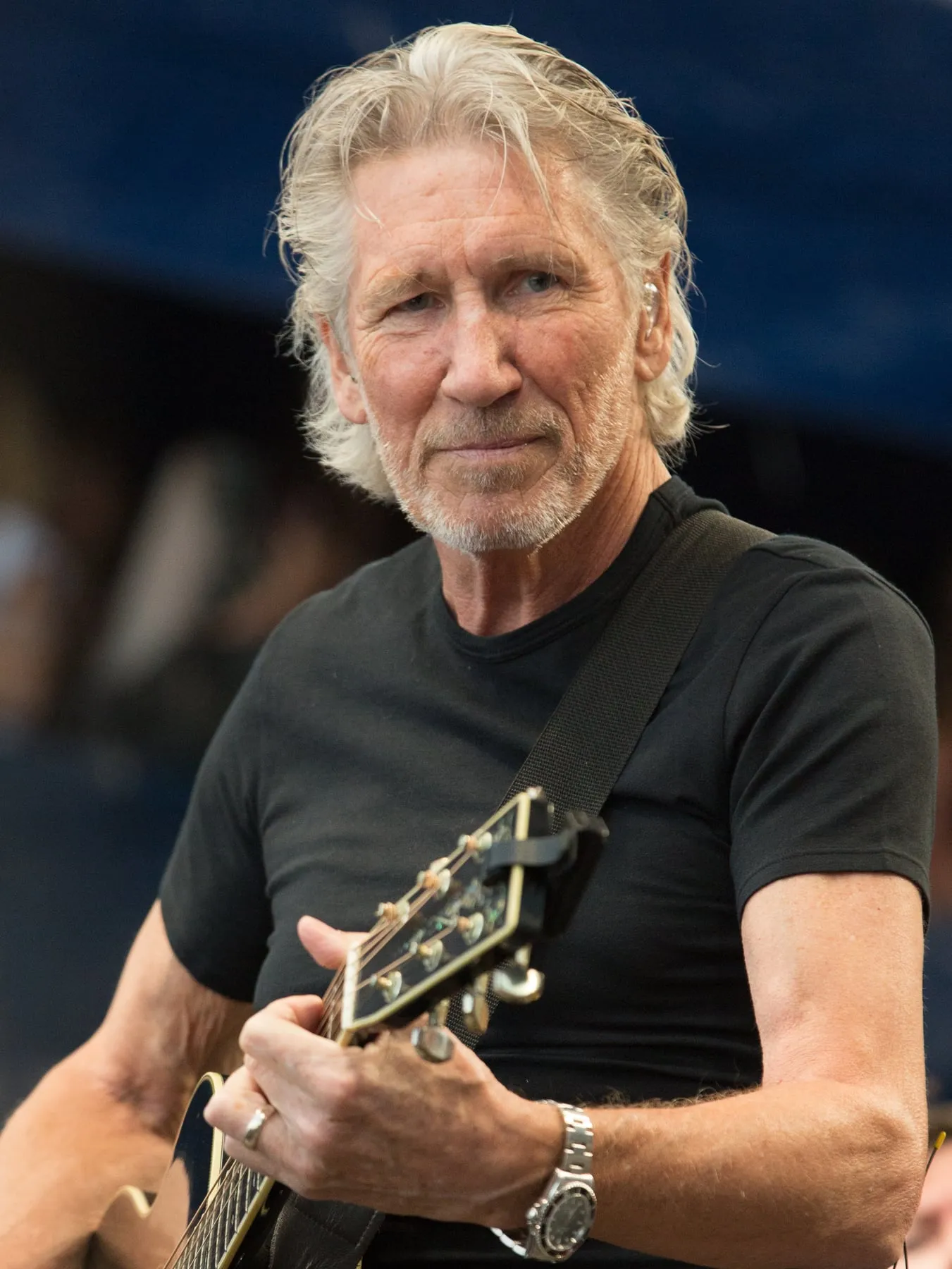
Photo by digboston , licensed under CC BY 2.0 · Wikimedia Commons
Rank #354
Roger Waters
From Wikipedia
George Roger Waters is an English singer-songwriter, musician and political activist. In 1965, he co-founded the rock band Pink Floyd as the bassist. Following the departure of the band's main songwriter Syd Barrett in 1968, Waters became Pink Floyd's principal lyricist, co-lead vocalist and conceptual leader until his departure in 1985.
Discography & Previews
Browse through and click an album to open and play 30-second previews streamed from Apple Music.

The Pros and Cons of Hitch Hiking
1984 · 12 tracks
- 1 4:30 AM (Apparently They Were Travelling Abroad) ↗ 3:13
- 2 4:33 AM (Running Shoes) ↗ 4:08
- 3 4:37 AM (Arabs With Knives and West German Skies) ↗ 2:17
- 4 4:39 AM (For the First Time Today, Pt. 2) ↗ 2:03
- 5 4:41 AM (Sexual Revolution) ↗ 4:49
- 6 4:47 AM (The Remains of Our Love) ↗ 3:10
- 7 4:50 AM (Go Fishing) ↗ 7:00
- 8 4:56 AM (For the First Time Today, Pt. 1) ↗ 1:39
- 9 4:58 AM (Dunroamin, Duncarin, Dunlivin) ↗ 3:04
- 10 5:01 AM (The Pros and Cons of Hitch Hiking, Pt. 10) ↗ 4:37
- 11 5:06 AM (Every Strangers Eyes) ↗ 4:49
- 12 5:11 AM (The Moment of Clarity) ↗ 1:29


Amused to Death
1992 · 14 tracks
- 1 The Ballad of Bill Hubbard ↗ 4:21
- 2 What God Wants, Pt. I ↗ 6:00
- 3 Perfect Sense, Pt. I ↗ 4:15
- 4 Perfect Sense, Pt. II ↗ 2:51
- 5 The Bravery of Being Out of Range ↗ 4:45
- 6 Late Home Tonight, Pt. I ↗ 4:01
- 7 Late Home Tonight, Pt. II ↗ 2:13
- 8 Too Much Rope ↗ 5:47
- 9 What God Wants, Pt. II ↗ 3:40
- 10 What God Wants, Pt. III ↗ 4:09
- 11 Watching TV ↗ 6:06
- 12 Three Wishes ↗ 6:52
- 13 It's a Miracle ↗ 8:30
- 14 Amused to Death ↗ 9:07

Ça ira
2005 · 38 tracks
- 1 Ca Ira: Opera in Three Acts: The Gathering Storm (English Version) ↗ 1:38
- 2 Ca Ira: Opera in Three Acts: Overture (English Version) ↗ 4:07
- 3 Ca Ira: Opera in Three Acts: A Garden in Vienna 1765 (English Version) ↗ 0:55
- 4 Ca Ira: Opera in Three Acts: "Madame Antoine, Madame Antoine..." (English Version) ↗ 2:54
- 5 Ca Ira: Opera in Three Acts: Kings, Sticks and Birds (English Version) ↗ 2:40
- 6 Ca Ira: Opera in Three Acts: "Honest Bird, Simple Bird..." (English Version) ↗ 2:08
- 7 Ca Ira: Opera in Three Acts: "I Want to Be King..." (English Version) ↗ 2:40
- 8 Ca Ira: Opera in Three Acts: "Let Us Break All the Shields..." (English Version) ↗ 1:45
- 9 Ca Ira: Opera in Three Acts: The Grievances of the People (English Version) ↗ 4:40
- 10 Ca Ira: Opera in Three Acts: France in Disarray (English Version) ↗ 2:35
- 11 Ca Ira: Opera in Three Acts: "To Laugh Is to Know How to Live..." (English Version) ↗ 1:43
- 12 Ca Ira: Opera in Three Acts: "Slavers, Landlords, Bigots at Your Door..." (English Version) ↗ 3:37
- 13 Ca Ira: Opera in Three Acts: The Fall of the Bastille (English Version) ↗ 1:36
- 14 Ca Ira: Opera in Three Acts: "To Freeze in the Dead of Night..." (English Version) ↗ 2:18
- 15 Ca Ira: Opera in Three Acts: "So to the Streets in the Pouring Rain..." (English Version) ↗ 4:17
- 16 Ca Ira: Opera in Three Acts: Dances and Marches (English Version) ↗ 2:13
- 17 Ca Ira: Opera in Three Acts: "Now Hear Ye!..." (English Version) ↗ 2:18
- 18 Ca Ira: Opera in Three Acts: "Flushed with Wine..." (English Version) ↗ 4:32
- 19 Ca Ira: Opera in Three Acts: The Letter (English Version) ↗ 1:37
- 20 Ca Ira: Opera in Three Acts: "My Dear Cousin Bourbon of Spain..." (English Version) ↗ 2:49
- 21 Ca Ira: Opera in Three Acts: "The Ship of State Is All at Sea..." (English Version) ↗ 1:49
- 22 Ca Ira: Opera in Three Acts: Silver, Sugar and Indigo (English Version) ↗ 0:54
- 23 Ca Ira: Opera in Three Acts: "To the Windward Isles..." (English Version) ↗ 4:51
- 24 Ca Ira: Opera in Three Acts: The Papal Edict (English Version) ↗ 1:17
- 25 Ca Ira: Opera in Three Acts: "In Paris There's a Rumble Under the Ground..." (English Version) ↗ 6:26
- 26 Ca Ira: Opera in Three Acts: The Fugitive King (English Version) ↗ 2:12
- 27 Ca Ira: Opera in Three Acts: "But the Marquis of Boulli Has a Trump Card up His Sleeve..." (English Version) ↗ 4:28
- 28 Ca Ira: Opera in Three Acts: "To Take Your Hat Off..." (English Version) ↗ 2:41
- 29 Ca Ira: Opera in Three Acts: "The Echoes Never Fade from That Fusillade..." (English Version) ↗ 3:16
- 30 Ca Ira: Opera in Three Acts: The Commune de Paris (English Version) ↗ 2:43
- 31 Ca Ira: Opera in Three Acts: "Vive la Commune de Paris..." (English Version) ↗ 3:15
- 32 Ca Ira: Opera in Three Acts: "The National Assembly is Confused..." (English Version) ↗ 2:42
- 33 Ca Ira: Opera in Three Acts: The Execution of Louis Capet (English Version) ↗ 1:41
- 34 Ca Ira: Opera in Three Acts: "Adieu Louis for You It's Over..." (English Version) ↗ 3:46
- 35 Ca Ira: Opera in Three Acts: Marie Antoinette - The Last Night on Earth (English Version) ↗ 1:36
- 36 Ca Ira: Opera in Three Acts: "Adieu My Good and Tender Sister..." (English Version) ↗ 5:10
- 37 Ca Ira: Opera in Three Acts: Liberty (English Version) ↗ 2:52
- 38 Ca Ira: Opera in Three Acts: "And in the Bushes Where They Survive..." (English Version) ↗ 6:59

Is This the Life We Really Want?
2017 · 12 tracks
- 1 When We Were Young ↗ 1:39
- 2 Déjà Vu ↗ 4:27
- 3 The Last Refugee ↗ 4:13
- 4 Picture That ↗ 6:48
- 5 Broken Bones ↗ 4:58
- 6 Is This the Life We Really Want? ↗ 5:55
- 7 Bird In a Gale ↗ 5:31
- 8 The Most Beautiful Girl ↗ 6:09
- 9 Smell the Roses ↗ 5:16
- 10 Wait for Her ↗ 4:56
- 11 Oceans Apart ↗ 1:08
- 12 Part of Me Died ↗ 3:12


-
 The Pros and Cons of Hitch HikingRoger Waters198412 tracks
 -
 Radio K.A.O.S.Roger Waters19878 tracks
 -
 Amused to DeathRoger Waters199214 tracks
 -
 Ça iraRoger Waters200538 tracks
 -
 Is This the Life We Really Want?Roger Waters201712 tracks
 -
 The Lockdown SessionsRoger Waters20226 tracks
 -
 The Dark Side of the Moon ReduxRoger Waters202310 tracks
Deep Dive
Overview
Roger Waters stands as one of rock music’s most consequential figures—a bassist turned conceptual architect whose influence extends far beyond instrumental virtuosity into the realms of narrative ambition, political consciousness, and studio experimentation. Co-founder of Pink Floyd in 1965, Waters evolved from the band’s rhythm section anchor into its principal lyricist, co-lead vocalist, and creative visionary following Syd Barrett’s departure in 1968. His departure from Pink Floyd in 1985 marked not an end but a transition to a parallel solo career that would span decades, establishing him as an uncompromising artist-activist whose work fuses psychedelic rock foundations with progressive complexity, blues rock grounding, and operatic ambition.
Formation Story
Roger Waters was born in Cambridge, England, in 1943, coming of age during the post-war years when British rock was beginning its first major wave of innovation. He emerged from the same mid-1960s Cambridge scene that produced Syd Barrett, with whom he would co-found Pink Floyd in 1965. The band’s early lineup crystallized around Waters and Barrett as the creative core, with Waters on bass providing both the harmonic foundation and soon-to-be conceptual ballast for the group’s psychedelic explorations. Waters’ entry into rock came during a formative moment when the genre was absorbing blues rock influences, experimental studio techniques, and the aesthetic ambitions of the avant-garde. By the mid-1960s, the Cambridge music scene offered a breeding ground for art students and musicians hungry for synthesis rather than strict genre adherence—conditions perfectly suited to Waters’ emerging role as a lyricist-bassist with conceptual vision.
Breakthrough Moment
Waters’ first major breakthrough came not as a solo artist but as Pink Floyd’s principal voice following Barrett’s nervous breakdown and departure in 1968. With Gilmour brought in to cover Barrett’s guitar duties and vocals, Waters stepped into the role of lyricist and co-lead vocalist, fundamentally reshaping the band’s creative trajectory. However, his true emergence as the band’s creative leader crystallized across the early 1970s, culminating in a series of concept-driven albums that redefined rock’s lyrical and thematic possibilities. The band’s peak commercial and critical success—anchored by albums that explored alienation, war, and psychological fragmentation—positioned Waters as rock’s foremost architectural mind, a reputation that carried him into his solo career when he left Pink Floyd in 1985. His solo debut, The Pros and Cons of Hitch Hiking (1984), released while still nominally a member of the band, announced that his vision extended beyond Pink Floyd’s framework, combining characteristically introspective songwriting with the same conceptual rigor that had defined his decades with the band.
Peak Era
Waters’ peak era as a recording artist spans the early-to-mid 1980s through the 1990s, encompassing his final work with Pink Floyd and his first several solo albums. The Pros and Cons of Hitch Hiking (1984) and Radio K.A.O.S. (1987) established his post-Pink Floyd sound as unrelentingly ambitious, combining narrative-driven songwriting with orchestral arrangements and a political consciousness that had always simmered beneath Pink Floyd’s more abstract early work. Amused to Death (1992) represented a creative pinnacle, marrying his lyrical concerns about technology, capitalism, and mass media with sophisticated production and emotional depth. Across this period, Waters demonstrated that his contribution to Pink Floyd’s success was not incidental but foundational—that his conceptual frameworks, thematic preoccupations, and song structures had been central to the band’s achievements. His solo work proved he could sustain that ambition across a full career, rather than as one member among four.
Musical Style
Rogers Waters’ musical identity, forged in psychedelic rock’s early ferment and refined across decades, encompasses psychedelic rock’s textural experimentation, progressive rock’s structural ambition, blues rock’s emotional directness, and operatic grandeur. As a bassist, Waters favored melodic, architecturally essential bass lines over pure rhythmic utility—lines that often carried the harmonic weight of a song, functioning almost as a second melody. His voice, never conventionally powerful, compensated through emotional precision and narrative clarity; he sang songs rather than dominated with vocals, allowing lyrics to dominate. Lyrically, Waters emerged as rock’s most sustained explorer of psychological alienation, technological dystopia, and political rage—themes he approached with philosophical rigor rather than sloganeering. His production aesthetic, developed across decades of Pink Floyd studio work, embraced orchestration, sound design, and conceptual coherence across full albums. By his solo career, Waters had internalized the tools of progressive rock—extended instrumental passages, shifting time signatures, thematic recurrence—while maintaining the emotional immediacy of blues rock and the textural innovation of psychedelic music. He wrote in narratives and song cycles rather than collections of standalone tracks, treating albums as unified statements rather than assemblies of hits.
Major Albums
The Pros and Cons of Hitch Hiking (1984)
Waters’ solo debut, released while still in Pink Floyd, established his post-band trajectory with a concept album built around a dream sequence and featuring guitarist Eric Clapton. The album proved Waters could sustain narrative ambition and orchestral sophistication in a solo context.
Radio K.A.O.S. (1987)
A state-of-the-nation concept album addressing technology, alienation, and political anxiety in 1980s Britain, Radio K.A.O.S. combined his progressive ambitions with contemporary social commentary and featured prominent collaborations with Phil Manzanera.
Amused to Death (1992)
Waters’ most coherent solo statement, Amused to Death married sophisticated orchestral arrangements with deeply personal songwriting, exploring how mass media and technology mediate human connection. The album cemented his status as a solo artist of serious intent.
Is This the Life We Really Want? (2017)
Returning to new studio work after a long hiatus, this album found Waters engaging with contemporary politics and personal reflection, proving his conceptual framework remained vital across generational change.
Signature Songs
- “Comfortably Numb” — Waters’ co-written Pink Floyd composition that became rock’s definitive statement on emotional dissociation and psychological numbness.
- “Mother” — A Pink Floyd track built around Waters’ lyrics, exploring maternal anxiety and dependency with unsettling intimacy.
- “Brain Damage” — Waters’ exploration of mental illness and institutional control, featuring his characteristically precise lyrical observation.
- “Pigs on the Wing” — A Waters composition from Pink Floyd’s Animals, his most direct political allegory set to blues-rock foundation.
- “The Pros and Cons of Hitch Hiking, Part 10” — His solo debut’s centerpiece, a lengthy orchestral narrative passage showcasing his conception of rock as serious artistic medium.
Influence on Rock
Roger Waters’ influence on rock extends across three major dimensions: the lyrical, the conceptual, and the political. He established that rock albums need not assemble pre-existing songs but could function as unified artistic statements with recurring themes, characters, and narrative arcs—a model that influenced progressive rock and concept-album traditions well beyond his own work. His fusion of psychological introspection with political consciousness demonstrated that rock lyrics could address interior emotional states and exterior social critique simultaneously, without contradiction. Waters’ insistence on artistic control, uncompromising thematic ambition, and refusal of commercial formula influenced generations of art-rock and alternative musicians who viewed him as a model of sustained integrity. His bass playing, though less celebrated than his songwriting, redefined the instrument’s role in rock from purely rhythmic to harmonically and architecturally essential. Waters’ work with Pink Floyd and in his solo career established psychedelic rock, progressive rock, and blues rock as vehicles for serious thematic exploration rather than mere stylistic exercise.
Legacy
Roger Waters’ legacy rests on his demonstration that rock music could sustain artistic ambition across a full career, addressing complex psychological, political, and philosophical themes without losing emotional immediacy or commercial accessibility. His work with Pink Floyd remains foundational to rock history; his solo career proved he was not a member of a successful band but rather an artist of first-rank vision operating within and then beyond collaborative frameworks. Waters’ continued touring and recording into the 2020s—including albums like Is This the Life We Really Want? (2017) and The Lockdown Sessions (2022)—demonstrated his creative restlessness across seven decades of life. His status as both a rock pioneer and a political activist reflects his conviction that artistic seriousness and social consciousness are inseparable. The sustained critical reappraisal of Pink Floyd’s catalog, and particularly Waters’ contributions to it, has only deepened understanding of his role in creating some of rock’s most enduring work.
Fun Facts
- Waters is an accomplished political activist and public intellectual, using his platform to address global conflicts and media narratives with the same conceptual rigor he brings to songwriting.
- His 2023 album The Dark Side of the Moon Redux represented a direct return to Pink Floyd material, reinterpreting the band’s most celebrated work from his solo artistic perspective.
- Waters’ bass playing on Pink Floyd’s early recordings was executed on a Fender Precision Bass, an instrument choice that influenced countless progressive rock bassists toward melodic, architecturally essential playing.
- His solo albums have been released across multiple major record labels including Harvest, Columbia Records, and Capitol Records, reflecting his movement through different corporate frameworks while maintaining artistic independence.